

Charles Pakana (Victorian Aboriginal News):
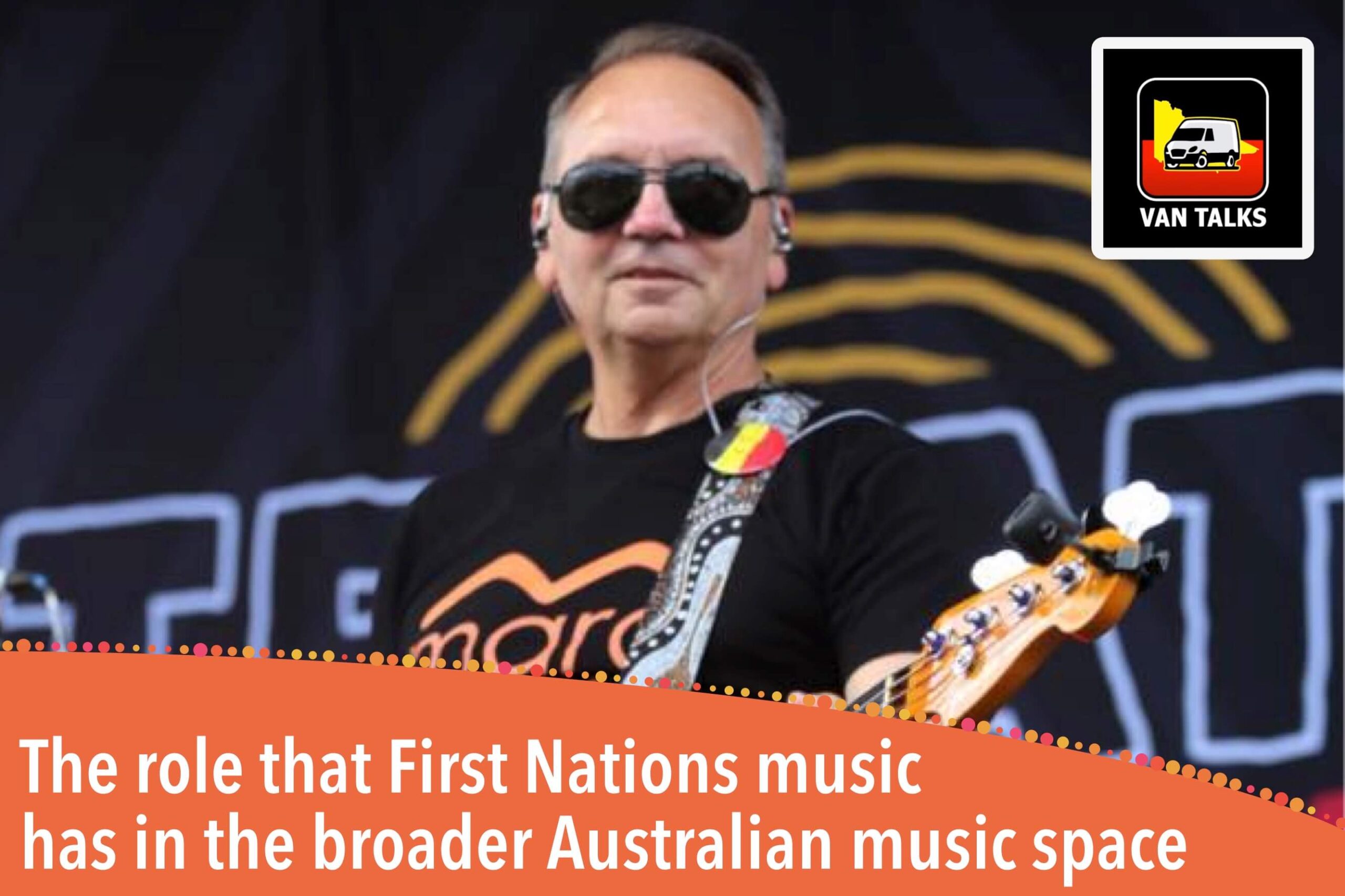
That was the track, Small Talk, from the Melbourne based First Nations rock group, Blackfire, and one the band’s tracks from its recently released album, Solar Eclipse. Joining me on the program is Blackfire co-founder, songwriter, vocalist, and rhythm guitarist, Grant Hansen. Grant, thanks for joining me on the program today.
Grant Hansen:
Yes, good morning, Charles. And you could have put Jack of all trades, master of none next to all that.
Charles:
Well, I think that was pretty well implicit in the description of what your roles are.
Grant:
I quite liked it. It was very good. Very good. At least someone’s done their homework.
Charles:
Well, we also need to include that you were a manager of the band for quite a while. But before we go on and talk about this latest album and listen to a couple of the tracks, let’s go back to 1992, casting your mind way back to then. The formation of the group, which was named after a documentary, I think, from what I gather…
Grant:
Yes, from the late Bruce McGuinness.
Charles:
Yeah. So tell us a bit about the formation of the group. Who was in it and what was the actual goal of the group?
Grant:
Yeah. Well, basically the band formed out of a number of other bands. It was Kelli McGuinness, Bradley Brown and I played together in a band called Interaction. And Selwyn was in Coloured Stone, and Kutcha just finished up in a band called Watbalimba with Brad and Kelli. So I got approached by a guy called the late great Bill Bellings to do a gig down at Healesville. He’d got the CEO job down there and he said, “I want to put the place on the map a bit. Can you put a band together, come down and put on a bit of a night for us?”
Charles:
Just put a band together.
Grant:
Yeah, yeah, yeah. Put a band, which I did. So I had to con Selwyn into playing. Selwyn had just left Coloured Stone, he didn’t want to play guitar anymore. But I told him I needed a bass player, ’cause I knew if I could get him on the bass, he eventually would want to go back playing guitar.
Charles:
So you pulled together Selwyn Burns, Kutcha Edwards.
Grant:
Yeah, so all these guys, and we went off like a firecracker, Charles. It was like Guy Fawkes night, there was that many sparks and bangs in the room, it was unbelievable. And after that, we thought, “Geez, that was great.” We went over really well, and Selwyn said, “Oh, we should start a band up, but I’m only going to play if you do original music, otherwise I’m not playing.” So anyway, Selwyn said he had some songs and Kelli and I wrote a few as well, and that’s how the band sort of got together. And Kelli and, I think, Selwyn came up with the name Blackfire, because Kelli’s late father, Bruce, had made the documentary Black Fire, and then the follow-up’s called A Time To Dream, which we called our first album was Blackfire A Time To Dream. So that’s how all that came about.
But basically, our first year we played something like 120-odd shows, played every major festival, national television appearances, rage, all that sort of stuff. And basically, we played a lot of benefits too, particularly for the Funeral Fund because we were very conscious of making sure that our elders were buried with some sort of dignity. And so we were always up for doing some benefits, and we’re a real community band, so a lot of our performances would be blackouts, so to speak. All the mob in Fitzroy would come along, and they’d be great nights, some of the best nights of my life actually.
Charles:
So what was the actual aim, apart from Selwyn saying, okay, let’s do it, and you deciding to do it. Was there a political social change?
Grant:
Yes, no doubt.
Charles:
Because it’s always been, and this is particularly evident in this latest album, there’s been calls, for example, truth-telling. There’s recognition of First Nations ex-diggers. What has been the, I suppose, constant social commentary thread from 1992?
Grant:
Well, basically, you’re right, we were singing from the perspective of Indigenous folk living in the city, loss of land, loss of culture, taken away, stolen generations.
Charles:
So very Fitzroy-driven almost.
Grant:
Oh yeah, most definitely. We all grew up in that Fitzroy realm and all brought up with the same sort of mentality, the same politics, all that type of stuff. And we wanted to educate people. We didn’t want to scare people off, but we were conscious of educating people about a lot of issues they hadn’t confronted before. So we thought we could do that through music, and we did a good job of doing that for quite some time. But basically, yeah, we were just out there to educate people and that was our main thing. Not to offend, but to educate.
Charles:
Would offending ever hold you back though if you needed to? You felt the need to?
Grant:
Oh, certainly, no. If people felt offended, well, that was part of the truth-telling, isn’t it?
Charles:
Absolutely.
Grant:
We’re not singing lies up, he was singing truth. So if some people were put off, and there was times when some people just wouldn’t have the truth, and that’s okay, that’s their prerogative. But we were always conscious that we were representing our community, representing our people, representing our families, and our tribes and nations, and that we were songmen in a modern era that were out there educating the greater masses.
Charles:
Now, from 1992 to 1998, there was quite a deal of success for the band.
Grant:
Yes.
Charles:
You had that first album that you made mention of, and then there were a couple of other albums that had quite a deal of critical success. You also played overseas throughout Asia, you had airplay right around the world. 1998 comes, what was the cause of the, well, we thought it was a break-up, but it proved to be a hiatus?
Grant:
Yeah. And a long one at that too. So from ’92 to 2004, so it was 12 years straight, Charles, that we played. And it got to the point where Brad was bringing up a family and had quite a few kids. Selwyn had his own little tribe of people, so they became really immersed in being family figures and working and supporting their families. And Kelli was working at the health service and had a lot of work to do there. And so Kutcha were the only ones left standing. And I said to Kutcha, “What do you want to do? Do you want to keep Blackfire going and we get some new members in, or why don’t we just call it the Kutcha Edwards Band and you’d be the front guy and I’ll be the bloke in the background pulling all the strings like I normally do, and we’ll run off with that for a while?” So that happened for five years. And Kutcha’s first album, I got a record deal with Shock Records, so that was cool.
But going back to the Blackfire stuff, it was the band, 12 years on the road, and as you mentioned, there was those tours overseas, but also we appeared in a lot of compilation albums in that time as well. And along with Yothu Yindi and probably Christine Anu, we were sort of the bands that were sort of flying the flag in that era, along with, obviously, Archie and Ruby. Archie played with us a lot because of that Fitzroy association, and Ruby. But Yothu Yindi and that, we became really close friends of those guys, and we were flying the flag. Aboriginal music was really bubbling along then. There were so many good bands coming out. Steve Pigram went solo from Scrap Metal, and there was such a push for Indigenous music at that time.
Charles:
So what about the Big City Combo, which I believe you formed in what, 2007? This was keeping Grant Hansen well and truly on the music scene. Tell us a bit about that before we then get to COVID and the big change then.
Grant:
Yeah, yeah. Well, the Big City Combo was just a band that I originally put together to do all my solo sort of songs that I’d written over time.
Charles:
Oh yeah. But can I just say Wilbur Wilde, Paul Kelly, so many visiting artists. It wasn’t really all that solo. You were bringing a cast of thousands, brother.
Grant:
Yeah, exactly. Well, I thought I’d lean on a few people that I’ve done favors for, so maybe they could do me a favor or two. But I’ve had long friendships with Wilbur Wilde since I was a young fella, and-
Charles:
Great bloke.
Grant:
… Ol’55, Jo Jo Zep, and he was absolutely awesome. And Paul Kelly, the same long history with Paul, and I was just sort of wanted some friends like them to play on the album, not because they’re famous but because they’re such great players and songwriters. So it was like a bit of a celebration, just getting some mates together and whoever I could think of to come and play on them, I would get them in. So it was a bit like that.
But then the Big City Combo band sort of brought out that first album, then that went into a bit of a hiatus. And I brought the band back as a cover band years later, with Merv Dick from The Deltones, and a couple of guys from Ol’55, and that went very well for a while. That was good. So yeah, so look, you meet a lot of great people in the music industry, Charles, and you get to a lot of towns. Someone asked me if I’d made a lot of money playing music, and I said, “No, I’m rich in meeting people and going to places I’d never ever been and done things.” Who would’ve thought I’d go to Asia and play in places where no Western bands had ever played before.
Charles:
But you played in China, haven’t you?
Grant:
Yeah, China, Japan, Taiwan. Yeah, so went to Mexico with Kutcha. So to experience that, you can’t put a monetary value on that because it’s just life experiences. And so I always felt that I was way ahead in terms of money and experience. Experience was just wonderful. And I made so many great friends through the music industry, and I’m still good friends with a lot of those people now.
Charles:
And we’ll talk about some of the overseas exposure, because that really does play out quite significantly when it comes to this latest album, the overseas uptake as opposed to the more domestic uptake. But we’ll cover that in a few minutes. So just before we go to a break, and we’ll have that break actually represented by, and I’ll give you a bit of warning now, your favorite track from the latest album. So get the brain thinking on that now. Don’t let us know, we’ll come back to it in a second.
But you’ve also been the founding member and former CEO of Songlines. You’re currently sitting in as the general manager at 3KND. The Marngrook Football Show, of course, that aired for… how long was that on NITV?
Grant:
13 years.
Charles:
13 years, and that was an incredibly successful program. What’s keeping you going right now? And look, you’re not a spring chicken, you’re getting up there to my age, brother. And what’s in the future?
Grant:
Well, let’s not make it obvious. There’s a lot of people out there listening in radio land. Look, I grew up listening to music and I tell people, “I’m like a Countdown child.” I grew up listening to Countdown, Saturday morning Sound Unlimited, then it becomes Sounds. And I just loved Aussie music, whether it was Drag and Ol’55, Hush, Ted Mulry Gang, Ol’55. All those bands, they were just like superheroes, John Paul Young. And I was just sort of immersed with watching them on TV. And then in those days, you could go through the Gig Guide or the Juke Magazine and go to a local pub and actually see them play.
Charles:
Absolutely, yeah.
Grant:
So it was just such a wonderful time. So I couldn’t help be immersed in Australian music, and I thought one day I want to have my own band. Not that I could play at that stage, but that was sort of like the inkling to I want to play music. And I’m glad I took that up because I had a chance to play AFL footy, VFL at the time, and I had to sort of make a choice between footy, really, and music. And I chose music only because if I had broken a-
Charles:
Probably a sensible approach, brother.
Grant:
It would last longer, which is true. So here I am, I’m still going. Footy’s only got a short lifespan. But the thing was, if I dislocated my shoulder, I broke my hand, I broke my fingers-
Charles:
You were stuffed, yeah.
Grant:
… I wouldn’t able to play that night. So that’s why I sort of made that decision. But I love footy and obviously the Marngrook Footy Show was another outlet for footy for me. But I just love playing music. And I write songs, and I’m not one of those people that write songs every week or every day, I just write them when I’m getting inspired.
Charles:
But we’re going to dive into that in a couple of minutes because the collection of music that you came up with when you went back through what you’d done over COVID and various other times, we’ll come to that in a second, but now getting to what’s our musical interlude, when we think about your favorite track from the latest album, Solar Eclipse, what’s that going to be?
Grant:
Save the World.
Charles:
And here is Save the World.
And that was Save the World From Blackfire, from their latest album, Solar Eclipse. And we’ll be playing a number of those tracks here on the program over the coming weeks and indeed months. So get onto wherever you buy your music, and here’s a great opportunity to support a local Aussie First Nations band.
Grant, what was the genesis of Solar Eclipse? You’ve told me a couple of times as we sat down, had a bit of a yarn, that you’re sort of going through some of the stuff you’d written during your down-times and found, “Wow, I’ve got almost a flaming album there.”
Grant:
Yeah, no doubt. And we brought out the one just before that and the latest Blackfire album, and that was-
Charles:
Which is Regeneration?
Grant:
Regeneration, yeah. And that was sort of the start of really Blackfire getting back together in this new guise as it is now, because it’s only me, Selwyn and Brad, three of the original five that are in the band.
Charles:
But three out of five is pretty damn good.
Grant:
Yeah, I think so. Yeah, I think so. And Selwyn’s not well. So Selwyn plays when he can. He’s in a wheelchair at the moment. He’s got problems with-
Charles:
Emphysema.
Grant:
… emphysema. During COVID, I just started writing songs and all of a sudden I thought, “Geez, these are more like Blackfire songs, they’re political.” And I don’t know where they’re coming from, because sometimes I think I’ll get channeled. So yeah, so then that’s how they came. And Sel still had some great songs that he wanted to do, so that got the Regeneration album. But the Solar Eclipse one was another step up, because the music industry, Charles, has changed so much since 1994 when we last played as Blackfire. And the industry’s changed, it was CDs and records at that time, but now we’ve got downloading and you go to your favorite music site to download your favorite album.
Charles:
Don’t show your age. Don’t show your age.
Grant:
But that’s just how fast and quick things have changed.
Charles:
Absolutely.
Grant:
And pubs have closed down. There’s not as many festivals anymore, not that many TV appearances. So I was conscious that our music, according to the record company, Golden Robot Records, is we don’t see you as an Australian band as such, we see you as a world band. Your music is world music. And it’s very strong, it’s political, but it’s melodic. It’s authentically rock, Australian music, but it also carries very strong messages and cultural pride, and they wanted to market us as a world band, not so much just as an Australian band.
Charles:
But tell me about the makeup of this particular album, because there are some surprising singles in there. And we can also talk about the production, because one of the first things that I noticed and I spoke to you about, jeepers, two months ago when you shared this with me, was the production level was way beyond anything that had been produced previously with Blackfire.
Grant:
Yeah. Well, Rick Evans, who’s a well-known local musician and sound recording engineer, and me and him used to work together, he used to work for me on Marngrook Footy show as a sound guy. So me and Rick have this relationship that we get along very well in terms of music mixing and recording stuff. And a lot of the stuff is thrashed out early on between me and Rick about the parts that people are playing and the sounds that we want. And we sort of get a little bit experimental in the demo stage of songs, so that before we get the guys in from the band to play, we already have a sort of grounding, a base to work from. And then we let those guys bring their own individual quality to the song.
But it’s sort of mapped out to probably about 60, 70%. And we’re always trying to add stuff into the songs to make them better. And also the production, if you’re going to bring out music, you’re competing with so much good artists out there, and so many great sound engineers and producers that you need to keep up to speed with that. So we’re just conscious of trying to make the best sounding record that we could. And Rick and myself, we’ve done a lot of music together now and a lot of recording together. And we have a really good combination, me and Rick. It’s unusual that you have two guys that can work together over a certain amount of years and not have any blues or any quarrels, so to speak.
Charles:
So to speak.
Grant:
Yeah. So if Rick’s thinking one thing, usually I’m thinking the same thing, or if he comes up with an idea, so that’s a great idea, and vice versa. So this album was probably that world music sort of theme that we were looking at.
Charles:
Well, I want to talk about that because when you and I’ve yarned over the weeks about this, you’ve made mention of the fact that it’s gaining quite a deal of success and airplay overseas. Here domestically, it seems that, well, we don’t really want to know too much about the homegrown heroes. Tell us a bit about that and what you think is the cause of that.
Grant:
Well, I think the current political climate has a lot to speak for in terms of Indigenous music. And I think during the referendum, I think, people like Warren Mundine and Jacinta Price has put the Aboriginal struggle back about-
Charles:
Oh, absolutely.
Grant:
… 50 years. And all of a sudden there’s a lot of hatred for Aboriginal people out there. I feel it all the time. I’ve written a new song for the next album, which talks about that. But I just feel that resentment and ignorance out there has gone to a whole new level, basically because of them two. And I find now that people don’t want to book Aboriginal artists. They don’t want to go and watch Aboriginal artists anymore.
Charles:
So is it more difficult for you to book a gig for the band?
Grant:
Yeah, no doubt. A hundred percent. And plus there’s less venues. I mean, the first time that we were playing, and so a lot of those venues have closed down. But I just feel there’s an anti-sentiment out there towards anything Indigenous here in Australia at the moment. So our music overseas, we’ve been getting played in Scotland and Ireland and England and Norway, in Sweden, in Germany.
Charles:
Oh my god.
Grant:
In New Zealand, in America. So these last two albums, funny enough, Charles, are the most successful Blackfire albums that we’ve had.
Charles:
Oh, that’s amazing.
Grant:
So we’ve had four albums and we’re working on a fifth one as we speak, even though the latest one’s out. So the last two albums with the new lineup have been the most successful. And the key to that, obviously, was getting a lead singer like David Leha to replace Kutcha, who’s a great singer.
Charles:
Oh, they both are, for goodness’ sake.
Grant:
Yeah, yeah, no doubt. But to find someone to replace Kutcha’s not an easy thing.
Charles:
No, funky about that, it’s so much.
Grant:
Yeah, yeah. And David’s just as big as Kutcha, and he sings just as good as Kutcha, so we’re very lucky. So we’re getting airplay all around the world. Charles, Save the World was the fourth single off the album, and it has been the most viewed one online out of all the songs so far.
But Small Talk has been nominated in the top 25 songs in England, and it’s in the Best Rock category, so hopefully we might win the award. But it’s nice just to be nominated in the top 25 songs in England. So yeah, I’m honored to be nominated in the top 25. But I post a lot of the running sheets on Blackfire’s website because when you tell people, “Oh yeah, we’re getting airplay in England again,” I post them on the page so people can actually see them, to know that I’m not talking porky pies. And plus it’s just we sit back and think, “God, a bunch of guys again from Melbourne and Victoria, and all of a sudden our music’s getting played all around the world.” But the hard thing for us now is to try and get back into even to the Aboriginal music scene here, is because people have got older that were Blackfire fans, and now there’s new generations of kids that have come through, but they’re not listening to Australian rock music, they’re listening to hip-hop, R&B, and all that sort of stuff.
Charles:
So is that an indication of where Blackfire might go, hip-hop, R&B?
Grant:
Definitely not, Charles, definitely not. Because music’s a bit like fashion, I think, and it goes around in circles. So long hair is in favor one decade, the next decade it’s a short haircut.
Charles:
And then it circles around again, brother.
Grant:
So rock music, you can’t get better than rock music.
Charles:
Oh, no argument from me on that.
Grant:
You can still listen to The Beatles and whoever you want from the ’50s and the ’60s and the ’70s, and they’re still just as good.
Charles:
Tell me now about the 26th of January. We’ll finish up with that one. So the 26th of January, we’ve got an event coming up in 2026. Tell us a bit about that. And importantly, is Blackfire going to be playing?
Grant:
Yes, Blackfire are playing and the full band will be in good form that day. We’ve got the girls, and…
Charles:
So tell us about the event though.
Grant:
So it’s 26th of January at Treasury Gardens. It’ll be broadcast from 3KND, and also a partnership that we’ve formed with PBS.
Charles:
Oh, great.
Grant:
It’ll be a simulcast, and it probably…
Charles:
As long as it’s all community radio, we don’t care.
Grant:
Yeah. So it’ll probably go to about a million people, so on radio. And obviously we’ll replay it again for the people that didn’t hear it live on radio or want to hear it again. We’ll replay it here at 3KND. But Blackfire is on the bill and it’ll be our full band. So Leonie Whyman and Monica McDonald are the two women that we added to the band. Great vocalists in their own right. They have their own solo careers.
Charles:
Absolutely.
Grant:
Great BVs. And also the whole band will be playing. So Brad will be there, I’ll be there, Daniel, Selwyn, Rod and Pete. So it’s an eight-piece band.
Charles:
It’s not the only band, it’s not just the Blackfire show.
Grant:
No, no, no….
Charles:
This is a celebration.
Grant:
Yeah. Well, there’s going to be quite a few. And that bill will be announced very shortly. In the next coming couple of weeks that’ll be announced. I don’t have any other idea. I think Dave Arden might be on there as well.
Charles:
Oh, lovely.
Grant:
I think Canisha might be on there. There’s a few artists, I think, even Monica McDonald doing a solo thing. So there’s going to be quite a few, but all Victorian bands, all Victorian based people will be doing that. And it’s important to support Indigenous music that’s from Victoria on these bills.
Charles:
Couldn’t agree more. I’ve been speaking with Grant Hansen, the co-founder, rhythmic guitar, vocalist, songwriter, and ex-manager of Blackfire. And don’t forget, listen out for all the tracks coming up from their latest album, Solar Eclipse. And we’re going to go out with Grant. What’s the track you want us to go out with?
Grant:
I think Big Billions.
Charles:
And we’re going out now with Big Billions.


0 Comments