

Charles Pakana:
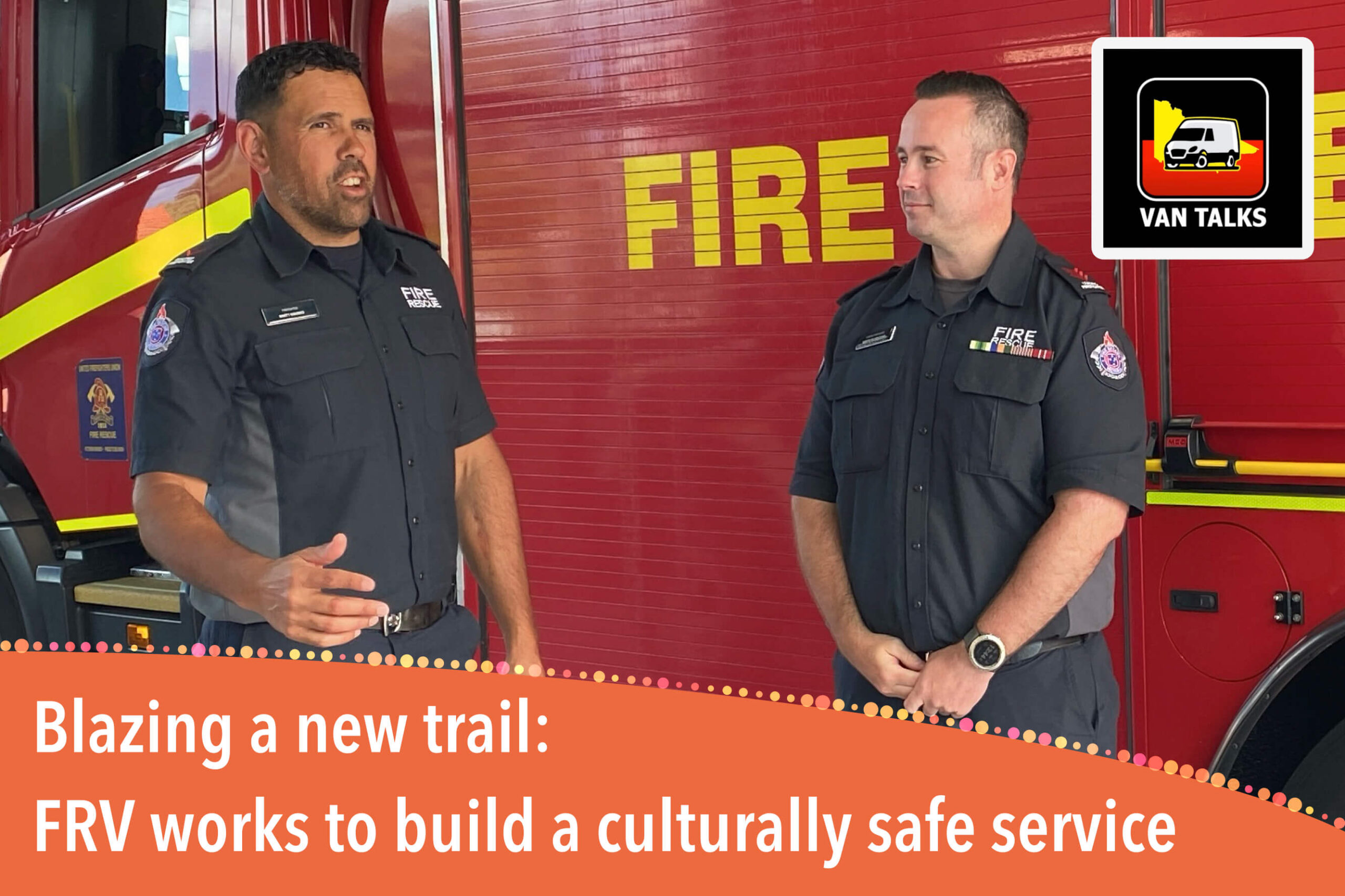
Today on the program, I’m fortunate enough to be at Fire Rescue Victoria; Fire Station 63 in Geelong, and meeting with a couple of professional firefighters, Yorta Yorta man, Aaron Felmingham, and Adnyamathanha and Narungga man, Brett Goodes. Aaron and Brett, thanks for joining me on the program today.
Aaron Felmingham:
It’s our pleasure.
Brett Goodes:
Yep.
Charles:
Really great to have you here. Aaron, I just want to kick it off with you because your role is really in firefighting recruitment or FRV recruitment. Just give us a bit of a thumbnail dipped in tar sketch of what your role is.
Aaron:
Yeah, so my role got created on the back of some success that FRV saw in the women recruitment space. They put some support people around that process just to guide people through our recruitment stages, and how complex and really be a detailed… You’ve got to read everything, get into the nitty-gritty of what each stage holds. And so just to provide better information on each stage of recruitment. They had stood up those roles to increase the women in firefighting.
Charles:
So women and mob in firefighting?
Aaron:
Yeah. So now they’ve created my position on the back of that.
Charles:
Yeah.
Aaron:
And the idea is to meet the same stuff and guide mob that want to become firefighters through the process, inform them what each stage of the recruitment process has in it and how to best get to the next stage.
Charles:
How long has that role been in place for? And we’ll come through to some of the particular requirements or changes involved in that recruitment process in a little bit of a while. But when did this role actually start up?
Aaron:
June last year.
Charles:
Right, so very new.
Aaron:
Yeah. June ’25. Yeah, we done a lot of work in the years leading up to that to get it stood up. And now it’s pretty well supported. It’s starting to flow on, and see some results, and get some good recruitment supports in place.
Charles:
And Brett, you, now I first met you when you were at Craigieburn going through your training about what we talked about four years ago now.
Brett:
Just on, yep.
Charles:
You’re an ex-footballer, you’ve been in the corporate world and now you’re out there, Fire Rescue Victoria. I’m really keen to know, and I know the listeners will be as well; what prompted the change from football, to corporate, to firefighting?
Brett:
My brother Jake was Parks Victoria. He still is. He’s been there for a long time.
Charles:
Right.
Brett:
He’s two years older than me. So he’s always fought bushfires and been involved in that. He’s now an airbase manager and works out at the Grampians. So when I was a young man trying to work out what I wanted to do in life, football was obviously priority, but that didn’t work out for me. So I studied conservation land management and got into the department sustainability environment, it was back then. So I was engaged as a wildlife officer, worked in bushfire management, amongst other things. So always had a bit of an interest in it.
Football and life took me elsewhere. And like you mentioned, I was in the corporate world most recently. And me and my wife were discussing starting a family and I’ve always had some friends in the job. And rewind back to when I was 18, playing North Ballarat Rebels, a guy by the name of Neville Collins was in the CFA as a professional firefighter, supporting us in the football program. And I got talking to him one day. And so from that point, for the last 20 years, he’s just always prompting me, “Goodesy, when are you going to come join the fire service?” So it wasn’t until I finished playing footy and I was in the corporate world. And another friend actually that I went to school with joined and he’s a carpenter by trade. And I got chatting with him and I was like, “Oh, you know what? What have I got to lose? I’ll have a crack.”
I was living in Adelaide at the time and went through the process. And like Aaron mentioned earlier, it’s quite stringent, and you’ve got to prepare, and you’ve got to know people in the job to succeed in that. So, yeah, I had a crack. I got in. Yeah, made the decision to leave the corporate world and join the fire service. Mainly again, I said my understanding is that the work-life balance was going to be much better for me and my family. And, yeah, four years in, I haven’t looked back and I will continue to do the rest of my time as a career firefighter, which is 30 years, but I don’t think I’ll get that far because I’m too old.
Charles:
Oh, you can’t leave that question or that statement open. How old are you?
Brett:
I am 42 this month. Yeah. So my 30 years, I plan on being retired well before then, so…
Charles:
Well, Uncle Owen Butler’d only retired recently and he’s… What? 74. So the option is there, brother.
Brett:
The option is there. I do plan on doing other things. And again, it’s the great thing about the job, you can.
Charles:
And I really want to come back to you in a few minutes and talk a bit about the importance of mentoring, Aboriginal mentoring within Fire Rescue Victoria. I know you’re very keen. We spoke previously about promoting it within community. You mentioned when you were younger that you’d go to carnivals and you’d see the army, the air force, CFA, and other services, but never the FRV. It was never presented as an option for the mob. We will come back to you and talk about the importance of mentoring. So let’s just bear that one in mind.
Aaron, I want to come back to you. Your history in firefighting, you’ve been in a bit longer than four years. I think, what was it? 15 years or so, is that right, brother?
Aaron:
13 years.
Charles:
13 years. Close enough to 15.
Aaron:
Yeah.
Charles:
Okay. What made you decide to join the FRV?
Aaron:
To put it in the shortest version I can. I was in the navy and we were part of operations for border protection.
Charles: Yep.
Aaron: And you didn’t always see the best of human nature and that welcoming aspect or really being there to help people. And then after the Black Saturday fires, I’d done some reading into some of the experiences people had had at the time, and figured that was an area I wanted to look at and do. So it was really born from wanting to help people a bit more, given I’d been on the other side of the fence where it wasn’t all about that.
Charles:
Yeah. I’m interested to hear your reflections on as an Aboriginal man, as I mentioned, a Yorta Yorta fella, what was the environment like to come into the FRV as an Aboriginal man?
Aaron:
It was very challenging, to be honest. Yeah.
Charles:
I wish the audience could see the smile. Yep.
Aaron:
Yeah.
Charles:
Okay. Challenging in what ways, brother?
Aaron:
Well, there wasn’t a lot of that journey that you see in the whole of society where people were getting more educated, people were knowing more, but that wasn’t there when I came through the doors, which was CFA at the time. And we used to have to go to Fiskville for our training, which was different to Craigieburn. It was a stay-onsite course, and it went for three months. So you got to know people a lot better, but there were certainly some experiences I had when we’re on the road or people had a few beers after a day’s training that they’d say insensitive comments and things like that, so-
Charles:
And we can imagine what they are.
Aaron:
Yeah.
Charles:
There’s no need to go over those, of course.
Aaron:
Yep.
Charles:
Yeah.
Aaron:
It wasn’t great at the time, but once I came out, and identified, and said, “This is me, you guys need to adjust what’s going on.” And then made that statement in a way I probably shouldn’t have at the time, given I had a belly full of anger, that people started to adjust, and ask more questions, and become more informed about who I was, and where I was from, and the life I’d had. And a lot of those people have changed their views across my career. We run into each other all the time, whether it’s at a factory fire or on the side, and you catch up and those attitudes have definitely changed.
Charles:
So I assume for you, Brett, that it would be significantly different because, first of all, can’t hide the fact that you’re an Aboriginal man. You’ve got that Goodes name, which is known right across the country. You’re a well-known man across Victoria as it is, through your own work in football and other areas. How was it for you, those four years ago? Do you think there was a lot more acceptance or did you still come across some, let’s be blunt, some crap and corruption?
Brett:
Being a bit older as well, I was 38 when I applied, you’d stand up and you speak pretty loudly for yourself in the moment and having, obviously the world knows what the brother went through and-
Charles:
Yeah.
Brett:
So, yeah, I didn’t really come across it. It’s funny actually, the only time I did, a comment came from an actual, one of our trainers on the course and it was tongue in cheek. And we had a word afterwards, and he was very apologetic, and that’s all it needed to be, but he was well aware. I made him well aware of his comments and others heard it too. So, yeah, he was apologetic at the moment, but again, it’s just things were very different 10 years ago when Aaron would’ve went through. And yeah, for me, it was a really positive experience. I enjoyed it and, yeah, that’s why we’re here, I guess. We want to encourage others to go through-
Charles:
Yeah, absolutely.
Brett:
… the same process.
Aaron:
I hope an element of that was too that we came out to recruits, and actually caught up with you, and introduced ourselves and said, “We’re here to support you.” I know it’s at the end of your course, but hopefully that also let you know that you weren’t alone.
Brett:
Yeah. Yeah. And I could imagine it’d be very different for a younger Aboriginal man or woman that’s going through that doesn’t have the confidence to speak up in something like that. But again, hence why we’re doing a lot of work and Aaron has his position full-time now with FRV to create some of this change within the organization that, to be quite frank, other organizations are well and truly 10 years into their journey when it comes to reconciliation and providing that culturally safe environment for its employees.
Charles:
So Aaron, just heading to the First Nations Pathway, which is the employment program that you have been responsible for spearheading within FRV. Obviously it wasn’t just smooth sailing for you, and hasn’t been smooth sailing, and once again, the smile is telling a million stories right now. Let’s at least get one or two of them. What have been some of the key challenges that you’ve faced in getting this program up and going to the point where it is now? Because I would assume it’s nowhere near completion.
Aaron:
This journey started in 2018 and it’s only really got some good traction probably over the last 24 months, but some of the things to start with were just, it was more around making our hierarchy know that this is an issue that we have cultural safety issues, that we have recruitment issues and getting them to listen to start with, and then getting people to champion the progress. Since we’ve become FRV, that they’ve had people and departments committed to this stuff, and working on it, and progressing it, until my position started and now I get to, which is great. But, yeah, that was probably one of the biggest issues was making it known that Black fellas are applying, and we want to become firefighters, and we’re falling out at different stages.
One of the biggest barriers we’ve seen is around our written selection test, which is some verbal, mathematical, mechanical reasoning tests that you do right at the start. The biggest thing is it costs about… Well, it used to cost $180. It’s now 238, which we were helped to subsidize.
Charles:
So it actually used to cost money or does cost money to sit for the exam to become a firefighter?
Aaron:
Yeah, correct.
Charles:
Oh, really?
Aaron:
Yep.
Charles:
I was never aware of that.
Aaron:
Yeah, and so we’ve set up some structures to be able to subsidize that, but also the study material, which is awesome. That’s our biggest barrier at the moment. We have about 60 to 80 mob out there apply every year, and we lose about 80% of them out of that. So it’s a huge loss, and then that is then reflected in each stage after that with the natural attrition rates. So that’s a big area we want to improve and-
Charles:
Have there been other specific areas that you’ve identified since taking on this role and starting up the program that may have been particularly challenging for mob and represented by over attrition?
Aaron:
Yeah, I’d say every stage where we’ve overrepresented it by 5 to 10% in each stage. A lot of it’s de-identified. So I can see it more as upskilling people and then giving them the inside knowledge as to what to expect in those processes. Like Brett mentioned earlier, one of the key aspects to finding out what happens at each stage is knowing a firefighter that’s been through it. And so that’s part of what my role is and what people will lean on Goodesy for in the future is to understand that a bit better.
Charles:
As a firefighter, been in for four years, Brett, do you find yourself being requested to act as a mentor for younger Aboriginal people, whether they’re in or about to express interest in joining FRV?
Aaron:
He mentors me.
Brett:
Well, the great thing is about the job, a lot of the people do apply and get through, they’ve had previous careers. And being fortunate enough to have worked in corporate world, and get it, and know it, and FRV is one of those things when you look at the business admin of our structure. And I think anyone in the job that has got in the job has had help, support to get in, and they are willing to pay it forward. So whether it’s myself or Joe Blow who works down the road at Station 62, he’d be willing to help a young person, if they’re interested in getting the job, to work through the processes and steps. So if there’s someone in Geelong and it’s an Aboriginal boy or girl, more than happy to support them, whoever it might be, even if it’s not an Indigenous boy or girl. You’ll pay it forward like the recruiters before me and the ones that’ll come after me.
So to answer your question, the requests only come through where I feel like I have more knowledge and awareness, and that comes probably more into the processes within FRV and being able to navigate certain areas. And I know Aaron’s been in the job for a long time and he’s much better at some of that with me, particularly around the union stuff that it probably not even worthwhile putting into this podcast, but it’s just good to be aware of that there are some different ways in which we operate as an organization because of that. So it just means it just takes a bit more time.
Charles:
Sure.
Brett:
Definitely love going out to community events. That’s something that I’ll always continue to do because remember when I was a young man, I loved meeting new people, particularly that have had other life experiences, not very different to mine, and footy carnivals and netball carnivals is probably one of the biggest gathering events…
Charles:
Absolutely. Yeah.
Brett:
… and cultural experience here in Victoria. So that’s a no-brainer to make sure we have a presence at, particularly for our Indigenous employees, both the operational and that work in the administrative part of our organization, because there are more opportunities than just becoming a firefighter. There are other opportunities in our admin areas as well.
Charles:
Let me ask you a question that may be a little bit uncomfortable, but it needs to be asked because you’ve mentioned, Brett, that you go out to these events and you like going out to the community events, and Aaron and I know that that’s part of your gig, but do you ever feel that there is a danger of being held up as essentially, “look, here are our token Aboriginal fellas” and used as lures to bring Black fellas in to the fire service? Because that in itself really touches on cultural unsafety, doesn’t it? Do you see that risk ever existing?
Aaron:
Yeah, absolutely it can. Especially-
Charles:
Nice pauses there, gents.
Aaron:
Yeah. In the early days, I labeled it Black cladding, in reference to cladding on buildings and it all looks good on the outside, but it’s got a risk to it. Obviously, I like to think that it’s now become a two-way street where it wasn’t just we need you to rock up and do this photo shoot and be part of our promotional material. I hope that we’re opening doors for Black fellas in the job to come to stuff like fire ops, which you done Unc.
Charles:
Ooh.
Aaron:
Or we’re running an immersion program later in the month for the Fitzroy Stars.
Charles:
Oh, wow.
Aaron:
So it’s about bringing Black fellas along to that, to be engaged and build their own awareness around the leadership, and see others interact, and see how those internal mechanisms work with the union, and the decision makers and stuff like that. So then they’re building their knowledge of the organization to then build other careers, not just in firefighting, but it might be in other stuff like community safety, or the logistics that FRV needs, or it might be in IC roles. It could be in anything, and just seeing that those opportunities are there for them, making those connections. And if they want, I can connect them back with those people they’ve spoken to, to have chats about career opportunities and development opportunities.
Charles:
Because as Brett mentioned before we started the interview, it’s much more than just jumping down into your kit, and getting onto an appliance and out to a fire. There’s a hell of a lot more than that. What is it that keeps you in the job, Aaron? And then Brett we’ll come to you with the same thing.
Aaron:
Disposition for starters. It’s something I’ve been working towards for a long time and I’m really passionate about it because it really forms the core of my why, to help people. Specifically, my mother didn’t have these opportunities and I want to open those doors for other people. So that’s why I’m doing this. But as far as the firefighting role goes, I think it’s probably jobs come and go. Sometimes it’s busy, sometimes it’s quiet. It’s the people you work with a lot of the time. And then that’s a factor I really enjoy, sitting around, chewing the fat, talking about footy or other things, how good Goodesy’s career was, whatever it might be. So, yeah, that’s the things I love about it, and then you get to go help someone on their worst day.
Charles:
Yeah. Brett, what about you, brother?
Brett:
Yeah, no, definitely some of the same things that Aaron’s mentioned. I’ll always say this, that being a professional athlete, playing in the AFL, has been the best job ever. And this is a very close second from all the other jobs that I’ve had, mainly because of the, and Aaron mentioned it, you’re sitting around the table and you’re with your colleagues that you work with every day. Here at 63, we have 12 on shift in four trucks. So it’s a lot of people and we have a lot of fun, and a lot of banter, and do big cook-ups for lunch. But when it’s serious, it’s serious and we go out and we train for different elements of the jobs that we need to do, and that’s to prepare us, similar to when you play football. In training, you want to make everything second nature, so it becomes subconscious.
So when you’re under pressure in that environment, whether it’s kicking a footy on the MCG or you’re the pump operator at a house fire, and people are relying on you to do your job. So you perform your job well, the result is what the result is, but you just know you’ve done your job and you’ve played a role in that. And then you get back to station, and you debrief and you, great job, everyone. And it’s just a great feeling. You are helping community, you’re supporting people in their worst day ever. And yet again, I mentioned earlier, the work-life balance is second to none really, and so…
Charles:
You’re passionate about that, aren’t you?
Brett:
And I will. And I’ll say that more on this station because I know that for our mob, that’s important.
Charles:
Yeah, it is.
Brett:
Work’s not everything, and we see that, and we know that. And in this job, you feel like that’s certainly… When you are here, you are present, but when you are home, there is no emails, there are no phone calls. You can completely shut off, and you can spend time with your family, and at home and whatever that looks like, you can do that.
Charles:
Before we get onto the last question, I’m really keen to explore just briefly the influence that Caring for Country plans are having on work being undertaken by FRV. Now, most notably here in Narrm, in Melbourne, the Wurundjeri Woi Wurrung released its caring for Country plan just a couple of months ago. And contained within that and with other traditional owner groups across the state, is caring for Country plans really have a bit of a focus on cultural burning and getting TOs to be involved in cultural burning. Do you both see that there is an important future for close relationships between FRV, and the individual stations themselves, and the traditional owner groups in these sorts of activities? Aaron, I’ll start with you, brother.
Aaron:
Yes, absolutely. My personal opinion is, I see it as extremely important.
Charles:
Yeah.
Aaron:
There’s a big picture thing happening in the background at the moment with FRV, and we’re looking at how we can get out of the way to let other agencies who have better connections with traditional owners; to come into our spaces and do that. We’re looking at our agreements with DEECA, CFA around vegetation management, and how we can expand that to include cultural fire, and how that can happen in our spaces. As it stands right now, I know all the TOs are under-resourced. There’s a lot of pressure on them around their reforms that are coming, and that’s only going to get worse, right?
Charles:
Yeah.
Aaron:
So why not just have the one point of contact who has all the resources that can then reach out to us and make that stuff happen? And we can provide whatever elements traditional owners need, whether it’s fire protection on the day, getting mob from FRV to come out, and just say, “G’day.” And sit and have a yarn and talk about the fire, and why they’re here, and what that Country means to them. And, yeah, there’s a whole bunch of stuff we’d love to learn from them as well.
Charles:
So it’s a changing landscape.
Aaron:
Yeah, definitely.
Charles:
Yeah. Brett, any thoughts on that, brother?
Brett:
Well, obviously there’s the responsibility part of it, and that’s the fire management area. That’s obviously relevant to us as FRV and other organizations. But then there’s the other part is, FRV, we’re on our own journey at the moment when it comes to our Reconciliation Action Plan and getting Aaron in his role so we can progress some things like employment opportunities and more of that cultural safety stuff. And for me, the educational part is the biggest part, is that what we can provide to our employees through our RAPs and other frameworks, and policies, and procedures. That for me is the foundation so that when we’re asking a station out at Wangaratta to engage with its Traditional Owner group, they have an understanding as to why and a better understanding of why there is the need for supporting Aboriginal people in the community, the equality and the equity that’s required and needed, that we didn’t get in school, right?
So that is always been the greatest thing about RAPs, in my opinion, is the education that it provides to its employees. And we’re on that journey, and no doubt as we roll that out, and we get more employees operationally and in our admin area, mob in the job, we’ll just see better outcomes on the back of things like that.
Charles:
Last question, bit of a tongue in cheek one, having just finished watching Station 19 and binged watching that, how accurate do you believe that television depicts firefighters’ lives? I’m going to start with you, Brett, because you smiled more broadly.
Brett:
Well, there’s a couple of things why, but-
Brett:
… I can only imagine because I haven’t watched it myself. So-
Charles:
Okay. You haven’t missed a lot.
Brett:
… I’m only going to, from what I’ve watched, like Ladder 47, those older movies from the ’90s and 2000s. Oh, that’s obviously Americanized stuff and they fight fires very different to us. So I don’t know. I’m not sure if there’s just anything as accurate as on TV at the moment. Aaron might know more.
Charles:
Aaron, your thoughts?
Aaron:
Wasn’t there a killer bees episode?
Charles:
Oh, there was.
Aaron:
Yeah, yeah, yeah.
Charles:
There was, yes.
Aaron:
Never happens.
Charles:
On that note, gents, Brett Goodes, Aaron Felmingham from the FRV, thanks so much indeed, fellas. Really appreciated the yarn.
Brett:
Thank you.
Aaron:
Thank you.

0 Comments