

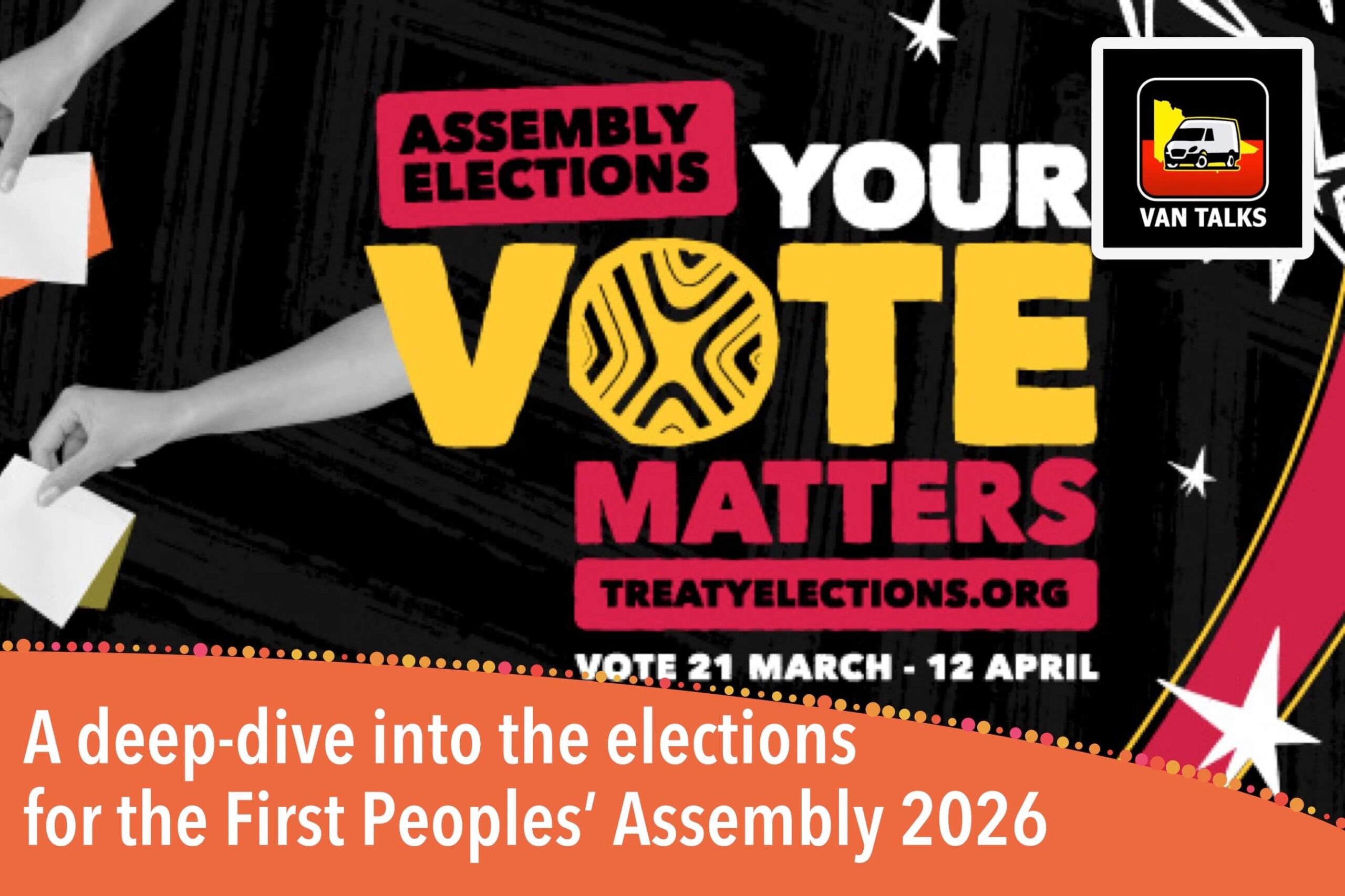
Charles Pakana: With elections for the new iteration of the first People’s assembly of Victoria due to be held between 21 March and 12 April this year, the Treaty Authority, which has been charged with conducting the elections, is well and truly gearing up. Joining me on the program today are two members of the Treaty Authority responsible for oversight of the forthcoming elections. They are Justin Baré, director of operations at the Treaty Authority and the person with overall responsibility for the conduct of the elections. And also Tyson Holloway-Clarke, a Nyamal man who is really very much on the ground with this. So first of all, Tyson, thanks for joining us on the program today.
Tyson Holloway-Clarke: Thank you very much.
Charles: And Justin, thanks indeed for making the time to come on.
Justin Baré: Pleasure. Thank you.
Charles: What I’d really like to do with this particular discussion is get back to some of the grassroots because a lot of people out there, a lot of mob, still don’t understand a lot of the prerequisites, a lot of the voting mechanisms that have been put in place since, essentially 2019. So that’s very first election. Justin, I’ll go to you. First of all, what are the eligibility requirements to be on the Aboriginal electoral roll and vote?
Justin: So there are a number of requirements. You need to be either a Victorian Traditional Owner and that can be someone living in Victoria or outside of Victoria.
Charles: Yep.
Justin: You can be an Aboriginal person who’s lived in Victoria for a certain period of time, but you also need to be 16 at the time of the election. So you can be 15 now, as long as you’re 16 by the time that polling closes, then you can be on the electoral roll and you’re eligible to cast a vote.
Charles: It’s a really important thing that when you said, you can be Aboriginal or Torres Strait Islander person and have lived in Victoria for a certain amount of time, so that’s three out of the past five years. So you could actually have lived in here for four years but not lived here for one year, sort of most recently, but still be eligible to vote, is that correct, Tyson?
Tyson: Yeah, that’s right. My mob aren’t from here in Victoria and so that applies to me in my category. But I’ve also got family in the territory, family in Tassie and If I’ve had to go back and forward or change my address a few times, if I’ve lived here for the majority of the last five years, then I’m eligible.
Charles: And 16, now obviously a lot of people are a bit surprised by that because in Australia, if you want to be enrolled on the Australian electoral roll, you’ve got to be 18 years and older. Just out of interest, why was the decision made all the way back in 2019, Justin, to make the age 16 rather than 18?
Justin: Well, I can’t speak necessarily to the reasoning at the assembly at the time, but I think it’s an important aspect of self determination. This is what community has decided is an appropriate eligibility requirement. It’s set that cut off and so we, we implement and follow those rules. I think it’s really important also to stress that this is really completely separate from Victorian Electoral Commission or Australian Electoral Commission processes. So the information that we hold when people enrol to vote or to go on the electoral roll is held only by us. We don’t share that information with anybody. It’s kept completely separate from those processes.
Charles: So let’s understand some of the security or the data sovereignty around that information when someone does enroll on the electoral roll, what are the principles of data sovereignty as they apply to that information, Tyson?
Tyson: As Justin’s mentioned, we don’t share this electoral information with the State of Victoria, we don’t share it with the Federal Government. This is wholly and securely held by the Treaty Authority on behalf of the First People’s Assembly. What’s changed with this election compared to past elections is by holding the voter data on behalf of the First People’s assembly, we are stopping any potential issues with their staff or members directly accessing personal information of Victorian Aboriginal people. We’re holding this in a secure environment that’s created specifically for us for the Treaty Authority’s purposes. What we did have to do is manage a transfer of that information from the assembly to the Treaty Authority in the first place. And we had really robust security arrangements to ensure that all of that data not only was correct as it was being transferred, but it was being held in a way that was not only readable and usable for our purposes, but also wasn’t going to be even accessed by other members of the Treaty Authority that didn’t have authorization. So we’ve got a very strict list about even the people within the Treaty Authority that can access that. And when it comes to the data being stored, it is stored digitally, but is also only stored here in Victoria. So there are data servers, of course, all over the world and files could get sent all over the world. But per our data sovereignty principles, we don’t send this information, say, to America, we don’t send this information to the UK – All of it is held here in Victoria. Data sovereignty is obviously a really important point for the Treaty Authority, and maintaining the confidence of our Traditional Owners in this state and Aboriginal people in this state is paramount. And so it’s really important that we understand that this information will only ever be used for the purposes as described by the Assembly Rules and allowed for under law.
Charles: And for our audience who might want to know a bit more information about that, last year we caught up with treaty authority member Dr. Peta Atkinson and spoke extensively about that. That is in the Victorian Aboriginal News Archives available on our website. Justin, given that the information is stored separate to the Australian Electoral Commission, there’s still a bit of confusion within some areas of community that they think, ‘but if I’ve enrolled with the AEC or the VEC, doesn’t my information or can’t my information be replicated across? And contrariwise, if I enrol in the Aboriginal electoral role, is my information then transferred across, even though, as Tyson said, it’s subjected to data sovereignty, will it be shared across to the federal and state government, to their electoral roles?’
Justin: So the information isn’t shared across either of those platforms or either of those organisations. It’s really important because we also need people to complete different eligibility requirements in order to enrol to vote that are required for federal or state or local government elections. This is a mob election, so we need people to be establishing their eligibility to vote and we hold that information separately and securely, as Tyson has outlined. But it’s really important that if people do want to enrol to vote, that they go to the Treaty elections website, they use the form that is there, they can do that to enrol for the first time. They can use a form there to update their enrolment if their details have changed since the last election. But it is really important that these elections, it’s understood that these elections are completely separate. Your enrollment has to be separate.
Charles: Tyson, you’ve got something to add to that, brother?
Tyson: Yeah. I spoke to an elder earlier this week who told me he’s never voted in the state elections or the federal elections…
Charles: There’s a few of those.
Tyson: …and he never will. He doesn’t plan on doing that.
Charles: Yeah.
Tyson: And he had that specific question, like, ‘if I sign up here, are you gonna dob me in for, you know, eligibility to vote in these other elections? are people gonna chase me up for fines?’ And the answer is absolutely not.
Charles: Yeah.
Tyson: All the information that we retain, including information about your mob, if you want to share that with us, your status as a Victorian Traditional Owner, the evidence that you provide around that, all of that is strictly confidential and it’s only held for us. And after we’ve determined your eligibility, we get rid of any of that additional information. So if you send us pictures of your ID or you send us a confirmation of your aboriginality or the like, in order to enrol, we clear out that after we’ve determined you’re on the roll and, and no one can find that afterwards.
Charles: It brings up an interesting point, fellas, and that is making sure the electoral role is not stacked by scurrilous influences. And I know there was a bit of concern in the last elections, especially because it was so close around the referendum, that a lot of non-Aboriginal people were going to come in and essentially flood the electoral roll, claiming they were Aboriginal and just, essentially, ruin the validity of the electoral roll. So what is that proof that’s required, or sufficient, for electoral purposes? So, Tyson?
Tyson: I understand people’s concerns about that. What we’re balancing between here is the accessibility for people to enrol and provide, you know, not an onerous, laborious or dangerous level of evidentiary requirements. It would be particularly dangerous for some of the mob who don’t have as much access to their family records, might not be part of their local Aboriginal corporation or their mob’s corporation and don’t have membership there. So under the rules, we have a pretty extensive list about the types of evidence that are accepted and we’ll also be following up with different, either registered Aboriginal parties or the First Nations Legal Research Services or the BACCHO and some of the other Aboriginal community controlled health organisations about people’s eligibility. So we have processes on our side and ways that we can check. As you know, the Treaty Authority and the First People’s assembly is pretty well tapped into the grapevine.
Charles: Absolutely.
Tyson: And I can see already, you know, as I’ve been going through personally, some of these eligibility enrolments, that’s one of my jobs, is to look at who’s signing up. I’m seeing a lot of names that I recognise, I see a lot of places that I recognise and a lot of families that even the look on some people’s faces when you’re going through the IDs. And so we’ve got quite a few different ways we can sniff out some of these spurious actors like you mentioned, and we’re taking that really seriously too. And it’s important that for the assembly, part of their success here is going to be able to say, the number’s gone up, more people are getting involved, more people are participating. But at the same time we have to have a robust process. And so we’re working on that constantly. We’re doing enrollments on a daily basis and reporting back. And thankfully so far we haven’t had any really curly situations. I wouldn’t say that we’re at risk of any stacking or any, you know, bad actors signing up to vote. And I would think it’s one of these situations where if someone’s going to go that far to do this, it’s a pretty high standard of sort of sabotage and activity.
Charles: Absolutely.
Tyson: When I find a lot of these characters, they rather just stick to the comments section. I find that’s probably hard enough for them, so…
Charles: I feel there are things you really want to say but you’re not going to say on air Tyson. Maybe we should have an off the line yarn a bit later on.
Tyson: Yeah, sure.
Charles: Justin, back to you with regard to enrolling and making it easy to enroll. So you were mentioning before we started the interview that people can actually enroll and vote on the same day at one of these traveling polling booths, and we’ll talk more about those a bit later. But so how does that process work? People just rock up, identify themselves and say, ‘right, I’m going to enrol and vote’?
Justin: So there are three main ways of voting and two of those allow you to enrol and vote effectively at the same time. So you can enrol using the online enrolment form at the Treaty elections website. You can register for an online vote or to vote in person and then you’ll be issued with an email link and you can cast your vote that way. Your vote won’t be included until your eligibility is verified and we’ve confirmed that you can be on the electoral roll. Equally, there are going to be around 70 polling booths set up at different places for different periods of time around the state. You can attend one of those polling booths in person. You can complete either a paper enrolment form or an online enrolment form. You can, again, you can cast a provisional vote, it’ll be held. Once your eligibility is confirmed, then it’ll be included and counted with the rest of the votes. And as I think we’ll get into it a bit later on, we’ll also be visiting correctional facilities.
Charles: Yeah, I do want to talk about this yeah.
Justin: So we’ll be encouraged. We’ll be visiting correctional facilities to allow people both to enrol to vote and cast their votes during the election period.
Charles:This is a really interesting point and it’s a major point that Auntie Jill Gallagher, when she was the Victorian Treaty Advancing Commissioner, really emphasised that no one was to be left out of this. I remember that Auntie Jill visited every single prison across the state and engaged with mob. How’s that actually going to work for what you’ve dubbed the Office of the Transitional Election, or OTE. I love the acronym. How’s that actually going to work in practice? Getting out to all the prisons? I assume that’s been organized with the government and corrections.
Tyson: Yeah. So one of the things that’s really special about this election for me so far is how the treaty authority in the First People’s assembly have worked together to share the work here. This is something that, obviously, the assembly holds really close to their core purposes and close to their heart. And a lot of the teams from the last election are working on this election. Part of this way that we’re splitting this up is we’ll be working together to go to the prisons. They’ve got a long standing relationship, engaging with a lot of people that are incarcerated.
Charles: Sure.
Tyson: And so we’ll be learning from them a little bit about the process of how we want to do this. But it’s really important to say that we’ll be, as Justin said, doing both enrolments and voting in some of these places, and we’ll be trying to cover both the men’s and women’s prisons and the youth detention centres. And as we do that, it’s going to be, you know, a challenge in some respects. The returning officers in the past, one of the things that we have to keep an eye out for is making sure that everything is understandable and accessible for people.
Charles: Yeah.
Tyson: And when they enrol, one of the things that we determine the region on is your last known address. And for some people that, you know, might not be in the state or that might not be something that they can recall depending on their circumstances, and so no matter what your situation is, we’ve got a long list of exceptions and qualifications and special consideration that we can give to people in their circumstances. So I want to say that, you know, no matter what has happened in the past, Treaty’s about the future and we want to hear your voice. So please, please, if you’ve got any mob that you know are locked up and you’re speaking to them about what’s going on on the outside, let them know this is coming and that we will be arriving at their facility.
Charles: Tyson, I just want to jump in. But you also mentioned before the yarn started, that you wanted mob to share with their family and friends who are incarcerated out of the state, who may be TO’s…
Tyson: Yep.
Charles: …That they are still eligible. They may be incarcerated in the Northern Territory, but they may be a Wadjibulluk man, for example. So how’s all that working and what are you saying to community to encourage this?
Tyson: Yeah, this is an area that we’ve identified, you know, was a bit of a gap in the last election and I don’t know off the top of my head, how many of our Victorian Traditional Owners are incarcerated in other states. But knowing that we share a big border with New South Wales, sharing a big border with South Australia, and there’s a lot of communities, that go across both levels, it’s important to remember that to be an ineligible elector, you can just be a Victorian Traditional Owner. You could have never have lived in Victoria, but your mob’s from here and we still want your voice to be heard and your voice to be counted in this vote. So we’ll be talking extensively with the assembly about what we’re going to do to make sure that it works and that we can get some of these ballots and enrollments into people’s hands. As you can imagine, some of the states and territories are going to be more friendly about the prospect of this. We’re hoping that the federal government will, you know, potentially lend their ear to this cause and make sure that people’s democratic rights, at the end of the day, are being realised and protected, no matter their incarceration status.
Charles: And I assume, once again, you’ll be relying on the connections within the First People’s Assembly to bring about that weight from the governments.
Tyson: Absolutely. And, you know, they’ve got long standing relationships both with this state and then the federal government. And I think, you know, this treaty moment, this treaty era that we’re embarking on, as Auntie Jill Gallagher said, no one should be left behind.
Charles: Absolutely.
Tyson: This is an area that, again, when we think about the future and know that a lot of people are going to get out, I want people to know that, you know, this is still their home and that they still have a voice in what happens down here. And in doing that, one small thing that we can do is make sure that those voices are heard and that ballots get out to them. And the people that are going to be representing them in this new treaty era are people that have their support.
Charles: Justin, talking about getting the ballots out there, you made mention before about having the polling booths out at, I assume, gathering places out at community controlled organisations right across the state – and we’re blessed in Victoria that we do have quite a number of those. But there are some instances where mob are still remote and still find it difficult. You’ve got old people who can’t get into the gathering places or to their community controlled organisations. So what are some of the voting facilities that have been set up for those who simply cannot get there physically?
Justin: In the last election, the primary method of voting was online voting. So people who have access to a phone or the internet will have access to online voting and that they can express that as their preferred method of voting. Of course, we understand that there are people living remotely who don’t use the internet, don’t have that access and can’t access the polling booth. So the other way that you can vote is via a postal vote. It’s important, though, to receive a postal vote to return and submit to us by mail that you request the postal ballot. And there’s a couple of different ways you can do that. You can email the Treaty Authority, you can email the returningofficer@treatyauthority.au
Charles: We’ll share that link on our website.
Justin: Or you can call the Treaty Authority and our phone number [0403 336 829], leave a voicemail and we’ll make sure that that request is passed on to the Returning Officer and they will communicate with you to confirm that they’ve received that request and then they’ll send you, once the polling period commences, a ballot paper. You’ll have the opportunity to return that ballot paper by mail. It needs to be received by us no later than 6pm on 21 April. Then it will be included in vote counting, which happens the following day.
Charles: When do we expect to get the results? Given that we’ve got the closing of Postal votes by 21 April. Tyson’s laughing at this one. It’s an easy job, don’t worry about it. So we’ve got postal votes closing on the 21st of April and physical voting on the 12th of April. Tyson, you were the first one to smile, so we’ll go to you. When can we actually expect results?
Tyson: At the very latest by 1st of May, because we’re going to be establishing an opening Gellung Warl from there.
Charles: Yep.
Tyson: And that’s our hard deadline. We’re hoping that the 22nd of April, we might even have them the same day.
Charles: Wow.
Tyson: The Returning Officers that we’re retaining and Gavin and his team are very proficient at this. They do very big elections constantly. They’re involved in some of the union elections where they see potentially twice or three times as many voters. The count will be held here in the Treaty Authority, so it’ll be a secure site and we’ll be spending the whole day working through it. And so for any of the candidates out there that are listening, get your scrutineers ready, make sure that they’re trained. We’ll be sending out information about how to participate in that process. We can’t know exactly based on the volume of votes, but it could be a pretty quick turnaround.
Charles: Justin, you wanted to make mention also of the fact of letting the candidates know before the broader public, which is an important aspect. So what’s the process there?
Jusin: That’s right. So once the votes have all been counted and we make sure that that’s a really robust process, we inform the candidates of the outcome and then there’ll be a formal declaration of the poll that happens after that. But of course, as Tyson indicated, that will all be wrapped up ahead of the 1st of May when the new body takes office.
Charles: Justin Baré, thanks so much indeed for your time.
Justin: Thanks, Uncle Charles.
Charles: And Tyson Holloway-Clark, the first interview with you. Looking forward to many more in the future. Thanks so much indeed, my brother.
Tyson: No, thank you for your time. This is a really important piece of work for the state and it’s an honour to be part of the story.

0 Comments