
Image courtesy of Leroy Miller
A new First Peoples’ Assembly of Victoria with a new set of challenges for a new era
Assembly co-Chairs Meriki Onus and Djaran Murray-Jackson commit to listening to community and "hit the ground running" to "bring about tangible and immediate change".
Posted by: Karina Wells
Published: 26 May 2026
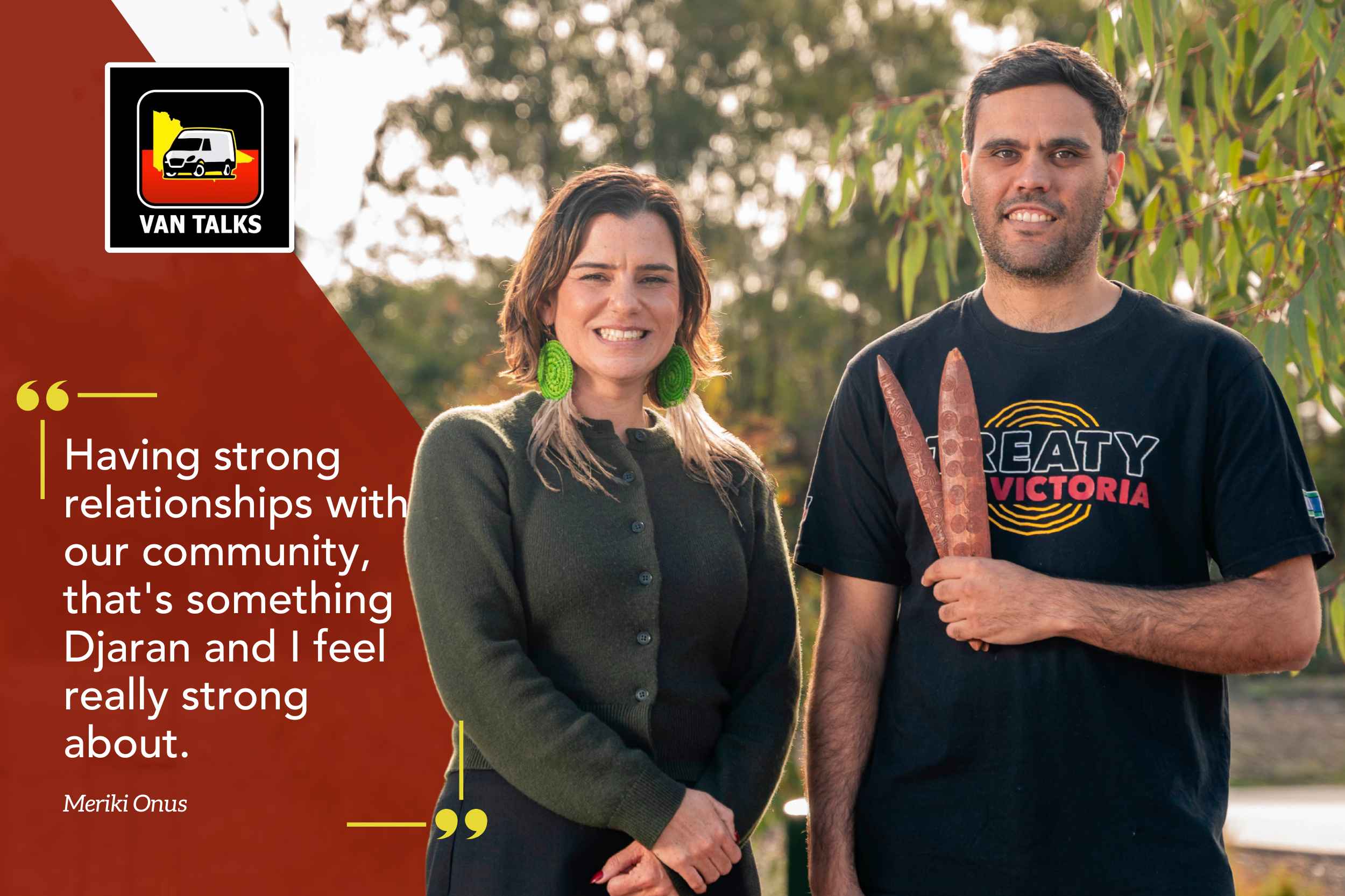
Following the historic passage of the Statewide Treaty Act 2025 and the official establishment of Gellung Warl on 1 May 2026, newly elected co-chairs Meriki Onus and Djaran Murray-Jackson are stepping into leadership at a pivotal moment.
While previous terms built the architecture and negotiated the framework, this third iteration of the democratically elected Aboriginal representative body is focused on implementation, delivery, and exercising new statutory powers.
The day-to-day focus has fundamentally shifted toward setting up internal rules, governance structures, and key committees tied to the functions of the Act.
Meriki, a Gunnai and Gunditjmara person, emphasised that the immediate non-negotiable priority is establishing a strong foundation driven directly by mob.
“We want our community to drive our work, and we want to hear how community want Gellung Warl to look,” Meriki stated.
A central mechanism for this transparency is the development of a Community Answerability Framework over the next six months.
This framework will include a 100-year strategic plan designed to ensure Gellung Warl remains transformational.
Aboriginal Community-Controlled Organisations (ACCOs) and Traditional Owners will play a vital role in shaping these processes, drawing on existing relationships to “hit the ground running.”
The new co-chairs are also firmly focused on economic self-determination as a tool for self-nation building and moving away from the deficit model.
Djaran, a Dja Dja Wurrung man, outlined the practical markers of this vision. “I think, for me, it’s stronger organisations, homes for our families, jobs for our people, and businesses for our people, too,” he explained.
Furthermore, the implementation phase will introduce the place-based ongoing truth-telling path, Nyerna Yoorrook Telkuna, allowing community members to continue sharing their stories.
With community trust surging—reflected by over 10,000 enrollments in the 2026 election—the co-chairs view Treaty as a living, evolving vehicle for sovereignty.
As Meriki noted, “This is just the beginning”.
Charles Pakana: With the historic passing of the Statewide Treaty Act 2025 and the official establishment of Gellung Warl on the 1st May 2026, the newly elected co-chairs, Mariki Onus and Djaran Murray-Jackson, are stepping into leadership at an incredibly pivotal moment. While the first term built the architecture and the second term negotiated the framework for Treaty, this third iteration of the democratically elected Aboriginal representative body is focused on implementation, delivery and the exercising of new statutory powers. I’m joined on the program today by Gunnai and Gunditjmara person, Mariki Onus, and Dja Dja Wurrung man, Djaran Murray-Jackson. Djaran, welcome to the program, or welcome back to the program, I should say.
Djaran Murray-Jackson: Thank you, thanks for having me again.
Charles: And Mariki, welcome to the program as well. Great to be yarning with you today.
Mariki Onus: Thanks for having me, Charles.
Charles: Djaran, we’ll start with you as a returning member. The first two terms of the assembly were heavily focused on building the framework, gathering community consensus and negotiating the Statewide Treaty Act. Well, now that Gellung Warl is officially established, how does the day-to-day focus of this third iteration fundamentally differ from the terms that came before it?
Djaran: That’s right, Charles. And yeah, the first term when I was in the staff, was about building the frameworks to actually negotiate what we want. And then, you’re right, in the second term we use those frameworks to negotiate the first statewide Treaty, which we saw come alive with Gellung Warl coming into action. Once we were all elected earlier this year, day-to-day, I can tell you it’s been lots of meetings. We’re still in our first chamber technically, so we’re still setting up our internal rules and our governance structures and who’s going to be leading our different committees and all that sort of jazz. We’re just really focused on getting ourselves right so we can set ourselves up for success.
Charles: What are, just off the top of your head, what are some of those key committees that are going to be established under Gellung Warl that you’re looking to get that leadership set up for?
Djaran: It’s all tied to the Statewide Treaty Act and our functions and powers. So they’re still up in the air at the moment. We haven’t really set anything in stone, but some of the powers that come across with statewide Treaties, like engagement hearings, for example, or two meetings of cabinet per year, that’s locked in, it’s just sort of based around that or the confirmation of Aboriginality conversation as well. So we’re trying to figure out, how does that fit in our governance structures and who’s actually going to be leading to work on those different items.
Charles: And we’ll be talking about some of those statutory powers in just a short while. Mariki, I want to go to you right now and let’s look at the first 100 days, and this is always a measure applied to a newly elected body. So from your perspective, what are the immediate non-negotiable priorities as you lead this new cohort of elected and reserved seat members into the implementation phase of the Treaty?
Mariki: It’s a critical phase for us, and what’s really important to the assembly is building a really strong foundation for Gellung Warl that’s been really strong with the members, working and meeting with the community, meeting with leaders across the state and building that relationship. So having strong relationships with our community, that’s something Djaran and I are really strong about.
And one of the biggest things that we’ll be working on in the first hundred days is our community answerability framework, where we’ll go across the state, and we’ll talk to community about what they want Gellung Warl to do, and that will be the measure of how we deliver on our outcomes, what they want this to look like and what outcomes they want to see. So I think that’s a pretty good start to see. We want our community to drive our work, and we want to hear how community want Gellung Warl to look.
Charles: That really does bring up the important role that Aboriginal Community-Controlled Organisations, ACCOs, have in this process going forward. And as you were talking about getting out there across the state and speaking to communities, can I assume correctly that ACCOs will play a major role in these first 100 days?
Mariki: Absolutely. ACCOs have been critical in the lead-up to signing the Treaty. The relationships across the state, the feed in on what they want that to look like ACCOs and even before that iteration, they had a strong contribution, and so that won’t change with Gellung Wal, and that won’t change with our Community Answerability Framework. Another thing that FPAV [First People’s Assembly of Victoria], the previous iteration, left us to work with is a framework on how to work with ACCOs, and that’s actually something Djaran and I worked on before we became co-chairs, and so we’re really excited to pick up those relationships again in our new roles as co-chairs and get the work started.
Charles: Mariki, I want to stay with you because in your election statement, you mentioned the need to ensure Treaty delivers, as you said, real change on the ground. So this is for community members. So what do you intend to be the tangible and visible markers of that change in the next 12 to 18 months?
Mariki: Look, there are many things in the [Statewide Treaty] Act that will bring about tangible and immediate change. We heard a lot that communities want to see some reform around confirmation of Aboriginality. One of the tangible outcomes that we aim to deliver pretty quickly is truth-telling in curriculum. There’s a lot of different things that we aim to hit the ground running on. And then there’s also our First Peoples’ Institute that we want to hit the ground running. So there’s a few different things also. I’m excited to see how the different arms of Gellung Warl interact with each other, like the Assembly, Nginma Ngainga Wara and Nyerna Yoorrook Telkuna, what they develop and what they come up with once they’re functional.
Charles: Djaran, you had something you wanted to add to this?
Djaran: Yeah, I’ll just add, those are all things that we need to do that’s part of the Statewide Treaty Act. Then it’s about things, what do we want to do as a community and a mob? And something that Mariki and I are pretty passionate about is economic self-determination and what that might look like. That’ll probably be a key focus over the next term. And what that might look like in terms of our community answerability. The mob will tell us what that might look like, and then we’ll be able to deliver on some of those outcomes as well.
Charles: I just want to stick with you on that one, because whenever you talk about self-determination, and economic self-determination, that brings up any number of arguments and opinions, and we know that because we’ve seen it so much over the recent years, decades. In your own mind right now, as you see it in these first few days of Gellung Warl, what are some of the achievements that you would like to see occur when it comes to economic self-determination? Because obviously you’re not going to implement it right across the state in the next three years.
Djaran: That’s right. I think, for me, it’s stronger organisations, homes for our families, jobs for our people, and businesses for our people, too. And then that generational wealth being passed down to their people as well.
Charles: Mariki, over to you.
Mariki: Yes, I think to what Djaran said about economic self-determination that will enable self-nation building, and so that’s what the collective interests are outside of what we have in this existing Treaty, and that empowers our interests as First Peoples. And so that is also a shift away from the deficit model. And this is something that we’re consistently hearing from professionals and community; that we want this Treaty to be transformational, and economic self-determination enables transformational work.
Charles: Because a lot of this wasn’t really inherent within the Treaty Act of 2025. Because, as we’re aware, the Treaty Act of 2025 was more or less setting up the foundation for Treaty 2.0, 3.0, ad infinitum, as has been spoken about since 2018 when the Victorian Treaty Advancement Commission was first established. How important is it – and Mariki, I’ll just stay with you – that the community see that Treaty is in fact much more than just a single Act or a single line in the sand, but that it is an evolving, living, document and movement.
Mariki: I’m really glad that you mentioned that. And something that, you know, I heard Ngarra Murray talk about a lot is this idea of “chapter Treaties”, or that this Treaty is just the starting block. It is to reset the relationship with the Victorian government, and it’s our political mechanism where we democratically elect our leaders, and then it’s then for us Gellung Warl to take the work to carry on to deliver on the next phases of work. And that could be chapter Treaties mean maybe a Justice Treaty, maybe a Health Treaty. And we will hear from our elected members and our community through our answerability framework and our stakeholders and rights holders on what that next step should be. It shouldn’t be up to us. We’ve got to pull all of the levers together on what those next critical steps should be. But it doesn’t stop at this Treaty. This is just the beginning.
Charles: So community engagement is only going to increase on what it’s been over the past seven years with Assembly 1.0 and 2.0, I’d imagine?
Mariki: Yes, I think it’d be greater than community engagement. In my mind, it’s about reciprocity. There’s a two-way approach. It’s that community tell us what they want through our answerability and their aspirations, and then we deliver on it, and then we report back to that. So it’s a very different way of working. It’s an enhanced way of working with communities.
Charles: This actually brings me to the next question. Djaran, this is for you: The Assembly has consistently argued that Aboriginal people know what works best for their own communities. Can you give us a bit of an example of a structural or policy failure under the old government systems that you believe Gullung Warl’s new decision-making model can fix relatively quickly?
Djaran: Yeah, I think something that comes straight to mind for me is something that I’m passionate about is housing AHV [Aboriginal Housing Victoria] and Darren Smith, who’s the expert in that sort of area. They always say there’s roughly six [thousand], I think, to eight-thousand black fellas on a waiting list for a home. So how do we use Gellung Warl and the tools that we have to review that, and how do we make sure we’re delivering more houses for our people? And how do we make sure we’re sharing the load so it’s not just AHV trying to build houses? Like, how do our Traditional Owners get involved? How do ACCOs get involved? It’s about sort of working together through those problems, those issues. And then the other side of it is probably justice and child protection. We’ve seen the Yoorrook recommendations that got done. What have the state done with those just yet? Nobody really knows what’s going on with that. They put it in a budget that day, that they’re going to have some implementation plan that we’ve asked to put a hold on to. We figure out a shared approach and then, yeah, we’ll hit the ground running in that regard. And then obviously with Nyerna Yoorrook Telkuna coming on board, they’ll be able to go through the whole Yoorrook recommendations and make sure they’re implemented fully
Charles: And we’ll talk about Nyerna Yoorrook Telkuna, which is the place-based ongoing truth-telling path of Gellung Warl, in just a short while. But Mariki, I just want to come back to you and focus on the statutory powers. And the new body does have some pretty exciting statutory powers, such as establishing binding rules for confirmation of Aboriginality. You mentioned that just a few minutes ago, the drafting of Cultural Safety Guidelines that can be implemented in various organisations across the state and the direct power of key appointments to bodies, including the Aboriginal Heritage Councils. But with these statutory powers, and that’s a mere sampling of the statutory powers given to Gellung Warl under the Treaty Act, what mechanisms are going to be put in place to ensure that Gellung Warl remains transparent and accountable directly to the diverse communities right across the state?
Mariki: That’s a good question, Charles. And I’ll go back to our community answerability framework. We’ll take what our mob tell us what they want to see through that mechanism. And then the transparency part, as I mentioned before, in that two-way relationship on how we are meeting the requirements of what community have asked of us through that Community Answerability Framework. There is a strategic plan that we have to have through our Answerability Framework. We have a hundred-year plan on how we remain transformational for what our people want to see over that hundred years. And there are other, different parts of the framework that we have to do in communities. It’s in the Act, this framework. This is something I’m really excited to see. And so we’ll use that framework, and I anticipate that the report back and transparency will also be back to communities on how we’re using our powers and functions.
Charles: What are some of the key, I suppose, measures within this answerability mechanism that you believe will ensure that information is constantly being fed back to the community? Because this is what they want to hear at this stage.
Mariki: We don’t have that developed. That will form part of the Hundred Days of Gellung Warl. We’ll have The Answerability Framework fully developed in the next six months, and so we’ll know what that looks like in due time.
Djaran: Yeah, and I’ll just add, it’s not for us to develop, it’s for community to develop and tell us how they see The Community Answerability Framework working and what the Hundred Year vision should look like.
Charles: So this goes back, Mariki, to what you were talking about previously about this hitting the ground running with connecting with community and hearing their thoughts, their concerns and their contributions to this entire process.
Mariki: Yeah, and we’ve got existing relationships and mechanisms from the previous Assembly around the ACCOs. Djaran led that work, and also the Traditional Owner work. And so we’ll be drawing on those existing relationships to hit the ground running. So we’re not necessarily starting from scratch. Thankfully that there was a lot of preparatory work done after the Treaty was assented to last year that we can pick up and hit the ground running on.
Charles: I’m aware that Reuben and Ngarra led Assembly 2.0 and post the Treaty Act of 2025. They really were working very hard. The whole assembly was working very, very hard to set things up to make it easier for this iteration of the assembly, for Gellung Warl. Regardless, not everything was done as you’ve just mentioned, Mariki, and you too, Djaran. Djaran, what are some of the key challenges, the major challenges that you’ve got before yourself and the body right now?
Djaran: The biggest challenge for me is setting up our internal rules and our governance structures. Like, we just got to get that right. And we had Auntie Karen Diver come and yarn to us at our cultural grounding, and she really took her time with that. So you get it right. You don’t want to be rushed into decisions because you don’t want to come later down the track and your governance structures aren’t up to scratch. But the beauty of the Community Answerability Framework is they’ll sort of tell us what our governance structures should look like as well. So we might have to adjust it in six months. But what we’re planning now is just to set up something that we need for the meantime for the next six months. So I think that’s one of our biggest challenges. And then obviously there’s probably something on the horizon of the upcoming state election and the threat of the opposition. But yeah, we’re keen to have conversations with the opposition and try and build that relationship now that we’re newly co-Chairs and see where that conversation goes as well.
Charles: Have you reached out to the Opposition?
Djaran: Yeah, Jess Wilson received a letter, so we’re looking forward to catching up with her very soon. Just to see where they’re at with everything, then I believe Minister Melina Bath, as well as the Shadow Affairs Aboriginal Minister.
Charles: Be interesting to chat with you once those conversations have been had, for you to share whatever you’re able to share.
Djaran: Yeah.
Charles: Djaran, I just want to stick with you again right now because a question I often hear, and I’m sure we all do, is about the future of truth-telling. With the ongoing truth-telling guaranteed under the Act, with the establishment of Nyerna Yoorrook Telkuna, what can the community actually expect from this?
Djaran: We all saw the amazing work that the Yoorrook Justice Commission did, and to experience that people from our own family telling their truths with my old man just seeing the weight lifted from his shoulders and the sort of healing that that would improve, was amazing to see. And as you said, a lot of people didn’t get a chance to submit their truths because they ran out of time. Because it’s a Royal Commission, it’s a time-based thing.
Charles: Yeah.
Djaran: The plan for Nyerna Yoorrook Telkuna is for community to still be able to tell their truths for as long as Gellung Warl’s around. And then on top of that, what does the healing look like? So it’s not just about telling your truth, but how do we make sure our communities are healed after they’re telling their truths, and what does that look like? I guess the process for us is more of an oversight and governance role, and then we’ll appoint… I think it’s up to two commissioners to lead that work, and they’ll have a whole operation underneath them as well. But we’re just more mainly oversight and governance.
Charles: So they will not have the powers of a Royal Commissioner. I think that’s important to stipulate right now.
Djaran: All their powers would be linked to the statewide Treaty Act.
Charles: We’ve pretty well run out of time. And a question that I’m really, really keen to ask – and Mariki, I will come back to you right now – is that, we saw in the 2026 elections over 10,000 Aboriginal and Torres Strait Islander people enrolled to vote in this election. Now this was four times what we saw in the very first elections of 2019. Why do you think community trust and participation in this non-compulsory process continues to surge, and it’s even at a time when mainstream political engagement often feels pretty strained?
Mariki: The only thing that I can really point to is that as the iterations of the Assembly goes, more and more of our people participate, and the more our people participate, the more our people get elected. As time goes on, they see their community on the Assembly, and they can see how the self-determination works in practice. And you know, I think that the last assembly did such a good job with this Treaty. That’s kind of the measure stick, isn’t it, that our people are coming out in droves to support our Treaty. And so it’s really encouraging that people can see the possibility of how Treaty can be a vehicle for our self-determination and sovereignty. And so that’s the thing that I think that our mob are coming out to participate in, and I think it’s really encouraging.
Charles: Mariki Onus, Djaran Murray-Jackson, Co-chairs of Gellung Warl, thanks so much indeed for your time today.
Mariki: Thank you very much. Thanks for having us.
Djaran: Thanks for having me again.
For Radio Play:
1 - Click the Download Audio button
2 - The audio file will commence automatic play in your browser
3 - Confirm this is the file you want to use in your program
4 - Once confirmed, click the vertical elipses (3 dots) and select download
3 Comments
CONTACT US VIA SMS
Get in contact with us via our dedicated SMS line:
0493 222 836
21 October 2026
Reconciliation in Seymour – one of Victoria’s highest recorded “No” vote regions
19 October 2026
Understanding the use – and over use – of the Acknowledgement of Country
15 October 2026
It’s time Australia recognised a shared history of often brutal “settlement” and expansion
12 October 2026
Start learning about First Nations cultures without the fear of offending
5 October 2026

Really appreciated this clear sense of next steps in implementation of Treaty, and getting to hear from the two Co-chairs. Thank you.
Thanks, Vicky. Appreciate your feedbck.
Thanks, Vicky! It’s great to hear from you, we really appreciate all your support for our work <3