
Native Title in the Victorian context with Kaley Nicholson
Kaley Nicholson, CEO of the Federation of Victorian Traditional Owners Corporation, gives an easily understandable overview of what Native Title is in the Victorian context.
Posted by: Karina Wells
Published: 8 June 2026
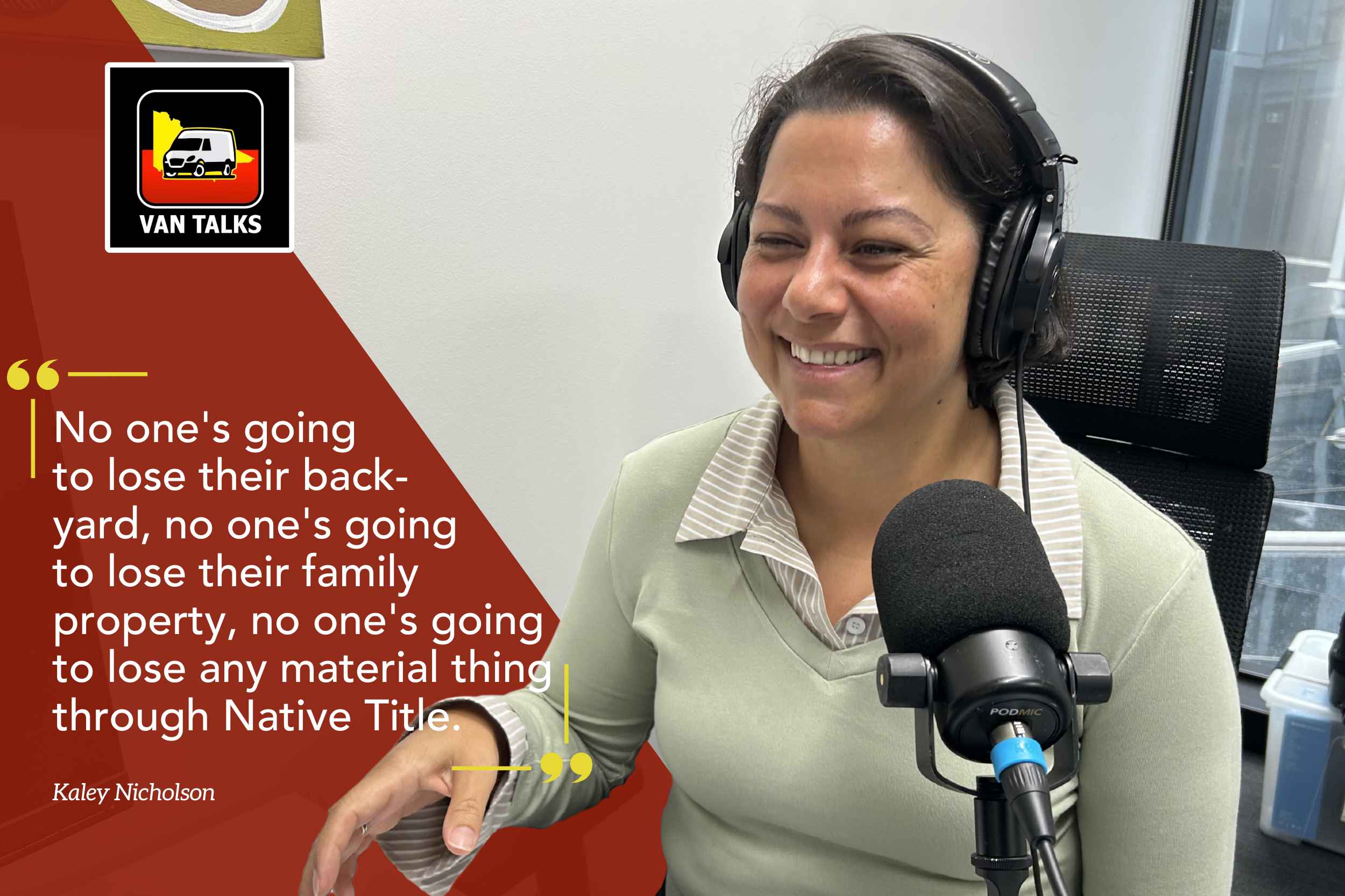
The complex landscape of land justice in Victoria remains a critical hurdle for Traditional Owners seeking formal recognition on their own lands.
On a recent episode, VAN Talks host Charles Pakana sat down with Kaley Nicholson, the CEO of the Federation of Victorian Traditional Owner Corporations, to unpack the friction between federal Native Title laws and state-based alternatives.
The discussion highlighted how the federal Native Title Act 1993 presents immense barriers in southeastern Australia. To succeed, Mob must prove an unbroken chain of connection pre-colonisation.
Kaley explained that “with the intensity of colonisation, that means that proving those things is really, really difficult”.
Furthermore, freehold titles and National Parks extinguish Native Title completely, leaving less than a quarter of Victorian land even eligible for claims.
Because Native Title is heavily restricted in the state, the alternative pathway is the state-based Traditional Owner Settlement Act 2010 (TOSA).
Kaley noted that the government recognised “Traditional Owners… do still have rights and interests over country, they do still have a cultural responsibility to care for country and place”. Under TOSA, groups negotiate Indigenous Land Use Agreements to secure rights, such as the Taungurung Nation’s agreement allowing for the harvesting of natural resources.
Crucially, Kaley addressed persistent community fear-mongering, clarifying that these legal pathways only provide a voice and seat at the table.
“There is and never will be a right to veto,” Kaley emphasised. “We don’t have the right to stop any projects or developments”.
Looking forward, Kaley urged the broader Victorian public and decision-makers to view Traditional Owner corporations as vital partners rather than threats. Re-embedding traditional knowledge systems into environmental practices is essential to mitigating escalating climate and bushfire risks across the state.
Charles Pakana: Today on the program, we’re speaking with Kaley Nicholson, the CEO of the Federation of Victorian Traditional Owner Corporations. And the focus of our conversation today is to start, at least, to unpack the complex landscape of land justice in the state of Victoria. And in that way, we’ll be exploring Native Title and state-based settlements and what true self-determination looks like or could look like for Traditional Owners on the ground. Kaley, welcome back to the program and thanks for your time.
Kaley Nicholson: Thank you. It’s really deadly to be here.
Charles: As always, Kaley, it’s a unique position here in Victoria. We have both the federal government’s Native Title Act and the state-based Traditional Owner Settlement Act of 2010, or TOSA as it’s more colloquially known. From the Federation’s perspective, how do these two pathways complement each other, if in fact they do? And where do they create friction, which I’m sure they do for Traditional Owners seeking formal recognition on their own lands?
Kaley: Again, as I was saying earlier, it’s a bit like that box of cables that we’ve all got tucked away somewhere that we don’t really want to start digging around in and having the hard time of unravelling. I think there’s lots and lots of layers to this discussion and a lot of nuance and perhaps some harsh realities in there.
None of the land justice legislation pieces are perfect in Australia. And the reality is this is a post-colonial settler society, and so we’ve got to find ways to make sure that any rights that are secured are to the benefit, and give impact to better outcomes for the state of Victoria and the broader population, not just Aboriginal people and ourselves. And obviously, we think that the key vehicle to do that is by managing and caring for country better in a way that benefits the average Victorian, or the average Australian.
Charles: Yeah. Well, let’s kick it off then with Native Title. And Native Title’s been subjected to a lot of, well, scrutiny and doubt, especially since 1994 and the failed claim by the Yorta Yorta. So just what is Native Title? Is it practical in Victoria? Because there are talks that it isn’t practical in Victoria, given what land is available to come under Native Title. And then what’s, then, the alternative?
Kaley: As always, lots of components to that question, Unc. [Both laughing] I think it’s really important to say that, so the rules around Native Title, in short, that, you know, the goalposts that Traditional Owners have to be able to kick a goal through, is to say, and be able to demonstrate, that they have an unbroken chain of connection from themselves to their ancestors pre-colonisation, and they’ve been living on, and caring for country and doing cultural practice, obviously through forced displacement, stolen generation, the banning of cultural practice, not being able to speak language, moving people around in the state of Victoria, and with the intensity of colonisation, that means that proving those things is really, really difficult. So obviously the Yorta Yorta Native Title claim didn’t get up, and led to a reckoning around, ‘okay, well, what does that actually mean in Victoria?’
Charles: Sure.
Kaley: It’s also really important to note that freehold title of land extinguishes Native Title.
Charles: So, freehold title, just explain that.
Kaley: That is privately held land. So if you’ve got a farm and you and your family own that, that means Native Title is extinguished and can never be re-established on that land. And so that is a really important point to make, because unfortunately, there’s a lot of fear-mongering around Native Title and what that could mean. No one’s going to lose their backyard, no one’s going to lose their family property, no one’s going to lose any material thing through Native Title.
Charles: They’re not going to lose their Hills Hoist, are they?
Kaley: [Laughing] Exactly.
Charles: And that’s the most important thing, for goodness sake. So that’s actually stipulated in the Native Title Act?
Kaley: Yes, Yep. Freehold title extinguishes Native Title. And that has been the case from the outset. So, you know, what does that mean in a practical sense? Here in Victoria, about 60% of the state’s territory is held freehold. So that means 60% of the land is already…
Charles: Yeah, spoken for.
Kaley: Spoken for and not available. Of the remaining 40%, there’s about another 16% that is National Park. And again, that also extinguishes Native Title.
Charles: So we’re down to 24%.
Kaley: Exactly, exactly. And then of that, the groups that are actually going to be able to prove that unbroken chain of connection, despite all of the harms of colonisation, whittles that down even further. So, Native Title, whilst it is an important symbolic piece of legislation, in terms of the practical applications in Victoria, it doesn’t always compute as being one that’s attainable for a lot of Traditional Owner groups. And then also there are questions around, ‘what is the actual value of Native Title?’ It doesn’t give you freehold ownership over land. It might give you rights to negotiate over certain components. But it’s not like you can say, “Well, we own this land, and we want to borrow against the value of that and build an economic super hub, a data centre.”
Charles: So what does it give then? And why are local governments so concerned whenever they’re given notification from the tribunal that a Native Title claim has been lodged for the area?
Kaley: I think you might have to ask them-
Charles: [Laughing] I’ve tried, I’ve tried!
Kaley: I honestly just think it comes back to that mis- and disinformation. When there are people that want to get elected, sometimes they will use what is called a political football, unfortunately.
Charles: [Laughing] You’re being very diplomatic, Kaley.
Kaley: Unfortunately for us and our laws and our rights, often Aboriginal people are very easy to pick up and kick around in that game of political football. And unfortunately, what gets votes, what gets people’s attention and interest? Fear.
Charles: We saw that in 2023 without a shadow of a doubt.
Kaley: Absolutely.
Charles: So, do you think that Native Title is being treated as a political football? Just as we saw The Voice [to Parliament] was as Treaty has been and will be? It’s all lumped into the same, “Let’s just have fun, let’s go ahead, stuff division, and let’s just try and get our bums on seats in Parliament.”?
Kaley: Yeah, if I’m to take a cynical view, I reckon you’d be bang on.
Charles: But I noticed you didn’t say that. I did, sis.[Kaley laughing].
So, okay, let’s talk about the fact that we may have, around about, rough figures, about 20, 25% of Victoria that could legitimately come under Native Title. You’ve mentioned that the Traditional Owners can’t simply go in there and say, “Yep, we’re going to borrow against that, we’re going to build infrastructure on that.” Typically, what have you seen across the rest of the country that’s happened with that land under Native Title?
Kaley: Primarily, I think it centres around mining rights and interests. So if you were to look interstate, WA, NT, Queensland, for example, primarily what it enables is the right to negotiate around resources that are held within the land. And so, you know, they might be able to negotiate, perhaps a royalty share or something like that, or jobs and different bits and pieces in a project. Again, here in Victoria, with the scale of the land that is available, it means that we’ve had to think differently about how we might be able to assert those rights.
And also, like I said, the bar is quite high. To get Native Title, you need a very coordinated, intensive effort from a nation to gather that knowledge, to put it into a format that is acceptable to the courts. Often, it needs to be interpreted and mapped out by an anthropologist. You know, how many of them are Aboriginal people? There is this distilling of that knowledge that needs to happen, and it takes a really, really long time. And so imagine the heartache for a group, Yorta Yorta, of which I’m a descendant, by the way, to do all of that and to get to court and then for it just to fall over anyway. And when it falls over, the ruling is that Native Title has been extinguished over that land. And so you can’t go back and have a second bite at it. It’s extinguished.
Charles: That then brings in TOSA, the Traditional Owner Settlement Act of 2010, introduced by the state government here in Victoria. If Native Title has been extinguished on a particular area, does that preclude the Traditional Owners from coming in and negotiating something under TOSA?
Kaley: No, it doesn’t. So, again, to government of the day’s credit, which it’s important to say, I think, they recognise pretty quickly that although Native Title in its current expression is technically extinguished on those lands, there are still Traditional Owners. They do still have rights and interests over country, they do still have a cultural responsibility to care for country and place. And so the alternative needs to be set up that would enable some way for that to happen.
And that’s where TOSA comes in, and the Indigenous Land Use Agreements, or ILUAs, which a group, to be able to even negotiate any of that, they need to have cultural governance in place, they need to have a board of directors, they need to have systems that enable collectively held knowledge and consensus to be built, because it has to be our ways of knowing, being and doing, and our ways of upholding that responsibility to care for country. And so there’s still a huge amount of work that a Traditional Owner group needs to do to be able to negotiate under TOSA and to have an Indigenous Land Use Agreement.
Charles: So, from your observations and your experience, let’s just explore a little bit about how those Indigenous Land Use Agreements actually come into play, and what benefits have you seen resulting from them across other areas of Victoria?
Kaley: Again, there’s probably lots of layers and different things to unpack in this, because in Victoria, there are many nations, and when the government negotiates these things, there isn’t necessarily a one-size-fits-all. I think it’s a natural outcome, though, that through the machinations of government, that there is a sort of… a set of templates that fall out of these things, and so there are some sort of standard outcomes that communities might get. And that would be, perhaps, for example, on Taungurung country, we have the Taken News Agreement, which means that for cultural practices, we can take and use natural materials and resources. That might include gathering wood, for making of artefacts or for having a fire on country, it might include hunting and harvesting possums and taking their pelts and processing their meats, any number of native animals and things like.
Charles: That’s fairly basic.
Kaley: Yeah, fairly basic. The other thing that it enables is what is called Aboriginal title over land. And so that gives rights to some of the more formalised ways for caring for, and making decisions about, country. So things like negotiating over, you know, when a development might take place on Crown land, is enabled through TOSA and is really important. And then what our stakeholders might ask next is, well, what about privately held land and land where big corporations are going to buy up large swathes of land to do things like renewables, critical minerals or gold mining or whatever that might be here in Victoria. Should those things be excluded from that right to negotiate? And our position on those things where it’s large proponents doing things on large swathes of land, is that our rights and interests should be asserted, and we should be at the table in terms of shaping what an outcome might look like in those places.
Charles: A couple of terms you’ve mentioned – I’m just going to jump in because you’ve not really stated anything that should scare people by way of, “well, it actually gives total control over to the Aboriginal people.” You’ve said that it affords a degree of representation, a voice at the table, the ability to negotiate. So that’s all it really is, isn’t it? It’s a voice and a seat at the table.
Kaley: Very much. There is and never will be a right to veto. We don’t have the right to stop any projects or developments. Again, like with all things in the public interest, a lot of it will come down to perhaps activism if there are issues. You know, for example, I see a lot of public activism around renewables. People are really scared about having big wind turbines or large areas of land having solar panels installed on them, and people express their discomfort and opposition to those in lots of different ways. We’re in the same boat as the broader public in terms of our opposition to things. We have to work within the confines of the current system, and at no point in this system does it enable us to veto a project or a decision of government at any step along the way.
Charles: I’m interested, when DJAARA [Dja Dja Wurrung Clans Aboriginal Corporation] recently negotiated the agreement with the miners out on their country with regard to gold mining and receiving compensation, or a bit of a… a bite of the pie, if you will. Did that come under Native Title, TOSA, or an ILUA at all?
Kaley: So the rights that they’ve achieved through TOSA and through the various processes for recognition, I think, give them a point of leverage. But they really had to take the initiative and to build those relationships and to be able to have those discussions with the miners. I think for mining in particular, the agreement-making is sort of the standard because of the fact that mining, you know, is primarily done in other states where they do have stronger representation under Native Title. So it’s sort of something that they view as part and parcel of the process.
I think I was chatting with the Minerals Council of Australia, and they said agreement-making by default is the standard that they recommend to their members and to their stakeholders. So, I think that that probably became somewhat of an enabling environment. And, you know, to DJAARA’s credit, they coordinated, they negotiated, they got a really deadly outcome. And, you know, we’re talking about land justice. These lands were taken, particularly around the gold fields, obviously, large swathes of DJAARA country. The harm to country is…
Charles: Phenomenal, yeah.
Kaley: …Untold, and we can see that with the bare eye these days, and the extraction of wealth, all at the expense and to the exclusion of DJAARA people. And so it’s one small step in the right direction of being able to have influence, and help shape how mining is done, to care for country. And I know that they talked in there about monitoring flora and fauna levels and, you know, lots of really important, intricate details on how that might look, but having an economic base that they might be able to harness and build and create their own wealth that doesn’t rely on public expenditure. Huge, amazing outcome. And I think, you know, regardless of what side of the political spectrum you sit on, isn’t that a good thing?
Charles: One would think, Kaley. But I want to look now at a different level, and that is what governments and communities can expect in return, because there is a bit of a quid pro quo. And you and I have spoken about that before, and we’ve spoken about it for quite a number of years in various formats. And I always go back to 2023 with the referendum of what a great benefit and a boon to this country, a Voice to Parliament would have been. When it comes to cultural practices that really give so much to the waters, to the land, to the flora, the fauna, just what could, conceivably, local governments and state governments and communities expect by way of these Indigenous Land Use Agreements, whether they come under TOSA or Native Title?
Kaley: I think the world is our oyster in this regard. There is so much untapped indigenous knowledge that’s out there, and, literally, this is the driest continent in the world. And for thousands and thousands and thousands of years, our ancestors didn’t just putter about barely getting by; we thrived. We actively shaped the landscape and created an ecosystem, or helped to shape the ecosystems that are formed across this continent. Disregarding that knowledge has meant that for the last 200 plus years, slowly, that ecological environment has been getting degraded, and those fragile, beautiful systems are at real risk. And now we’ve got climate change, and we’ve got a further drying out happening.
So, for example, you know, if I were to think about cultural fire management, we systematically, at different times of the year, had cool burns that were low, that regenerated the land and cleared out fuel stocks, and then we didn’t actually have wildfires or bushfires prior to colonisation. Now, if I go up to the high country, perhaps around the alpine, and I’m driving up to Mount Bulla or Hotham or something like that, and you see the, the fall, the wood fall that is just there, that if a fire ever tore through, there would be, oh my God…
Charles: Catastrophic.
Kaley: Catastrophic is the word. Those are the sorts of things that we can manage and mitigate by re-embedding Aboriginal knowledge systems and by having Aboriginal land practices in place. Often, environmentalists, we understand because we are environmentalists to our core, but they perhaps don’t understand the need to clear trees and clear woodfall and things like that, because they’re primarily worried about habitat for vulnerable species and things like that. But the woodfall being on the ground and the overgrowth of trees is a risk that creates obviously untold risk to human life, but to flora and fauna.
Charles: Yeah.
Kaley: So yeah, there are lots and lots of advantages. If I think about waterways and perhaps again up and around Taungurung country and the waterscapes and the work that the Taungurung Land and Waters Council have been driving up there is incredible. The health and well-being of an entire ecosystem of water and the bringing back of the brolgas and what that does to the health and well-being of country and what that gives to the broader community should be celebrated and known about. And unfortunately, probably the average Victorian doesn’t get the opportunity to hear about those things. And I think that’s a real shame.
Charles: Only hear about the potential of losing their Hills Hoist, of course.
Kaley: Yes.
Charles: Kaley, given that we’re just about out of time, unfortunately, until we meet again, which I know is going to be in the next couple of months, I’d really like to ask you if you wouldn’t mind just sharing a message out there to the broader communities, not just Aboriginal community, but to the broader communities right across this state.
Kaley: I think it’s really important that communities locally understand that the fear-mongering around Aboriginal community organisations or Traditional Owner groups is completely unwarranted, that everyone is better off with traditional land management practices in place. Country flora, fauna, the average Victorian. But it’s more than that. We are economic powerhouses. If you’ve got a Traditional Owner entity on your country, in your region, we’re some of the biggest employers at a rural and regional level. Everything is so city-centric, and you’ve got these vehicles through which caring for country, economic development, jobs, skills development, employment, all of that!
Charles: The list goes on!
Kaley: It goes on and on and on and on. And so we’ve seen, actually, a sustained attack on the Traditional Owner corporation and the entities that represent the nations and their sovereignty, and it’s been really, really sad to see. So if you’ve got an ear of a decision maker or you’ve got a vote to be cast at the next election, please be thoughtful and understand that Traditional Owners are not a risk. And actually, we’re a part of the puzzle of the economic and environmental success of this state.
Charles: And there you go, listeners, there is your plain, simple but so important call to action. Kaley Nicholson, until next time, thanks and respect to you.
Kaley: Thank you very much.
For Radio Play:
1 - Click the Download Audio button
2 - The audio file will commence automatic play in your browser
3 - Confirm this is the file you want to use in your program
4 - Once confirmed, click the vertical elipses (3 dots) and select download
1 Comment
CONTACT US VIA SMS
Get in contact with us via our dedicated SMS line:
0493 222 836
19 October 2026
Understanding the use – and over use – of the Acknowledgement of Country
15 October 2026
It’s time Australia recognised a shared history of often brutal “settlement” and expansion
12 October 2026
Start learning about First Nations cultures without the fear of offending
5 October 2026
The revival of cultural burning practices to remediate Country and help mitigate disasters
1 October 2026
Thank you Uncle Charles and Kaley for this immensely informative program.
In learning from it, I’m stronger in my ability to talk positively about our collective future with Treaty as well.