
Behind the face of VAN with Charles Pakana in the interviewee seat
In this special episode on VAN Talks, a podcast normally hosted by Charles Pakana, Karina Wells, takes to the mic to interview the face of VAN. Charles talks about the impact his mentors and the move to Naarm had on him, as well as what the future of VAN might look like.
Posted by: Karina Wells
Published: 11 June 2026
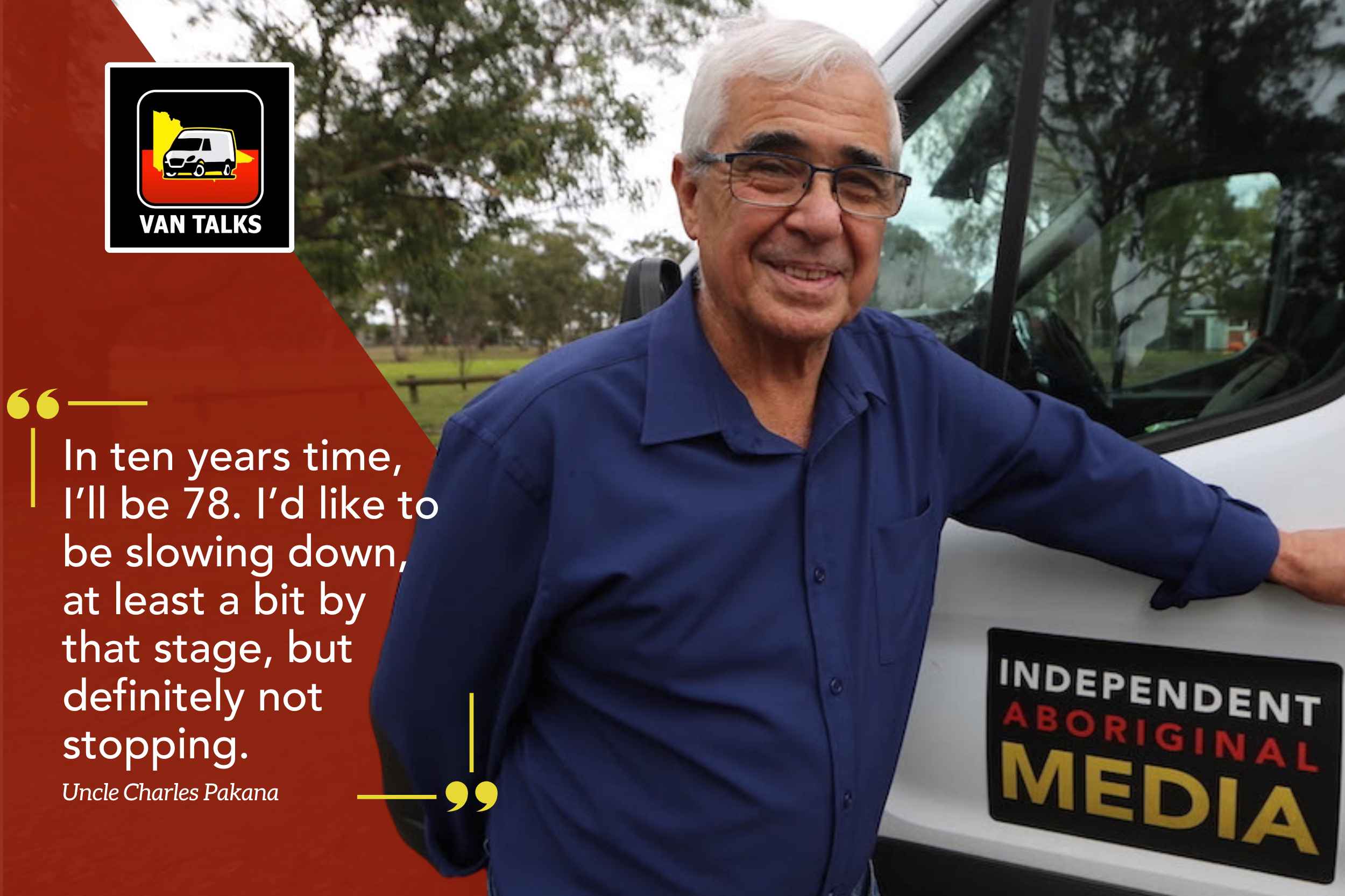
In a special episode of the VAN Talks podcast, the tables were turned on veteran Indigenous affairs journalist Charles Pakana.
Normally holding the microphone, Charles was interviewed by his daughter and trainee journalist, Karina Wells, in a deeply personal reflection spanning family history, cultural reclamation, and the future of First Nations media.
Born Keir Wells, Charles changed his name to help ground himself in his identity as an Aboriginal man. Growing up without his culture due to his father’s trauma in Tasmania, a move to Victoria nearly 20 years ago proved life-changing, leading to deep mentorships with prominent community Elders.
Reflecting on his path to grounding himself on Country, Charles emphasised the profound necessity of humility when listening to knowledge holders. “The recognition of the fact that you’ve got to stop. You’ve got to shut up. And you’ve got to listen, and then ask questions… there’s no room for arrogance,” Charles said.
Quickly approaching its 200th episode, the VAN Talks podcast has grown from a 40-episode limited series into an independent platform driven by four clear pillars: Treaty, Truth-telling, Reconciliation, and Self-determination. For Charles, these elements represent an essential foundation for community progress and long-term societal cohesion.
“Treaty… at its very core, from my perspective, is about promoting our presence, promoting the fact that we as Aboriginal people exist here, that we have a right to be here, that we have a legacy here,” Charles stated.
Looking to the future, Charles outlined plans to transition Victorian Aboriginal News into a multi-platform media asset, including upcoming video projects over the next 18 months, with the ultimate goal of supporting the next wave of young community public interest journalists.
“My legacy is I’d just like to see this continue,” Charles concluded. “I’d like to see young Aboriginal journalists take up the gauntlet of public interest journalism focused on truth-telling within the Victorian Aboriginal communities.”
Karina Wells: Welcome to a special episode of VAN Talks. A podcast normally hosted by Uncle Charles Pakana. But today, I’m turning the tables and putting Uncle Charles in the interviewee seat. My name’s Karina Wells, and I’m very proud to be a third-generation Aboriginal journalist. Uncle Charles.
Charles Pakana: That’s me.
Karina: How are you feeling being on the other end of the microphone?
Charles: Oh, a little bit wary about this. I’m not too sure about the dynamics of it, but it’s interesting, and I’m proud to see you taking control of it.
Karina: Thank you. Okay. So I’m gonna kick it off with a pretty broad question that I want you to interpret any way you like.
Charles: Okay.
Karina: Who is Charles Pakana?
Charles: Oh, that’s it?
Karina: That’s it.
Charles: Very broad question. Well, Charles Pakana is actually born Keir Wells, as you know. And I’m very proudly your dad, Karina. I changed my name to Charles Pakana in line with my growing identity as an Aboriginal man and to help me ground myself as an Aboriginal man. But, essentially, I am a 68-year-old father who loves journalism and has been a journalist for oh, crikey, the best part of, I don’t know, 40-45 years in print and radio. And I’m a man who lives in his van, travels around Victoria, and tries to promote the positive stories and voices of Aboriginal Victoria on radio and podcasting. In essence, I see that’s who I am.
Karina: You came down to Victoria nearly 20 years ago now. It’s been a while.
Charles: It has. Great move.
Karina: Back then, you said you… you just needed to, you just felt this draw to Victoria. How has being in Victoria helped you with developing your identity?
Charles: Oh, Victoria was somewhere that I knew I always had to be ever since I was a little boy, and my mother and father would bring my brother and I down to Victoria for holidays to visit family down here. And ever since then, I just had this absolute yearning to live in Victoria.
And then very soon after I turned 50, I decided that look, now’s the time. I was facing a lot of personal problems, as you’re well aware, up in New South Wales. And it was just the decision made to pack up, and get down here and just see what happens. The move itself, how has it helped me? Wow, that would fill volumes, quite frankly, because, and I know we’ll talk about these in a while, but the opportunity to connect with Elders who’ve since become my mentors, and we’ll talk about them in a bit, to help me gain my identity, having been brought up not as an Aboriginal man due to my father’s trauma, having been born in Tasmania in 1918.
It’s just given me the opportunity to explore myself, to explore my Aboriginality, and to realise in life what is the most important thing for me personally. And for me personally, it is to act as a… a conduit for other Aboriginal people to share their stories and their truths. And I know we’ll talk more about that as well, but really, that’s what… that’s what it meant to me when I got down here, and to be given the opportunities to be on radio, to podcast, to meet and communicate and connect with all these amazing people that we’ll talk about in just a minute, it’s been life-changing.
Karina: You’re talking about your mentors.
Charles: Oh, yeah.
Karina: These are some really influential people in your life, aren’t they?
Charles: Amazing people.
Karina: And they’ve really helped you develop your culture, your identity.
Charles: Mm.
Karina: Who are they?
Charles: Oh, wow. So, there are so many of them. The people I consider to be my main mentors, I… I’ve got to start off with Aunty Jill Gallagher, a proud Gunditjmara woman, who I met, I think initially, round about 2017-2018 when she became the Victorian Treaty Advancement Commissioner. Uncle Bill Nicholson from the Wurundjeri Woi-wurrung, who’s just been so instrumental in my life and who was the first one to give me the title of Uncle, which was an incredibly emotional point in my life.
People like Uncle Andrew Jackomos, a Yorta Yorta man and Elder. Aunty Esme Bamblett from the Aboriginal Advancement League – absolutely critical in my life and my development, because all of these people have selflessly given of their time to help me understand who I am and what I need to do. And look, there are others as well, and I… I do need to mention them, but Uncle Talgium Edwards was just been such a support.
And I remember when I decided that I’d give all my… my goods and chattels away, move into a van, and just travel around Victoria and just pursue this ideal of promoting First Nations’ voices. I remember sitting down with Uncle Talgium one day, saying, “Look, Unc, this is the most ridiculous thing ever. What do you reckon?” And he just looked at me through his beautiful eyes and said, “Bunjil will provide for you.” And by God, the man was right.
Karina: Yeah, he was, wasn’t he?
Charles: Yeah. And there’s so many others as well.
Karina: Oh, there really are.
Charles: Yeah, I’ve been very, very fortunate. But what I found is that these Elders are always happy to give their time. But as someone wanting to learn, whether it’s a young person or an older person seeking to identify and pursue their culture, you’ve got to get off your bum and actually speak to them and say, “Here’s my situation. I’d really like the opportunity to come and talk with you at times.”
Frankly, Karina, I see so many young First Nations people and others who discover their Aboriginality, or they move into the area, and they think that they have some right that the Elders will come to them. And that’s simply not the case, because most of these Elders are tight for time. They’re being pulled in all sorts of directions. I mean, you look at Uncle Bill, for example, he is all over the place. He is just being dragged from one place to another. His expertise is always being sought. You’ve got to be able to just find your time. You’ve got to go to them and explain to them. That’s an important thing, and it is a humbling experience, because, you know, some of these people are younger than I am, but their knowledge is what sets them apart.
Karina: That sort of learning of culture—
Charles: Yeah.
Karina: —has really benefited you, hasn’t it?
Charles: Oh, in so many ways. As I said, it’s… it’s a humbling experience, and I think to sit there and realise you know nothing.
Karina: Mm.
Charles: Absolutely nothing. Yet you want to make a difference in this space. The recognition of the fact that you’ve got to stop. You’ve got to shut up. And you’ve got to listen, and then ask questions. That’s a really important life skill, I don’t care who and what you are. So, that for me, since I’ve moved down to Melbourne and I’ve pursued my cultural identity, has been one of the massive changes in my life, because there’s no room for arrogance.
Karina: No.
Charles: There’s no room for you being the centre of the universe. It is just you listen, and you learn, and you realize and you recognise that you’re never going to stop learning.
Karina: That’s a very difficult thing for… almost everybody, isn’t it?
Charles: You really wanted to say it’s a very difficult thing for me, and yeah, it was.
[Both laughing]
Karina: But it is, it’s difficult for everybody, because we all sort of have that little bit of… of ego that we feel like we do know things. And to just have to sit down and pursue the mentorship, it is, it’s a very humbling thing, I think.
Charles: It is, and I think probably it’s the initial stages of learning to do that have benefited me enormously in my work as a journalist and a broadcast journalist, because my work is all about sitting down, asking some questions, and then listening to the truths. And these can be truths from young people, from, you know, our new young leaders at Gunaikurnai—
Karina: Yes.
Charles: —young people from right across Victoria, and our Elders out there. It’s just that experience and that preparedness to sit down, as I said, shut up, and listen. That’s a critical life skill.
Karina: In doing that, you’ve gotten started in podcasting.
Charles: Yeah, that was never really meant to happen.
Karina: How did it happen? What happened?
Charles: So, it’s an interesting story. It really started with radio. Now, round about, I think, 10 years ago, when I was working as the First Nations lead, or [what] they [now] call the Aboriginal Liaison Officer, at a local city council here in Naarm, in Melbourne. And I visited the offices of 3KND for the very first time. At this stage, 3KND was at Mary Street in Preston. And there was an amazing fellow who was so instrumental in First Nations’ radio by the name of Uncle Jim Remedio, the late Uncle Jim.
And he was sitting in the seat for about a year, and I met him, and after about 2 minutes, he said, “Oh, I love your voice. How about you come on radio?” And I thought about it for a second, I said, “Look, I’m prepared to do it, but don’t expect me to do a music program. What I want to do is I want to get back into my journalism, and I want to do First Nations’ current affairs.” So that happened there, and that was actually the birth of VAN [Victorian Aboriginal News], but it was Connection Matters Radio back then. And this was about 10 years ago, I think.
Karina: That’s right, yeah. You said you wanted to get back into your journalism, your roots. Your background is definitely not in radio; it’s in the written media, in case studies.
Charles: Print journalism.
Karina: Print journalism.
Charles: Print journalism. So it started in the oh, crikeys, I think round about 19… 1980-1981, something like that, when I was just about to leave the Army after about 9 years there, I was just on the cusp of leaving. And I got really excited about this burgeoning information technology, personal computer age, because the IBM PC was about to be announced. And I started writing for local newspapers and trade magazines about computers and technology and programming languages and things like that. And that got me into print journalism.
Journalism is not something I ever, ever wanted to do. You know, my father, your grandfather, was the industrial correspondent at the Sydney Morning Herald, and I had no intention of following in his footsteps. But it just happened. And then I started up, after a while, my own company, Australian Corporate Writing, where we worked for IT companies such as Microsoft, and Epson, and Dell and IBM, and wrote their Australian case studies. And all during that time, I still did a bit of just freelance journalism. So I’ve always been writing.
But, yeah, writing was always the way, but I just happened to find that doing radio and doing podcasting, it gives me the opportunity, and I’ll go back to what I said before, to sit there, ask some questions, and let people deliver their own stories and their own truths without being edited and cut back in any way. People get the opportunity to tell their stories, and for the audience to hear those stories and those truths. And that, for me, is a great medium.
Karina: Well, that brings me perfectly to my next question, which is the four pillars upon which Victorian Aboriginal News pursues. And that is Treaty, Truth-telling, Reconciliation, and Self-determination.
Charles: Mm.
Karina: You work in this area, and these are probably the four most important things. What do these terms mean to you personally?
Charles: I just want to start with Treaty and Truth-telling first, because for me, they are the most important when it comes to culture, when it comes to identity, is that Treaty and Truth-telling. Treaty, when it really started happening big time here in Victoria in 2016, when the government went to the mob and said, “What do you want? Do you want recognition in our Constitution, or do you want Treaty?” And the overwhelming response was, “We want Treaty.”
And that process, starting off with the Interim Treaty Working Group, then with the Victorian Treaty Advancement Commission, which, of course, as I mentioned before, with Aunty Jill Gallagher, then into the First Peoples’ Assembly of Victoria, and now we’re in our third iteration of that, for goodness sake.
What I’ve seen in that is that the Treaty itself, the Treaty process, regardless of whether you approve of everything that’s going into it or not, and not everybody does and that’s fine, but at its very core, from my perspective, it is about promoting our presence, promoting the fact that we as Aboriginal people exist here, that we have a right to be here, that we have a legacy here, that we have so much to deliver to the rest of Victoria and to the rest of Australia, and importantly, there is a, you know, 55,000 to 65,000-year unbroken chain of connection to the land.
I mean, this is something that no culture, no society, should ever turn its back on, and it must be supported. And as someone who’s gone through the… I think the agony, almost, of trying to identify and find culture, I see Treaty as being something that will make that easier for you and future generations. And as was said all the way along, that there cannot be Treaty without Truth-telling. And I’ve said this time and time again in interviews and in various other platforms, how can we negotiate a Treaty if we don’t know why we’re negotiating a Treaty? And that’s where Truth-telling comes into it. So the two are inextricably combined and connected.
With Reconciliation, I see that as this is a coming together of everybody, walking side by side, shoulder to shoulder, as is said in that very last line of the Uluru Statement from the Heart, you know, “walking together in a movement of Australian people for a better future.” That’s what Reconciliation’s about to me. And that’s not a racial thing, that’s not a divisive thing, that’s a social cohesion thing. And I think that’s amazing.
Karina: Yeah.
Charles: And Self-determination, I happen to be a great supporter of the United Nations Declaration on the Rights of Indigenous Peoples, which gives First Nations people right across the world the right to Self-determination, to political independence, to economic independence. And a lot of these things are actually directly addressing so many of the issues that are brought up in the Closing the Gap reports. So these are just so critically important.
Karina: You’ve done some pretty memorable interviews over the years.
Charles: Oh, yeah.
Karina: What are some of the ones that really stand out in your memory?
Charles: I’ve been so fortunate to interview some of the most exciting people. The first one that or the first ones that come to mind is actually a collection of interviews that I’ve done over the years with Aunty Jill Gallagher during her time as the Victorian Treaty Advancement Commissioner, then as the CEO of VACCHO, because of course, she took a break during her time in that role to take on the Commissioner role. But that was always, for me, so important.
Another one was with Uncle Bill Nicholson, where we sat down, and I just wanted to unpack, so what is a Welcome to Country? And that was a phenomenally impactful interview for me. And done as a podcast, it’s actually one of the highest hit episodes that we’ve ever produced, because of course everyone says, “Oh, we don’t want to be welcomed to our own country.” I mean, just sit down and listen to Uncle Bill, for goodness sake, and understand you’re not being welcomed to your own country. This is what it’s about. And that was a learning experience for me.
Thomas Mayo, when I really started the podcasting in earnest and started this particular series of podcasts, and it was only meant to be 40 episodes, and we’re now closing in on episode 200. The very first episode was on the 28th of January 2023, when I decided, let’s do something about the referendum and let’s present these interviews. And I reached out to my mate Thomas Mayo and said, “Brother, would you, you know, take a risk and be interviewed on this podcast, which doesn’t even exist right now?” And Thomas just took the time to talk about the Uluru Statement from the Heart and to talk about the importance of a Voice in parliament. That was an amazing interview.
But there are so many others, Karina. Sitting down with Uncle Dave Wandin at Coranderrk and talking about the history of Coranderrk and the future of Coranderrk. Every single interview I’ve done, I may not be passionate about the subject, but the fact that we get responses on every single interview, people saying, “This has meant so much to me,” they’re all just as important as each other.
Karina: They really are. Victorian Aboriginal News as a whole, but specifically VAN Talks, has really had such a… a big impact and such a growing impact in community. Was there a point that you remember thinking, wow, this is really becoming something? Because, like you said a moment ago, it was only meant to be 40 episodes.
Charles: Yeah.
Karina: It wasn’t meant to be like this.
Charles: No, there wasn’t really. And I still, I’m not being self-deprecating here, but I still don’t see it as a critically important thing. I enjoy what I’m doing. I think what I’m doing is of value to people. But I’m yet to be 100% convinced that it’s what it should be. So I’m not being modest. I just think you’re being a bit too generous.
Karina: Those aren’t even really my words. These are things we hear on a daily basis out in community, so—
Charles: Oh, people being nice to me, that’s nice. That’s nice.
Karina: But, like you said, we’re reaching up to the 200 episode mark as we’re recording this, and that’s pretty impressive in itself.
Charles: Wild.
Karina: It’s wild. Where we’ve come from is impressive, but where do you think it’s going? Because like you said, it’s not where you want it yet. Walk me through where you see it going.
Charles: Wow. Okay. So in 10 years’ time, let’s look at that point first. I’ll be 78. I’d like to be slowing down.
[Both laughing]
Karina: Hopefully! Hopefully, yeah.
Charles: At least a bit by that stage, but definitely not stopping. I see there’s no stop to the podcast and to our partnership with community radio stations across Victoria carrying those. And as you know, we’re getting a growing number–
Karina: Yes!
Charles: –of community radio stations at Bendigo, at Ballarat, at Seymour, a couple of stations here, of course, our home, beautiful radio station, 3KND 1503 AM
Karina: Yes!
Charles: –here in Melbourne, in Naarm, is just so important. And Triple R, of course. But I’d like to see us really reaching further afield. More and more radio stations. As a matter of fact, what’s my goal when it comes to radio stations taking our content? is wherever there’s a community radio station in Victoria, I’d like them carrying at least a bit of our content and sharing the messages of First Nations communities. I recognise, also, that we have to go into video.
Karina: We do. We’ve got some exciting things coming up.
Charles: Yeah, well, dragging me kicking and screaming into that, but the realisation is that we do need to move with the times. So, there’ll be some exciting things happening over the next 18 months with regard to that. So that’ll be exciting. We’ll be going to complement our podcast with vidcasts. And a few other interesting projects as well.
But I’d like it to be that it’s not Charles Pakana. I… I would like to be very much in the background. I would like to see a new generation of First Nations journalists, public interest journalists, taking up the flag and continuing on the work and taking it in directions that they think it should be going, as long as it is, as far as I’m concerned, true to the real core of VAN, which is promoting and sharing the voices and the truths of First Nations Victoria. I’ve been asked so many times, oh, go further afield. No.
Karina: Mmm.
Charles: No, Victoria. I love Victoria. Victoria is the community that’s embraced me, that’s taught me, that’s given me the opportunities that I’ve had. But that’s essentially my not-so-comprehensive go-forward plan.
Karina: [laughing] But it’ll be very exciting to see where it does go, because—
Charles: Oh, yeah.
Karina: —the sky’s the limit, isn’t it?
Charles: The sky’s definitely the limit.
Karina: Well, just before we get to our last question, Victorian Aboriginal News, the acronym–
Charles: Unintentional.
Karina: –It’s not intentional, is it?
Charles: Unintentional, totally unintentional. So I [laughing] I actually moved into the van, my Ford Transit van, which has been my home for the past 5 and a half years, in 2020, I think, or late early 2021, can’t remember. And it wasn’t until later that I changed the name of my business to Victorian Aboriginal News. And I didn’t even recognize till probably about 12 months later, when, oh my god, yeah, I’m a van-lifer and the acronym is VAN! [Karina laughing] People recognised it before me, quite frankly. [Charles laughing].
Karina: I love that. I love that. All right, so, last question, and again, this is a pretty broad one, but I want you to answer honestly.
Charles: [laughing] Well, I’ve been answering honestly!
Karina: You have, but I don’t want you to be humble.
Charles: Oh, okay. All right.
Karina: Okay. What do you want your legacy to be?
Charles: I think I summed it up, Karina, in the previous response, and that is that; I’d like to see Victorian Aboriginal News continue. I’d like to see young Aboriginal journalists take up the gauntlet of public interest journalism focused on Truth-telling within the Victorian Aboriginal communities. That’s what I want, because there’s no shortage of stories.
And the… the stuff that we see out there, the language that’s coming back to life, the cultural practices that are coming back to life, I mean, that I think is just so important, these stories be[ing] told. And what that means for the secondary love that I have of Reconciliation, where people understand just what we as Aboriginal people are about, and what the amazing Traditional Owners are doing across this state. These are stories that need to be told. My legacy is I’d just like to see this continue. That’s all I want.
Karina: Oh, that’s beautiful. Well, Charles Pakana, thank you for coming on the podcast today.
Charles: It’s absolutely my pleasure, and I look forward to being on the other side of the microphone next episode.
For Radio Play:
1 - Click the Download Audio button
2 - The audio file will commence automatic play in your browser
3 - Confirm this is the file you want to use in your program
4 - Once confirmed, click the vertical elipses (3 dots) and select download
2 Comments
CONTACT US VIA SMS
Get in contact with us via our dedicated SMS line:
0493 222 836
26 October 2026
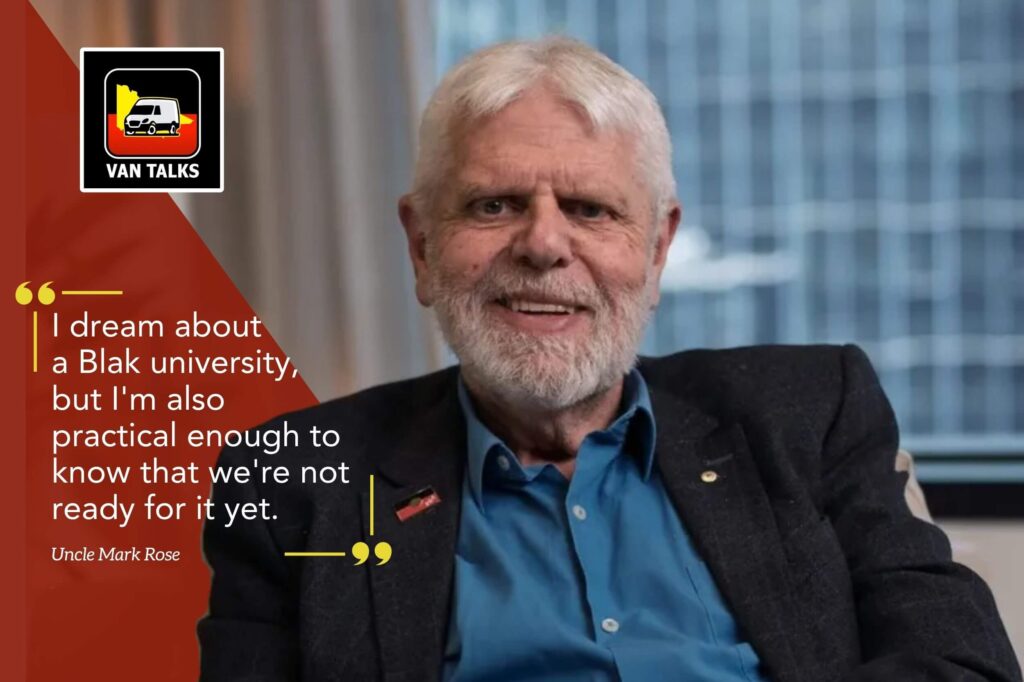
Leading the push to embed Indigenous knowledge systems in Australia’s tertiary education system
21 October 2026
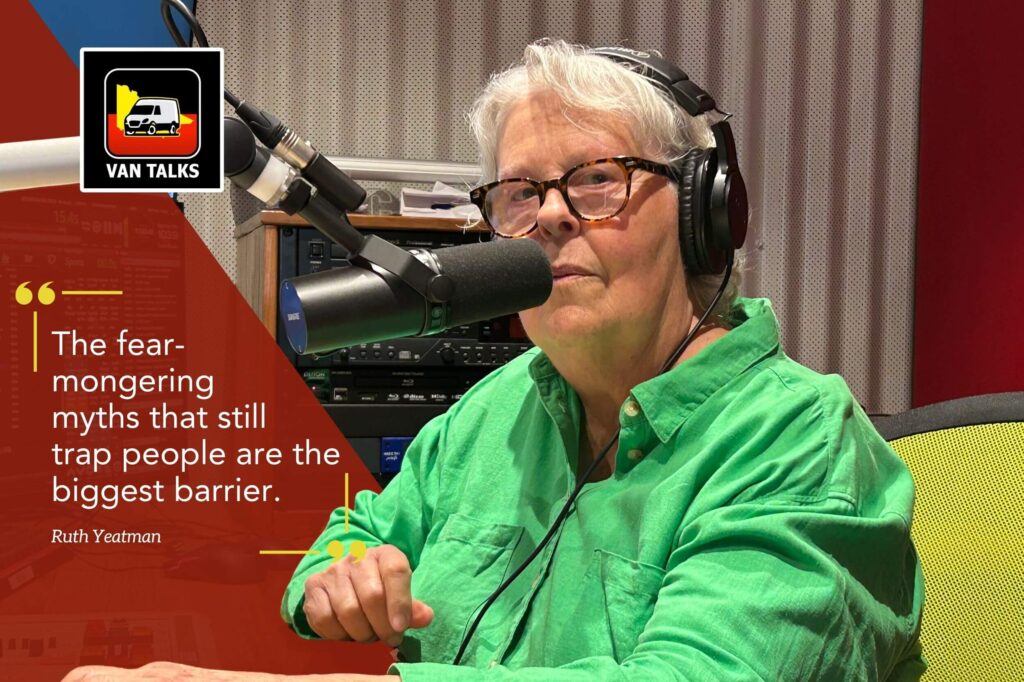
Reconciliation in Seymour – one of Victoria’s highest recorded “No” vote regions
19 October 2026
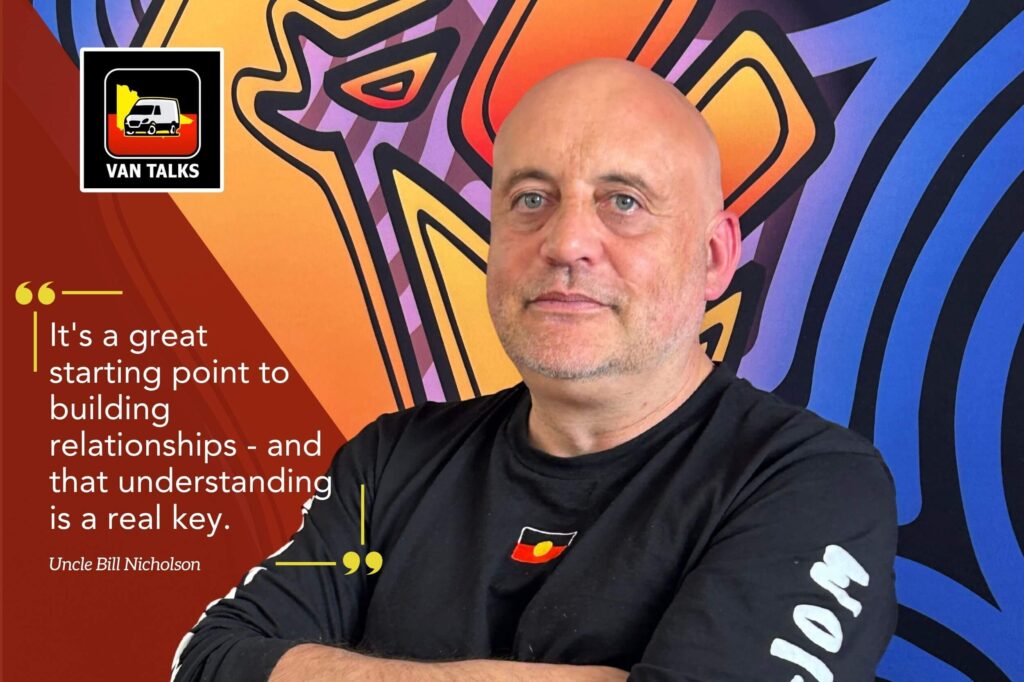
Understanding the use – and over use – of the Acknowledgement of Country
15 October 2026
It’s time Australia recognised a shared history of often brutal “settlement” and expansion
12 October 2026
Loved listening to this dialogue, especially the tone. Seemed to demonstrate the aspiration for the future of VAN, and give shape to the present. Like a yummy lasagne.
And I’m grateful that the interview answered questions I don’t ask.
Hi Sue! Thanks for your comment. It was fun getting to interview Dad. I’m glad it answered some questions for you. I’m curious though, what questions did you have? It’s always helpful for us to know.