
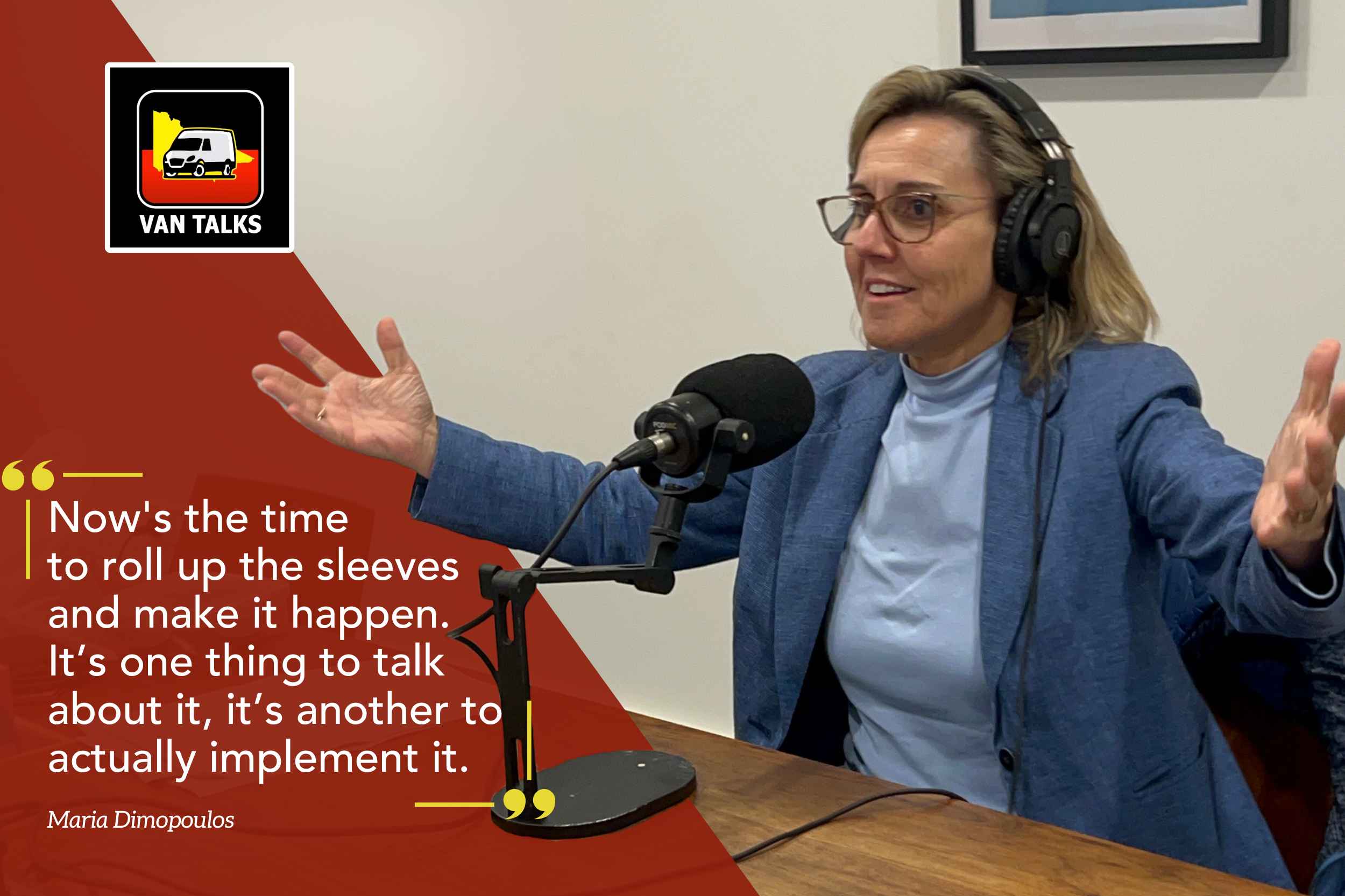
CEO of Settlement Council of Australia says, “It’s time to roll up the sleeves and make it happen.”
Settlement Council of Australia CEO Maria Dimopoulos addresses a profound, 25-year oversight: the total absence of dialogue regarding what "settlement" truly means in the context of First Nations dispossession.
Posted by: Karina Wells
Published: 18 June 2026
The Settlement Council of Australia (SCOA) has launched a groundbreaking Reconciliation Action Plan (RAP) that directly confronts the complex, intersecting truths of multicultural settlement on unceded First Nations lands.
Led by CEO Maria Dimopoulos, the peak body representing 180 member organisations across the country is challenging the long-held assumption that reconciliation is strictly a conversation between Anglo-Australians and First Peoples.
Instead, the initiative firmly positions multicultural, migrant, and refugee communities as active participants in truth-telling, systemic accountability, and deep solidarity with Traditional Owners.
For many newly arrived migrants and humanitarian entrants, settlement represents safety, hope, and a vital chance to rebuild lives after profound trauma. However, Maria stresses that this newfound hope exists simultaneously alongside the painful reality of historical and ongoing Aboriginal dispossession.
“We think it’s possible to carry both truths, like to reject that sort of binary positioning. But it does mean that we’ve got to sit with truth, and we’ve got to sit with discomfort,” Maria shared, identifying this dialogue as the critical, unfinished business of multicultural Australia.
To turn this framework into real-world practice, SCOA has established a milestone memorandum of understanding with Reconciliation Victoria. This partnership aims to equip a national workforce of over 10,000 sector staff with accurate historical knowledge, actively dismantling the systemic racism and political disinformation that frequently targets Indigenous communities.
While acknowledging patches of resistance, Maria highlighted the powerful allyship emerging from refugee groups that understand the brutal impacts of colonisation. She cautions, though, that newcomers must always respect the unique, foundational positioning of First Australians.
Looking forward, SCOA is embarking on an ambitious national roadshow led by board members across urban and regional sectors in every state and territory.
The movement seeks a 100% commitment from all member organisations to implement their own reconciliation pathways within the next 12 months.
By fostering localised, grassroots dialogue grounded in trust and mutual accountability, the sector is actively refusing to allow the post-referendum silence to take hold, building a powerful multicultural movement dedicated to walking alongside First Peoples.
Charles Pakana: In a recent interview on this program, I spoke with Tamil refugee and reconciliation activist, Shankar Kasynathan, about reconciliation in the multicultural space. Today, with so many listeners wanting to hear more about this, we continue along that path and speak with one of the foremost leaders in this space, the CEO of the Settlement Council of Australia, or SCOA, as it’s more colloquially known, Maria Dimopoulos. Maria, thanks for joining me today on the program.
Maria Dimopoulos: Thank you. Appreciate it.
Charles: Maria, your organisation recently announced, to quite a deal of fanfare, I might add, its Reconciliation Action Plan. And I noticed that within that RAP, settlement, the term itself carries contrasting truths; safety and hope for migrants and refugees, and secondly, displacement and colonisation of First Nations. So, as the CEO of this organisation, which I believe embodies what, 120 separate organisations?
Maria: 180.
Charles: 180. How does this impact on the organisation you lead?
Maria: It fundamentally changes our purpose. I have been in the position now for 12 months, and it was pretty extraordinary coming into an organisation that is essentially about providing settlement services to newly arrived migrants. 25 years of existence, and absolutely no real dialogue about what that concept of settlement might mean in the context of dispossession of First Peoples in this country.
As you pointed out in your opening statement, settlement for newly arrived communities, often refugee and humanitarian entrants, conveys hope, the opportunity to rebuild lives after trauma, after war. What does it mean, though, when you settle on lands that, essentially, have never had, or been, the subject of a treaty negotiation, that are stolen?
What does that mean for those of us that are newly arrived, migrants, refugees to this country? And that was the question we wanted to put to our settlement sector. These truths, on the one hand, where settlement conveys that hope; on the other, it conveys a history of pain and dispossession. We think it’s possible to carry both truths, like to reject that sort of binary positioning, but it does mean that we’ve got to sit with truth, and we’ve got to sit with discomfort. And really, to address what we keep saying is the unfinished business of multicultural Australia.
Charles: But how does that look like in real-world terms? It’s all well and good to put that into a Reconciliation Action Plan, but with your 180 organisations and their… goodness knows how many individual members, how do you actually bring that to at least a degree of reality?
Maria: I think building their understanding and awareness of the history of this country. Being able to equip our staff across the nation with information that essentially tells them that this lie that Captain Cook discovered, Australia, or the idea that there is no sort of history prior to this, that the oldest living culture on this earth has so much to give us in terms of wisdom, insight and knowledge. If we can equip our staff across the country with this knowledge, and that can then be translated to those that are newly arrived, we feel like we’ve got better opportunities for social cohesion, for intercultural dialogue. I mean, these are the things that we’re trying to build in. I think, from a systems perspective as well, really understanding the policies that we may be inadvertently embracing as part of that settlement journey, without questioning or interrogating what their implications might mean for First Peoples.
So I think they’re the sorts of things that we’re trying to convey with the Reconciliation Action Plan. But essentially, to say that historically, this idea that reconciliation is something between Anglo Australians and First Peoples, as if somehow multicultural Australians are sitting on the margin and have no accountability here, I think that’s really gotta be addressed. So we’re introducing that part of the process.
Charles: I’m interested to hear about the reactions you would have had from some of your members. As you mentioned, this is an organisation, SCOA, that’s been going on for decades with nothing in this particular area. What sort of response did you get from a lot of the members when you said, hey, you know, I come from a background in multicultural reconciliation, and you and I have spoken before about the Roads to Reconciliation program that you and Shankar conducted quite a while ago. But when it comes to this, 180 members, what was the reaction, the general reaction?
Maria: The first thing we did was to actually find out, of those 180 members, how many had actually engaged in even conversations about having a Reconciliation Action Plan. And… 8. Eight of the 180 responded. Now, those had been on a fairly comprehensive journey. They tended to be the larger organisations, Settlement Services International, for example. I think that the Voice campaign had necessitated a greater opportunity to at least look at ways in which we could build awareness and understanding.
But the messaging often hit a lot of misinformation or disinformation, and we’ve got a lot of work to do to address, if you like, some of that disinformation that was coming through during the Voice campaign, where many migrant and refugee communities were actually not interrogating the truth of what they were being told. Yeah, you know, you’re going to lose your backyard. First Peoples are going to take your rights away. It was that kind of disinformation that we felt we really needed to address.
On the whole, while the sector has embraced our journey towards reconciliation, there is resistance, and it can range from “this isn’t our business, we didn’t create the problem.” Right through to, “We need to actually embrace this issue.” Newly arrived and often refugee communities that have shared experiences of dispossession and colonisation would often be the ones to provoke the discussion. “Who are the local custodians?” They would ask. Because they had a history, they were familiar with what the brutal impact of colonisation could look like. So you get the full spectrum of views.
It’s not going to be an easy process, but I feel really inspired by the fact that on the whole, the introduction of a commitment, a memorandum of understanding between us as a peak body, representing what in essence is a workforce of about 10,000 out there, 180 organisations, 10,000 staff, we feel that that memorandum of understanding, now’s the time to roll up the sleeves and make it happen. It’s one thing to kind of talk about it; it’s another to actually implement it.
Charles: But an MoU between your organisation and…?
Maria: Reconciliation Victoria. So when we went along and said, this is what we want to do, we actually do want to address the erasure, the silencing that has happened around this relationship between First Peoples and newcomers. We want to address that. Karen Mundine, the CEO of Reconciliation Australia, was so responsive to that because I think she’s recognised that there’s a missed opportunity here, that if we only ever see reconciliation as being between, as I said, the majority cultural group, the white Anglo Australians and First Peoples, what do we do with the 48% of the population that has at least one parent born overseas? That is a missed opportunity, and at the same time, it gives us hope for moving towards a future where genuine intercultural dialogue, but one based on truth, one based on recognised accountability, can take us forward as a nation.
Charles: What impact do you honestly believe that immigrants and migrants, refugees, can have on the reconciliation process, given also that there’s a resurgence of this “reconciliation is dead” mantra, which is sadly coming across all over the place right now. What’s the role of your members and the immigrants themselves?
Maria: To inform themselves. To equip themselves with the truth. To become more aware of what those stories look like. I think the wisdom and knowledge that so many First Peoples around the country have generated means that there is no excuse for saying, “I don’t know.” So I think, first and foremost, a commitment to informing oneself, and informing the sector around those truths and realities. The other, I think, is directly stand up. Stand up and respond to what we know, sadly, is increasing racism that’s being directed to First Peoples, to seeing it as your business to address the kinds of lies that get generated out there and to find out, find out who the local custodians of your area are, get to know who those organisations are, reach out and work with those organisations, as I said, towards a shared future. I think sometimes, though, that there is a danger that I sometimes hear being articulated by some of our refugee organisations that by virtue of those shared experiences, if you like, of colonisation and its impact, that that somehow means that they understand exactly what First Peoples are going through. I think the unique context of this continent and the fact that we have the oldest living cultures on earth, on the planet, means that there is a unique positioning of First Peoples in this country. And that means that we can’t slip into the false, I think, argument that, “We know how you feel.” You actually don’t. You don’t know how First Peoples feel. And I think that’s the first part of the conversation that we’ve been having lately, is let’s really appreciate that unique positioning of First Australians.
Charles: What would you say though to critics of this particular initiative who may be saying, “look, it’s all and good to do that, but the reality is that so many of our members, that so many members of our community have come out from war torn areas, they are legitimate refugees, they are carrying their own trauma, which may well take generations from which to recover. We need to focus on that first and foremost. What’s your comment there?
Maria: I don’t think they’re mutually exclusive concepts. This is the thing that they get set up as this false binary between groups, essentially divisive in my view, where one truth is somehow erases the other. What we’re doing with this RAP is to say, “We understand and appreciate that you want to celebrate settlement as a process that has given you hope for your family after you’ve fled [a] war-torn environment where trauma has characterised that experience prior to arrival. At the same time, though, surely that should give you an insight, an understanding that says, ‘Now you demonstrate compassion for those who are- have lived in effect on their own land and been essentially erased from white history.’”
Charles: You’re embarking upon a roadshow, and we’ll talk about that in a couple of minutes, but first of all, just before we get there, I want to have an understanding of some of the key challenges you see before you in this particular initiative. I know you to be a very strategic person. You think things through, you talk with your colleagues and your staff. What are some of the key challenges, political, social and otherwise, that you see before you to achieve the goals that you’ve set for yourself and the organisation and your member organisations?
Maria: Having campaigned during the Voice, I think I’ve recognised that there are some powerful interests that seek to undermine our commitment to these issues.
Charles: [Laughing] You’ve been very diplomatic, Maria, very diplomatic!
Maria: I’m being very diplomatic. There are some dangerous discourses that are out there that essentially are being supported, resourced, funded by interests that essentially want to undermine the rights of First Peoples in this country. And I think the rights of, you know, that group mean that if you erode those, it’s a slippery slope, essentially. Rights, in my view, are indivisible. You can’t pick and choose which rights you want to support. Look, the biggest challenge, I think, is the disinformation that is generated out there. The direct characterising of the rights of First Peoples will undermine your rights. The cost of living argument, essentially all designed to deflect from what the real solutions are. And they are essentially about addressing the powerful interests that are shifting our attention away from the need to solve inequalities in our society and to focus on, essentially, scapegoating particular groups of people. Look, refugees, asylum seekers, they get this stuff.
Charles: They’re not strangers to this.
Maria: They’re not strangers at all to these arguments.
Charles: The roadshow that you mentioned during the launch of the RAP just a couple of weeks ago, huge, ambitious undertaking and I assume a lot of what we’ve been speaking about today will be echoed during that roadshow. Give us a little bit of a sketch of what that roadshow is going to look like.
Maria: The roadshow is very exciting, can I say, because it does represent a commitment to ensuring that by the end of 12 months, every single one of our member organisations has at least put their hand up and said, we are going to commit to implementing a reconciliation action plan era in our organisation..
Charles: That’s hellishly ambitious, Maria.
Maria: It’s very ambitious. But I happen to believe that these things are possible. I think that each state and territory. So our board members have put their hand up as lead organisations in each of the states and territories and said we will host conversations in our respective states, urban areas, regional areas. We will get our local communities talking about, “What is it that stops you from wanting to engage with First Peoples?” How can we develop meaningful relationships, ones that are based on mutual accountability, on trust, on truth-telling? How do we generate these conversations in a way that really does mean that when you are on the journey towards citizenship, that first and foremost, you understand that the concept of citizenship in this country, for at least while a treaty nationally, is missing, that that is based on certain principles of dispossession. We need to really understand and appreciate that. The conversations I’m particularly excited about, I can already see them starting; it is generating a momentum. So for me, the roadshow is a movement. It’s exciting. I’ve been pretty disappointed post-referendum that there’s been this sort of lacklustre, non-committed sort of, you know, response to it, this overwhelming, deafening silence. What now? Well, what we’re trying to do is create opportunities for what communities can do. We’re getting that feedback, “I contributed to the Voice referendum.” We know 6 million people voted “yes”. How do we continue to build on that momentum, not lose hope, not lose sight? Because really, we can’t afford to.
Charles: Maria, I’m really interested to hear from you, and we’ll just diverge a little bit here. We’re seeing more and more, distressingly, quite frankly, from my perspective, the call that reconciliation is dead. And we saw that immediately post the referendum in 2023. But it seems to be gaining even greater momentum right now. What are your personal thoughts on that?
Maria: First and foremost, I think it’s important that if those concepts are being contested by First Peoples themselves, then we have an obligation to listen to why. So I totally appreciate and understand the full spectrum of approaches and perspectives because essentially they’re a response to, I think, history repeatedly denying the truths of First Peoples in this country.
However, I also happen to believe that reconciliation is not something that First Peoples have to do. The Uluru Statement from the Heart. My goodness, what a generous invitation.
Charles: Yeah.
Maria: “Walk with us.” How painful is it, that this nation chose to reject such a dignified, sophisticated gesture of “walk with us”? How horrifying that was for so many of us who fought very, very strongly, I’d argue, for what could have been.
I think that for us now, for those of us who are non-indigenous, particularly those of us in multiple multicultural Australia, who I would expect, understand what racism feels like, who can appreciate the way in which that machinery of racism operates, I would hope that we see reconciliation as something that rests with us. That’s not about generating guilt; it’s not about making people feel bad. It’s actually about saying, “this is a vision, a vision of a genuinely reconciled future where we can actually walk together.” But that is conditional and is conditional on taking some responsibility because we continue to benefit from the ongoing dispossession of unceded lands.
Charles: Maria Dimopoulos, CEO of the Settlement Council of Australia. Thank you for your time and your thoughts.
Maria: Charles, it’s always a pleasure because you, my friend, inspire.
For Radio Play:
1 - Click the Download Audio button
2 - The audio file will commence automatic play in your browser
3 - Confirm this is the file you want to use in your program
4 - Once confirmed, click the vertical elipses (3 dots) and select download
CONTACT US VIA SMS
Get in contact with us via our dedicated SMS line:
0493 222 836
5 October 2026
The revival of cultural burning practices to remediate Country and help mitigate disasters
1 October 2026
Implementing First Nations knowledge to heal country
28 September 2026
It’s time for Australia to acknowledge historic atrocities
24 September 2026
First Nations star knowledge predates Western astrophysics by millennia
21 September 2026
0 Comments