
The role of Blak media in the “fight for the soul of this country”
This is an episode not to be missed. Yorta Yorta man and award-winning journalist, Daniel James, gives a one-on-one interview with VAN Talks to discuss the critical role of First Nations media. Discussing current threats to community and culture, and pleading for people to just be nicer to one another.
Posted by: Karina Wells
Published: 25 June 2026
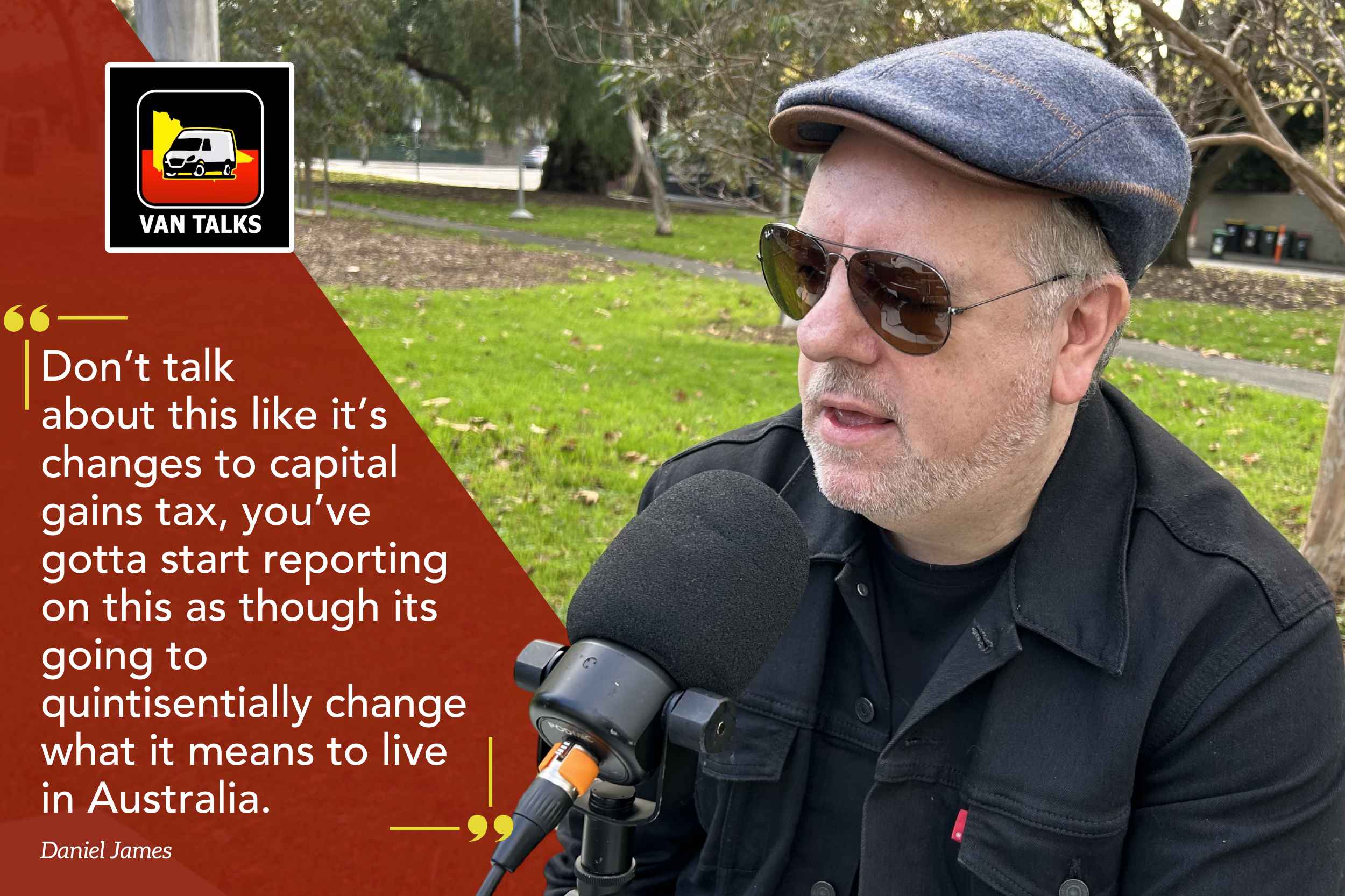
The primary responsibility of First Nations media is to elevate unique perspectives on broader society and inspire future generations. Speaking in North Melbourne, Yorta Yorta man, broadcaster, and award-winning journalist Daniel James highlighted why community-led media remains essential.
Daniel, who serves as the co-host of The Mission on Triple R and co-host of 7am, believes Blak journalism counteracts a highly concentrated media market where corporate and vested interests often dictate the news.
New technology has empowered storytellers to bypass mainstream newsrooms and form direct relationships with audiences.
Reflecting on his role as the author and creative lead for the Yoorrook Justice Commission’s historic Truth be Told report, Daniel opened up about the massive cultural and personal burden of documenting thousands of pages of colonial trauma and hidden massacres.
“It was massively burdensome,” he said. “That was a really difficult thing to do. Bringing that story to life in an evocative way so people are shocked by it but don’t want to turn away from it either, is probably the most challenging thing I’ve done in my professional life so far.”
Beyond truth-telling, Daniel noted that Blak media shoulders the heavy mantle of championing vital front-line stories—such as the realities of domestic violence shelters—that are routinely ignored by the mainstream media.
With conservative circles posing severe threats to First Nations and multicultural broadcasters, Daniel urged independent media to cut through the noise and report on these political shifts as an urgent matter of survival.
Looking ahead, Daniel called on the broader Australian community to push back against a toxic political landscape.
“My call is for people to be kind, show some imagination, think of real solutions, and treat others as you would like to be treated yourself.”
Charles Pakana: As we continue our series of interviews with First Nations journalists, I’m joined today by Yorta Yorta man, broadcaster, and award-winning journalist, Daniel James. He’s really well-known as the host of The Mission on Melbourne’s Triple R radio and co-host of one of Australia’s leading daily news podcasts, 7am. Among his many credentials, he was the author and creative lead for the Yoorrook Justice Commission’s Truth be Told report, which serves as the Commission’s official public record that documents First Nations experiences since colonisation. Daniel, welcome to the program, brother.
Daniel James: Charles, it’s absolutely wonderful to be here.
Charles: Daniel, I’ve asked this first question numerous times of many leading blak journalists, and now it’s your turn. As we sit here in the park here in North Melbourne, so just be aware there may be ambient noise of trams going by, but what do you see as being the primary responsibility of blak media in Australia, and that’s in contrast to mainstream media?
Daniel: I think it serves two major purposes. First of all, it gives our perspective on a whole range of matters, not just issues that impact us, but issues that affect broader Australian society. We have a unique perspective on that, and I think there is blak excellence right across this country when it comes to journalism, blak journalism in this country at the moment. So, I see that as the primary reason, but the secondary, main reason I would add to that is to be visible and have young people look at the Australian media landscape and see people that are from similar backgrounds that they are and recognise that they could potentially go into what, at its best, is a very, very noble profession.
Charles: Mm. It’s interesting, you’ve been a journalist for quite a number—how many years have you been a journo for?
Daniel: Probably approaching nine years now. It… wasn’t a direct path. I don’t even know whether I… call myself a journalist. I—
Charles: Oh, let’s dive into this, okay. Well, let’s go off on a tangent. What would you call yourself then?
Daniel: I kind of call myself a writer and broadcaster.
Charles: Right.
Daniel: A journalist, at their most noble, from my perspective, is someone that has either come up through a cadetship or they’ve gone to university, or they’ve worked in newsrooms for several years.
I think that’s a—a positive thing, but I also think it’s a positive thing not to have gone through the normal channels as well.
Charles: Couldn’t agree more.
Daniel: And so I—I do journalism, absolutely, I do journalism.
Charles: Yeah.
Daniel: Do I call myself a journalist? I’m not sure.
Charles: But what role do you see for people now that we have this new technology, now that there’s still such a strength in community radio and, of course, podcasting?
Daniel: Well, Australia is famous, or infamous, for having one of the most concentrated media markets in—in the world.
Charles: Just a few companies holding it all.
Daniel: And what new technology has brought is the ability for a whole range of other voices to come through and speak about what’s happening in this country and around the world from their unique perspectives.
We don’t have to go through, for want of a better term, mainstream newsrooms, which may have a corporate interest, may have vested interests influencing their decision-making. There is now an ability for—for journalists and storytellers to have a direct relationship with their audience.
Charles: So what got you into, let’s say, The Mission to start with, on Triple R?
Daniel: 2018 was kind of a big year for me for a couple of reasons. I entered an essay competition called the Horne Prize, after Donald Horne.
Charles: Yeah.
Daniel: And I was fortunate enough to win that, and it was kind of like the first time I’ve ever had my writing validated. I’ve always enjoyed writing. I’ve always been considered by people that know me as, you know, a reasonable writer, but to have that validated on a really major essay competition, as it was at the time, was extremely validating. And then I started writing a little bit for IndigenousX, and I started writing a couple of articles on LinkedIn as well, and there was one I wrote on the changing of the federal seat of Batman—
Charles: Yes.
Daniel: —to—to Cooper.
Charles: Yeah.
Daniel: And I just went in and wrote an article on that, explained who William Cooper was and why it’s such a—a beautiful, sort of ironic thing that Batman’s name was changed to Cooper and this is why. And then someone at Triple R had read that article, and then they invited me in for an interview on one of their shows. And I did the interview, and then a couple of days later Dylan Bird, who was production manager at the time, called me and said, “Do you want to do a mic test?”
Charles: [Laughs]
Daniel: [Laughs] I go, “Sure, whatever that is.” So I went in and did the mic test, and then I started being offered the graveyard shift.
Charles: Oh, yeah.
Daniel: Which is a tremendous way to learn your craft, from 2:00 to 6:00 in the morning. You’re in charge, you’re in charge of the station. You can play and do and say whatever you want, and then they obviously listened to that. And then within a few months Bek Hornsby called me up and said, “We want to offer you your own show.”
Charles: And Bek Hornsby, for those of you who do not know, shame, shame, is the programming manager at Triple R.
Daniel: Your life is worse for not knowing her.
Charles: Absolutely an amazing woman who has done so much for Triple R and really as an advocate for community radio right across. So, Daniel, all of a sudden you found yourself a journalist, a reporter, an interviewer, a radio personality, should we say, which then led into 7am with Schwartz Media. Tell us how that fell in, because I’m really interested to interrogate you a little bit on some of the nuances of both these programs.
Daniel: So, the writing thing started to take off, and so I was published in The Guardian and The Age and The Sydney Morning Herald, and The Saturday Paper, and various other publications across the place. And so that started to raise the profile as well, and that happened at the same time that The Mission was starting to take off. And I think in the first year we won the Community Broadcasting Association award for best Indigenous program. And so my profile, without even sort of crafting it or wanting it to take shape, rose sort of through osmosis, really just by doing stuff.
And then eventually Ruby Jones, who’s the long-time host of the 7am podcast, she went on maternity leave and an opening came up for me to host during that, and to then be appointed formally for like two or three days a week, depending on whether I wanted to do it full-time or not.
The craft of podcasting and the craft of broadcasting are completely different.
Charles: [Laughs] Very much so.
Daniel: As you would know. Broadcasting is very conversational. If someone is waffling on, you kind of politely sort of jump in and either get them to get to the point or to change path to get to another point.
Charles: Can’t beat live-to-air.
Daniel: Yeah, it’s great! With podcasting, because it is recorded and it is edited, it actually is beneficial to sort of sit back and let the person waffle a little bit more, just in case there is something that they touch upon. You don’t want to necessarily disturb their train of thought because they might be working through the process to get to an answer, or the answer that would be best suited for the question you actually asked.
So, that’s a huge difference. Broadcasting is live, as you know, there is a tremendous amount of adrenaline that is actually coursing through your veins when you’re live on air. And so if you’re hosting a radio show and you’re not coming out sweating at the end of it–
Charles: You’ve done a good job.
Daniel: Yeah, exactly! Podcasting is about whittling down stories. So, we will interview someone, and we’ll interview them for like half an hour, and then we’ll whittle that story down to about a 15 to 16-minute podcast.
We tend not to do that when we interview politicians because we want to, first of all, keep them on their toes and make sure that we don’t get calls from media advisers [the] next morning saying, “Hey, why did you cut this question?” or “Why did you cut the answer to this question?”
Charles: Plus, you’ve got to give them enough rope.
Daniel: Yeah, exactly. So we let the political interviews just sort of run.
Charles: [Laughs] Yeah.
Daniel: But then with the podcasting we add audio. Sometimes we’ll add some effects. Sometimes we’ll add pauses just to make someone’s question land a bit harder.
Charles: Yeah.
Daniel: And it’s really a crafting of a story, it’s really storytelling. Broadcasting is broadcasting.
Charles: What about the opportunities that you found in The Mission and in 7am to champion some blak causes that have been close to your heart for so long?
Daniel: The Mission has been a godsend for that in particular. I think… incarceration rates, deaths in custody, but even trying to champion people that aren’t actually necessarily in the spotlights. I’ve always been very passionate about speaking to people, and particularly women, who are on the front line when it comes to domestic violence and women’s shelters, and domestic violence shelters. And I’ve seen some of the people I’ve interviewed during that time go on and become… Yoorrook Justice commissioners, like Sue-Anne Hunter, who has been on the front line with that sort of thing. And championing these stories that just don’t get told, because they’re just not in the mainstream media. They just don’t get heard.
Charles: Do you feel, though, that that’s, [sighs], we’ll use the term unfair, but an unfair load on your shoulders and the shoulders of other people who are carrying the mantle of blak media to give voice to those stories and give voice to those people who are carrying those stories and experiences?
Daniel: Yeah, I don’t think I’ve ever met anyone in blak media that considers themselves a victim.
Charles: Mm.
Daniel: But there is definitely a recognition outside of us, and amongst us, that, yeah, it can be a burden. It can be a very, very heavy burden. If you’re preparing for a—for a show like The Mission, which you co-host, spending a day delving into women’s shelters and why they are necessary, and hearing stories about men putting tracking devices on cars so they can go and find out where the women’s shelter is, and harassment of staff at some of the organisations looking after these women, circling the—the premises in their cars for hours and hours and hours. That’s heavy stuff, but then you realize that the person you’ve got to be speaking to, it’s nothing compared to what they go through.
So the challenge is always to keep perspective. But where it does become a bit of a grind is when you keep having to revisit the same issues over and over again because they are not getting better.
Charles: Well, let’s talk about revisiting issues. You, as the author of the Yoorrook report, you were really making it digestible for the rest of Australia to read about these traumas and these tragedies that have befallen First Nations people for so long, for goodness’ sake. How did that sit with you, and how did you deal with it? Because it couldn’t have been easy.
Daniel: Look, I—I won’t pretend it was easy. I won’t pretend it was easy. I had a good team around me that were supportive, and they would deal with my—my mood swings from time to time, [laughs] which is—and I apologize for that, but I kept myself in check pretty well.
But taking the thousands and thousands of pages of evidence, either given primarily to the Commission or done through desktop research through the work of other historians or first-hand accounts from colonists and—
Charles: Yeah.
Daniel: —and Aboriginal people, that was—that was massively burdensome. That was a really difficult thing to do. The brief that was given to me was—and if they had come to me like six months earlier it would have been a lot easier—but the brief to me was, “Okay, we don’t want this to be a typical royal commission report,” because that’s what it was. Yoorrook had the powers of a royal commission. “We don’t want this to be a typical royal commission report. We want this as something that people can pick up and read as though they’re being told a yarn about the history of colonisation in this place and its impacts on First Nations people.” So that was the brief.
And so taking all of that really, often harrowing testimony, those terrible, terrible stories about the massacres around the place, discovering massacre sites that I had previously been unaware of—I consider myself a pretty decent amateur historian—and finding out that there were massacre sites that, in this place that we call Victoria, that I didn’t previously know about, and then bringing that story to life in an evocative way so people are shocked by it but don’t want to turn away from it either, is probably the most challenging thing I’ve done in my professional life so far.
To delve into the injustices of this place and how we set up Aboriginal protection boards that were there to ostensibly stop us from dying out, and then they were eventually turned into instruments of trying to eradicate us through the Half-Caste Act, which is—is a terrible term, but that’s what it was colloquially known as, which was just a—an act that was designed to breed us out into the population because it was assumed that we were a dying race.
And reading the letters of mothers to mission managers who would want to get, you know, socks for their children and then the mission manager writing off to some bureaucrat at Spring Street saying, “Listen, uh, you know, this woman wants some socks, but I don’t think she needs socks. We’ve got plenty of socks.” Just wanting some basic provisions for their family, or to leave the mission to go and seek better climates because they were suffering from TB [Tuberculosis], all being red-lighted or green-lighted by, first of all, mission managers, but then by bureaucrats. That stuff is the stuff that sort of really sort of… infuriates me.
Charles: But how did you deal with it? Because it– it wore you down. We saw that [chuckles] when you launched the report.
Daniel: We did it over the course of six months.
Charles: Yeah.
Daniel: And part of that six months was a month for me deciding whether or not I wanted to do it, because the responsibility of writing it is obviously one of the most important things I’ll ever do.
Charles: Yeah.
Daniel: But also the reputational risk of messing it up [laughs]—
Charles: Not something to be sneezed at!
Daniel: —and—and the reputational risk not only professionally to you, more importantly, the reputational risk within your own community of all the people that have poured their hearts and souls into this project, and to not deliver it because for some reason, I don’t know whether it was going to be too difficult or whether I—I would bump into a bureaucracy at Yoorrook that would just make things extremely tiresome and—and slow.
The great thing about the whole thing was we—we put together this little team, and there was four of us. The Yoorrook Justice commissioners and the—the bureaucrats within the Justice Commission left us alone. And we didn’t have to jump through hoops. We didn’t have to go through a—a senior policy officer to a manager to a—a CEO. We had a direct line to the commissioners themselves.
Charles: Yeah.
Daniel: And so that was great. And that made things so much easier. It took a toll, I won’t lie. It, meant a lot of sleepless nights. It meant that, I was probably a little bit more agitated about the world than I would usually be, and that people around me may have noticed that and suffered as a result. But I think I kept myself in check pretty well. But what it has meant is that ever since that experience, [laughs] my tolerance for… uh… bullshit—
Charles: You can say that, that’s fine.
Daniel: —has, has really, really, really lowered.
Charles: If we’re talking about your tolerance for bullshit, let’s talk about a recent address at the National Press Club. And without mentioning names, there’s obvious threats from some elements of community and the political side of things to First Nations media.
Daniel: Yeah.
Charles: Now, it was made mention at that presentation at the National Press Club that one of the first actions, should that person become Prime Minister, would be to get rid of SBS. That’s a major First Nations and multicultural voice. Do you see other threats to First Nations media, and how do we address them?
Daniel: I think there’s a move across Australia at the moment, particularly, well, only really from conservative circles that would like to eradicate First Nations voices from public life. And the terrible thing about [The Voice to Parliament in] 2023, and we won’t go into that, was anyone that was kind of half switched on could see that if the result ended up the way that it did, and that the campaign was run the way that it was, that we would get to this point.
Charles: Yeah.
Daniel: And we are now at this point where we have the populist right that has risen through various vested interests, both here and abroad, means that we are basically in a fight for the soul of this country at the moment. We have a political… proxy, I would say, that is calling for us to become a monoculture. That was tried once, that was called colonialism, and it nearly worked—
Charles: [Laughs]
Daniel: —except for our resistance.
Charles: Yeah, exactly.
Daniel: So, it’s a huge threat to blak voices, but it’s also a huge opportunity. It’s actually a real opportunity for us to cut through the bullshit. There is so much talk in the commentariat around the—the technicalities of what Hanson and her like are trying to do. Because we’re the ones that are going to cop the brunt of it, and we’re the ones that have already copped the brunt of it, so no, you don’t talk about this like it’s changes to capital gains tax. You’ve got to start reporting on this as though it’s going to quintessentially change what it means to live in Australia.
Charles: Yeah.
Daniel: And that minority groups and refugees and immigrant groups, trans people—
Charles: Exactly.
Daniel: —they’re the ones, slash we’re the ones, that are going to cop the brunt of it. And so we need a press gallery that doesn’t treat this as some sort of academic exercise. Got to start reporting on it as a matter of urgency. Now, they don’t do that. So that’s why blak voices in the media are so important, and that’s why independent voices in the media are so important because from what I can see at the moment, Charles, they’re the only ones that are actually reporting on this in a way that reflects what is actually at stake right now.
Charles: Okay, that’s essentially a call to action to the politicians and to the political forces, and to the media itself in general, really. What then, as the final question, would be your call to action to the Australian community?
Daniel: [Sighs] I guess I—if I had a call for action, it would just be kinder. So much of the politics that we have at the moment is just, it’s just horrible. It’s just people being mean for—for meanness’ sake.
Charles: And the vote, of course, because it works as a vote-getter.
Daniel: Yeah, it does. The politics of grievance is something that is incredibly popular at the moment. But understand that that grievance, what comes with that grievance from a political perspective, there are no solutions. There are no real solutions being offered here. We can see that the political landscape is completely changing and that the two-party system is kind of on its way out.
Charles: Yeah.
Daniel: Well, organise and take advantage of that! We have the far right taking advantage of that at the moment. Why can’t we have a similar movement, not as extreme, come in and fill the void that is opening up in Australian politics at the moment? So, my call is for people to be kind, show some imagination, think of real solutions, and treat others as you would like to be treated yourself.
Charles: Daniel James, thanks for your time, brother.
Daniel: Thanks, Charles.
For Radio Play:
1 - Click the Download Audio button
2 - The audio file will commence automatic play in your browser
3 - Confirm this is the file you want to use in your program
4 - Once confirmed, click the vertical elipses (3 dots) and select download
CONTACT US VIA SMS
Get in contact with us via our dedicated SMS line:
0493 222 836
5 October 2026
The revival of cultural burning practices to remediate Country and help mitigate disasters
1 October 2026
Implementing First Nations knowledge to heal country
28 September 2026
It’s time for Australia to acknowledge historic atrocities
24 September 2026
First Nations star knowledge predates Western astrophysics by millennia
21 September 2026

0 Comments