
Uncle Richard Frankland shares deep thoughts and challenges ALL Australians
Recently, having given a magnificent oration on SBS’s NITV, Uncle Richard Frankland goes even deeper into his five challenges for institutions, governments, and ourselves, as well as social engineering and the need to be free thinkers.
Posted by: Karina Wells
Published: 16 July 2026
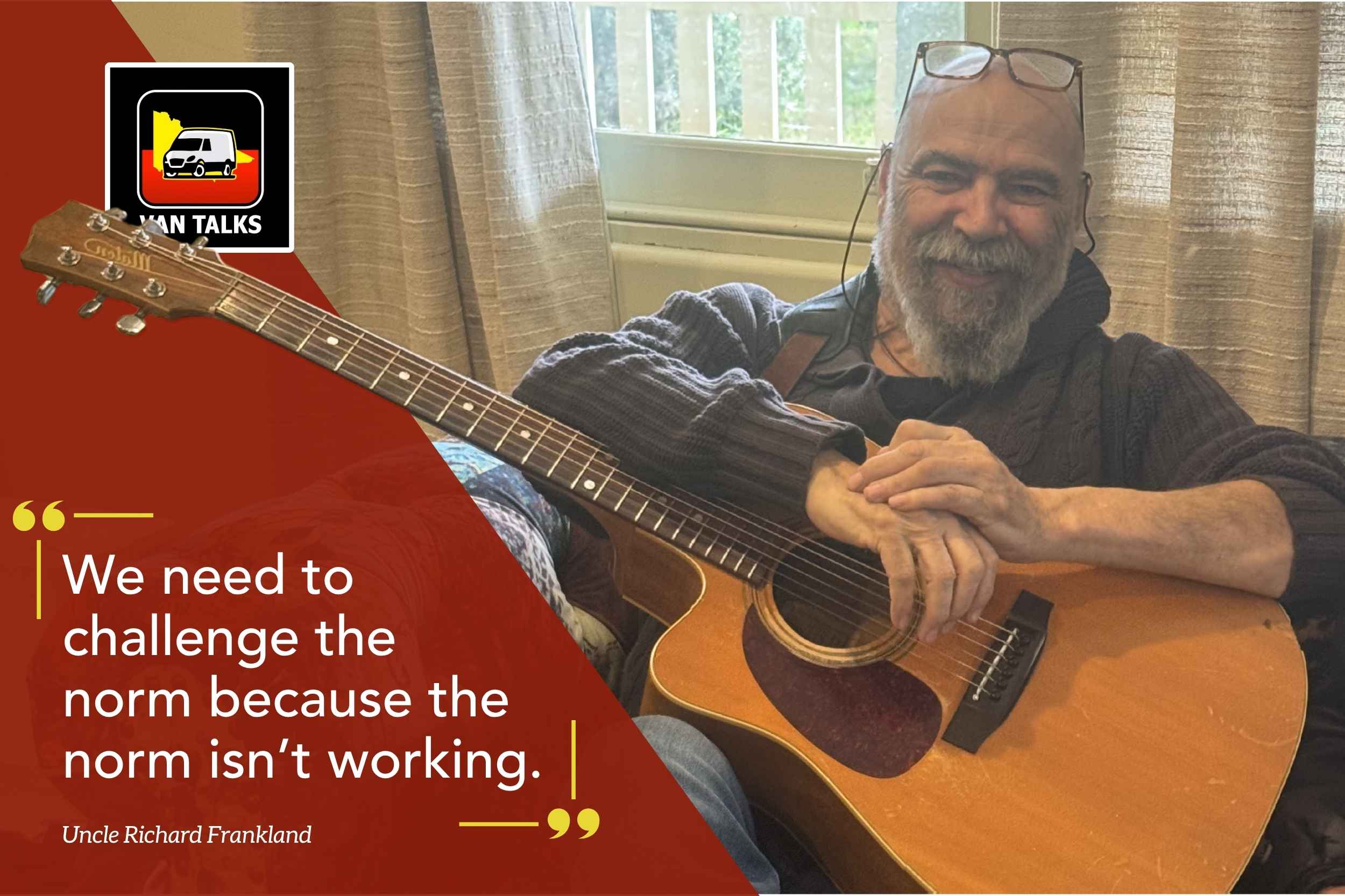
Gunditjmara Elder Uncle Richard Frankland has issued a powerful call to action for all Australians to confront truth, challenge the norm, and walk together towards genuine healing.
Speaking on Gunditjmara Country following his Elder in Residence Oration on NITV, Uncle Richard reflected on the enduring impacts of invasion and structural inequality.
“Invasion is a structure, not an event,” he said, quoting historian Patrick Wolfe to highlight the multi-generational trauma embedded in Australian society.
He addressed those who deny the lingering scars of history, pointing out that wider society continues to benefit from what was taken from First Nations people.
“We had a cultural bomb dropped on us,” Uncle Richard shared.
“Have a look at our past, step across the cultural abyss with humility and with honour, and help us walk together,” he urged.
To drive systemic change, Uncle Richard outlined five critical challenges for institutions, including embedding Elders in Residence and reframing the Australian War Memorial to recognise the Frontier Wars.
He also advocated for legislating racial discrimination as a mental health issue, funding culturally appropriate trauma programs, and launching a Royal Commission into First Nations youth suicide.
“When you save these lives, you save our every future and you save ourselves,” he said.
By listening to Elders and dismantling entrenched systems, Australia has a vital opportunity to build a shared future rooted in justice and self-determination.
Charles Pakana: In July of 2026, Gunditjmara man Uncle Richard Frankland delivered an Elder in Residence Oration on NITV. During that oration, he spoke of resistance, resilience, social challenges, and threats, as well as a call that we all, as Australians, carry a moral and spiritual requirement to challenge the norm. Today on the program, I’ve travelled down to Gunditjmara country to sit with Uncle Richard and talk about some clear calls to action he outlined in his oration. Uncle Richard, thanks for the chance to sit in yarn with you.
Uncle Richard Frankland: Oh, it’s an absolute pleasure. I’ve been looking forward to having a chat with you.
Charles: It’s taken a while to get here.
[Both laughing]
Charles: Unc, you stated in your oration that as a nation, and I’ll quote here, “We’re all scarred from the battles of the past, from the frontier wars, the massacres, deaths in custody, Stolen Generations, cultural survival in the face of attempted erasure.” What do you say to those in our society, and we’ll start with a bit of an antagonistic question, who advocate that as a nation we’re not scarred at all, but it’s more the First Nations people simply won’t let go of what’s happened in the past, and it’s not the fault of those who live now?
Uncle Richard: There’s a couple of really amazing points to pass on to your listeners. One is that we’ve been living with this nursery version of history for a long time. And the nursery version is a lack of acknowledgement of the frontier wars, of the massacres, the battles, the murders, the language destruction, the pulling down of social orders, cultural authorities. We had a cultural bomb dropped on us, in the words of Ngũgĩ wa Thiong’o. And history begins at that point for the dominant culture. And anything before that is a cultural wasteland. And what our people do is we diffuse the cultural bomb. We replant and reseed the cultural wasteland by exposing our culture, our law/lore, our business. And we also unify the nation by creating a… a vision for victory, if you like, where we can link arms.
Patrick Wolfe said, “Invasion is a structure, not an event.” And what he meant was the legacy of invasion is trauma, transgenerational trauma, vicarious trauma, discrimination trauma, being excluded from the dominant culture, being excluded from the opportunity to contribute or even have our contributions recognised. Those people out there that deny this, I say, come have a cup of tea. Learn to listen and hear. Learn to actually see. Have a look at our past. The reason you are complicit in this is simply because you benefit from what was taken from our people. And what was taken wasn’t simply one life or an inconvenience; it was a destruction of an entire society. It was attempted erasure and genocide of entire peoples, an erasure of 65,000 years of culture, of law/lore. This is what was attempted.
If you could see the courage that I see, if you could see the resilience that I see, the resistance… if you could see my people as the great warriors that they are, you would cry with pride. You would be deeply honoured that these people have extended their hand to you and said, “Let’s create a future together. Let go of this hatred you’ve got, this is what I say to you, let go, and step across the cultural abyss with humility and with honour and help us walk together.” Otherwise, history will not judge you kindly. They will not see you at all.
Charles: Unc, that brings up something else that you said or reiterated a number of times in the oration, and very early, you acknowledged our allies, stating that we’re in a space together dedicated to centering the voices of First Nations people. And you also spoke, just as you have now or alluded to it at least, a… a shared future for this country. What does that shared future look like to you?
Uncle Richard: There are many ways to have a shared future. The first point would be that we need the courage to recognise the past so that we can actually grapple with the contemporary happenings. Once we do that and see each other, we can start planting seeds for the future. None of us can own it. We can only plant the seeds.
Michael Mansell spoke of a nation within a nation. Others have spoken of a new Australia. Me, I speak of a Tomorrow Australia where everybody has a home, but the diversities recognised and celebrated. Where the oldest living culture in the world becomes part of Australia’s history, not just First Nations history. Where we could look around with great pride and strength. Most of all, where there’s no children or people who feel homeless from Stolen Generation or being displaced, or children scared to state who they are.
This point of time, Australia has a great opportunity. And those that would decry or put down others simply based on race, creed, or colour, they’re the greatest traitors. They’re misplacing their spirit.
We, as a nation, can unravel the cultural tapestry that we live with now and weave it back together so that it keeps all of us warm and all of us with no hunger inside. And I don’t mean just hunger for food; I mean hunger for identity, hunger for culture and good business with each other.
Charles: Unc, you said that healing a multi-century wound doesn’t happen overnight, and that’s what you’re talking about now, this shared future. And nor does it happen if we choose not to be agitators and stirrers.
Uncle Richard: [laughing]
Charles: Morally, spiritually, we are required to challenge the norm. What does that look like from you, who is someone who’s actually become an agitator and a stirrer, but opting rather than using your fists, as you’ve done in the past and admitted to that, you’ve now adopted a measure of media, where you are a songwriter, you’re a storyteller. But what does in general this agitation look like going forward to bring about this change?
Uncle Richard: For anybody to change, it’s a great effort. First, you have to see yourself, not only who you are, but what you are advocating for. As a nation, we need to advocate for each other. And, as I said earlier, for a home where we’re all safe. Changing the norm is something that is not only a necessity, it’s a requirement of every free-thinking individual.
We need to challenge the norm because the norm isn’t working. We need to challenge the norm because those indoctrinated processes and protocols that we live under are simply wrong. We need to maintain our identity. We need to establish not only who we were, but who we are and who we hope to be, and you can only do that by instigating change.
To my mind, we need councils of Elders who have governance. We need to enshrine First Nation cultural shape and law within Western Eurocentric protocols and bureaucracies. And we need to do it where we’re not advisory committees, but we are directors. We shape culture, we shape law. We reclaim not only who we are, but our very humanity.
Charles: You mentioned, just talking about indoctrinated processes, you mentioned that during your times as a field officer with the commission, that the system, as you said, was not geared to recognise the humanity in us. And later in the oration, you stated that racism and hate are not isolated instances, but they’re embedded and emboldened by structures and systems. I want to give you the opportunity to just dive into that, at least for a couple of minutes, and explain what you meant by that.
Uncle Richard: We’re socially engineered. I mean, you ask anybody what the golden arches are and they’ll be able to tell you.
Charles: [Laughing] Tragically, yes.
Uncle Richard: We’re trained to see things and as part of our everyday life. We were trained with McCarthyism to believe in the nuclear family. Husband, wife, and 2.5 kids. We’re trained to think that we need fences around our homes. We’re trained to see people as the undifferentiated other.
Well, if you can train people to be like that, you can un-train them not to be like that. And that’s what we need to do as… people speak of social engineering and social conditioning all the time. We need to change the way we’re doing that, the way we see each other, the way we feel about each other.
For me, the biggest thing I think we need to introduce once again, and this is not just about a united First Nation people, it’s about a united nation. We need to re-instil hope as a way to begin to trust each other again. We need to socially engineer all of us as a collective to aim down that path.
Charles: That’s a bold ambition, something that’s going to take a lot of time and a lot of people, without a shadow of a doubt. So you’re talking more about social change rather than bureaucratic systemic change. That seems to come later with the social… force change within society, yeah?
Uncle Richard: Absolutely. A legislation is fundamentally useless if it doesn’t have the attitude of the people behind it.
Charles: Well, look, talking about legislative change, I want to get onto the end of your oration where you called for five essential challenges for our institutions, governments, and ourselves. Now, we’ll just go through them one by one, and I’d just like you to expand on them a bit. The first one was the recognition and integration of First Nation social orders by establishing something that you and I are both passionate about, First Nations Elders in Residence. Just expand on that, what you’d like to see and the benefits that you believe it would bring to society as a whole and the organisations individually.
Uncle Richard: When I began Mirimbiak Nations Aboriginal Corporation, I hired two people who are both now deceased as Elders. And when I made No Way to Forget, the film, I hired two people to be Elders. And it allowed me to be a director, not just an Aboriginal director, because they carried the cultural load. I knew in telling these most important stories, we needed a pure cultural lens and environment.
And Western Eurocentric bureaucracies assimilate us in every process, in every step, in every regard. We need to have our own cultural authorities within our organisations. So I believe there should not only be just an Elders in Residence, but Elders Governance committees. And these governance committees direct more than advise. They need to be able to be the cultural authority within those agencies. And that would give us a cultural agency unheard of before.
I’ll use the military as an example; they have honorary colonels and so on from all types of worlds, but not from the Aboriginal world, not from the First Nation structures. The military, in my opinion, could take a… a lead in this and appoint a First Nation man or woman of high degree and appoint them as a colonel. It’s as simple as that, it’s recognition of our cultural authorities in a broader sense, in a Western Eurocentric sense, and to me in an incredibly advancing sense for our nation.
Charles: That brings us to the second recommendation, and it’s almost as if you’re feeding me these segues, Unc, because your second challenge for institutions, governments, and ourselves was to reframe the Australian War Memorial and acknowledge the true history of this continent. You’re not alone in this, and whilst you’ve been advocating this for a long time, so too have many others, but what does the Australian War Memorial need to actually do? What are we looking to see at the Australian War Memorial? And are we looking just to prick the conscience of the country?
Uncle Richard: It’s not about the conscience of the country alone; it’s about who we can be. We see the past, so we know what we can see in the future, what hopes we can see. I think the first thing the War Memorial should do is recognise the negativities of their own terminology. There wasn’t just massacres or occasional battles; there were battles, there were massacres, and there were murders.
The mentality of colonisation is to take, to destroy, and to build something on top of. By recognising the first time Australia was defended at such a high level, we actually get to start healing this moral bankruptcy lens that we have on our past. When we do that, we move a whole heap of people forward. By moving them forward, I mean they actually get to look at us collectively as a nation. And from the initial despair that many will feel will come hope.
We have an ability in this nation to deny so wonderfully.
Charles: Yeah.
Uncle Richard: We have this wonderful ability to deny. And when I say wonderful, I mean it’s… it’s horrific. Every day I see First Nation people not only justifying their existence, but justifying the cost of maintaining culture. Institutions like the War Memorial have an unequivocal obligation to advance our nation by recognising the wars that happened on this nation’s very grounds.
In the 90s, just to tell you, Charles, in the 90s, I lobbied them very heavily, and they wrote to me, a minister, the Minister for Defence, I can’t recall his name, wrote to me and said, “We only acknowledge wars that didn’t happen on Australian soil.”
Now, in saying that, recently there was an expose on The 7.30 Report, I think it was, I was on there with Leigh Morgan singing a song about veteran suicide.
The members of the guiding council of the War Memorial all get a chop out financially from munitions… not all of them, but quite a few of them, a chop out from bloody munitions factories! Now, what type of heinous, disgusting, immoral act is that, that you can take gold coins at the same time you’re meant to be honouring the dead, those that have fought for our country, those that have worn the uniform, those that were civilians and defended our… our morals, our fair go?
That’s not a fair bloody go. By any means, that’s… it’s horrible, it’s… it’s distasteful, and these men and or women, if there were any amongst them, need to be dragged out and put before the courts, the people’s court, in my opinion, and told who they really are.
Our frontier wars, our wars, every First Nation act of resistance should be there. Pemulwuy, Jandamarra… all of these men and women that fought, that were murdered, that were massacred, they should be there.
Charles: Uncle, from that, let’s go to the third essential challenge, which I think was the most challenging one of all and took me quite by surprise, and that is legislate racial discrimination as a mental health issue. A bold statement.
Uncle Richard: [Laughing] Well, anyone who unequivocally hates has a problem. But I guess we’re talking about both edges of the sword here. One is there’s overwhelming evidence that shows that people who have been subjected to discrimination end up scoring very high on the Kessler test, high psychological distress. There’s people in the past who deny their heritage and probably still do today in some ways because of discrimination. And those who act in a discriminatory manner, neo-Nazis, those type, obviously have something very, very wrong with them. I don’t hate these people, I just think they’re very sick and that they need healing. If they are attacking people, which they are, they should be incarcerated.
Charles: Number four, Unc. Established, well-resourced trauma programs culturally appropriately addressing six primary traumas experienced by First Nations people. A call that I believe has been echoed quite a bit in community in one form or the other. So if you could just expand on that call there.
Uncle Richard: So there are First Nation traumas that are invisible to the non-Aboriginal health system. And if they’re not invisible, they’re seen as untreatable. Transgenerational trauma, discrimination trauma, navigating the dominant culture trauma, vicarious trauma, lateral violence trauma, cultural load trauma, and of course, when they all get together and turn into one super trauma.
Charles: And the last one, Unk, a royal commission into First Nations youth suicide and self-harm, something I know is very close to your heart.
Uncle Richard: I’m going to say this to all Australians: Our children are taking their lives because of the way they’re being treated. We need to know how, why. We need adequate resources and recommendations, and we need to act on them. When you save these lives, when you save these lives, you save our very future, and you save ourselves. What man or woman in their own right mind would stand by and let a child take their own life? When we do that, we’re being complicit. I say to everyone, stand up, rise up, fight, resist, be resilient. Don’t give up.
Charles: Uncle Richard Frankland, thanks for your time and your thoughts.
For Radio Play:
1 - Click the Download Audio button
2 - The audio file will commence automatic play in your browser
3 - Confirm this is the file you want to use in your program
4 - Once confirmed, click the vertical elipses (3 dots) and select download
1 Comment
CONTACT US VIA SMS
Get in contact with us via our dedicated SMS line:
0493 222 836
1 October 2026
Implementing First Nations knowledge to heal country
28 September 2026
It’s time for Australia to acknowledge historic atrocities
24 September 2026
First Nations star knowledge predates Western astrophysics by millennia
21 September 2026
Reclaiming cultural heritage through proper consent frameworks
17 September 2026

I couldn’t agree more with Uncle Richard that we all need to have our heads in very different places for contemplating the future. Governments are irrelevant because they only follow the desires of the majority. One way of getting people into a different place is to ask them the right questions. ‘What do know about our colonial history?’ ‘ What do you know about massacres that occurred?’ And they don’t have to be so negative. For example, ‘Do you think it is better to act for your own needs or to take the community into account?’ ‘Do you think we get better results through competition or working collaboratively?’ There are a zillion similar questions. It is not very effective to tell people what to think. It is better to get them to reflect on these questions. Ie. to discover who they really are. (I am an optimist about true human nature!!) As you said – a very long project to change attitudes, but we are ‘******* into a typhoon’ at the moment.