
Defining the next frontier of an Australian First Nations economy
Uncle Ian Hamm joins VAN Talks to argue that true self-determination requires shifting from rights-based social policies to macro-economic participation and wealth independence.
Posted by: Charles
Published: 20 July 2026
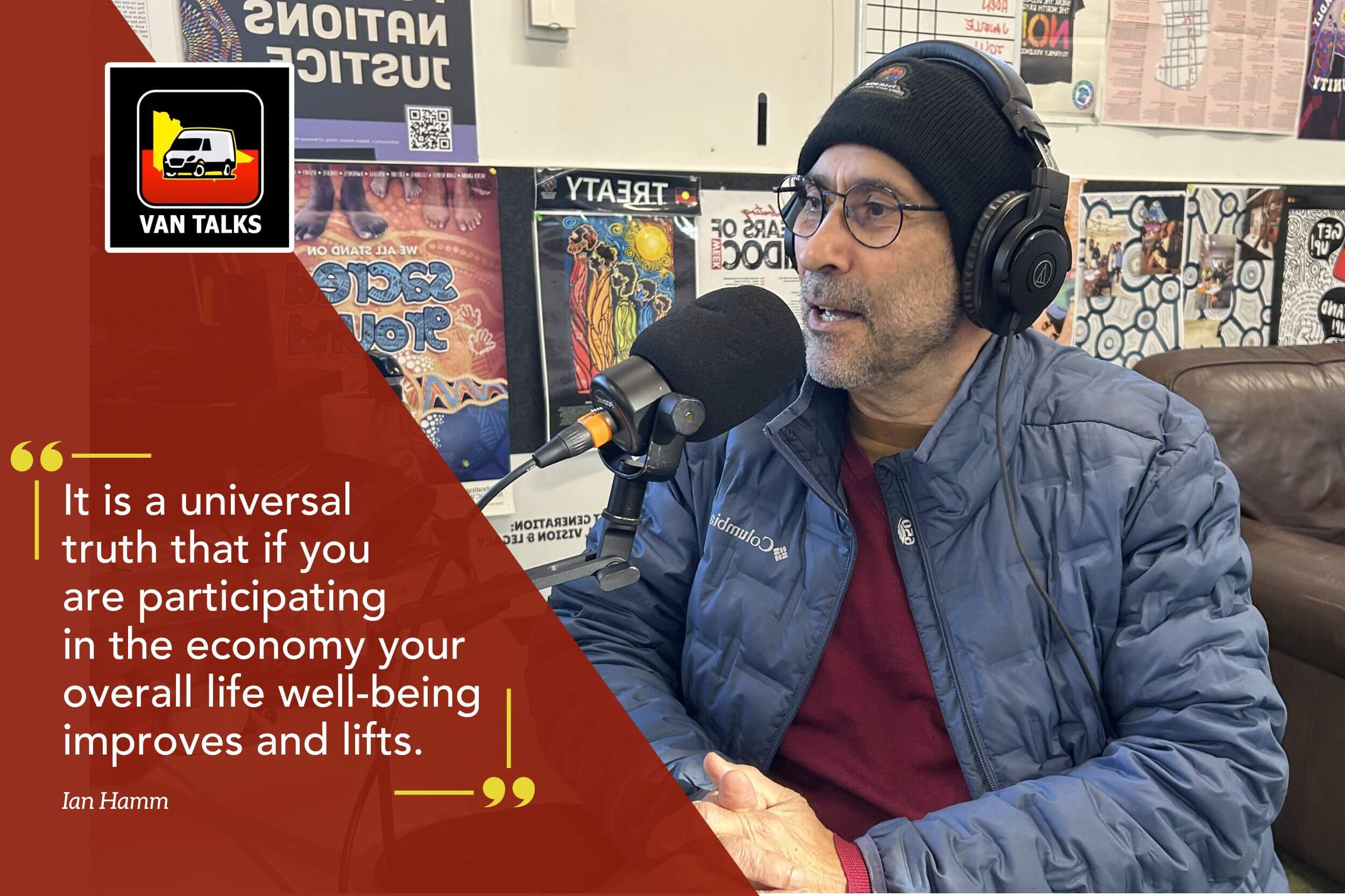
Traditional rights-based social policies have reached their limit. True self-determination now requires a major shift toward macro-economic participation and wealth independence.
That is the view of economic advocate and Yorta Yorta man, Uncle Ian Hamm.
Speaking on the latest episode of VAN Talks, the former public service executive argued that First Nations advancement is stuck in a “micro loop”. He said relying on one-off grants and localised employment programmes fails to alter the fundamental structure of the economy.
Uncle Ian is calling for equity. He wants Aboriginal Australians to achieve the same economic outcomes as the rest of the nation.
“What does improve people’s lives is participation in the economy,” he said.
He believes a strong First Nations economy benefits the entire country. It is not a zero-sum game.
Achieving economic equity would dramatically decrease the draw on Commonwealth outlays for deficit reduction. At the same time, it would boost national revenue through taxation.
The shift is already beginning at the federal level. A landmark agreement was recently signed between the Coalition of Peaks, the First Nations Economic Alliance, and the federal government.
Crucially, Federal Treasurer Jim Chalmers is a lead minister on the initiative. This moves First Nations economic policy out of minor agency spaces and straight into the Department of Treasury and Finance.
Uncle Ian concludes that First Nations people are inherently industrious and enterprising. Bringing these attributes into the macro economy will ultimately create a wealthier, more balanced Australia for everyone.
Charles Pakana: Today I’m speaking with your Yorta Yorta man and economic advocate, Uncle Ian Ham, to discuss what is increasingly being recognised as the next frontier of First Nations advancement. Now, in the wake of the 2023 referendum, Uncle Ian argues that traditional rights-based social policies have reached their limit, and that true self-determination requires a major shift toward macro-economic participation and wealth independence. Unk, thanks for joining me today.
Ian Hamm: Always a pleasure, Charles.
Charles: You seem to be arguing in your work that First Nations advancement is essentially stuck in what you refer to as a “micro loop”—that is, relying on one-off grants, localised employment programs, and targeted agency projects. And while that’s all well-intentioned, and we recognise that, they essentially don’t change the fundamental structure of the economy. Help us explore your proposed macro approach.
Ian: Okay, Charles. So, as many people would know, I was in government in the public service for over 30 years. And so my view of the world is fundamentally broken into two states of being—that is, social policy and economic policy.
Now, traditionally, Aboriginal affairs, Aboriginal issues, Aboriginal everything has been viewed primarily, in fact almost—I won’t say exclusively, but all but exclusively—through the lens of social policy, which is indeed a very worthy thing because we have many social issues. You know, there’s health outcomes, there’s education outcomes, there’s justice outcomes, all of those sort of things. And so a great deal of focus has been on those.
But investing heavily in that only has limited return. Does it actually advance you? Does it improve your state of life, or life well-being, all of those sort of things?
Now, the common argument is that it does not. What it generally does is stop a bad day getting worse, which is absolutely an admirable thing, and it to some extent improves people’s lives.
But it has a very limited ability to do that. What does improve people’s lives is participation in the economy. So if you think about what I said before—social policy and economic policy—my argument is we need to give equal effort to using economics and economic policy, and the economy, to uplifting Aboriginal people. Because it is a universal truth that if you are participating in the economy, your overall life well-being just improves and lifts.
It’s been shown time and time again throughout the history of mankind, basically, that your participation in the economy allows you to have an improved life, but more importantly, the generations that come after to build on that and have even better lives.
Charles: But what does participation in the economy actually look like under your ideas?
Ian: Okay, to put it simply, that Aboriginal Australians have the same economic participation and economic outcome as the rest of Australia.
Charles: But couldn’t it be argued they already do? The opportunities are there.
Ian: There’s a difference between perception of opportunity and the reality of it tangentially coming out on the ground. I mean, that’s just a fact. It’s a very clichéd thing to say that everybody is equal. That is so not true.
Charles: Yeah, we know that.
Ian: Yeah, yeah, that is so not true. And not just for us, but anywhere you go. The notion of “oh, we’re all equal,” that’s usually said by people who are at the top of the pile. “We’re all equal and anyone can do it.” Everybody else who is further strata down the pile, as it were, recognises we are not equal at all. Not equal in starting point, not equal in opportunity, not equal in resourcing to give us opportunities. So you have to create the circumstances for that. And in the case of the economy, you’ve got to create and make pathways for people to participate in the economy as a whole. That’s not just getting into it.
So, jobs programs is a really simple one. Taking people from unemployed to employed is relatively easy.
Charles: But that’s only part of the equation, isn’t it, as you argue?
Ian: That’s the easy part. The hard part is giving them the skills, opportunities, capabilities, and capacities to have an increased income over a lifetime of economic participation.
Charles: Well, you’re talking career progression essentially, as well, aren’t you?
Ian: Career progression, or whatever it might be. But essentially, yeah, career progression because basically the bulk of us are on somebody else’s payroll, right? There are people who run small businesses, their own business—good on them, they’re actually a cornerstone of this too—but the bulk of people, Aboriginal or non-Aboriginal, are on someone else’s payroll.
But they want to have an increasing income over a lifetime of work. Is that not an admirable thing and a basic human desire?
That’s one of my fundamental precepts of this. It’s not just fixing the problem of unemployment, but once people are engaged in the economy, how do we create the opportunity, give them skills, capabilities, and capacities to have that increasing income over a lifetime of economic participation—whatever that participation might be?
Charles: Where have we seen this work? Because obviously this can’t be something new. People must have done work in this particular area. So off the top of your head, some small case studies?
Ian: There are case studies that you can see. So, the public service is a good example. So when Aboriginal employment really became a focal for the public service, right? So it was about let’s just employ Aboriginal people. So, did that. And what you had was, “Oh look, we’ve got X number of blackfellas working in government.”
Charles: That was ticking a nice box.
Ian: On the surface of it, an admirable thing. Sure. Quality jobs, long-term jobs, people have got a job. But when you found that people were still in the same job they started at 20 years before, still at the base levels, and hadn’t moved on, hadn’t been given any opportunity to progress—and in fact, the focus was on retention of those people in those positions to keep numbers up—that actually was, in my view, it’s better than being unemployed, but not much better.
Charles: Yeah.
Ian: So the other part of it is you have to give people meaningful work and the ability to contribute. So government—and we did this here in Victoria back in, what, 20 years ago now we were involved in it—was let’s stop with just the gathering of people and start to build career structures for people so people can advance. Let’s create opportunities for movement. But it is that thing of giving people the opportunity to bring all that they are to what they do in a job, and therefore increase their capacity to have meaningful employment and increased income over a long period of time.
Charles: Some of the people that come to mind, or to my mind at least, as you talk about that are Terry Garwood in the Department of Premier and Cabinet, and Uncle Andrew Jackomos—one of your fellow countrymen—who did so much amazing work in the state government. Just how prevalent are these particular people, these sorts of successes?
Ian: Well, it was interesting. Actually, Terry’s a really good one because he was Executive Director of Aboriginal Affairs many years ago, and then he went off to be Director of—I can’t remember what it was called, but it was in the Department of Transport. He used to have a wonderful time bragging to me about, “Have you been in the front of a train when it’s hurtling up from here to Albury? Have you ever been on the bridge of a ship when it’s one of those big freighters when it’s going down Port Phillip Bay?” Director for having a good time or something, you know?
Charles: It sounds like a bit of jealousy there, mate.
Ian: Oh, god yes! Yes. But there’s an Aboriginal person who moved out of Aboriginal affairs into something else. So, and now he’s back as Deputy Secretary of First Peoples at Premier and Cabinet. Andrew’s work, moving up the ranks, because he was actually the first Director of ATSIC in Victoria.
Charles: Of course. Yeah, yeah.
Ian: Yeah, so he didn’t stay at the base. He moved up, he sought positions that had a big influence over policy. So not only were there good outcomes for the public at large from via working in government, but both of those people, for example—Angela Singh is another one, who was at a Deputy Secretary level responsible for the whole of the North-West of Victoria in education. People being given the opportunity to be the best that they can be, and also have meaningful employment, and also have increased income moving up those scales as well.
They’re three examples, in government at least, of real and meaningful and engaged economic participation. And it was about not what they got, but what they gave.
Charles: But what was changing within the system to enable those three people, and others we haven’t named of course, those opportunities to go up that career ladder?
Ian: It was a recognition within Aboriginal employees in the public service itself is there is more to us than just this. If people think that all blackfellas can do is just blackfellas stuff, that’s a terrible situation. I’ve always said, if you can do Aboriginal stuff, then you can do anything else because the rest of it’s pretty easy.
And, you know, I used to be president of a football league, right? The Western Region, or the Western Football Netball League it is now, covers Western Melbourne. When I became president of that, I thought, “Oh, you know…” When I joined the board, I thought, “Wow, this is big.” Then I realised, they’re just like mob. It’s only, you know, about footy as opposed to Shepp or Ballarat or Bendigo or something.
Charles: Yeah, exactly.
Ian: And I thought about them through the lens of our community, and I was regarded as a pretty successful president. And it was pushing that stuff of: I can do more than just Aboriginal stuff. And creating the opportunity, and that was provided. That stuff, for myself, helped me think about it’s not just me—lots of people can do this, do do this. We have to create the opportunity for people to do all this other stuff.
Charles: Well, let’s take it back into the world of business now, because we’ve focused a bit on government.
Ian: Yep.
Charles: And what I’d like to know is, what are some of the actions you’d like to see being taken at a state and federal level to really generate a more revitalised and wealth-generating Blak economic area?
Ian: Okay. We have to go almost back to foundational stuff here. So if you ask the general public, you ask people who are in parliament, “Give me your perception of Aboriginal Australia.” They will build it around disadvantage, they’ll build it around being at the bottom of everything, they’ll build it around deficits, they’ll build it around closing of gaps and all that.
Charles: The deficit model, yes.
Ian: Yeah, it is all very legitimate, right? And then you say, “Okay, now what about people in the economy?” Well, it’s about giving unemployed people a job, it’s about closing of gaps. There is something fundamentally not right with that. And to be honest, we do this to ourselves a little bit as a community.
Charles: Sure.
Ian: We don’t talk about what’s good about being Aboriginal, right? We don’t do that. We talk about what’s bad. But how often do we talk about what’s good? Now, if I take that to the economy, we should be talking about what Aboriginal people potentially can bring to the Australian economy. What are the things that would help the economy grow? What are the things that, quite frankly, without us, the Australian economy lacks at this point in time? Right?
And if we were fully participating and have equity with other Australians, here’s what it would mean for the Australian economy—which, in my view, would only mean benefit for everybody on a whole range of different fronts.
Charles: And we’ll deal with that a bit later on.
Ian: So, that’s the fundamental construct that you’ve got to rework the narrative of almost who we are and what we are about, and say, “And here’s what it means for the economy.” Now, once you get past that, then you look at, so where is the economy going as a whole? And where can Aboriginal people play a meaningful part in that, to contribute to the Australian economy and those things the Australian economy is going into?
I think about, for example, governance, because I’m on the board of the Australian Institute of Company Directors. And so governance is changing rapidly.
Charles: In what way?
Ian: Well, the prevailing economic model for the past 40 years is basically based on the theories of Milton Friedman, who was out of the Chicago School of Economics in the ’60s. It’s what is known to most people as neoliberalism, right?
That is small government, deregulated as much as possible, the market will fix it. And in terms of governance, that has meant the role of directors is their company only, profit maximisation, and return to shareholders, and you comply with what you have to do but nothing more. Your big thing is on return to shareholders—profit maximisation, return to shareholders.
Now, that model, in my view and in the view of many others who look at it, has failed. That’s why we have increased inequality. That’s why we have a larger amount of people having less and less, and a smaller and ever-shrinking group of people having more and more. And so that model doesn’t work.
The problem we have in a governance sense is that a lot of directors have been brought up in that model. Now, the Hayne Royal Commission, which was the Banking Royal Commission—Kenneth Hayne, former High Court judge, did that Royal Commission—one of the conclusions he reached was that the role of directors needs to be much more than that, particularly of large institutions. In that case it was the banks, but it could be equally said of somebody who last week, I don’t know, put us into a bit of chaos around parts of Australia—Telstra! As an example.
Directors have to think about they not only have a responsibility to their corporations, they have a wider responsibility to society at large. What is your company, your organisation doing to contribute to society at large? Not just your shareholders, but society now expects and is asking, and quite rightly asking, the question: “Yes, you have to be profitable, yes, you have to make a return for your investors, but you also have to make a social return. You also have to make a bigger contribution.”
Charles: Let me… I’ve got to challenge you a bit on that, Ian, because it really seems that regardless of this is the way that it’s got to change, that there’s got to be more consideration given to society and the impact of that business on society, the fact that we seem to be down this other model where it’s let’s just focus on the shareholders and our own careers and pockets. Just how difficult is it to really start turning the mindset of all these directors?
Ian: It’s A, changing the mindsets of the director community, but B, expanding the director community to bring in people who traditionally might not have been included in it.
Charles: Now, this brings in something that you’ve been saying for a long time—you want to see more… I’m just going to say previously disenfranchised people. I know you’ve been saying First Nations people, but a lot of what you’re saying is to sectors of the community that are typically disenfranchised or disengaged. So how do you see that coming about, and how do you see that people are going to change their mindsets to bring these people in?
Ian: Yep. I’ll start with: this is an evolution, not a revolution. So that will change over time. But given the complexity of the world we live in, given the different and ever-increasing range of expectation on people who are in governance, you cannot limit it to a single, small, defined group of people anymore. You have to expand the sources that you get directors from.
Now, there is some base stuff about being a director. It’s usually people who’ve been in, at very least, middle to senior roles in whatever it is. They’re usually people who’ve worked at executive level. But increasingly, that is being expanded—that group of people too.
The important part is that when you sit on a board, you not only bring your technical skill, which is important for some things, but you bring who you are as a person. You bring your own background, you bring your own experience, you bring your own values. You bring your own very identity to that role as part of the discussion, the group discussion as a board, and the group decision-making a board around the decisions you make collectively for your organisation.
So, if you have a board that is made up of a diverse group of people, you’ll be covering a lot of bases, but it will give you a much better quality outcome. And I’ve always said, you need one of those things is people from a background where they think of community first before they think of individual. They think of themselves as part of a large network, not as an individual who is just simply another individual in a collection of disconnected individuals. And the ones that fit that for me, the ones that fit the network model, are—that’s us, blackfellas.
We think about the wider group that we’re part of, what we contribute to it, and how we see collective benefit outweighs individual benefit, just as a, you know, as a generalisation.
That is the evolution of the things that Kenneth Hayne mentioned in his report, in his Royal Commission report. Directors have to think about what are we contributing to society at large, what are we doing beyond just making a bunch of money for our company.
Charles: What about at the federal government level? I know you’ve been advocating for federal government and federal Treasury involvement in this and leadership in this. What’s called for at that level?
Ian: This is really important. That traditionally, as I said, big focus on social policy, very little on economic policy, right? So the main levers of the economy in government haven’t really been involved. So it’s mostly been run out of the Aboriginal lead agency at the time, which now it’s NIAA at the Commonwealth level. So that’s changed. So there is now work being done in the Commonwealth—and it’s usually, too, this is the other thing, it’s usually only been, and I would say, micro-targeted. So it’s been, “We will do a jobs programme in the remote communities of the Northern Territory. We will do tourism in X.”
Charles: Band-aid fixes.
Ian: They’re not band-aid, they’re just micro things. Right? There’s nothing wrong with them, but they’re not whole-of-Aboriginal-population, right? They kind of look at a micro thing and just say we’ll do that. There’s nothing wrong with them, but they’re not macro. They don’t think of all Aboriginal and Torres Strait Islander people resident in the Commonwealth of Australia. They think about unemployed blackfellas in Northern Australia, or tourism opportunities in—I don’t know, pick somewhere—the Pilbara, or here in Victoria, South-West Victoria. But that’s all. There’s nothing wrong with those and they’re good, but what about everything that doesn’t fit into those?
So, the change that has happened is that there’s been work done with the Aboriginal Economic Alliance, or First Nations Economic Alliance, the Coalition of Peaks, and the federal government. And now the government has understood that we need to think about Aboriginal people and the macro economy, and therefore we need a macro approach to that. So, last year an agreement was signed by the Coalition of Peaks, the First Nations Economic Alliance, and the federal government.
But the signatory to it for the federal government, or one of the signatories, was Malarndirri McCarthy as the Minister for Indigenous Australians. The other one, and the lead minister on this, is Jim Chalmers, the Federal Treasurer.
Charles: That’s a bit of a different thing, yeah.
Ian: That’s a huge difference. So while Malarndirri’s got oversight of everything Aboriginal, relevant ministers have portfolio responsibilities in there, so the health minister has stuff on Aboriginal health.
Charles: But he’s the man who holds the strings to the budget.
Ian: Yeah, Aboriginal economics is not being dealt from a programmatic approach in NIAA. It is now being looked at at a policy, macro approach, led by the Department of Treasury and Finance, and the responsible minister is the Treasurer, Jim Chalmers.
That’s a fundamental shift in how the Commonwealth is looking at because it’s now shifted from reduction of disadvantage in specific locations and maybe small opportunities that exist in this place or that place or over here, to now—and the economy works on a macro scale—is what are the things that can we bring to the Australian economy which will enhance it, drive it, kick it along, make it better at a macro level. That’s a fundamental shift in the very narrative, the very framework, the very understanding of what our potential is as people.
Charles: Let me finish off with this last question because we have, unfortunately, pretty well run out of time. And that is to those people in the community who may hold a view that First Nations funding results in a zero-sum game—and that is one person’s gain is another person’s loss—what’s your belief that a strong and independent First Nations economy in this country is in the best interests of the entire country?
Ian: It’s pretty simple, Charles, once you do the maths of it, and most people will get this. If Aboriginal people had economic equity with the rest of Australia, right, that would mean a couple of things just in terms of sheer dollars. They’re probably the first things I’ll go to.
Number one, the draw on the Commonwealth outlays for Aboriginal people to reduce disadvantage or stop it getting worse would dramatically decrease. Because we would have the same financial underpinnings for ourselves that everybody else does. So a lot of those Commonwealth outlays wouldn’t be necessary.
Charles: We’ve been hearing this for a long time.
Ian: And they could go to other things. The other bit is it would actually increase income into the Commonwealth because we’d be paying the same taxes as everybody else, you know? That in itself—so the reduction of outlays and outlays to Aboriginal programmes to reduce deficits, and an increase in taxation. So you get a shift in the fiscal stuff. That’s a beginning point.
More importantly, beyond that, what we would bring in terms of new thinking into the economy, how we perceive the role of the economy. I’ve always said, we are an industrious people, we’re an enterprising people. I mean, you look at us how we have, for tens of thousands of years, been on this continent, and how we have not just survived but relatively thrived in a rapidly adapting world in the past 200 plus [years].
If we are not enterprising and if we are not industrious, I don’t know what we are given those things. And yet here we are, doing new things. Here we are with Treaty in Victoria. Bringing those skills and attributes to the Australian economy, how much better would it make it for not just Aboriginal people but for every Australian as well?
That’s the real payoff, that’s the real benefit. And I think bring a better balance around how much we regard the social construct of Australia versus solely, probably overtly, too much overtly focusing on its economic construct. That very fundamental thing, Charles, I think we’d find the rebalancing of: we don’t live to work, we work to live.
Charles: Uncle Ian Hamm, thanks for your time.
Ian: Always a pleasure.
For Radio Play:
1 - Click the Download Audio button
2 - The audio file will commence automatic play in your browser
3 - Confirm this is the file you want to use in your program
4 - Once confirmed, click the vertical elipses (3 dots) and select download
CONTACT US VIA SMS
Get in contact with us via our dedicated SMS line:
0493 222 836
19 October 2026
Understanding the use – and over use – of the Acknowledgement of Country
15 October 2026
It’s time Australia recognised a shared history of often brutal “settlement” and expansion
12 October 2026
Start learning about First Nations cultures without the fear of offending
5 October 2026
The revival of cultural burning practices to remediate Country and help mitigate disasters
1 October 2026

0 Comments