
Highlighting culture through art without compromise
An acclaimed Victorian Aboriginal artist, Bayley Mifsud, discusses navigating major corporate collaborations while safeguarding cultural integrity.
Posted by: Karina Wells
Published: 27 July 2026
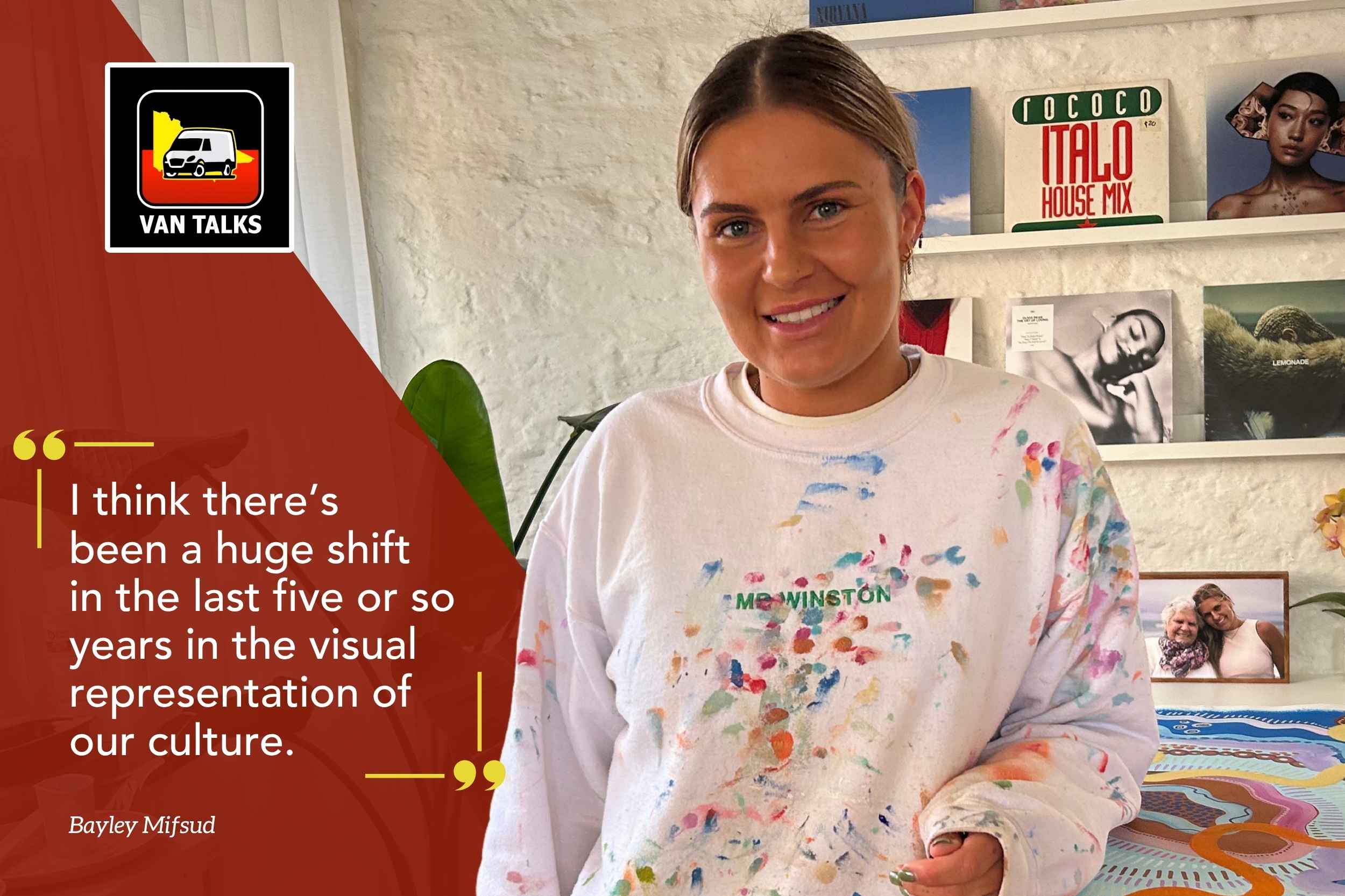
Acclaimed artist Bayley Mifsud is using her platform under Merindah-Gunya to reshape how First Nations culture is seen, respected, and embedded in everyday life across Victoria.
Speaking on Victorian Aboriginal News, the proud Gunditjmara woman reflected on balancing huge commercial success with strict cultural governance and clear boundaries.
“I obviously learned Aboriginal art when I was really little,” Bayley said.
“I was five years old, learned off my blood-uncle, the senior loreman of our community, what symbols we can use and how to tell those stories.”
That guidance came directly from respected Elder Uncle Rob Lowe, who provided her with an unshakable foundation of cultural authority and confidence.
When navigating high-profile brand partnerships, Bayley maintains firm ground rules and expects genuine accountability from corporate partners.
“I try my best to communicate clearly and educate people around either if they use the wrong language,” Bayley said.
“If you don’t think it’s the right fit, it’s not worth doing.”
Her practice remains deeply grounded in Country, refusing mural or workshop commissions on lands where she lacks personal connections or local consultation.
While mainstream perception often associates First Nations art with desert dot paintings, Bayley proudly asserts the distinct visual language of South Eastern styles.
“I do what I was taught,” Bayley said.
“I was taught a combination of symbols, of which was for our possum skin cloak, but then I was also taught more the lines and the hatching, as well as the dots.”
Looking ahead, Bayley hopes her growing commercial visibility inspires the next generation of Aboriginal artists to step into their power and own their cultural identity.
“I hope that I’m able to show young Aboriginal kids that you can be an Aboriginal artist,” Bayley said.
“You can’t be what you can’t see, and I hope that young kids growing up feel proud of their culture no matter what.”
Charles: Today on the program, we’re joined by acclaimed Victorian Aboriginal artist Bayley Mifsud, whose work under Merindah-Gunya is essentially reshaping how First Nations culture is seen in everyday life. We’re going to be diving into the distinction of Southeastern art styles and pushing back against corporate tokenism, and what genuine accountability to community really looks like. Bayley, thank you so much indeed for joining me on the program today.
Bayley Mifsud: Thank you for having me.
Charles: Bayley, your art is everywhere right now. We’ve discussed this before we turned the microphones on. It’s from global Swatch watches to Cadbury packaging.
So, when these huge corporate brands approach you, how do you, first of all, set the ground rules around what traditional symbols can and can’t be used commercially?
Bayley: I’ve kind of got a few ways I look at this. I obviously learned Aboriginal art when I was really little. I was five years old, learned off my blood-uncle, the senior loreman of our community, who I’ve known for my whole life, what symbols we can use and how to tell those stories.
And I think also having a corporate background within Indigenous affairs has also helped shape my broader understanding of what then that looks like from the corporate perspective.
And then when I do get engaged by an organisation, usually they’ve got briefs, they’ve got an understanding of what they want, but I, culturally, then know what I can and can’t do, and then professionally I am also confident to be able to communicate that.
And I think a lot of the time when young artists will ask me these questions because they’re unsure. I then reflect on that I am quite grateful that I’ve never had that uncertainty, because that would create more stress and cultural load that you just don’t need.
So, yeah, I think that I am really grateful to have had Uncle Rob around my dinner tables, and to be able to constantly ask him and know exactly what I, yeah, can and can’t do.
Charles: And that’s Uncle Rob Lowe, of course.
Bayley: Yes, correct.
Charles: Great man. I’m interested in situations that you might have come across where people, corporates, have come to you with preconceived ideas and said, “Oh, we want this, we want that, and we’ve seen this in another piece of art, maybe from up north,” and they’ve tried to impress upon you that that’s what they want. What do you do in those situations, because it must have happened?
Bayley: Yeah, definitely. I think, yeah, it happens a lot more than what you would think.
And despite my artwork, as you said, has been now on a lot of amazing collaborations, I do turn away a lot of collaborations. I try my best to communicate clearly and educate people around either if they use the wrong language. It’s pretty easy to gauge as an Aboriginal person, I think, when a business is authentic or not.
Maybe that’s just me personally, but I’m pretty clear on then… let’s say it is language, and they use a word which I don’t identify with, I’ll tell them why not and what they should use.
And if they then continue to say that, it’s pretty easy to then just say, “Look, I don’t think this is a good fit.”
An example for that, for people that are not sure, ATSI—I don’t know why people…A-T-S-I, Aboriginal Torres Strait Islander. Some people will reach out and say, “We want an ATSI artwork,” and I’ll say, “Oh, you shouldn’t really say that.” And I’ll try my best to educate, be very clear, send them references to posts I’ve done before.
And if they were to then say it again in an email, I’m just straight up, I’ve got a two-time rule.
It’s pretty easy to then gauge, and a lot of the time some people might not know, so that’s why I do give them the benefit of the doubt, try and educate them along that way, and that also then just comes with that confidence which has grown over the years.
I am in my late 20s now, and I think about the way I communicate now to brands versus when I’d first started. Obviously, now I am a lot more confident.
Don’t get me wrong, I would still try and communicate whatever I wanted to, but now, you know, one might call me blunt, because I, yeah, got to the point where it happens so much, but, yeah, I just think you’re not going to be proud of the collaboration if you’re already identifying early on that they’re not the right fit.
Maybe that is also because I am in a position where I don’t need the work as such, but to any young artist listening, if you don’t think it’s the right fit, it’s not worth doing.
Charles: Now, one of the things that you and I spoke about before we turned on the microphones was actually having a connection to the Country on which you’re going to be doing your artwork.
And we have seen a number of examples, and there are no names, no pack drills on this, where we get artists coming in from different parts of Australia who have no connection to Naarm or any area here in Victoria, and freely take up art commissions.
So, what are your thoughts on that, and what’s your own, I suppose, ruling by which you live and practise?
Bayley: So, I’m a proud Gunditjmara woman; however, we’ve got ties to Yorta Yorta and Bunurong. My great-grandparents were from those mobs and then got moved to the mission, Warrnambool, Framlingham Mission. So, most of my ties are to Victorian Aboriginal mobs.
I’ve lived here on Wurundjeri Country for most of my life now. And I will only create in these areas. Whilst I don’t actually have blood connection to Wurundjeri, I work closely with the elders, and will consult elders when it is a project, like a mural and things like that, on that Country.
In saying that, Bunurong, I still do that with Uncle Shane, and I think that it’s an important process in which I’m seeing more and more that people don’t understand.
And as I said, I’ve been raised to say that I’m Gunditjmara, but I still do have that bloodline, also then to Truganini in Tasmania. But in saying that, I wouldn’t do any work for anyone in Tasmania, because I’ve never actually been there myself, let alone telling stories from Traditional Owners that I never actually got to meet.
I think it’s important that you only create artworks on Country that you are connected to. And in saying that, if it is a collaboration, such as, let’s say, Budgy Smuggler, for example, they’re based in Sydney, but I’ve done work with them because people that are wearing them are everywhere, and they’re also then my stories, and it’s really clearly communicated where I’m from and where the stories are from, that’s different.
However, if I was to do a workshop or a mural, where the artwork will, you know, the knowledge will be or the artwork will be permanently, you need to be connected to that Country.
Charles: That actually brings up an interesting point. You mentioned Budgy Smuggler, and, of course, I mentioned previous to that, Cadbury’s and, of course, Swatch. Before you actually release a piece of artwork, do you go through any sort of consultation process, either with your family or with your elders, to discuss what you’re presenting and just gauge its cultural appropriateness?
Bayley: I don’t because, as I said, that upbringing with Uncle Rob, I’ve got that confidence that I know everything. Anything I send Uncle Rob, he’s just going to be, “Can you get me a size 2XL?” He’ll be very, very excited about it.
He supports everything I do, and as I said, because I’ve been doing this since I was five, and I am confident in the way that I’ve been taught and what I am doing, I don’t need to do that on a day-to-day basis.
However, if it was a bigger collaboration for a product, more so like Cadbury, then I will bring my elders along with me, also to celebrate it with me, as well as then that cultural verification, as such.
Charles: Bayley, I just want to talk about style for a bit. And I’m a great admirer of your style and your use of colours and your blending of traditional and contemporary.
But there still is a misconception in mainstream Australia that “authentic”—and I’m doing air quotes as I’m saying this—Aboriginal art only comes from the Top End or the central desert.
So, how, in your mind, does your work challenge that, and what do you believe defines the distinct voice of South Eastern Victorian art?
Bayley: It’s a conversation I have a lot, particularly when I am teaching art. A lot of people say, “Can we learn dots?” And all dot art is desert mob.
They are more Dreamtime spiritual stories which, if you were to talk to some of my elders, that did exist; however, was completely disconnected for a very long amount of time.
So, there are Gunditjmara elders that will create in dots. Again, it’s not for sale; it’s just hobbies. And I think that it is something in which then, when reflecting, that does make a lot of sense, in that that spiritual connection was disconnected for so long in a lot of our communities in Victoria.
I mean, statistically, Tasmania, more so, and then followed by Victoria, and I don’t want to get into that history, but I do what I was taught. I was taught a combination of symbols, of which was for our possum skin cloak, but then I was also taught more the lines and the hatching, as well as the dots.
The rule of thumb, from what I’ve been taught, is that the symbols will be the main story, the story elements, followed then by either the stitching or the lines, and then dots.
So, it’s not to fully say that any of my pieces is all lines, or it’s all dots, and, you know, no matter what piece I’ll do, I’m sure there’s someone out there that will try and question it.
I did do a piece with some lines in it, and Torres Strait Islander mob said lines is Torres Strait Islander, and then you’ll get desert mob saying dots is desert.
And I think there’s—I don’t know what is left. I actually had somebody say meeting places weren’t Victorian, and I called Uncle Rob, and he said, “Give me their number,” and he said, “There’s a meeting place in the land down in the mission, you know, around the campfire.” And it’s literally, if you were up in the sky, bird’s-eye view, like our art, you would see the meeting place.
He said, “That’s been there for thousands of years,” and then I just go, “Okay.” I don’t retaliate to then those online questions; you just think, “I know what I’m doing, and I know that that’s okay.”
But if I ever do get questioned, that is, I guess, that specific, I will just give him a call, and he’ll then explain, as I said, about that meeting place that is down near the Hopkins River, built in the land, and I’ll go, “Yep, I’m allowed to do this, I know that.” But it’s just nice to then have that voice to confirm it.
Charles: So, it is a constant path of learning for you as well, regardless of how much you know and picked up over the past 20-odd years.
Bayley: Yeah. Yeah, definitely. Because you just assume that, again, it’s on our possum skin cloaks, it has been for hundreds of years, that that would be okay.
But I think, given that I do post on social media and that does reach a broader audience, that’s when more questions do come in, so, yeah, I’m always prepared for that.
Charles: Let’s put the remuneration side of things off to the edge for a while. What does it mean for you and for your family, including Uncle Rob, to see your artwork out there on watches and on all these commercial products, because it wasn’t that long ago where, well, if there was Aboriginal art, people would think of Albert Namatjira and a nice print hanging in someone’s lounge room. Much, much more than that, but what do you think it actually means for Australia?
Bayley: I think there’s been a huge shift in the last five or so years in the visual representation of our culture. Someone said to me the other day, “God, Aboriginal art’s just everywhere,” and I said, “Isn’t it great?” And then I was driving, there was an electricity truck next to me with it on it, and I went, “Oh, wow.” I obviously always notice it, but after that comment, I just thought, “How amazing.”
And when I do see it on that electricity truck, whatever it was, I think that’s amazing because their staff would have gone through a workshop—if it was done appropriately, obviously, you would be assuming that their staff’s gone through a workshop, their team have gone through some form of cultural awareness, they’ve got this recognition and celebration, and there’s just more people being educated.
And up until now, no one has been taught any Aboriginal culture. When I was in school—I finished in 2016, so 10 years ago—I learned history in year 10, but I didn’t learn any culture.
And now, for the first time, kindergartens are definitely leading the way, that culture’s being taught, and I think then we’ll see such a shift in even just when people hear the word “Aboriginal”, how they’ll feel about it.
Because little kids love it, they’re doing their acknowledgement song about their friends and the sky, they learn about Bunjil. But that category of people that are maybe 30s and older, they didn’t even learn the history, let alone the culture.
So, I think that, yeah, we’re just seeing such a big shift, and myself, I would have loved to have been a five-year-old girl with an Aboriginal colouring-in book or an Aboriginal design on my chocolates. I would have been decked out everywhere and everything. And I think that that’s what I also love, is that, no matter what, what happens in your life, you’re going home, you’re jumping in your bedspread and it’s got your culture on it, like you’re going to be proud.
And I think about me having kids who are definitely going to have everything from lunch boxes to pens, and just how proud they’re going to be to celebrate that in those spaces where they might be the only Aboriginal kid, because I was at school, and sport, and the rest of it, growing up in here in Naarm.
Charles: I’m interested also to understand how, in your own art practice, you balance the digital creation and more traditional styles of art. How has that actually evolved and how does that impact the work you do?
Bayley: It’s always my preference to do a painting compared to a digital artwork. If you ever see that I have done a digital artwork, just know that it had to be done digitally for the application, being if it was, let’s say, a sporting club’s design, and usually when it’s being printed, a vector file or a digital artwork is needed.
Charles: Ah, hence the Banyule Reconciliation Action Plan or Self-Determination Strategy cover art, that makes sense.
Bayley: Yes, yeah, because it’s going on a website, so it’s more versatile to be done digitally. A lot of the time I’ll actually do a painting and then draw over it digitally on Adobe Illustrator, because if, yeah, you were to show my nan what she would call “iPad art”, she would just have no idea what’s going on.
And I just think it’s further and further from what it originally was. And I do use the word “contemporary” with my art, because even paint is contemporary. Traditional Aboriginal art was rock art or dirt and water, ochre and water.
So, I think then, yeah, even painting is contemporary, and then digital art’s just that next step, but if it needs to be, it needs to be, but it’s pretty easy to determine that once you are engaged with a client.
Charles: You were speaking a few minutes ago about youth and how wonderful it would be for young people to have, you know, Aboriginal art colouring books and lunch boxes and all those sorts of things.
What about the situations where there are cultural mores that prohibit the prevalence of these things in a primary school or a kindergarten, or don’t they exist?
What’s the appropriate way forward, because I know that in the education system, so many teachers are scared to step into this area for fear that they’re going to really trip over something all-mighty wrong?
Bayley: Yeah. It is, I think, because the curriculum has changed to add Indigenous perspective, that some teachers might misunderstand that. I don’t want to make a generalisation there, but I think there’s a difference between teaching Aboriginal culture versus, as I said, like the influence of an Aboriginal artist or person or songwriter, whatever that may be.
And I think that often when I go into schools, and usually I’m working with the art teachers, they will ask me questions on how they could incorporate more Aboriginal culture, and I remember picking up feathers outside and making a bird with, you know, paper-mâché and clay and the rest of it, glue, and how do you make that then a totem?
So then, how are kids then learning about what an Aboriginal totem is, and then the bird that they’re already putting that glue and feather on, there’s that additional Aboriginal knowledge.
It’s not so much needing to do Aboriginal artwork all the time. There are other ways in which you can integrate Aboriginal perspective and people into that.
And another example of that, I remember having to make a life-size clay sculpture in high school, and I did it of my brother, which I look back and there was this creepy big clay version of my brother at Nan and Pop’s house, but how do you then make the subject of that, for all of the class, an Aboriginal leader or person?
Again, then they’re having to do a little bit more research, you’re then celebrating Aboriginal people, and then they can obviously have that end product. Like, how are you just integrating it into whatever you’re doing, rather than it being you’re literally doing Aboriginal artwork?
Charles: So, what would you say to teachers out there that are looking to incorporate Aboriginal art as an engagement form into the younger curriculum years?
Bayley: Treaty will definitely help with this, obviously, then the curriculum changing to incorporate Aboriginal perspective and culture. There’s been no guidance on that, and no one that is Aboriginal and Torres Strait Islander is supporting that framework whatsoever currently.
However, that will change, and I think that, in that, it’ll be Aboriginal-led, which is so, so important, and then teachers will be able to have that additional support and confidence in that what they’re doing and what still they’re reading to do has been decided upon [by] Aboriginal people. And I think that will obviously support them.
Charles: So, the change is coming.
Bayley: It is, it definitely is.
Charles: And so much of this has also been driven, of course, as we know, by the Yoorrook Justice Commission and its various findings and all the evidence there.
Bayley, I do want to also understand, talking about Yoorrook—about truth-telling and how truth-telling and storytelling actually forms a part of your work.
Bayley: I, most of the time when I’m working with a client, the story isn’t flexible, as such, but for my own personal pieces that I have, all of those stories are my family stories, my nan’s stories, Uncle Rob’s stories.
And I think that there is such a beautiful way that I can communicate those stories in, let’s say, the Fram[-lingham] Mission, for example, a print of mine that I’ve done to reflect how Nan felt on the mission, which was safe and was happy.
The missions, obviously, I won’t get into the details, because I’m sure if you’re listening, you understand those, but for me then, when I was creating that story, I wanted to use bright pink and bright blue to get that other understanding of that actual positive feeling that Nan always associated with being on the mission.
And I think that that’s my way I can truth-tell without talking. And it’s a way in which then people can look at the artwork and feel, hopefully, those emotions as well. And, yeah, I always have such a great sense of pride in sending Uncle Rob those artworks, and he just goes, “How do you think to use those colours?” He’s a little bit old-school with his colours, but I then think about he didn’t—he didn’t go to school, he didn’t learn colour theory, so, yeah.
Charles: Last question, Bayley, and that is: what’s the legacy that Merindah Ganya should be leaving over the next 10, 20, 30 years? What do you envisage it to be?
Bayley: I hope that I’m able to show young Aboriginal kids that you can be an Aboriginal artist. You can’t be what you can’t see, and I hope that young kids growing up, A, feel proud of their culture no matter what, B, know that you—you can look like me and be Aboriginal, and that you—you can be successful and you can create your own path, no matter what what that path was supposed to be for you, no matter what you can—you can change that as well.
Charles: Bayley Mifsud, thanks for your time.
Bayley: Thank you.
For Radio Play:
1 - Click the Download Audio button
2 - The audio file will commence automatic play in your browser
3 - Confirm this is the file you want to use in your program
4 - Once confirmed, click the vertical elipses (3 dots) and select download
CONTACT US VIA SMS
Get in contact with us via our dedicated SMS line:
0493 222 836
21 October 2026
Reconciliation in Seymour – one of Victoria’s highest recorded “No” vote regions
19 October 2026
Understanding the use – and over use – of the Acknowledgement of Country
15 October 2026
It’s time Australia recognised a shared history of often brutal “settlement” and expansion
12 October 2026
Start learning about First Nations cultures without the fear of offending
5 October 2026

0 Comments