
Breaking through the barriers that held back Blak voices on radio
We sit down with First Nations radio pioneer Uncle Joel Wright, discussing the past, present and future of Blak voices on Australian radio.
Posted by: Karina Wells
Published: 31 July 2026
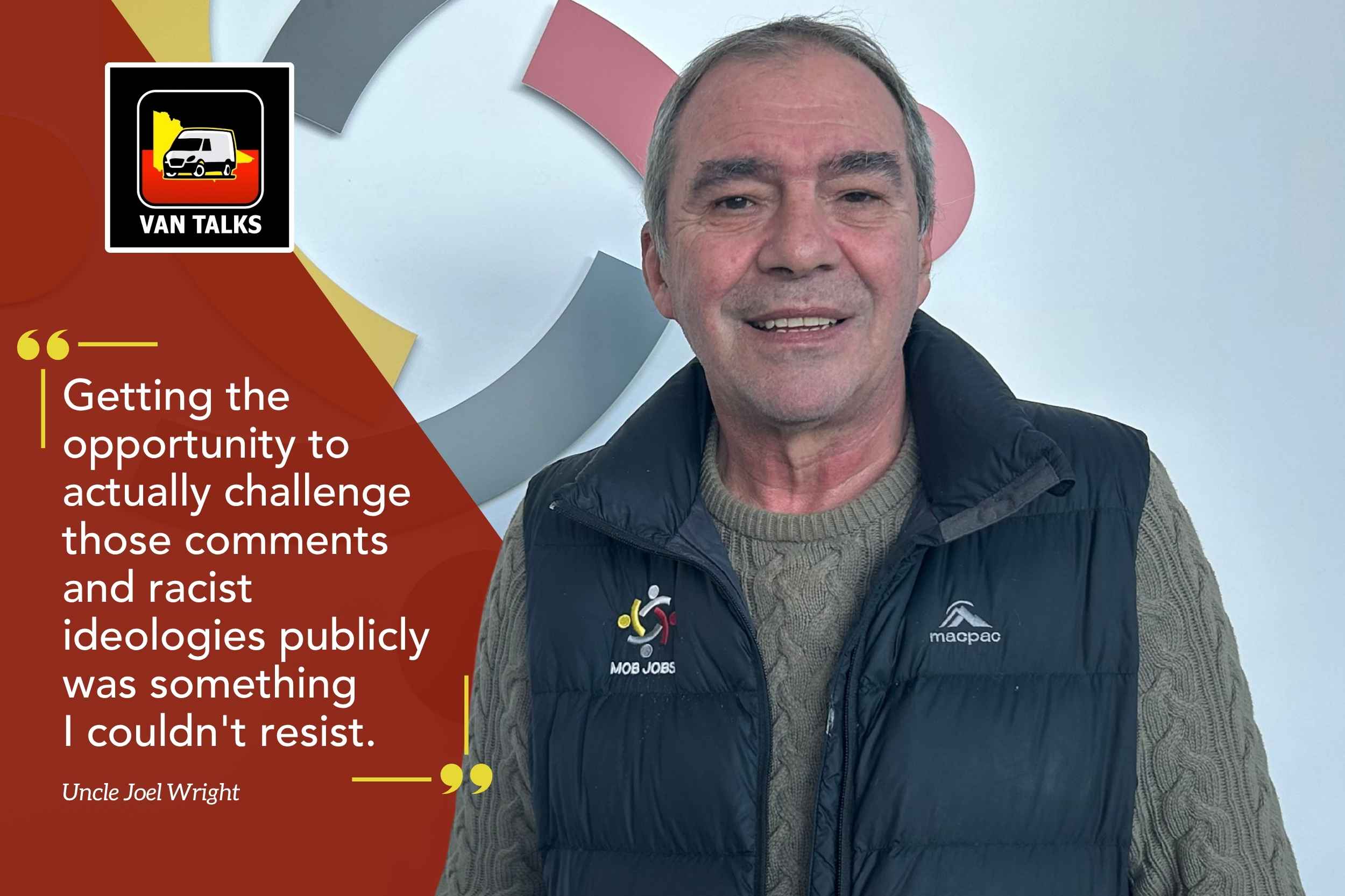
When Gunditjmara Elder Uncle Joel Wright co-founded Koorie Connection in the late 1980s, First Nations presence on community airwaves was virtually non-existent.
“It was pretty silent, to be honest,” Uncle Joel said, recalling the ad-hoc nature of early Aboriginal broadcasting before he took the show from 3CCC in Harcourt to Naarm’s 3RRR.
Driven to challenge pervasive societal racism, Uncle Joel transformed the broadcast into a live talkback forum.
“Getting the opportunity to actually challenge those comments and racist ideologies publicly was something I couldn’t resist,” Uncle Joel explained.
His work caught the attention of the ABC, where he became the inaugural producer for Speaking Out in 1990, working alongside the late Wayne Coolwell.
The groundbreaking show brought stark, unapologetic truths about First Nations experiences to national and international audiences.
Building an all-Aboriginal team provided vital solidarity against persistent pushback and workplace hostility.
“Because we were an all-Aboriginal unit, we all supported each other, and we had resilience and strength from each other,” Uncle Joel shared.
Looking forward, he stresses that First Nations media remains a vital educational vehicle to dismantle systemic racism and drive meaningful reform.
“Aboriginal voices on radio is very much an educational opportunity for wider Australia for them to learn about our issues, our people, our culture, our history,” he stated.
Charles Pakana: Today on the program, I’m sitting with Gunditjmara Elder, Uncle Joel Wright, a pioneer who helped pave the way for First Nations voices in Australian broadcasting. Now, back in the 1980s, Uncle Joel co-founded the Koorie Connection, which was a groundbreaking program that brought self-determined Aboriginal current affairs, culture, and music directly to our airwaves.
We’re speaking with him today to reflect on how he built platforms for unfiltered truth-telling in community radio, went on to shape national broadcasting, and paved the path for First Nations storytellers today. Uncle Joel, thanks so much indeed for yarning with me today.
Uncle Joel Wright: It’s an absolute pleasure, Charles.
Charles: Unk, looking back to the late 1980s when you established the Koorie Connection program on community radio, now initially that was on 3CCC in Harcourt, then later moving it to 3RRR here in Naarm, what was the landscape like for Aboriginal voices on air?
Uncle Joel: It was pretty silent, to be honest.
Charles: I can imagine.
Uncle Joel: We had a strong voice coming out of 3CR here in Fitzroy. Certainly, there were some music programs that were being played on regional public radio stations across Victoria. But once again, it was not really supported to the degree that it is today in terms of having resources to be able to compile all of the music that you require, which is our music, the interview equipment, etc., to actually be able to interview our people.
There was no real resources available, so it was really ad hoc. But our people were still having a go and getting behind the mic, playing our music, telling our stories. It was relatively quiet.
Charles: But you wanted to do more than just play music and tell stories. You wanted to bring your own brand of Blak current affairs to the airwaves. What was the motivation for that?
Uncle Joel: Oh, look, clearly the amount of cultural ignorance that was in mainstream society that basically manifested in racist attitudes and comments towards our people and me personally pretty much for the whole of my life.
And so getting the opportunity to actually challenge those comments and racist ideologies publicly was something I couldn’t resist.
Charles: But had you had experience with radio prior to starting the program?
Uncle Joel: No, not really. I was involved in a lot of public speaking activities when I was in my schooling years, and I was quite a proficient academic in that sense and quite successful. So I wasn’t afraid of standing up and speaking out, so to speak, in any way, shape, or form.
So when an opportunity came along for us to start the Koorie Connection program in 3CCC in Harcourt with my cousin, Ron Briggs, who certainly deserves mention here as well, it was really about showcasing our culture through the music that was produced by our community.
We really didn’t focus on having interviews on specific issues of that nature, but we did speak to particular news articles around Aboriginal issues that might have been reported on television or in the newspaper.
Charles: Okay. So, well, a couple of years after you started on 3CCC, you moved it here to 3RRR in Naarm. What was the driving force there, and what evolution did the program go under in that transition?
Uncle Joel: Okay, so the way the program moved from 3CCC to 3RRR was through my successful appointment for a position that was offered by the Public Broadcasting Foundation at the time.
And that was an Aboriginal producer/trainer for the Victorian and Tasmanian region. So basically, I was employed to actually travel around to community broadcasting stations and support the emerging number of Aboriginal broadcasters that currently had programs on community radio in Victoria and Tassie.
So I did a fair bit of that, and there was a bit of a course that we undertook at RMIT—Advanced Journalism and Production—so we could certainly have some skills to share with our brothers and sisters who were also behind the mic. So part of that appointment also entailed actually having a time slot allocated on 3RRR.
Charles: Right. But what changed in the program? Because you mentioned that you, at 3CCC, were focusing on Blak music and commenting on articles or stories of particular interest. Was there a particular shift once that transition took place to Triple R?
Uncle Joel: Yes, certainly the course that I did at RMIT in Advanced Journalism and Production certainly, I suppose, increased my motivation to become more politically vocal. The format for the Koorie Connection program on Triple R was that it was live talkback.
It was a perfect format for us to actually engage with the wider community and invite the wider community to call in, to ask us questions, to have discussions around particular issues that were prominent on the day affecting First Peoples. And it became quite a lively forum for this cross-cultural discussion and head-banging.
(Laughter)
Uncle Joel: As we used to get…
Charles: Good way to put it!
Uncle Joel: Well, we used to get quite a few rednecks would ring up.
Charles: I do want to ask about that. So, what was it like then for a Blak producer and a Blak commentator on community radio doing talkback?
Uncle Joel: Yeah, it was interesting. As you’re probably aware, it’s always in seven seconds delay.
Charles: Yes.
Uncle Joel: So those comments that came through that were not suitable to go to air, well, they were, you know, obviously dumped.
Charles: Yeah.
Uncle Joel: But, you know, we’d certainly make comment that those sorts of comments are not welcome. If you want to engage in some really constructive debate around Aboriginal issues and culture, then by all means, but to start calling people names over the air is not acceptable. So we had a fair bit of that, so we dumped quite a few calls every time the program went to air. But generally, we started to get really good traction with the wider community because, you know, we had some legitimate issues to put forward.
Charles: So what were some of the key issues that you were looking at in those late 1980s years?
Uncle Joel: Sure. Certainly with regards to the establishment of the Aboriginal and Torres Strait Islander Commission.
Charles: Yeah.
Uncle Joel: And we had direct access to the then Federal Minister for Aboriginal Affairs, Gerry Hand.
Charles: Yep.
Uncle Joel: So I was able to, you know, obviously get him to speak in response to questions that the community had about the proposed establishment of ATSIC. And ultimately, it really contributed to the debate, and it contributed to the policy design significantly for the establishment of ATSIC as well.
Charles: Now, let’s jump ahead a couple of years, specifically to the 1st of July 1990, and you started the Speaking Out program on ABC Radio. You served as its inaugural producer alongside the late Wayne Coolwell, who was presenter.
And it was ABC Radio’s first national program dedicated to First Nations perspective and news, and importantly, produced and presented by an all-Blak team.
I’m really interested in hearing about the challenges you faced in bringing your own form of unapologetic reporting and commenting into national broadcasting.
Uncle Joel: The challenges I had was really getting the ABC to support the need for having the real stark realities of First Peoples’ experiences on a daily basis being broadcast nationally and, ultimately, internationally, Charles, because the program was also syndicated through Radio Australia.
So it was being broadcast around the world as well. It was a bit of a challenge because some of the stuff that was coming into the program from the daily experiences of our people from all around Australia were quite confronting and, without a doubt, extremely embarrassing to the Australian government on a domestic level…
Charles: Sure.
Uncle Joel: …but also particularly on an international level as well.
Charles: Did that motivate you, or cause you to sort of second-guess yourself and consider maybe, “Oh, we’ve got to ease up a little bit”? I know the answer, because history’s told us this, but interesting in your thought processes.
Uncle Joel: Well, look, I was very careful in the design of the actual program format. And the format had checks and balances built into the way it was structured.
Now, it came out after our theme song and an introduction by Wayne, bang, straight into a wrap-up—the week in review. The most significant news stories, 30-second news stories that happened pretty much right around the country. We’d get one from every state. From police bashing people and being recorded on mic, all those sorts of activities were happening, and that being shown to the whole of Australia was obviously sensitive.
We followed it through then with a more in-depth look at one of those key issues that was happening through the news bulletin, a three-minute interview, then with some music, then we followed into our feature piece for the program, which usually went for 10, 15 minutes.
And it was more an exploration of culture, community achievement, all those sorts of things. A bit more music, celebrating emerging artists and promoting them, and then the last part of the program was recognising significant people in our community and the achievements that they’ve made.
Charles: What sort of pressure were you getting from management at the ABC? The smile is telling a myriad of stories are there, but what were some of the pressures you were getting, if you are permitted now, nearly 40 years later, to yarn about them?
Uncle Joel: At the end of each program, when it was broadcast on Sundays, Monday morning would be the editorial meeting with the news editor-in-chief and the executive producers of the National Syndication Unit, for which Speaking Out was part of.
And certainly there was some, let me say, quite rigorous, robust discussions and arguments about choices for particular content that was included in the previous Sunday’s broadcast at those meetings.
So there was a lot of pushback in that sense in a formal context. But one of the things that was really difficult was the amount of racist attitudes that were directed towards certainly myself, and Wayne, and ultimately Aaron Ross, who came on board as a production assistant as well.
Charles: Just talk a bit about then, Unk.
Uncle Joel: It was quite abhorrent, and it was constant. But nonetheless, we were pretty tough-skinned, Blakfellas. Because we were an all-Aboriginal unit, we all supported each other, and we had resilience and strength from each other. And we were able to keep our mission as our focus, and that was to showcase the best of Aboriginal people and culture, as well as demonstrating to the wider Australian community the level of oppression and discrimination and racism that pervades our country and targets Aboriginal people on a daily basis.
Charles: When you look at mainstream media and community broadcasting now, it’s nearly 40 years later after you started that first program on 3CCC. What are some of your aspirations? Where have we, as current Blak media, missed the mark based on what you and Wayne were seeking to achieve way back then?
Uncle Joel: Look, I think it’s a different world today in terms of the political attitudes and climates. And certainly, if you’re talking from one state to the next, they can be very different socio-political environments.
Charles: Very much so, yes.
Uncle Joel: And so, clearly here in Victoria, this state is leading the way in terms of recognising First Peoples’ sovereignty and First Peoples’ rights and social justice issues more broadly.
Whereas in comparison, we’ve only just heard this week or last week, the reform of the child protection provisions introduced by the Northern Territory, which is a total regression of progress that we’ve made here in Victoria.
So in that sense, I think it’s a very, very different environment, but more, I think it’s much more acceptable by wider community that there are Aboriginal points of view, and they are legitimate points of view, and they need to be heard, and they need to have a voice.
And certainly, I think that was reflected in, whilst we had the failed result for the Voice to Parliament referendum, we still had six and a half, seven million people vote Yes.
And I think certainly programming from Aboriginal broadcasters has contributed significantly to raising the level of awareness of our issues within the population to that degree.
Charles: What do you want to see more of, though? And I feel like I’m almost asking for a private class in what I should be doing at Victorian Aboriginal News, but in the broader community radio environment, let’s focus on that. What would you like to see more of? More bravery, more risks being taken, more outspoken commentary? What is it?
Uncle Joel: One of the biggest issues that still continues today, and that existed at the time that I started broadcasting, and I think it’s actually got worse, is the degree of racist attitudes towards First Nations people.
And I think we need to be able to garner the support of those allies out there who understand the issues related to racism, and they understand and respect our unique position in Australian society as First Peoples, to actually challenge all of the racist attitudes that are now being focused towards us post-referendum, now through the emergence of far-right and right-wing political parties.
So I think that’s what we really need to start focusing on. We have a lot of allies in this space, looking at what the Human Rights Commission is challenging the Australian Government to do in terms of stepping up to be stronger in response to racism.
I think we can bring more pressure to bear on those lobbies through our voices and telling our stories and experiences of racism that we cop every day.
And, Hopefully, that can culminate in a bit of momentum to actually get the government to move and introduce stronger measures to hopefully reduce racism across the board.
Charles: Unk, last question before we have to sign off. Being aspirational, and you’re always known as an aspirational man, what would you like to see going forward, 5, 10, 20 years into the future, when it comes to dealing with Blak matters in the general media of this country?
Uncle Joel: Obviously, my overarching aspiration is for a national treaty, and that we have a voice in the parliament, in all parliaments of this country, so we’re able to then progress the issues that are still continuing to impact on our health and well-being today. I think in the spirit of reconciliation, promoting reconciliation as a path towards achieving national recognition through a treaty framework, I think, is really what I see as the pathway to success.
Charles: And media’s role in all this, Unk?
Uncle Joel: Aboriginal voices on radio is very much an educational opportunity for wider Australia for them to learn about our issues, our people, our culture, our history, and understand the reasons why we need to have social justice and reforms and to properly address the inequities that we face on a daily basis.
Charles: Uncle Joel Wright, respect and thanks so much indeed for your time.
Uncle Joel: It’s a pleasure, Charles. Thank you for the opportunity.
For Radio Play:
1 - Click the Download Audio button
2 - The audio file will commence automatic play in your browser
3 - Confirm this is the file you want to use in your program
4 - Once confirmed, click the vertical elipses (3 dots) and select download
CONTACT US VIA SMS
Get in contact with us via our dedicated SMS line:
0493 222 836
12 October 2026
Start learning about First Nations cultures without the fear of offending
5 October 2026
The revival of cultural burning practices to remediate Country and help mitigate disasters
1 October 2026
Implementing First Nations knowledge to heal country
28 September 2026
It’s time for Australia to acknowledge historic atrocities
24 September 2026

0 Comments