
Beyond acknowledgements: How youth redefine reconciliation
Sixteen-year-old Lola Wood-Sharples speaks out on VAN Talks, calling for real accountability on Closing the Gap targets and demanding meaningful action over empty government promises.
Posted by: Karina Wells
Published: 3 August 2026
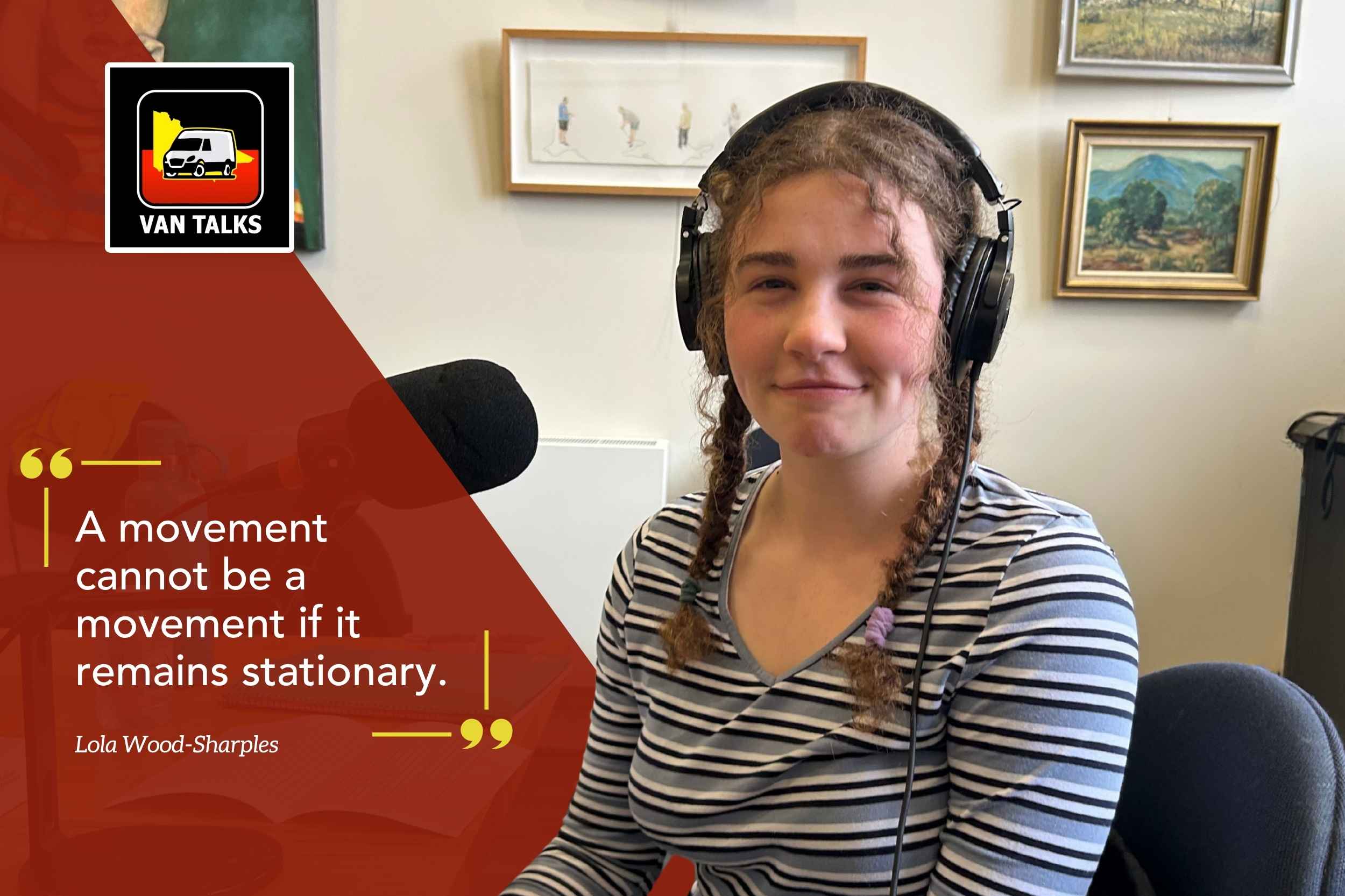
A sixteen-year-old student has issued a powerful call to action on Closing the Gaps, challenging Australian leaders to move beyond rhetoric and deliver genuine change.
Speaking on the Victorian Aboriginal News VAN Talks podcast, year 10 student Lola Wood-Sharples delivered her compelling speech scrutinising national progress.
“For two decades, Closing the Gap has been Australia’s national pledge to give Aboriginal and Torres Strait Islander peoples the same life opportunities as every other Australian,” Lola said.
Latest data shows only four of nineteen Closing the Gap targets remain on track, highlighting severe delays in key areas.
“Taking steps are not the same as arriving,” Lola said.
“We set nineteen measurable goals… but we are either falling short, stalled, or going backwards on fifteen of them.”
Youth incarceration, imprisonment, and suicide rates continue to present urgent challenges across the nation.
“The gap will not close itself,” Lola said.
“We are five years out from the 2031 deadline.”
Systemic failure stems from treating self-determination as an administrative program rather than repairing genuine relationships.
“A movement cannot be a movement if it remains stationary,” Lola said.
True reconciliation requires embedding First Nations culture, history, and truth-telling into everyday education systems.
“There’s a difference between acknowledgement and action,” Lola said.
Empowering young voices remains crucial to driving community-led solutions and keeping accountability alive for future generations.
Charles Pakana: Earlier this year, I was invited to attend Eltham High School and hear some Year 10 students deliver their own speeches that focused on any one of a number of First Nations-specific subjects. The first speaker of that session was Lola Wood-Sharples, a young woman, just 16 years old, who really impressed me when she spoke with authority on our country’s shameful work towards closing the gap. I am absolutely delighted to introduce her to the program today, during which she will share her speech and some key messages. Lola, welcome to our program.
Lola Wood-Sharples: Hi.
Charles: Lola, let’s get rid of some of the nerves, shake those off. Let’s put you back in your comfort zone, and if you could share with our audience that speech.
Lola: Closing the gap: to reduce or eliminate a discrepancy or difference between two points, groups, or state of affairs.
For two decades, Closing the Gap has been Australia’s national pledge to give Aboriginal and Torres Strait Islander peoples the same life opportunities as every other Australian. It’s a commitment to close the gap in life expectancy, child mortality, education, employment, and housing. Not in some distant future, but within a generation.
Imagine something for a minute. Imagine being born in a country where, before you’ve even taken your first breath, the odds are already stacked against you. Where your life expectancy is eight to 10 years shorter than the person lying in a cot next to yours. Where as you’ve grown up, you’re more likely to be removed from your family, more likely to be suspended from school, more likely to end up in prison than in university. All these decisions are made the moment you’re born. Your future decided for you, but not by you. Now imagine this isn’t some far-away country. It’s here. It’s Australia, and it’s 2026.
The Closing the Gap movement was never meant to be a slogan. It was a promise. A promise made by every Australian government at every level to Aboriginal and Torres Strait Islander peoples. A promise that we would close the gap in life outcomes within a generation. A promise that we would do better.
I want to ask a simple question: Have we kept that promise? Let’s look at where we stand right now, our current reality. The latest data from the Productivity Commission, updated just a few months ago, shows that only four out of 19 Closing the Gap targets are on track. Four out of 19. Let me put that another way. We set 19 measurable goals to close the gap in health, education, employment, housing, and justice. This is the summary of the Closing the Gap campaign, a fierce, independent advocacy for health and life equality between Aboriginal and Torres Strait Islander peoples and white Australians. An action of social justice derived from Indigenous-led organisations that is big and inspiring and moving.
But none of those words matter, because we are either falling short, stalled, or going backwards on 15 of them. There are so many arguments made as to the idea that no one has gotten the chance to reconcile with Indigenous Australians. Right there are 15 chances that we as a country have not only failed to satisfy, but have failed to even take, failed to even attempt.
Now, don’t get me wrong, of course there are some bright spots. We’re on track to achieve the target of 95 percent of Indigenous children enrolled in preschool, real progress that deserves acknowledgement. The Remote Jobs and Economic Development Program, an Australian Government initiative aimed at creating thousands of well-paid, sustainable jobs for First Nations people and locals living in remote communities, has supported over 1,500 jobs since its creation in the second half of 2024. More than 850 new homes have been built in remote communities since 2022. The government has invested in food security for remote stores, in Indigenous health worker traineeships, in upgrading 100 health services. These things matter. They are steps in the right direction, a direction that we never should have tried to veer away from in the first place.
But let’s be honest with ourselves: taking steps are not the same as arriving. Suicide rates among First Nations peoples are at their highest since 2017. Adult imprisonment continues to rise. Aboriginal Australians make up 3 to 4 percent of the population, however make up over 30 percent of the prison population. Think of that like having read nine pages of a 300-page book compared to having read 90. It just doesn’t make sense. These hard facts prove that it’s no longer just a gap, it’s a chasm, a widening chasm.
Youth incarceration is going backwards. Children, children are being locked up at rates that should shame every one of us. So why? Why, after all these years since 2007, after all the reports, all the funding announcements, all the press conferences that year after year confirm the illusion of change and reveal honest failure cowering behind lies, hasn’t anything worked?
I’ll tell you why. It’s because we keep treating Closing the Gap as a government program to be managed and maintained, rather than a relationship that must be repaired. The National Agreement on Closing the Gap, signed in 2020, was supposed to be different. It was supposed to shift power from Canberra to communities. It was supposed to mean that instead of Indigenous Australians being informed after all decisions were made, they would be at the table from the start.
But too often, do old habits die hard. Governments continue to announce programs without proper community consultation. Funding is still short-term and competitively driven. You cannot close the gap by doing the same things and expecting different results. A movement cannot be a movement if it remains stationary.
February 12th of this year, the Prime Minister stood and delivered the annual Closing the Gap statement. He said, and I quote, “Closing the Gap is a national test, a generational task, a moral imperative.” Those are strong words, but what really matters isn’t the strength of his words, it’s whether he meant them. But words are not the same as actions. Reports are not the same as results. Good intentions do not build houses or keep children out of prison and in their homes or stop somebody from taking their own life.
The gap will not close itself. We are five years out from the 2031 deadline. Five years to prove that this time, we mean it. Five years to show that the Closing the Gap is not just a report filed every February, a form we allow the government to push to the back of a filing cabinet. It is a promise that we have made and must continue to keep. The question is not whether we can close the gap—we know we can. The question is, will we?
Charles: Wow. And just for our audience, I’ll remind everybody that Lola is a 16-year-old, young non-Aboriginal woman. And that is one heck of a powerful speech calling out the Prime Minister, in fact, calling out the entire country, I think which is really important to note. Lola, you were given an option to choose from about 20 subjects, I think you mentioned to me. Why on earth would you choose the most complex one with Closing the Gap?
Lola: I think my initial thought was that I thought that my own beliefs would be able to get the most out of the Closing the Gap. I looked at all the other ones, and I thought, you know, most of the people already have chosen those and no one’s choosing this one yet. And I had a look at it because we had a session to figure out which one we wanted to choose. And I did some research on it, and I just ended up going, yeah, I reckon this one’s my target, and I reckon I can get the most out of this.
Charles: Did you end up going down a bit of a rabbit hole that is sort of uncovering fact after fact after fact that you may not have thought were going to go that deep into all this?
Lola: Yeah, I definitely didn’t think I’d get that far into it in the one session, because I think we had maybe two weeks to actually complete the whole assignment. But I remember looking at all the facts and all the websites, and I remember there was like five at the start, there was like nothing, because my teacher had supplied us with original websites that we could have a look at that were general for all of these. And I think there were maybe two that covered Closing the Gap, because it’s just something that no one wants to even attempt to cover. I thought, I guarantee I can find more on this.
Charles: Was there much shock value for you as you were uncovering all these facts? Because it is a pretty shameful scorecard when you look at it, given that we’re what, six years down the track with this, halfway there, as you pointed out. And really, if we’re only what, four of the targets on track—
Lola: Yeah.
Charles: What really surprised you and shocked you, even, in this?
Lola: I think what you just said, that there’s four out of 19, that—and when you look at that statistic, you assume that it’s four out of 19 that are completed, but they’re not even completed, they’re just attempted. And of course, we’re still trying to complete them, but we shouldn’t just be focusing on those four, we should be looking at all of them in that case and trying to complete all of them. You can get a lot done. That’s—that’s how old I am. You can get a lot done in that time. I’ve almost completed my first education and second education. You can get quite a lot done in that time, especially if that’s all you’re putting your focus into. And we’ve only tried four, and none of them are even at 100 percent yet.
Charles: What would you as a young person who very soon is going to be voting, as a matter of fact, you’ll be voting in the next federal election, what would you be expecting the government to really start showing up to do to bring about some measurable change in Closing the Gap?
Lola: I would hope by then that we’ve had a little bit more movement in the Closing the Gap initiative. I’d hope that by the next February that we sort of sit up and think, how is it practically the same result after 10 years? Like I remember a decade ago, it’s like déjà vu. I’ve already heard this speech. And I’m hoping more people are going to look at the speech given, and at the reports and the results and think, yeah, yikes, what are we doing here?
Charles: If you were to be able to sit down with the Prime Minister tomorrow, what are some key messages from a young person who’s socially active and socially aware, what are those messages that you would want to ram down the Prime Minister’s throat?
Lola: I have always been a firm believer of treating people the way that you want to be treated, and that everyone deserves as much respect as possible, and that no one should really be given more respect, or in this case, less respect than others, whether it be one person, a group of people, or a community of people.
And in this case, it’s relevant to a core part of Australia, and that we haven’t done anything. We—we try to acknowledge it, but there’s a difference between acknowledgement and action, especially with matters like these. If we’ve promised to do something, we can’t just not do it.
Charles: Is it a reflection on the government, or is it a reflection on the nation, from your opinion?
Lola: I think it’s a reflection off of both in different ways, because it’s the government that promised us something, promised the Indigenous community something, and it’s the government that hasn’t delivered. But it’s not like Australia’s got up off the couch and gone, yeah, let’s do this, we don’t need the government to do this, we can deliver change on our own. But I think everyone’s just relying on the government because they made that promise and they haven’t delivered, and they see it as something that they shouldn’t have to take the blame for, which ironically is how a lot of people see the Stolen Generations, that they shouldn’t have to take blame for it. And it’s kind of like history is almost repeating itself in many different ways.
Charles: As a young person in high school, what are some of the things that you would like to see change within the education system? Now, we’re not pointing directly at this school here, because I know that over the years, they’ve actually done some good stuff, but if we take this as a microcosm of the educational system, at least in Victoria, what would you like to see change to bring about greater awareness of some of these key issues?
Lola: School’s a place of learning, that’s the whole point of it. And I’m—I don’t know why school ever came down to be compacted into maths, English, humanities, and all those staple subjects that you did get taught at school. And I don’t know why schools stopped teaching, or even some of them didn’t even start teaching about different matters in the world or in Australia.
Charles: Yeah.
Lola: And I certainly see that some schools are starting to try and introduce different subjects. But if we could get some classes in the education system that teach us about the Indigenous community… Cause of course, in humanities, we have topics that cover it, and an assignment that covers it, but it’s only a part of it, and it’s only for like one term. If we had a whole class across every year level, even just one—
Charles: Yeah.
Lola: —I really think it would do something. Whoever takes it, it would be something that helped everyone at least know and learn.
Charles: You’re a young person, you’ve lent your voice to this, and you’re obviously passionate about this as well. If you were to stand up in front of the entire school, what would you be calling for from your schoolmates?
Lola: I would say that I would just try to help them learn the same thing as I said in the last answer. I think I would just try and help them see things from not just my point of view, but as many people’s point of view as I possibly can, because it’s not all about what I think, it’s about how we can make everyone come together as a nation and be okay.
Charles: Lola, I’m interested to hear your thoughts on the future of reconciliation. Now, over the past several years, we’ve heard calls from various parts of society, political, media, and general community, that reconciliation is dead, and it died in 2023 with the failed Voice to Parliament referendum. It seems, though, that your speech, and I’ll also acknowledge the speeches of your classmates, because they were some amazing speeches, and certainly I wish we could have them all on this program, but reconciliation is not dead. As long as there are young people who are paying attention, doing the research, and giving voice to this, what are your thoughts on reconciliation and the role of youth in keeping reconciliation alive?
Lola: I think reconciliation is certainly not dead, but I think quite often it’s—it’s mistaken for dead because of the way that we consistently do it. I think the way that it’s done is dead because we’ve been doing it for so long and no change has been sought. But I think that if we can go about it a different way, rather than just at every school assembly, and at every conference meeting, and at every, you know, gathering… The Acknowledgement of Country is important, but it shouldn’t necessarily be the only mode of communicating reconciliation, because the definition of reconciliation isn’t Acknowledgement of Country.
Charles: Exactly.
Lola: It’s its own thing.
Charles: Yeah.
Lola: It’s—it’s not anyone’s fault, though, because of what I said earlier about introducing classes into schools. If we can teach people that, because no one knows that. Everyone just equates the word reconciliation to an Acknowledgement of Country when it’s not, and you and I know that, but there are many, many people that don’t know that. And there are many other ways that we can reconcile that just isn’t told to people. No one is taught that.
Charles: What are some of those ways that you might call out to people to say, you know, here is a way forward for real, meaningful, and substantive reconciliation?
Lola: There’s different ways. There’s simple ways, there’s difficult ways, but they all mean the same thing at the end of the day. Things like introducing more Indigenous culture into even things like playgrounds, you know, for young children, so that it’s something that they don’t get to high school and they go, “What’s—what’s that?”
Charles: So you’re talking Traditional games, Traditional artwork that may be decorating the playgrounds—
Lola: Murals.
Charles: Yeah.
Lola: Flora and fauna, like Indigenous gardens around playgrounds as well. Sometimes schools will have them, my primary school had one. Yeah, we had smoking ceremonies as well at my school, and I just remember everyone used to be really pumped about them, and they thought they were so cool because we were all like six years old. They were the highlight of the year or the semester or whenever we did them.
Charles: Yeah.
Lola: If that’s something that the kids like to do, why put the brakes on that? Why have it just that? Why not many other things? You know, why not have a mural like that on the side of a school or have an elder come in and speak to kids or speak to high school students in an informal way? Because I think the formality placed upon it by students and teachers makes it so impersonal that we feel like it has nothing to do with us. And if you feel like something has nothing to do with you, then you don’t want to go near it, you don’t want to touch it, and you don’t want to get involved. But if it feels just that little bit more personal, like when you came in to my class and spoke, we were all speaking afterwards, and we felt that it was so different than how it normally is. No one was bored by anything, and everyone had a decent time because it was so much more personal than it’s shown to be normally.
Charles: So you’re actually saying to make it a normal thing, to normalise it, which is just such an important thing, rather than shunning it and pushing it aside and saying, “Oh, that’s strange, and we don’t want to have a part of that.” Lola, we have unfortunately run out of time. I want to thank you for sharing your speech and your thoughts, and also demonstrating quite clearly, I think, to all listeners and hopefully all Australians that reconciliation, as long as we have young people like Lola and her classmates, is never dead. Lola, thank you so much indeed for sharing with us today.
Lola: Thank you for having me.
For Radio Play:
1 - Click the Download Audio button
2 - The audio file will commence automatic play in your browser
3 - Confirm this is the file you want to use in your program
4 - Once confirmed, click the vertical elipses (3 dots) and select download
2 Comments
CONTACT US VIA SMS
Get in contact with us via our dedicated SMS line:
0493 222 836
15 October 2026
It’s time Australia recognised a shared history of often brutal “settlement” and expansion
12 October 2026
Start learning about First Nations cultures without the fear of offending
5 October 2026
The revival of cultural burning practices to remediate Country and help mitigate disasters
1 October 2026
Implementing First Nations knowledge to heal country
28 September 2026
Go Lola – thanks for your vision and commitment to reconciliation: truth & justice.
Would you like to call me at Reconciliation Victoria for a short chat, please?
We’re starting a Younger Allies Network, in Naarm/Melbourne at first.
Cheers – Vicky
Powerful and articulate speech, well done Lola.