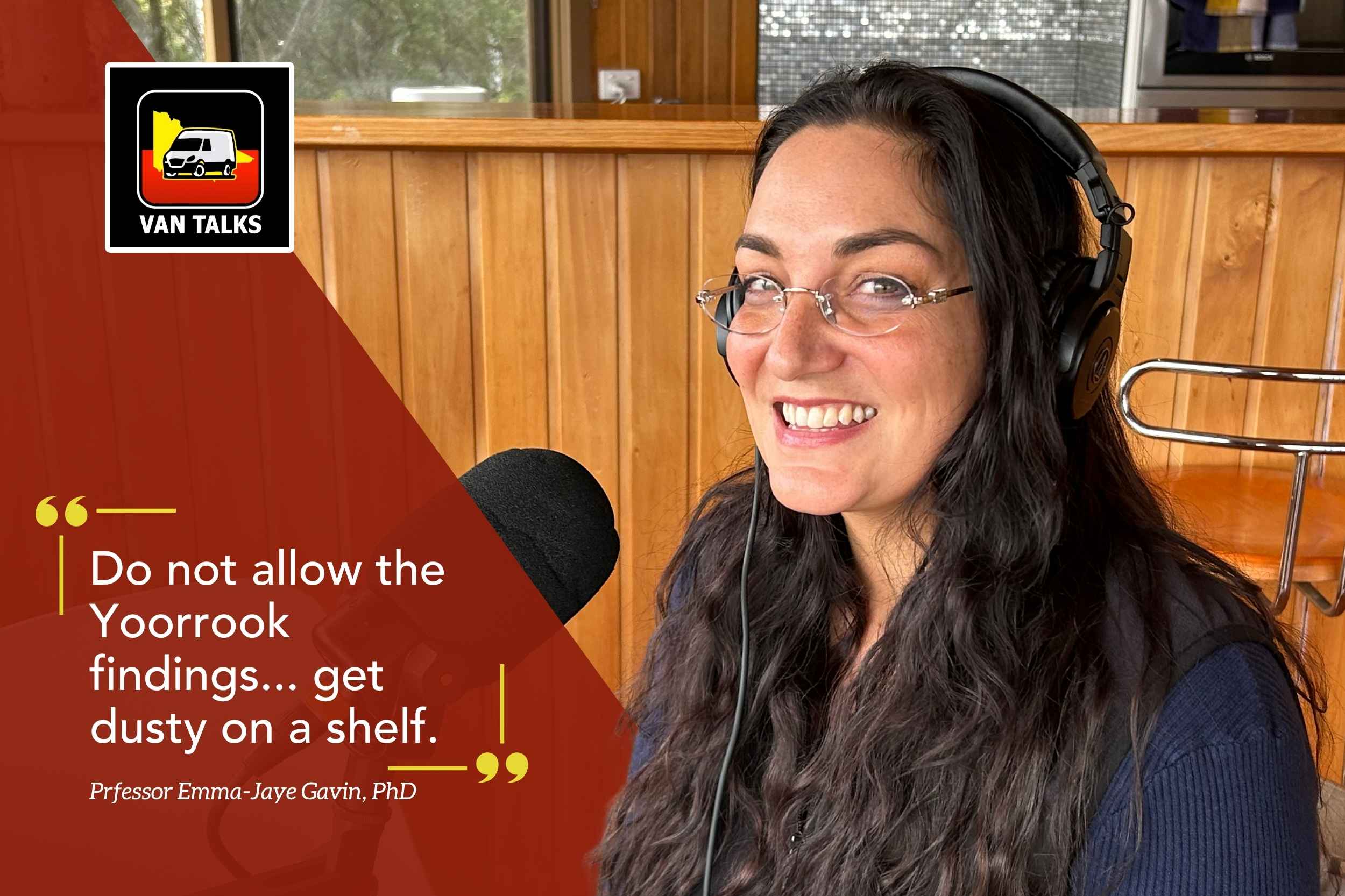
Uncle Charles Pakana: For 15 years, Garrwa woman Emma-Jaye Gavin has been a thought leader on First Nations matters in the world of academia here in Australia. The country’s first Indigenous professor for truth-telling at Federation University, she is now at Monash University as Professor of Politics and International Relations. She joins us now. MJ, thanks for joining me on the program.
Emma-Jaye Gavin: Thanks for having me, Uncle.
Charles: MJ, the move from Federation University, where, as I mentioned, you were the Indigenous professor for truth-telling, to the Professor of Politics and International Relations—I know that you have a passion and an expert area in truth-telling. How does this move keep you in the truth-telling space and actually add to your already impressive experience?
Emma-Jaye: Truth-telling remains central to my work. It now includes teaching, so I have an international First Nations relations unit—a couple that I teach—where truth-telling is a big foundation. But I also, of course, have truth-telling as central to my research. The move to Monash enables me to actually grow the truth-telling research work that we’ve been doing, so we’re going to be creating a First Nations Truth and Reconciliation Partnership Hub at Monash University, which will continue the research that we’ve been doing, but also allow us to expand it.
And also have a lot more support through research officers, through publications, more access to PhD students who might want to work with us, and a bigger international focus because there’s a lot happening in that international ally space.
And we continue to have those partnerships that we built originally with Canada and others around the world, just to make sure that we’re not continuing doing this work on our own. It’s happening everywhere in colonised First Nations countries, and truth-telling is a core of how we are approaching decolonisation. And so we can learn, and we should be learning and sharing.
Charles: I’m interested, and let me challenge you a little bit here… How does this work actually translate to real-world change? I mean, we’ve seen what happened with Yoorrook, and we’ll talk about Yoorrook and indeed Queensland in just a short while. But how does the academic world of truth-telling actually relate to changes and calls to action within the broader community?
Emma-Jaye: It’s a really good question, and it works in a lot of ways. So we create research, whether traditional or non-traditional, and that is engaged with by community, and by government, and by those stakeholders and people with power, like your radio station. Reaches the ears perhaps of people who might not have the knowledge of this before, and that translates into policy change or into the change of how people approach politics and how they approach voting, when they can consider what their party is voting for and if it’s in their interest or not.
So if they don’t know about these things that are happening or have happened to First Nations Australians, then it’s unlikely that they will vote in our interests, whereas if we make this knowledge available, both to students within a teaching perspective, from academia, but also when we translate this into books or journals or films or on this radio show, we reach larger audiences.
Charles: And tell me, how does the work of the Yoorrook Justice Commission, and hopefully in the future other justice commissions on the state and territory basis, how does that inform the work that you are doing?
Emma-Jaye: Oh, definitely. It’s foundational. Yoorrook, for example, Australia’s first formal truth-telling—we get to lead by example from that. So there are other states and territories who we work with, or we support through truth-telling work while we wait for the state-level truth establishments to either come or be reinstated.
Yoorrook informs all of that. It’s the best practice model. Yoorrook was created through a very intense, focused look at the world, and truth-telling commissions on the large, and then dedicated and directed to be very Australian-focused and what worked in other places, what didn’t.
It’s a formal way of getting our point across, so while there are issues with how the government might use the Yoorrook findings, or not use them and let them sit on a shelf like others, there’s a series of key documents now. And so when we call on government to do things, rather than it being hundreds of individual voices, we can say, “Here is Yoorrook. Here are the collection of First Nation Victorian voices. Here is their experiences. Here is what they are calling for. And how can you ignore that now? It’s gone through Western processes.”
Charles: Just talking about Western processes and systems, of course, a lot of the evidence and the submissions that were given to Yoorrook demonstrated what many consider to be a system that is well and truly broken. But what really impressed me and formed, actually, a foundation for me reaching out to conduct this interview was when I attended a book launch just a couple of months ago, and you were up there as, I think, the co-editor, and you authored a chapter.
Emma-Jaye: I did.
Charles: And you made a comment which just has stuck with me, and I am going to paraphrase it a bit, but you stated with a… quite a degree of angst, that systems are not broken—that is, the Western systems as we see in Australia are not broken. They worked just as they were designed against First Nations peoples. I want to explore that, and your rationale for coming out with that.
Emma-Jaye: Sure, absolutely. I want to start by saying I am not the person that came up with this. I have heard it quite a lot in recent years, but I do think it is a very good way of reframing the way we think about systems.
Charles: Yeah.
Emma-Jaye: So in saying that the systems are not broken, I am challenging the idea that the outcomes are simply accidental failures, right? Presuming that the institutions are neutral. The institutions are not neutral. They were designed through dispossession of First Nations peoples, through imprisonment, rape, destruction of country and lands and laws and languages.
And those systems that weren’t built here came from the UK. And so we’ve already got systems not designed for us, and then new systems built on the back of our dispossession.
So when we say they’re not broken, well, they’re operating the way they should. They are operating in the defence of the primary population, which is not First Nations peoples. So when we look at the failures such as Closing the Gap, or we look at First Nations incarceration rates, that is not the justice system failing. That is the justice system operating by design.
Charles: So what role do you think that your work in truth-telling has? You’ve already made mention of the fact that it helps to inform academics, it helps to inform the politicians. What do you really see that it could achieve within the next 5, 10 years, and by all means be aspirational?
Emma-Jaye: Look, I’m hopeful. I remain hopeful, and I remain hopeful because elders tell me to remain hopeful. And so even though we can look at the many, many, many reports that we have written and given our hearts and souls into over many, many years and see them gathering dust on a shelf, I’m hopeful that we continue to move towards a truth… almost reckoning in Australia.
I was hoping that Yoorrook would be the basis for that, and that other states and territories would follow, and of course, we know that that has not been the case. But in the next 5 or 10 years, I hope that it will.
And so when we engage in the kind of research that we do at Monash and in this new hub, we have a variety of outcomes from that research, like I said, books and journals, and there’s films, and there’ll be documentaries, and different ways that we engage.
And we just have to keep trying to change the people closest to us, right? If every single one of us approached truth-telling as “What can I get my immediate family to understand? What can I get the person at the place that makes my coffee to understand, or the people in my cubicle at work?”, you know? Because it’s too much to consider, “how do we change the government, how do we change the world?” Start. Start here, right?
Charles: Essentially, start at the grassroots.
Emma-Jaye: Yes, and it’s being done.
Charles: So, well, it is being done, I agree with that. But a lot of it here in Victoria is based on the high profile of the Yoorrook Justice Commission. Let’s talk now about Queensland, and obviously the kick in the guts that was experienced by so many people right around the country, not just in Queensland, when the Queensland Government decided, “You know, we’re going to backpedal on truth-telling.” Just what sort of impact have you seen or heard that have on the local communities up in Queensland?
Emma-Jaye: Honestly, for a lot of the people I spoke to, it was like being re-traumatised after the Voice [to Parliament Referendum]. In a lot of them, it almost broke them, you know? There’s a lot of mental unpacking and preparedness that you have to do to undertake truth-telling as a First Nations person.
And so you have an entire state of First Nations peoples and leaders prepared for this level of trauma unpacking. You’ve got several months of work being undertaken, and then you rip it away while the wound is still fresh. I think it’s hard now to have faith in a government, because if your truth-telling is at the whim of a single political party, then it’s not sustainable.
And so I’ve seen a lot of people withdraw from politics and from politics as a hope for truth-telling. We can fall back, of course, on the communities that have always done truth-telling at a community level. That work continues, and thankfully, it does, because the state is not going to do it, as is seen.
But I think the bigger problem here is that we are going to lose the faith that we might have had in a political truth-telling future.
You know, we’ve got a census coming up. I’ve spoken to quite a few Indigenous people who have no interest in engaging with the census, because why? It doesn’t work. Engaging in the political future doesn’t support your outcomes. And so I’ve had to have some conversations with people about: “yes, it’s hard to have this faith in any kind of political infrastructure, but something like the census acknowledges where we are as First Nations peoples, where we live, what services we need, and so to not give up faith in those political institutions because they haven’t worked so far, but they may work while we continue to do this work.”
Charles: What about at the community level? You’ve made mention of the fact that, yes, people can speak to the person in the next cubicle, in the family, whatever. But from your experience and understanding, if the government’s not going to be doing truth-telling or conducting the truth-telling, such as what took place here in Victoria, what does community truth-telling look like, and where have you seen it actually work well, whether here in Australia or even overseas?
Emma-Jaye: So the different truth-telling that I’ve seen done by communities is incredibly vast and very different. It can be as simple as renaming a place, and a place of importance, back to its First Nations name. Or it can be enacting a statue that tells a First Nations story. We drive all around this country, and we see a statue of a random white settler, usually one that has done some awful things…
Charles: Plenty of those.
Emma-Jaye: …and there’s no history there of the First Nations peoples or their stories. And so just that, as simple as enacting a legacy there, or a story there, or some level of significance. You know, I was in Tasmania recently, and I saw they’ve made huge efforts in areas—I was at Bruny Island—and there’s representation now. It tells you important facts, it shows you important faces that you wouldn’t have seen 10, 15 years ago.
Charles: So this is like a statue they have, for example, up on Wiradjuri country in Gundagai, with it’s a beautiful statue of two Aboriginal men who in their bark canoe, when the region flooded, actually went out there and saved goodness knows how many white lives. That’s acknowledging and keeping truth-telling alive. Is that the sort of thing you’re talking about?
Emma-Jaye: Absolutely, this is truth-telling.
Charles: So this is where local governments can also come into play. I mean, you made mention of the fact of changing a street name or changing a park name. I mean, these things in many cases can be under the control, or at least the influence, of local government. What about in other areas as well, I mean, just organisations and just groups of communities and interested people? What can they typically do to influence this?
Emma-Jaye: Absolutely, it’s a great question, and what’s great is it’s already happening. There are individual businesses, there are individual local governments or schools who are engaging in truth-telling in unique spaces. So whether it’s the story of the local place where the school is or where the local government is, or just acknowledging the country that you’re on, these things create awareness, and that awareness creates more mobile thinkers who are considering First Nations peoples and their experiences and what we need. And then when we come around to elections, you’ve got a more informed base and also a more empathetic Australian population, because we hear a lot, “I wasn’t taught that.” And if you read our new book, Barriers to Truth-Telling, one of our authors speaks to that, you know, “Why wasn’t I told?” So, of course, in at least in the last 20 years, they have been taught, because it’s in the curriculum. It’s in the secondary curriculum. But why didn’t we listen, right? And that’s the main point of our book: why aren’t settlers listening?
So if they’re not listening in the schools and they’re not listening through the traditional methods of reading and history and in that format, then can we get them in these other areas? Through your local gym, even, or the local place that you get coffee? Can they have an acknowledgement of the land they’re on? Can they have some sort of understanding about where they are, whose stories that they’re on, you know, what are the truths of that place? And we are seeing this work being done across the country by some really, really well-engaged people, and working with First Nations communities to tell those stories, you know, not telling on behalf of us, but working with us to acknowledge and create these spaces that feel informed, and also feel a lot safer for us as First Nations people.
Charles: So for those people in community who wish to advocate for state-based truth-telling, and where it’s obviously not going to happen—and we’ll look at Queensland and other states right now—there’s obviously things that they can do. So do you encourage them to take their efforts and their enthusiasm, and start lobbying local governments and general communities as well?
Emma-Jaye: Yes, if it feels safe to do so, yes. And go to your local co-ops, because First Nations people are leading this, whether it’s televised or not, and whether it’s in a formal process or not. First Nations communities all across this country are working towards truth outcomes. If you are a business owner, or you work for your local government, or you work in some capacity where you think truth might play a role, or you might be able to advocate for First Nations truth-telling in your area, then look to the co-ops, look to the elders in your area, and invite them for a yarn where you can unpack and create, you know, co-design a direction together.
Charles: And that also works with Aboriginal gathering places for those people who may not have access to a co-op. MJ, we’re nearly approaching end of time. I want to bring it back to state-based truth-telling, and this time let’s be specific to Victoria. We’ve got elections coming up in November of this year. No one is prepared to put money on anyone getting across the line here, but thinking now, what would you say to an incoming Premier and their cabinet by way of supporting the outcomes of the Yoorrook Justice Commission?
Emma-Jaye: I would say with a lot of passion, and a little bit of anger…
Charles: As much anger as you like, that’s okay.
Emma-Jaye: Do not allow the Yoorrook findings to be something that you acknowledge and praise, and then let get dusty on a shelf. Too much work and too much trauma has been undertaken by First Nations Victorians and allies working in this space for this to be another report that goes nowhere. We’ve already seen the Victorian Government fail to enact some of the suggestions, right? No, we’ve established this, we’ve put in the work, the money has been paid, the outcomes are there, the work has been done. It cannot stop here.
Charles: MJ, you recently co-wrote a submission to the federal parliamentary inquiry into the impact of racism towards Indigenous peoples. Now, given the typical lack of impact such reports and inquiries have—and we sort of alluded to that with the caution to the incoming parliament of Victoria with regard to Yoorrook—just what are your thoughts and hopes for this particular inquiry?
Emma-Jaye: So I remain hopeful, as our elders instruct us, that even though we have lost faith in a lot of parliamentary reports, I remain hopeful that this will have a positive outcome for the racism that we experience as First Nations peoples. Now, the submission we put in was focused on universities, because that’s the space that we occupy. And so from a university perspective, I hope that universities will look at the report, look at our submission, and see how systemic and built into their systems, to their curriculums, to the way they accept students or don’t, is that racism. So I really hope that that is addressed. But…
Charles: I’m sorry, I’ve got to stop—I’ve got to pause you there. That’s taken me a bit by surprise. So when you’re looking at universities and tertiary institutions as having essentially, I’m reading as having systemic racism in-built within there, what are some of the key challenges that you’re seeing, without naming universities?
Emma-Jaye: Okay, without naming universities, some of the challenges I’m seeing are that there are so few of us that they will make a decision off one student and apply it to others, right? So if one student who they’ve supported to access a degree pathway, and then for whatever reason that student is unable to continue, then they have less faith in offering it again to another student. I see that time and time again.
But even so far as the class aspect, there’s so little understanding in the universities.
I remember being at a university once, and they were talking about how the Indigenous PhD students were stealing food from the PhD kitchen. And I said, “Right, but the food is there for the students.” And they’re like, “Yes, but they’re taking it home.” And I said, “Are they stealing it, or are we paying Indigenous, and all, PhD students so little that they cannot afford to eat, and so they are eating noodles that we provide for every meal?” You know, this kind of lack of understanding of social class differences, presuming that an Indigenous person coming through will understand what is required at a university level, or again, that their supports will be acceptable, or that they will be treated well in class by their tutors or their, you know, peers—these are the things that we unpack in the racism inquiry and realise how unsafe a lot of the universities are for First Nations students, and also First Nations staff, for that matter.
Charles: And if we see that in the educational institutions, we’re going to be seeing it right across the entire spectrum of our society. Professor Emma-Jaye Gavin, thank you so much indeed for your time and your insights.
Emma-Jaye: Thanks for having me, uncle.


0 Comments