
First Nations creatives given safe spaces through Blak and Bright
Skye Cusack discusses how Blak and Bright supports First Nations storytellers year-round through publishing partnerships, digital commissions, education initiatives, and industry advocacy to ensure cultural safety and fair remuneration.
Posted by: Karina Wells
Published: 11 September 2026
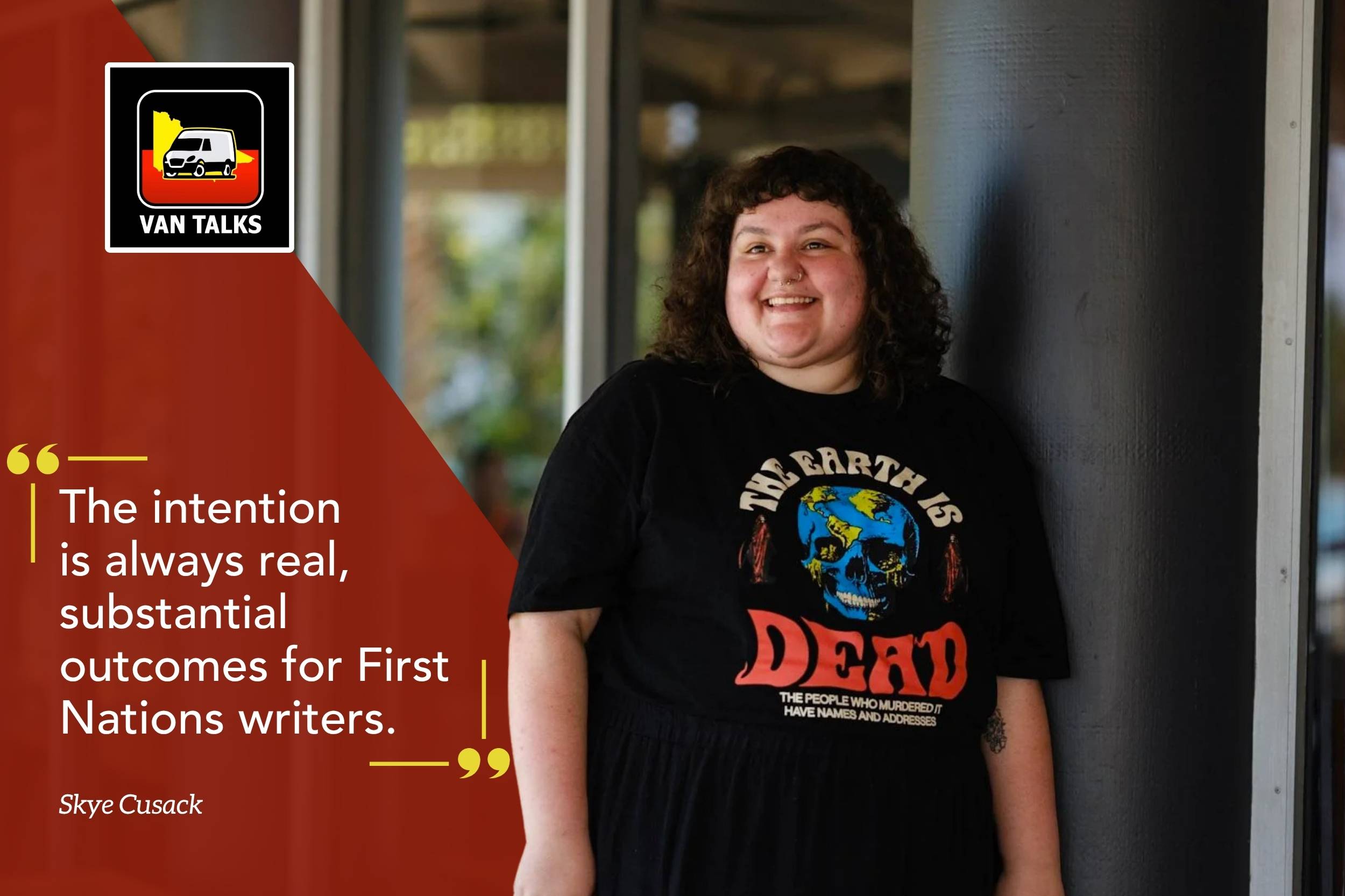
Naarm-based literary organisation Blak and Bright has expanded its footprint beyond its flagship biennial festival to provide year-round support for First Nations writers, storytellers, and artists.
Founded in 2015 by Jane Harrison, the organisation initially operated as a grassroots event before transitioning to continuous programming under current CEO Bebe Oliver.
“It’s great that we’re going to the festival and it’s great that people are enjoying it and Blak writers are able to come together and have community and have an impact on their careers, but why does this have to be a three-day festival every two years?” said board member Skye Cusack.
“Why can’t we do this all the time?”
Through initiatives like Pitch Blak, the organisation connects First Nations creators directly with major publishers, funding bodies, and literary agents.
“The intention is not to have a written pitch and then go and do a little dance in front of these people and beg them for an opportunity,” Skye said.
“The intention is to have real, genuine conversations.”
Blak and Bright also manages the Blak Stories Hub, a digital platform that provides paid commissions for Blak writers and artists.
Beyond publishing, the organisation runs a free nationwide online writers group to mentor emerging creators.
In partnership with Magabala Books, Blak and Bright introduced the First Stories Collective to establish cultural safety standards across the publishing sector.
“First Nations truth-telling is something that has been sort of cannibalised in the literary and creative industries outside of safe Blak spaces,” Skye said.
Through the Yarn Lab initiative, the organisation also works directly with schools to help educators embed First Nations literature into school curriculums with confidence.
“It’s okay to get it wrong, and that’s better than not doing it at all,” Skye noted regarding non-Indigenous educators bringing Blak books into classrooms.
Look out for Skye’s upcoming books, including a queer romantic comedy releasing in 2027, The Dangers of Just One Person, and a queer new adult title in 2028.
Charles Pakana: Many listeners are already aware of Blak & Bright being Australia’s leading First Nations-led literary organisation, widely celebrated for its flagship biennial festival held in Naarm, or Melbourne.
Today we’re joined by Skye Cusack, board member of Blak & Bright, to explore how the organisation’s ongoing programs, advocacy, and digital initiatives support First Nations writers 365 days a year.
Skye, welcome to the program and thank you for joining me.
Skye Cusack: Thank you for having me. I’m excited to be here and to yarn with you about Blak & Bright.
Charles: Well, lots to yarn about, I know that. Let’s kick it off with understanding the shifting from a biennial event to year-round programming. How does that allow Blak & Bright to build more sustained momentum for First Nations authors, and of course you being an author yourself?
Skye: So, it has been a wild journey for Blak & Bright over the last ten years, and I became involved with Blak & Bright in 2023, but Jane Harrison founded Blak & Bright in 2015, and then there was the initial flagship festival in 2016. And at that time, it was a very grassroots… sort of activation, something that Jane Harrison- she’s one of my favourite people on the planet, she was really passionate about having a dedicated literary festival space that was just for mob in terms of programming, but obviously everyone’s welcome to attend.
Charles: Right.
Skye: Because often in literary spaces, it can seem like… there’s a bit of box-ticking, and there might be a Blak fella on a panel, but they might be the only one on that panel; they might be the only one programmed for the entire day. And things have changed a lot in the last decade in that way, but it was, you know, trying to have a space for mob, by mob, to support their writing.
And then over time, there was such support from the community, and as they transitioned from leadership from Jane Harrison over to the incredible current CEO, Bebe Oliver, that we realised that there shouldn’t just be a community impact every two years. Like, it’s great that we’re going to the festival, and it’s great that people are enjoying it, and Blak writers are able to come together and have community and have an impact on their careers, but why does this have to be a three-day festival every two years? Why can’t we do this all the time?
And that’s when there was this shift onto year-round programming and different types of events—truth-telling events, pitching events—and I know those pitching events worked because I actually got a publishing deal with Magabala Books from one of those pitching events in 2024.
Charles: Tell us a bit about the pitching event.
Skye: So, they’re called Pitch Blak, and they’ve been running for a few years now. And they’ve happened in Melbourne; they’ve happened in Adelaide. They’re becoming more of a national thing. And the pitching events, essentially, Blak & Bright gets in touch with major publishers, so people like Magabala Books, Penguin Random House, Text Publishing, etc.
Charles: Wow.
Skye: And then they also talk to funders like Creative Australia, Screen West, or Screen Vic, and also literary agents as well. So, they come- all of these industry people who are looking for new authors and new creatives and writers all the time, and a lot of them are interested in diversifying their portfolio of creatives and storytellers that they work with.
And then it’s almost like speed dating. And Blak fellas come who want to talk to people. And for a lot of us, especially for me when I was first starting in this industry, I had no connections at all. I personally didn’t come from a family where my parents had connections and a path forward. I just kind of forced my way into this industry, really. I was just very passionate and not afraid to jump on the phone and ask questions.
Yeah, it’s a really, really great way to create access. And it’s beneficial for the publishers, and agents, and funders as well, because oftentimes, they don’t know who’s out there. They have no idea who’s out there. And so, you go round and round in your speed dating. And I was lucky enough to… my pitch was accepted. And I’m not the only person as well who’s gone to a Blak & Bright pitching session and had a strong outcome. And I think that’s what’s really important about Blak & Bright is the intention is always real, substantial outcomes for First Nations writers.
Charles: Yeah. So tell me, the pitch event itself, you’ve described it as a bit of a speed dating. I am fortunate enough to be able to say, “Well, I have no idea what you’re talking about, except what I’ve seen on TV,” and I’m serious about that. Tell us how it actually looks, and if someone is looking to take part in one of these pitch events, what should they actually be preparing, rather than being prepared to read their entire manuscript?
Skye: So if you’re interested, first of all, you can look for the callouts. So there is one that happens in alignment with the festival, every time the festival’s held, but sometimes they do have pitching events that are called Pitch Blak just throughout the year, if it’s lucky enough to be able to partner with another event or organisations. So you can look on the website or on social media, and see the expression of interest, then you fill out the EOI form.
And then, in terms of what to bring, the intention is always to have a process that is as decolonised as possible.
Charles: How does that look?
Skye: So, the intention is not to have a written pitch and then go and do a little dance in front of these people and beg them for an opportunity. The intention is to have real, genuine conversations.
And I had a bit of a comedy of errors when I pitched, because I was talking to Rachel Bin Salleh, publisher at Magabala. And she said to me, “Don’t pitch. I don’t want to hear it. Don’t pitch.” And I thought she was saying to me, “Oh, I’m not interested in your book.” But what she meant was, “You don’t need to pitch to me. We can just have a conversation. Just tell me about your life, tell me about your ideas as a human being.”
And then that delayed my publishing contract by a year, because I thought she was telling me that she wasn’t interested, and so I walked away. So, maybe that’s some advice for people, is when people say “Don’t pitch” at these Pitch Blak events, what they mean is you don’t have to come prepared with a written-down paragraph and recite what you’ve learned. You can really just go and say, “Hello, my name’s Skye. I’ve written something, or I’m thinking of writing something in this genre, about this thing, and I feel passionate about that because…” and it’s just having a conversation.
And it’s a lot more accessible and a lot more culturally safe, and it also, they’re conversations that if you’re someone like me who didn’t grow up with a strong sense of culture, and I definitely didn’t grow up with a strong sense of what the publishing or the storytelling or literary industry looks like, it is accessible. And that’s the goal, is that people have these opportunities to have these conversations, and they can feel comfortable, and you just are yourself. Because at the end of the day, the intention and the feeling should be, “I’m just one person talking to another person.”
Charles: What if people don’t want to publish their books formally, but wish to get some feedback? And I believe you’ve got the Blak Stories Hub. Does that come into play there at all, for maybe digital publishing, self-publishing?
Skye: Yes. So, I actually founded the Blak Stories Hub, and that’s my little pride and joy and my little baby.
Charles: So I come to the right person. Tell us all about it then.
Skye: Yes, I’m the right person to speak to. So, I was very passionate about having alternative ways to commission Blak writers. I worked at Blak & Bright; that’s how I became involved, and I was the marketing manager. And we were doing a program through Creative Australia called the Digital Residency Program, and as part of that, we had to pitch a project that we could get seed funding for.
And I thought, we need some way to have a digital archive, similar to what you mob would do, having a digital archive for our stories, because not everyone wants to have a book published. And Blak & Bright has shifted from being a literary festival to the terminology that we use more now is being a writers festival or a storytellers festival. And now we include things like music, and dance… and… every form of art that has ever existed has left my brain for some reason, but we’ve tried to transition away from just saying “literary”, because I don’t think that expresses the full breadth of First Nations creative expression.
Charles: Of course.
Skye: And so, with the Blak Stories Hub, the intention was every single piece of writing that you see on there, or every single piece of art that you see on the Blak Stories Hub, is a paid commission in some way. It may be that we commissioned an artist for an event, and as part of that agreement, we said, “Would you be comfortable for us to put it on the website?”, or it may be a piece that was commissioned specifically for the website.
And so that’s one way, definitely through the Blak Stories Hub, and Blak & Bright are looking for things all the time. They’re always looking for writers, ideas, and ways to kind of feature artists on the Blak Stories Hub.
But another opportunity as well is through the Blak Writers Group. So we have a dedicated writers group of First Nations writers, and it’s an online group, and there’s people from all over the country. And that’s really special too, because you might have an idea, or a story, or a song, or anything, and you’re not even sure what to do with it. And I was like that for a long time. I had this thing in my head, and I was like, “I want the world to know about this, but I don’t know what to do.” And there are some really impressive, very experienced, knowledgeable First Nations people in that writing group, and I feel very privileged in the past that I’ve been able to just have access to them and their genius, and it doesn’t cost any money, and you can sign up through the website. And it’s just a sense of community and starting to get some industry advice without having to spend money, in a safe space for Blak people.
Charles: That’s literary advancement and literary mentoring. What I’m also interested to yarn with you about is, what is Blak & Bright’s involvement in advocating for appropriate remuneration for Blak artists? Because you mentioned that it’s not just writing, it’s song, it’s art, it’s every form of creativity. What is Blak & Bright’s role there?
Skye: Since the beginning of Blak & Bright, I know that fair remuneration for First Nations creatives is something that Jane Harrison was very passionate about. And I know, because I’ve seen people’s contracts, that the way that artists are paid for at the festival and for the digital commissions on the Blak Stories Hub, it’s very fair. Often it’s paid in alignment with the ASA (Australian Society of Authors) recommended rates of pay for things like panel events and writing commissions, and that’s generally how you know that there is healthy investment into creatives in Australia, especially when it’s First Nations people; that’s really important to get that right.
But outside of that, and just our own practices as an organisation making sure we’re fairly paying creatives for their time, there’s a lot of advocacy that happens in the community.
Another way that Blak & Bright is really committed to making changes in the sector, the literary, the storytelling sector, is in 2025, it was announced that Blak & Bright was partnering with Magabala Books to have a consortium called the First Stories Collective.
Charles: Ah.
Skye: And the intention of the First Stories Collective is to become an industry representative for First Nations creatives and publishing professionals across the board. And there will be events like workshops to develop skills; there will be funding opportunities, things like fellowships and grants; and also at the end, the intention is to create a white paper called The Fighting Stick, which is sort of a written-down recommendation of, “Here’s how to work with Aboriginal and Torres Strait Islander people in the creative industries. This is how to be culturally safe, and this is how we’ve invested the money.”
And there’s also many other exciting things planned for the First Stories Collective, but I feel I may get in trouble if I tell you about them, so I may, I might just stop talking.
Charles: Well, we’ll hold off on those. What I will bring you back to then is something you mentioned in the first couple of minutes of our yarn, and that is truth-telling. You mentioned that Blak & Bright is also essentially a platform for truth-telling. I’d really like to hear you expand on that, if you wouldn’t mind.
Skye: Something that Blak & Bright has a very strong commitment to is that as a First Nations population in Australia, we are a non-homogeneous community.
Charles: Mm.
Skye: And we don’t always have the same truth; we don’t always have the same opinion on culture, and that can vary from language group to language group, about, “You know, this is the way that I spell this word, versus this is the way that someone else in my community spells it.”
Again, First Nations truth-telling is something that has been sort of cannibalised in the literary and creative industries outside of safe, blak spaces. There’s often an expectation, and I felt this myself as a writer as well, there’s an expectation that when I turn up to a speaking event in a non-Blak dedicated space, that my truth-telling will be a sad story from my childhood, and a sad story from my grandfather’s childhood, and those stories are important. They’re really important, and we need to keep talking about them, but Blak & Bright’s approach to truth-telling is, how do we tell these truths, and how do we really create a safe space for our artists to tell these truths when they’re not palatable to a general audience?
What is a truth that you have, or what is a truth that another writer or storyteller has, and do they want to tell that truth through writing, or through song, or through dance?
And not everyone is happy with everything that everyone says in First Nations communities.
Charles: Oh, of course.
Skye: I’m sure that I say things on podcasts or on panels, and there are First Nations people in the audience and they think, “Skye, I strongly disagree with you,” but that is the point. How can all of us feel empowered to disagree in a safe way? And I think safe, open, strong disagreement, it is very, that’s like traditional cultural practice, that’s my understanding, is how do we tell the truth?
Charles: Yeah.
Skye: And that’s something that I feel very passionate about, and I think that’s something I really respect about Blak & Bright as an Aboriginal-owned organisation. How do we all share our truths with each other, and how do we make sure that allies can also start to understand that we have truths that aren’t palatable and aren’t easily digestible?
Charles: How about from the broader community’s perspective? As an author yourself, but a voracious reader and a communicator, how do you see that the Blak & Bright’s efforts in this area, especially in the literary world, can contribute to a more understanding general community?
Skye: I think something that is so strong about Blak & Bright is the programming, and I felt that when Jane was the artistic director, and I felt that as well when Bebe has been the artistic director. It’s that concept, and that notion that I mentioned earlier, that often when we’re programmed in other festivals, and by “we”, I just mean First Nations people…
Charles: Mm.
Skye: …when First Nations people are programmed in other festivals, the themes are very limiting. And at Blak & Bright, artists get to go on stage and talk about whatever they want, and in that way, we become humanised, because obviously I have an understanding that we’re human beings, and other people who are First Nations have an understanding, but to a general audience, maybe sometimes there is a need to see us as people on stage, laughing, and crying, and telling our stories, and explaining our ways.
And so I think that, honestly, just having people in a room together, that’s something I really strongly believe in, and I think that’s cultural. Having people in a room together, just telling stories and just listening, that’s important too. Because I think a lot of people that I’ve met at Blak & Bright as audience members and attendees, they will say, like, “This is the first time that I’ve ever seen an Aboriginal person.” And my response is, “Actually, I don’t think that’s true,” but I think maybe there are a lot of people who don’t feel comfortable, and people, you know, like myself who can pass as non-Indigenous if they feel that’s the safest thing to them. And so I think this is actually, I think to myself, “I think this is the first time that maybe you’ve been in a space where people feel safe to talk about their culture, and their heritage, and their stories.”
Charles: Are there any initiatives currently underway by Blak & Bright to embed some of its content or its influence into the education system—primary, and secondary, and even tertiary?
Skye: Yes, so Blak & Bright actually does a lot of work in the education space, and that’s something that I also am very excited about. There’s a lot of partnerships that are upcoming, and there’s a particular initiative called Yarnlab, and that’s where First Nations creatives, or storytellers, or industry professionals go to schools, and they have conversations with students, well one, about, you know, “If you have a story, this is how to tell it,” but just also in general, just empowering kids of all cultures to understand the history of the countries that they live on and the people that are in their communities, and embedding First Nations books and other forms of media into the curriculum, and teaching.
Also, a big part of education that I’ve learned working at Blak & Bright and also working at Magabala Books is a lot of the time, non-Indigenous educators don’t pick up Blak books because they don’t feel confident, and they feel, “Oh, if I’m non-Indigenous, and I have…” You know, I’ll use one of Jane Harrison’s books, because she founded Blak & Bright. Becoming Kirrali Lewis is one of my favourite novels in the entire world, and that’s been on multiple curriculums in its lifetime as a book, and sometimes educators might feel scared or nervous to use that book, and so they’ll select another book because they think, “I’m non-Indigenous, and I don’t want to get this wrong.”
And so I think a big part of Blak & Bright’s educational programming is empowering people, like it’s okay to get it wrong, and that’s better than not doing it at all.
Charles: Skye, you’ve been promoting and talking positively about Jane Harrison’s book. Before we let you go, because time’s pretty well against us, how about the book from you, Skye Cusack, the author? Tell us a bit about that.
Skye: I do have two books coming out. I have a queer romantic comedy called Checked Out, which is being published by Penguin Random House in June 2027. And then I also have a queer new adult book that’s being published by Magabala Books in February 2028.
Charles: What’s that one called?
Skye: That’s called The Dangers of Just One Person.
Charles: So look out for that, and once they are released, we will also be, we’ll be sharing the information on the Victorian Aboriginal News website. Skye, thanks so much indeed for joining us today.
Skye: Thank you so much for having me. This was a really great yarn.
For Radio Play:
1 - Click the Download Audio button
2 - The audio file will commence automatic play in your browser
3 - Confirm this is the file you want to use in your program
4 - Once confirmed, click the vertical elipses (3 dots) and select download
CONTACT US VIA SMS
Get in contact with us via our dedicated SMS line:
0493 222 836
21 October 2026
Reconciliation in Seymour – one of Victoria’s highest recorded “No” vote regions
19 October 2026
Understanding the use – and over use – of the Acknowledgement of Country
15 October 2026
It’s time Australia recognised a shared history of often brutal “settlement” and expansion
12 October 2026
Start learning about First Nations cultures without the fear of offending
5 October 2026
0 Comments