
First Nations star knowledge predates Western astrophysics by millennia
Astrophysicist Professor Duane Hamacher explores First Nations development and use of astronomy, revealing tens of thousands of years of sophisticated science well outdating Western astrophysics.
Posted by: Karina Wells
Published: 24 September 2026
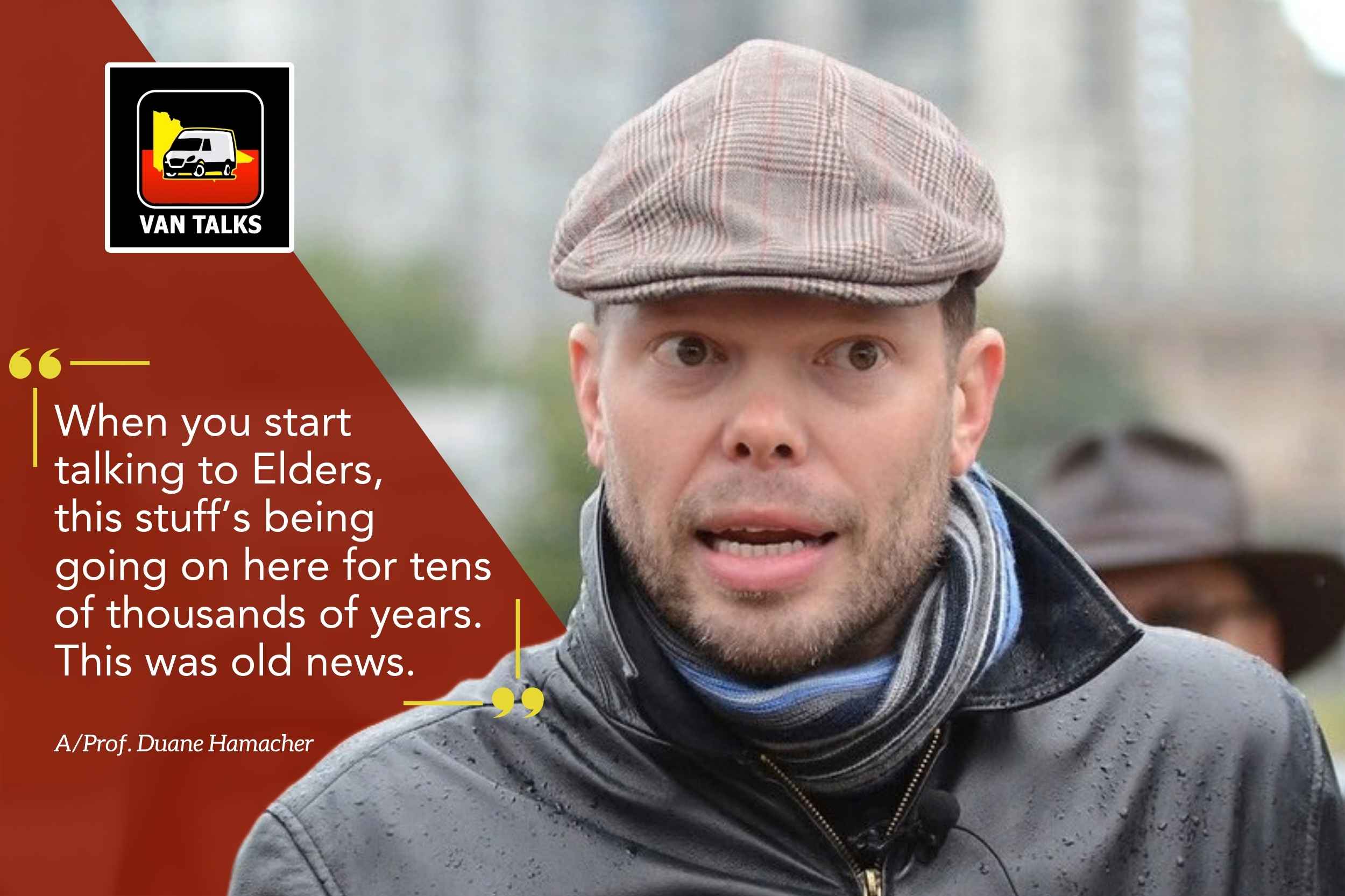
Associate Professor Duane Hamacher has highlighted how First Nations cultural astronomy demonstrates deep scientific sophistication embedded across tens of thousands of years.
He explained how Traditional Owners used the stars for seasonal forecasting, navigation, and understanding complex atmospheric patterns.
“You have to pick very specific stars. It’s going to depend on their declination, it’s going to depend on their right ascension, their position in the sky, relative to the ecliptic, relative to the equatorial plane of the Earth,” Duane said.
He highlighted the incredible complexity of Torres Strait Islander traditions predicting total lunar eclipses through oral systems.
“What has never been given credit is the fact that the Torres Strait Islanders did this through oral tradition. There were no written works to tell you, there were no star charts,” he said.
The research challenges historical dismissals of Indigenous sciences and highlights how knowledge was maintained with exact precision.
“If you’re going to convey information, you create narratives, and these narratives are going to have multiple layers of knowledge embedded within them,” Duane said.
Work is ongoing to embed these cultural astronomy principles into national and state school curricula.
“If you can combine astronomy in with Indigenous knowledge and history and culture, you’re going to create a different angle for this,” he said.
Partnerships with Mob are also expanding local night sky tourism and dark sky preservation across Victoria.
Charles Pakana: During a recent interview with Professor Marcia Langton, she made mention of the work undertaken by a fellow academic, Professor Duane Hamacher.
That work, which focuses on cultural astronomy, demonstrates an incredibly high level of sophistication and knowledge that was instrumental in Australia’s First Nations peoples’ ability to navigate, understand weather, and manage the land.
He joins me on the program today. Professor, thank you so much indeed for your time.
Duane Hamacher: Thanks Charles for having me on. Great to be here.
Charles: How did your background as an astrophysicist of all things lead you to focus on cultural astronomy and then to collaborate with First Nations knowledge holders?
Duane: It was an interesting journey. Growing up in the US, I knew nothing about any of this topic. I came to Australia as a study abroad student over 20 years ago, and I had quite an interesting experience. I think one that you’d probably recognise, but for me was quite shocking.
I was at Macquarie University in Sydney, and at the time, Mars was coming very close to the Earth, it was probably the easiest we’ve been able to see it for quite some time. So I was at the local observatory and we were having a look through the telescopes. And I asked somebody there about Aboriginal views of Mars or the stars. I knew nothing about it, but I was interested.
And the response I got was horrific and dismissing. And I stood there in a state of shock, and the other person who had joined me, we just sort of looked at each other like, “What in the world was that?” We just sort of smiled and walked away. We were quite shocked about it.
Charles: I’ve got to ask you, what was the response?
Duane: “Oh, there isn’t much here. They don’t know much about astronomy. They just had a few stories and names.”
That wasn’t the shocking one. I mean, that’s shocking enough, but that wasn’t the shocking one. I haven’t told many people this… but a few of the other study abroad students in my cohort who were from different universities, they were taking the first-year Indigenous Studies course at Macquarie. And they were, you know, they’d been sharing some of the knowledge. They… I think some of them expected it would all be like dancing and didgeridoos kind of thing, and it wasn’t like that at all, right? They were learning about the real history of Australia.
And when this person said that to me, I said, “Yeah, from what I understand from other studying, like there was a horrific situation. Lots of Aboriginal people were… killed off.”
And they said, “Well, not all of them, unfortunately.”
Charles: Okay.
Duane: And we were just… we turned and looked at each other like, “What in the, what did she, what did this person just say?!”
And we just, we laughed. And I was just like, “Oh my god, I can’t believe that.” That was, it was shocking for me. I think for a lot of people, especially in the community here, they’d be like, “Oh yeah, that’s just another Tuesday.” But for me, that was quite shocking.
And when I came back to Australia a couple years later, ’cause I fell in love with the place and I’ve always wanted to come here, you know, I was doing a PhD in astrophysics. I was searching for planets around distant stars, but I got so interested in this idea, and that seed was planted in my mind. Whenever I would ask people about Aboriginal astronomy or Aboriginal science, I would just get this look like, “What are you talking about? There isn’t anything there. You Yanks don’t know anything. Like, what are you on about?”
And I was like, “Hang on. You look at some of the stories, even the ones that are published, most of them are like the kids’ versions, right?”
Charles: Yeah.
Duane: And I’m looking at them and I’m reading them and I’m like, “There’s all kinds of great science behind this. I can see this clearly. How is it nobody else can see this?”
I mean, as an astrophysicist with the background, I did courses in all the different sciences and I was like, “There’s so much awesome science here that just isn’t getting recognised.” And when I spoke to people, there was just a dismissive attitude, and I thought, “Well, you know what? This stuff needs to be understood.”
I had a couple of people I had met who were sympathetic to this, and I was like, “Well, if nobody else is going to do this, damn it, I will.”
Charles: Well done.
Duane: And I reached out and I decided, I’m going to leave the world of astrophysics, and I reached out to some different people to maybe pursue a career change.
Charles: When was this?
Duane: This was back in 2007, most of this was happening. I was a year into a PhD in astrophysics. I was in Sydney, not at Macquarie, but I was in Sydney.
And I ended up contacting an astronomer, a British astronomer at the CSIRO named Ray Norris, and he’d been doing this project on Aboriginal astronomy. And I hooked up with him, and we decided to do a PhD. So I ironically went back to Macquarie and was enrolled in the Department of Indigenous Studies, which was a little bit of a separate story because everybody told me, “Don’t apply to the Department of Indigenous Studies, they won’t take you.”
And I said, “Well, why not?”
And they said, “Well, first off, your background’s physics, and second off, you’re not Indigenous, they won’t take you.”
So I went to eight or nine other departments across three universities. None of them would take me. When I finally approached Indigenous Studies, they were like, “Yeah, we’d love to have you.”
I said, “But my background’s in physics.”
They said, “Well, it’s a studies program. Everybody comes from a different background.”
And I said, “I’m not Aboriginal.”
They said, “Well, so what?”
And that ended up being where I did my PhD, so it was just this, you know, a learning curve that I was on coming into this.
But to answer your question, the whole idea of Indigenous science and pursuing that, and that being the focus, not the exclusive focus of my work, but the main thread of my work, is understanding the science behind this knowledge, not to validate it, ’cause it’s valid in its own right—it doesn’t need some white American to validate it—but that wasn’t the point. It was to showcase and demonstrate the science behind it, and then how so many of the things Western science takes credit for discovering and learning and understanding, when you start talking to Elders, this stuff’s been going on here for tens of thousands of years. This was old news.
Charles: What are some of those things that really have been understood and practised here for all that period of time that Western science takes credit for?
Duane: Oh, one of them that I’ve been very prominently involved in is the topic of variable stars.
So variable stars, all this means is that a star’s brightness will change over time. Its brightness is variable. Now, that might not seem like it’s important—who cares? You know, a little flickering of stars- scintillation, we call that…
Charles: Mm.
Duane: …that’s caused by our atmosphere. Astronomers hate that. We spend so much of our time trying to get rid of the effects of scintillation, ’cause when you’re pointing your telescope at a star, and you’re recording it to get all the data out of it, it goes to a CCD chip; you’re not looking through, you know, a lens like you do when you take your telescope outside. Big problem when you use computers, and to get good data, you can’t have noisy data, which means you’ve got to get up above the atmosphere. That’s why we build these telescopes in space; there’s no atmosphere, so we don’t have all these problems.
But something that astronomers see as a detriment, Aboriginal communities see as a benefit. If you know how to read the way the stars twinkle, how they change in brightness, how they change colour, how they change in resolution, you learn about our atmosphere, which will tell you about predicting seasonal change, forecasting weather, all these great things.
If you have the stars themselves changing in brightness, not because of our atmosphere, but because of their internal structure, you know, that’s a whole huge branch of astrophysics that’s only kicked off in the last 150 years. Before that, the idea that goes back to Aristotle is the cosmos are invariable and unchanging; they’re part of God’s perfection.
And yet, Aboriginal communities and Islander communities have been observing that, “Yeah, the stars change in brightness.” These are embedded in the most widely known songlines across Australia. The Seven Sisters songline, a big part of that, is the stars of Orion being the man, and the girls of the Pleiades, the Seven Sisters; he’s chasing them. And there’s all these narratives that tie into the motions of the stars, their colours, their behaviours, and this serves as a songline that goes from coast to coast, from the Kimberley to Byron Bay and all around the country. It’s a huge map embedded in the landscape, all tied into this narrative. And one of the parts of that narrative is these stars changing in brightness.
Charles: So I just want to understand, how did those early astronomers, those first astronomers, how did they actually interpret and utilise that variability of the stars themselves, the scintillation, as you say?
Duane: Well, there’s two different ones. Scintillation would get used for understanding the atmosphere. So if it’s the scintillation, the twinkling of the stars, that would get used for, like I said, predicting the seasonal change, forecasting weather, and if you’re, you know, like in the Torres Strait, if you’re navigating out at sea, the seasons up there are dominated by trade winds.
So you need to know what’s happening at different times of the year. You’ve got the dry season, the wet season, and the trade winds; you can actually note changes in them based on the twinkling of stars, so it had a navigational purpose as well. If the stars are twinkling like crazy, there’s a ring around the Moon; you probably don’t want to go out on a boat, ’cause a storm is coming. It’s bad conditions to be out, right?
But if you look at the long-term changes in the stars’ brightness, like maybe over months or even a year, it didn’t have a practical application as far as navigation or calendars, but people still recognise, and you can’t unsee something that you recognise.
So in that case, it didn’t give a calendric function; it didn’t give that practical—what people think of as practical—function. It was given symbolic meaning. It was seeing as this figure, Nirrum; in many communities, it’s his passion, it’s his fire magic he creates that he’s trying to throw at the younger sisters or to move the eldest sister, who’s in his way ’cause he wants to get to them, and she says, “No, you ain’t,” and he says, “I’m trying…” So she would create fire magic as part of her body. These are bright red stars that are noticeably variable.
So this dynamic playing out in the sky is part of the overall narrative. But even though those aspects of the stars didn’t have a practical function for calendars or navigation, it didn’t mean you didn’t find a use for them.
Charles: What about in care for land? First Nations people right across the continent and the islands are renowned, or should be renowned, for their absolute care and knowledge when it comes to managing and caring for Country, making sure that it remains viable for millennia after millennia. How did the stars play into that? You’ve mentioned that it helped in understanding the seasons, but were there other ways in which it played a role?
Duane: So you have sustainable practices embedded within the traditions of seasonal change, especially food economics. The types of foods and medicines you want to gather, when you gather them, how you gather them, how you consume them, how you dispose of them, that is often reflected in narratives of the stars, because the stars link to time and space. You cannot separate time and space.
So if you want to know everything that’s happening on the landscape, you look to the stars. There’s your scientific textbook. That’s your map. That’s your timepiece. That is your storyboard. It’s your canvas. It’s your memory space. It’s all of those things as a source of stability and predictable movement in the sky.
So you notice the changing of the seasons and you can notice that particularly when stars and constellations will rise or set after dusk or before dawn. And you work out that different stars have different pathways. Some stars are going to be in the sky for a long time, some stars are going to be in the sky for a short time. Some stars rise at this time of the year and set at that time of the year. Some of the stars never rise or set, they’re always up in the sky, like the Southern Cross from Victoria, it’s always in the sky.
So the people had to work out how to link all these different stars and constellations with what’s happening down here. How do they link to the animals? How do they link to the plants? How does this inform about the weather? How does this inform about social practice, ceremonies, and, you know, initiations and things? How do you blend all of that together? The stars. The stars work as a perfect link for that, and the narratives about how you do that are embedded in the stars.
Charles: I’m interested in your perspective, and I want to get onto the passing the knowledge on, and you mentioned songlines before, and we’ll come back to that in a minute, but I’m interested, from your perspective as a scientist, how sophisticated is this really for people who were so disregarded and derided upon colonisation?
Duane: It’s incredibly sophisticated, and this becomes my biggest motivation and, oftentimes, my biggest frustration when trying to explain to people that you’re not just casually gazing—I hate this term “stargazing,” first off. You’re not just gazing up at the stars to have a look and then coming up with some fun stories about it; that’s not how it works.
With the seasonal stars, like I said, you have to pick very specific stars. It’s going to depend on their declination; it’s going to depend on their right ascension, their position in the sky relative to the ecliptic, relative to the equatorial plane of the Earth. You’ve got all these effects you have to calculate for precession and nutation. All these kinds of things, you have to understand how they work if you’re going to be able to set up a reliable calendar that can be used. If your calendar is not accurate, you are not going to survive.
But let me give you a much better example, I feel, ’cause I don’t know that people can necessarily appreciate the complexity of choosing stars as seasonal calendars. That’s one of the more difficult examples.
Charles: Okay.
Duane: And this comes from the Torres Strait, and it’s not exclusive to the Torres Strait, but this is a solid example. There is a special ceremony that is conducted in the Torres Strait, a special dhari, a headdress, a very particular dance. This only occurs; they only do this during a total lunar eclipse.
The total lunar eclipse, this ceremony is the highest level of initiation of the Zugubam abaig. The Zugubam abaig, which literally means constellation man or star man, is a traditional astronomer who goes through years of training and initiation. Their entire job is paying attention to what’s happening in the sky. They have to be able to, as their final level of initiation, is to predict when to hold this ceremony, when there’s going to be a lunar eclipse.
Now, the lunar eclipse cycle, you know, works based on the 18-year, just slightly over 18-year Saros cycle. You’ve got to understand eclipse seasons, you have to understand the phases of the Moon, the relative position of the Sun, the Moon, and the Earth in the sky, the timing of that. It is not an easy process. Ask any person if they can tell you how to predict an eclipse, and I guarantee you nobody’s going to be able to tell you how to predict an eclipse.
There are only maybe a handful of astronomers I know, and I work in astrophysics, who could actually tell you how to predict an eclipse. Most astrophysicists don’t know, right? This isn’t something they spend a lot of time working on; they’re looking at galaxies and stars and black holes halfway across the bloody universe, right? They’re not focused on that aspect of it, but that’s my bread and butter, that’s what we do.
It is not an easy process at all. We know that some ancient cultures of the world did this. We know the Sumerians did it, we know the Maya did it, we know a few other cultures did it because of their written records. But what has never been given credit is the fact that the Torres Strait Islanders did this through oral tradition. There were no written works to tell you, there were no star charts that told you a timestamp and you had to work things out. You had to figure this stuff out, and you could, if you recognised when the Moon goes into eclipse and it’s next to a particular star at a certain time of the year, in 223 months, 223 of those lunations, it’s going to repeat. And that took a long time to figure out.
Charles: I’m interested also, I mentioned before that I was quite fascinated by the passage of this information, and you just spoke about it then. How, from your observations, how accurately and efficiently was this information and knowledge passed on? You talked about songlines, and we know that songlines are an efficient way of passing on knowledge, but when it comes to something so incredibly sophisticated, how was that actually achieved and maintained when it comes to integrity of the information?
Duane: Well, this is part where the years and years of training come in. You can develop a body of knowledge, but if you’re going to pass that body of knowledge on, you have to have effective ways of doing so.
So we oftentimes will think of stories, and the term that gets used all the time these days is myth, mythology. And the problem is, in modern colloquial language, myth now means something that’s false; it’s an untruth. “Oh, this is a myth, that’s a myth, the myth of this.” That drives me insane. It literally drives me insane, ’cause that’s not what myth means. Myths are spoken stories. That’s what a myth is. Mythology is the study of spoken stories.
If you are going to convey information, you create narratives, and these narratives are going to have multiple layers of knowledge embedded within them. These narratives are your stories. We are a storytelling creature. We love stories. Even when you do science communication, they’re going to tell you, “You have to create a story.” When I wrote The First Astronomers, they said, “You have to have the story.” That’s how you keep people engaged.
It’s not that every element of the story is meant to be taken literally. It’s a story; it’s a narrative. And stories are incredibly powerful. Music is incredibly powerful. Art is incredibly powerful. Dance is incredibly powerful. These all work because of the power of orality, the power of memory, utilising the method of loci, for example, how you associate memory to a place, which is largely how songlines work.
Charles: Yeah.
Duane: You bring all these different layers together. You’ve got to pass this information on, but you have to do it correctly; you have to do it appropriately. You’ve got multiple generations doing this, and you’re tested through ceremony every time to make sure it’s correct. So you’ve got a system that is sufficient at ensuring accuracy and longevity.
Charles: Before we head off, because we’re nearly at time, Duane, I’d like to understand how, from your perspective, how you believe this can be brought into the Australian curriculum, and how an understanding of the sophistication of First Nations sciences and their applications can be brought in?
Duane: Well, this is something, fortunately, we’ve been doing for a number of years. So we created a number of modules for different year levels across all subjects through the Australian National Curriculum, and now we’re doing this through the Victorian and New South Wales curriculum as well.
So I think one of the great things, the great hooks about this—and as we spoke about at the very beginning—trying to challenge the continuous negative view and perception of anything Indigenous in the media, it’s almost always seen as something negative. There’s always some kind of detriment, there’s always a deficit, and that’s frustrating, because this is knowledge and culture and history that should be celebrated.
And what ties into the education side is what got me motivated to do this in the first place. I know, being an astronomer, that everybody loves astronomy. Of all the sciences, it’s arguably the most popular. It’s often seen as the most complicated. If you ask people, “Who’s the smartest person in the world?” chances are very good they’re going to name an astronomer, right? So people love that.
So if you can combine astronomy in with Indigenous knowledge and history and culture, you’re going to create a different angle for this. It’s no longer something that’s a deficit; it’s something that’s a huge benefit; it’s an advancement; it’s something people are fascinated by. It doesn’t bring the astronomy down; it elevates astronomy and the Traditional Owners’ knowledge.
And since most people think astrophysics, you know, if somebody says, “What do you do?” and you say you’re an astrophysics professor, I’ll tell you what, that’s about the best job title you can give somebody next to maybe an astronaut, right? Trust me, it works, right?
[Both laughing]
Charles: That’s another yarn, Duane.
Duane: That’s another yarn. In the same frame, when you start talking about Indigenous astronomy, people are like, “Oh, what’s that?” And that’s the hook.
So getting people excited about that, the other initiatives that we’re doing on the education side, it’s creating tour programs, or working with Aboriginal land councils and organisations to assist them in building tourism programs. So Djaara has got one up in Dja Dja Wurrung Country, that they do some night sky tours. We’re developing a planetarium show with the Bunurong community. We’re helping to develop Dark Sky Reserves, so we can help the communities, help facilitate them in developing these night sky tourism places, but keep the skies dark so they don’t get ruined—that’s the whole point.
And in some areas, the drawcard is the dark skies, and people are going there in droves, and because of that, there’s locals who are like, “Oh, let’s capitalise on this. We need to build more accommodation, we need to build campsites, we need more lighting around that.” They’re building lighting that is destroying the skies that are bringing people there in the first place.
Charles: Yeah.
Duane: So you have to have some proper protocols, you’ve got to have some proper policy set up to help facilitate that. But there’s amazing stuff happening in this space, you know, the books and theatre productions and commemorative coins, documentaries, and all kinds of random stuff coming out in this space. It’s really blowing up and taking off. So doing Indigenous astronomy education, that’s the easy part, and that’s the fun part.
Charles: Duane Hamacher, unfortunately we have run out of time, so I thank you very much indeed for sharing the knowledge and at least a small part of your insights into cultural astronomy. And hopefully that will motivate other people, maybe to get down to Bunurong Country or up at Djaara Country, and start understanding a lot of what you’re talking about. So once again, thanks very much indeed for your time.
Duane: Thanks, Charles, so great to be here and chat with you.
For Radio Play:
1 - Click the Download Audio button
2 - The audio file will commence automatic play in your browser
3 - Confirm this is the file you want to use in your program
4 - Once confirmed, click the vertical elipses (3 dots) and select download
CONTACT US VIA SMS
Get in contact with us via our dedicated SMS line:
0493 222 836
15 October 2026
It’s time Australia recognised a shared history of often brutal “settlement” and expansion
12 October 2026
Start learning about First Nations cultures without the fear of offending
5 October 2026
The revival of cultural burning practices to remediate Country and help mitigate disasters
1 October 2026
Implementing First Nations knowledge to heal country
28 September 2026

0 Comments