
Truth Telling: The real history of our First Nation’s Veterans
Charles Pakana sits down with Peter Bakker to discuss a very important topic: Aboroiginal people who have served in the Australian forces. Listen in to this discussion on how the army provided a rare space of racal equality where mateship often superseded discrimination.
Posted by: Karina Wells
Published: 30 April 2026
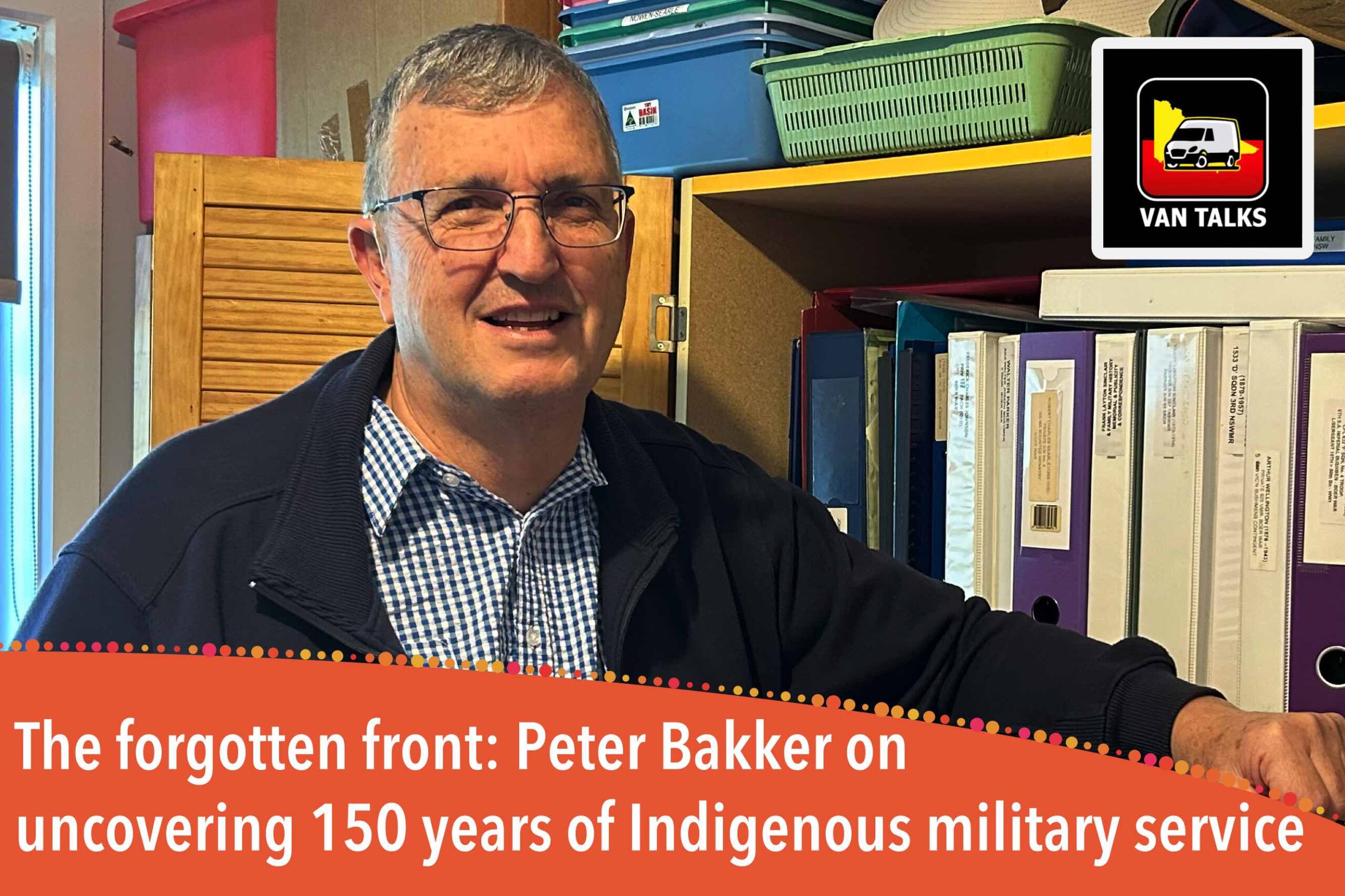
For over 20 years, non-Aboriginal historian Peter Bakker has been at the forefront of researching and promoting the truth of Aboriginal and Torres Strait Islander military involvement in service of Australia.
His journey began in late 2006 when a photograph of Private Reg Rawlings at the Warrnambool RSL prompted him to look into the rich, yet largely unrecorded, heritage of Indigenous soldiers.
Despite strict historical regulations designed to bar them from service, hundreds of First Nations people actively found ways to enlist.
Peter’s extensive research highlights that the Defence Acts of 1903 and 1909 explicitly stated that “Aborigines and half castes are not to be enlisted”. Yet, many traveled between multiple recruiting locations until they were accepted.
Once in the services, the shared hardships of military life fostered a profound sense of equality that was tragically absent back home.
As Peter reflects on the camaraderie within the ranks, he notes that “the evidence actually indicates that the vast majority had a positive relationship experience during their service”. This equal standing stood in stark contrast to the severe discrimination these veterans faced upon returning to civilian life.
Unearthing these hidden histories remains a vital component of the broader national truth-telling process.
Peter encourages the public to move beyond mainstream narratives and actively engage with this enduring legacy. “Find out more. Do a bit of your own research, okay?” Peter urges, emphasising that a deeper collective awareness is required to truly honour the courage and contributions of First Nations servicemen and servicewomen.
Charles Pakana: For over 20 years, historian Peter Bakker, a non-Aboriginal man, has been at the very forefront of researching and promoting the truth of Aboriginal and Torres Strait Islander military involvement in service of a country that, for so long, sought to remove them from history. He joins me on the program today to discuss his work and share some of the insights he’s gained over the years. Peter, welcome back to the program.
Peter Bakker: Thank you, Charles.
Charles: Peter, let’s just get a bit of an understanding of what got you involved in this. I know you were a history teacher at high school, but what sparked the interest in understanding and researching First Nations service for Australia?
Peter: Well, in late 2006, a photograph of Private Reg Rawlings in the Warrnambool RSL hit me in the face as I entered into the foyer of that building. And having taught history for over three decades, I hadn’t ever taught about Aboriginal involvement in Australia’s wartime experiences. And so I made some inquiries, and I found out that there was quite a rich heritage of Aboriginal involvement. But when I went to the Warrnambool library, I only found one book on the history of Warrnambool that had one small paragraph mentioning one name. And I thought, “This is wrong.”
Charles: Yeah,
Peter: This is an injustice. And there’s lots of interesting stories I’m coming across. And so, working through both the Aboriginal and non-Aboriginal community, I started to find names that had been forgotten and thought, “This needs more research.” And I’ve been hooked ever since.
Charles: Was there much material that you were able to unearth to support your work? As in published material, I’m talking about.
Peter: Not then. 20 years ago, there was the flame starting to spread in terms of interest in Aboriginal involvement in all areas of life. That’s also when, in 2007, was actually the first ceremony held by Sam, Helen and Auntie Dot Peters to recognise Aboriginal military service. And I didn’t know about that at the time. I was just doing my thing, or just starting my thing.
Charles: Yeah. From your research, how far back does First Nations military service in service of Australia actually go?
Peter: That’s a good question. And I’m happy to say that Victoria has the distinction of having Australia’s first Indigenous service person in the person of Thomas Bungaleen. In the late 1840s, there was a false rumour spread in Victoria that a white woman had been kidnapped by a tribe of Gunai Kurnai Aboriginals over in Gippsland.
And Aboriginal police trackers were sent to try and hunt her and them down. And they couldn’t find her because it was just a rumour, but they kidnapped a family of four Aboriginals, the headman of the Gunaikurnai, his wife and two boys, and they brought them back to Melbourne. The father died, the mother sort of left the boys.
And the boys went into the early Yarra Aboriginal school, and one of them unfortunately died due to health reasons. And Thomas Bungaleen, he grew to be quite an intelligent boy. He learned English, and he learned arithmetic and so forth very well, but he was quite unruly. And so the Aboriginal protector at the time decided he needed some tough discipline. And Victoria had just established its Victorian colonial navy.
Charles: Good Lord.
Peter: And so in 1861, Thomas was sent to be a sailor-boy on the first Victorian navy ship, the HMCS Victoria. And of course, he had to live on the ship; [there] wasn’t shore leave all the time in training. In those days, life was on the ship. And one of the adventures that he had was actually going up to the Gulf of Carpentaria on the ship where they were looking for the Burke and Wills Expedition, which was trying to travel from south to north.
Charles: Yep.
Peter: But it was a tragic expedition, and they were there to try and resupply it, but they were never seen. Anyway, Thomas underwent those three years of service with the Victorian Navy, and he was signed off at the end, like all of the men. And in 1864, quite educated now, fairly disciplined, he became a well-respected draftsman in the Mines Department in Victoria and quite a reputable member of the community of Melbourne. Tragically, he died after a year, and he’s buried in the Melbourne cemetery. So it was another 36 years until the Boer War that we have our next Victorian Aboriginal service person.
Charles: How do you go about finding out all this information? You’ve already stipulated that when you started this research 20-odd-years ago, there was very little published material out there. The amount of sleuthing, I would imagine, to find all this information and then get it out there to the broader community must be a mammoth task. Where do you go for the information?
Peter: My particular interest is finding those who haven’t been identified.
Charles: Yeah.
Peter: And could give them recognition. So I find out what is known. There’s been a lot of work done in various universities, academics, local historical societies, but in order to find the missing, if you like, the forgotten, one really does have to scratch to look at records, to try and draw links. There are basically two ways. One is that somebody approaches us with a lead. In other words, they come to the War Memorial, or they come to us as historians, and they provide us a name.
Charles: So when you talk about the War Memorial, you’re talking about Uncle Michael Bell up at Canberra, yeah?
Peter: That’s correct, yes.
Charles: Right.
Peter: [The] Australian War Memorial has a particular section under the Aboriginal Liaison Officer, Michael Bell, to identify and recognise Aboriginal service persons. And so even Michael, if there’s something to do with Victoria, particularly to do with the Boer War, which is my specialty, there’s a lot of networking that goes on and so I’m a lead footer, I search around.
But the other side is, what I and a few other researchers do is we don’t use the existing pieces of information that are available in research papers and books, etcetera. So what we do is we go to a particular Aboriginal community, and we talk, we yarn.
Charles: Yeah.
Peter: And we have to win trust. We have to respectfully go about this. So we look for leads. Also, I looked for particular Aboriginal names and particular Aboriginal areas where there are some quite distinct, perhaps Aboriginal missions or reserves that existed there.
And I just go through the records, which are through the National Archives of Australia records, and plod away looking for little clues on the attestation and service papers through old newspapers. Once you’ve got a lead, you can zero in and do some more work.
Charles: What I’m interested, also, in discussing, because we have discussed in a previous interview on this program, I think around about a year or maybe even two years ago, I can’t remember. It was a while ago. We’ve discussed a number of things, such as the myth about Aboriginal soldiers or trackers being left behind in the Boer War, and we’ve dispelled that particular myth. Something we didn’t discuss last time that I do want to focus on is; given the restrictions that Aboriginal and Torres Strait Islanders had in enlisting during the First and Second World Wars, a lot of them were either passed off or passed themselves off as different ethnicities. Give us a bit of an insight into that and some of the challenges that represents to you as a researcher in finding the truth.
Peter: Definitely a challenge there to enlist in World War I and World War II, for instance, army regulations were actually designed to prevent Aboriginals from enlisting. The 1903 and 1909 Defence Acts stated, quote, Aborigines and half-castes are not to be enlisted. So it’s pretty black and white. Many recruiters and medical officers, however, failed to know or to apply this regulation and therefore hundreds of Aborigines [sic] enlisted, and it was not uncommon, if an Aboriginal was rejected by a recruiter at one location, to travel 20 miles down the road to another location and try to get in. And I’ve come across some who went to four or five locations-
Charles: Wow.
Peter: -before they were enlisted. In World War I, the situation with the troop numbers, restocking the numbers because they were dropping off by mid-1916, our Prime Minister, Billy Hughes, introduced conscription acts or referendum. Both in 1916 and in May 1917, these conscription referendums failed. So he couldn’t force people to join up and so therefore they laxed the rules. And they came to that in 1917, a military order 200 that, quote, half caste may be enlisted in the Australian Imperial Force, providing that the examination officer are satisfied that one of the parents is of European origin.
Charles: Oh my god.
Peter: And so this is sort of the regulations. But most Aboriginals had actually already managed to enlist prior to this regulation, and very few checks were actually made once the leniency of having some sort of European descent, there – one of the parents -, few checks were actually made by the recruiting officers because they had to meet their quota.
Charles: In your research, and I’m sure you would have seen letters, you would have heard anecdotal evidence, but we hear about ‘trenches knowing no colour’, and one can imagine that would be the truth. So from your research, was the experience of Aboriginal and Torres Strait Islander soldiers truly different from the discrimination that they faced at home prior to the war, and tragically, after the wars as well?
Peter: That’s a really good question, Charles, because when I have studied all these hundreds of men, and a few women, of course, too, don’t forget that.
Charles: Yeah.
Peter: The evidence actually indicates that the vast majority had a positive relationship experience during their service.
Charles: Yeah. You’re emphasising that, I hear you.
Peter: If you talk to a lot of current servicemen or former servicemen today, a lot of them will tell you that there’s only one colour in the Australian army and that’s khaki. Now it may have been true, and it may still be true, in some situations where a white fellow might try to play the superiority cards. But in most cases, Aboriginal service persons became accepted, and they proved their worth so that other non-Aboriginal mates soon sorted out those disruptive racist types. Military training – as you’re aware, Charles, as an ex-serviceman yourself – you do everything together. You live, you eat, you sleep, you serve with others 24/7, and that’s an amazing leveller of men. As infantry in particular, you are treated as equals as long as you did your fair share. In actual warfare, every Australian soldier must depend on their mates with their lives. During World War I, several Aboriginal men received medals or commendations for their bravery. And there are many accounts of mourning by their non-Aboriginal mates when they died as a result of warfare. So in this way, I believe the Australian Army, along with the Air Force and Navy, have been Australia’s biggest promoter of understanding and acceptance between Aboriginal and non-Aboriginals.
And there are many cases after World War I and World War II, where non-Aboriginal ex-Army buddies provide tremendous support to Aboriginal communities in their campaigns, fighting for racial equality, equal working conditions and pay, and recognition of land rights. So, things have changed a lot, I would say, particularly around the time of the Vietnam War.
Charles: Yeah.
Peter: The treatment of Aboriginals during the war, but more importantly, after the war. Because the sad story is that up until recent times, Aboriginal men were not allowed to join some of the RSLs, march in Anzac parades, get a drink in the local pub, and I could go on.
Charles: When you’re saying recent times, how recent are we talking about, to your knowledge?
Peter: Oh, [it] would go back to even after the Vietnam War.
Charles: Good Lord.
Peter: Yeah, yeah. Because there are certain examples of various publicans refusing to serve Aboriginal people. You know, you go to places in northern New South Wales. I won’t name any places.
Charles: No, we know them, we know them. It’s okay.
Peter: Yeah. So it took a long time for the Australian population to realise, but as I say, that experience for so many non-Aboriginals forced into a relationship with people of different ethnicities, they realised, “Hey, an Australian bloke is just the same as me, same needs, aspirations, hopes and talents.” And so that was fantastic. So after the war, the Second World War and Vietnam War, trade unions and local community groups, churches, etc. They rallied around injustice.
Charles: Of course. What I’m really keen to also understand from your research and your conversations with people is: what understanding have you gained with regard to this enthusiasm that was demonstrated by so many Aboriginal and Torres Strait Islanders to go and fight in service of this country that had only generations before sought to eliminate them from the very land?
Peter: Yes. You know, why did they enlist? And in such great numbers? In fact, my research, because, you know, there’s an accumulation of more and more names, we’re finding that people who are distinctly Aboriginal, or even those who are not distinctly Aboriginal but were treated very much as Aboriginals, we’re finding that proportionately in most areas of Australia, they exceeded the local white population’s involvement as a percentage of their population.
Charles: Why? What drove them?
Peter: Well, there’s quite a few factors. There’s not one single common factor, but the opportunity that the Army presented itself as an equal opportunity employer. You know, five bob a day was a king’s ransom.
Charles: Of course, yeah.
Peter: In the First World War, Aborigines couldn’t expect to be paid that anywhere.
Charles: Yeah.
Peter: And they couldn’t get that opportunity, the opportunity for adventure to go to places that they’d heard about only at school or in churches. You know, in the Bible lands in the Middle East. There’s lots of references in early Aboriginal letters to their experiences in the Middle East and the Bible stories that they had learned on the missions they’re going with mates, both Aboriginal and non-Aboriginal family members. There was a real sense of camaraderie and also a desire, sort of passion to have adventure and to fight for country. And so when the opportunity came, even though they were not wanted or desired, they were both busting the gates to get in. Most of them had never travelled overseas, of course. So here’s an opportunity; you get paid, you get clothing, you get food, you get accommodation, and you get a uniform!
Charles: You get bloody shot at, too, by the way. But okay.
Peter: That’s true. Yeah, so there were lots of things that were appealing, and whilst it has been said that many of them went to improve their lot after they came back, we don’t find that much in the written record. There’s a few accounts of it.
But primarily, they did what they could for themselves and their families. They knew it would be a leg up for them after the war in terms of… Because they were getting financially remunerated, it could be put aside. Family members could be paid while they’re away. They could allocate a portion of their money like any soldier.
Charles: Yeah. How important do you think this research that you, and from what I hear you saying, and gather, a number of other historians are actually undertaking – how important is this to achieving a greater understanding and truth-telling across Australia?
Peter: Oh, it is vital, I think, because of Aboriginal and Torres Strait Islander involvement over a century and a half now.
It has sort of penetrated Australian society, both during and after the war, causing people to think about the situations of the Aboriginal community and a realization that respect for them for being involved, but also they got involved under the way we treated them, sort of thing.
And so, a lot of people realise we need to give back. And when I say a lot of people, that’s not the entire Australian population. In fact, the majority of [the] population is absolutely ignorant. So we need it in our history books.
I said I was a history teacher, I had never – and still there’s a complete lack of material in most school curriculum that exposes not just their military involvement and the suffering and contributions before and after and during the war, but through the whole of colonial history and even modern-day times. So I think that finding this information there’s power and it needs to get out there. It’s a fantastic story, too. There’s so many great stories of endurance, of courage, of sharing, of mateship. That story needs to get out there through films, through books, through ceremony. And it’s starting to happen. And we’ve got nearly in every state and territory memorials now and annual ceremonies and these things, including your radio blog. These things are getting the message out there, and we’re getting there, but a lot more needs to be done.
Charles: So, one call to action that you would give to listeners of this program, what would it be?
Peter: Find out more. Do a bit of your own research, okay? Don’t just listen to the news on the telly. Just find out what has happened in regards to the treatment of Aboriginals since settlers have occupied their lands and pushed them into missions and reserves, and limited their access to their traditional culture. Find out what’s being done to restore knowledge of culture, and just get involved. There’s books you can read, there are films you can get. One of the things that happens here in Victoria is we have an annual ceremony at the Melbourne Shrine on 31st May each year, which recognises Aboriginal and Torres Strait Islanders, and [the] public is welcome to come along, and it’s very informative. You’ll get exposed to some of the stories and meet some of the people.
Charles: Peter Bakker, thanks so much indeed for your time and your work.
Peter: Well, thank you very much, Charles.
For Radio Play:
1 - Click the Download Audio button
2 - The audio file will commence automatic play in your browser
3 - Confirm this is the file you want to use in your program
4 - Once confirmed, click the vertical elipses (3 dots) and select download
CONTACT US VIA SMS
Get in contact with us via our dedicated SMS line:
0493 222 836
12 October 2026
Start learning about First Nations cultures without the fear of offending
5 October 2026
The revival of cultural burning practices to remediate Country and help mitigate disasters
1 October 2026
Implementing First Nations knowledge to heal country
28 September 2026
It’s time for Australia to acknowledge historic atrocities
24 September 2026

0 Comments