
Reconciliation Action Plans at a crossroads: Jason Mifsud on the future of RAPs
Are Reconciliation Action Plans still delivering for Mob? Jason Mifsud explores why organisations must shift from symbolic gestures to structural accountability, embedded governance, and genuine self-determination.
Posted by: Karina Wells
Published: 11 August 2026
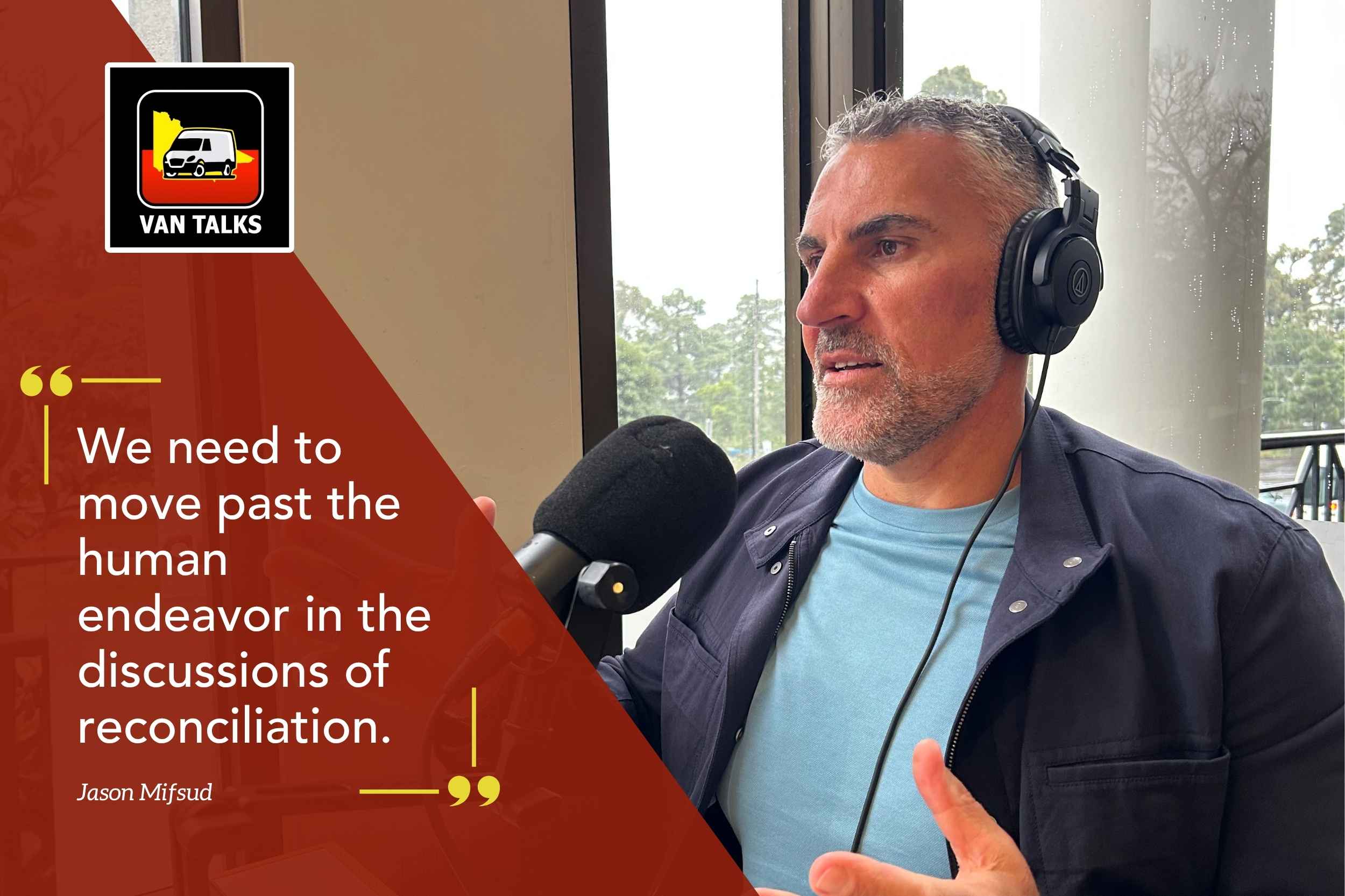
Reconciliation Action Plans are facing a critical turning point as organisations push to shift from symbolic gestures toward real, structural accountability.
Eastern Maar man Jason Mifsud believes these frameworks have played a vital role over the past two decades.
“I think broadly, there’s a very strong argument to say they’ve been a very important instrument,” Jason said.
He noted that around 3,000 organisations currently hold Reconciliation Action Plans across Australia.
However, the conversation must now evolve toward embedded governance and self-determination.
In Victoria, the rise of Treaty legislation is prompting sectors to re-evaluate what reconciliation truly demands.
Jason highlights the importance of aligning corporate frameworks with international instruments like UNDRIP.
“What role do they play for the next 20 years?” he asked.
He stresses that real progress happens when commitments move beyond individual goodwill into formal planning.
“Unless we find ways to integrate the reconciliation principle or reconciliation objective into the corporate planning process, we’ll always be dependent on the human being very amenable and empathetic,” he explained.
When embedded into core operations, commitments become part of how an organisation resources and measures success.
“If the board is not looking at this and measuring it by way of outcome and impact… we remain at the start of the spectrum,” Jason said.
Local governments and corporations must allow Traditional Owner rights to shape core strategy.
This structural integration ensures reconciliation survives changes in leadership or personnel.
“We need to evolve it, we need to be lifting our eyes up a little bit more,” He said.
Moving forward, the focus must remain on genuine institutional accountability and self-determination for Mob.
Charles Pakana: It’s no surprise to many that Reconciliation Action Plans, RAPs, are currently at a critical inflection point in Australia, transitioning from symbolic, compliance-driven policy documents into frameworks that must demonstrate structural accountability, self-determination, and core business integration.
My guest today is Eastern Maar man, Jason Mifsud, who brings a grounded perspective to this topic, having sat at the intersection of First Nations leadership, corporate governance, and state and local government policy, such as authoring the Victorian Aboriginal and Local Government Strategy, affectionately known as VALGS. Jason, thanks for joining me today.
Jason Mifsud: Pleasure, Uncle Charles.
Charles: Jason, to understand where Reconciliation Action Plans are now, what’s your observation of these being over the years that you’ve been involved in their development?
Jason: I think, broadly, there’s a very strong argument to say they’ve been a very important instrument to help…
Charles: Have been?
Jason: …and have been enterprises of all persuasions. I think there are about 3,000 organisations today have RAPs, from kindergartens right through to Corporate Australia and others. So, I think they’ve played a very important role in terms of helping enterprises organise their formal reconciliation efforts and endeavours through the framework that R.A [Reconciliation Australia]… mandated 20 years ago now, 2006. So, I think they’ve played a very important role. That’s probably my opening point. I think the broader question is, what role do they play for the next 20 years?
Charles: Well, before you get to that, what evolution have you seen in these plans over the past two decades? Because other things have evolved; First Nations rights, the interpretations of self-determination has certainly changed over the years. Do you believe that RAPs, and the construct of the four levels of RAPs, has kept pace with that?
Jason: Largely, yes. And I think there’s always this healthy tension, which I’m always encouraged by, between what does the sector keep demanding more of, whether it’s the Aboriginal sector around UNDRIP, and we’ve slowly seen the integration of UNDRIP principles into various RAPs, particularly at the Stretch and Elevate level. All a bit imperfect still, so I think that’s okay.
Charles: And just for the audience, UNDRIP is the United Nations Declaration on the Rights of Indigenous Peoples, of which Australia is a… well, a late signatory.
Jason: Late signatory, last Commonwealth government to be a signatory, in 2007 under the Howard Government of the day. So, we’ve seen the inclusion of the principles of UNDRIP slowly get integrated. We’ve seen how the country more broadly is sorted out, you know, its broad reconciliation efforts. And we know that jurisdiction by jurisdiction, that’s all a bit different.
Charles: Yeah.
Jason: And more particularly here in Victoria, we’ve seen, in recent times, the Treaty legislation. And I think the sector more broadly, not only the mainstream sector, but the Aboriginal sector is now saying, what does Treaty mean by way of these Reconciliation Action Plans and things of that particular nature?
So, I think there’s always this healthy tension between the market driving a greater threshold for how we organise our efforts around reconciliation in a corporate sense, and Reconciliation Australia’s effort in that space as well. So, I always welcome the tension; I think it’s a healthy discussion, and I think it’s a discussion we’ve got to continually bring ourselves to the table to have, given the younger generation of Aboriginal people are taking this thing called reconciliation and doing what they believe to be the right thing with it, as we did back in our… more activist and youthful days. And I think finding ways to create space for that is really important.
Charles: You mentioned, though, the influence of Treaty on Reconciliation Action Plans. From your perspective, having been involved in Treaty from the very early days, and obviously with your depth of experience with Reconciliation Action Plans, what do you see by way of RAPs needing to change or evolving in light of Treaty, especially here in Victoria?
Jason: Mm. Well, I think if you’re a public administration, it’s incumbent upon you to understand what the current Treaty legislation is demanding or determining by way of law in Victoria. So, I think if you’re in public administration—and this is where market segmentation becomes very important… So, if you’re in public administration, it is incumbent upon you to understand what the local laws are determining or dictating, particularly around Treaty.
But if you’re a corporate, who’s just got a corporate entity, but you’re a national corporate, what does it mean in a Victorian context versus your broader national footprint? So, I think that’s where the flexibility is needed, and having a template of any description is somewhat limiting in many respects. I think where the more contemporary way to think about it: what are the broader principles that there’s consistency around in terms of Aboriginal rights and recognition? I think if we go down to principles—and that’s where I think the United Nations Declaration is important, given it’s an international instrument, imperfect, but what does that mean in place? And in place, I talk about; in the nation and/or in the state of Victoria. And I think allowing enterprises to map those particular principles in regard to their own enterprise endeavours, because a kindergarten, their principles and objectives are distinctly different to a local government, who are distinctly different to a corporate.
Charles: Yeah.
Jason: And I think empowering people to say, “As long as you are adhering to these principles and your efforts are being mapped against these key objectives”—and that could be around self-determination, it could be around economic rights, it could be around access to land and benefit-sharing, you know, depending on your space—I think we need to move towards, for the next 20 years, more of a principles and objectives approach, and then let the corporate planning process integrate those into the endeavour of that enterprise, depending on who they are.
Charles: So, what are some of the key changes that you believe need to be made if Reconciliation Action Plans are to remain relevant? And we’re speaking particularly about corporations here and maybe the education sector. We’ll talk about local government strategy, something you and I have yarned about many times, but what is needed in order to make them relevant for the next 20 years?
Jason: I think the market’s determining that there needs to be change. I think as the relationship matures—and there’s a variety of views on whether the relationship is maturing or not, but I think if you’re very objective, being an Aboriginal person in 2026 is a lot more amenable than being an Aboriginal person in 1986 in this state, if not in the country. And we know there are still significant gaps and challenges.
One of the important evolutions of the a RAP framework, or an Indigenous strategy, or an engagement program, however it gets framed moving forward, we need to move past the human endeavour in the discussion of reconciliation. So, the human endeavour is always going to be very important. Unless we find ways to integrate the reconciliation principle or reconciliation objective into the corporate planning process, we’ll always be dependent on the human being very amenable and empathetic towards our peoples. If you move it into the corporate planning process, you then embed it structurally in the way that our organisation behaves, the way that it resources the effort, and the things that it then tends to measure. And then all of a sudden, you become a part of the broader governance process, so then you institutionalise it. And that’s where I think we’ve got to open our eyes a little bit more and move not only from a human endeavour, but to structurally embed it into the enterprise of choice, and then institutionalise it.
And what I mean by institutionalise, if the board is not looking at this and measuring it by way of outcome, impact, in whatever way any board measures itself, we remain at the start of the spectrum around the human endeavour: Are we doing enough cultural awareness training? Are we doing enough on country? Are we doing enough… smoking ceremonies? Should we be having a Welcome to Country or Acknowledgment to Country? We end up being stuck there. And I think that debate’s been had; I think it’s time we move on, and I think the evolution of a RAP program is the trusted vehicle, imperfect, but trusted vehicle that Corporate Australia and others have now become fairly comfortable with over the last 20 years.
Charles: So, something you’ve spoken about many times over the years, and you spoke about just then, was embedding the Reconciliation Action Plan or the actions of the Reconciliation Action Plans within the structure of the organisation itself. One particular instance was when you were advocating for a self-determination strategy or an Aboriginal action plan or a RAP, whatever you want to call it, within a local government here in Melbourne. You were saying that it should not be a standalone plan, but it needs to be embedded within the government plan itself. So it can’t be changed, it can’t be put on a bookshelf; it has to be dealt with at a political and bureaucratic level. Just how critical is that, and how do organisations manage that?
Jason: Well, if you want it to be sustainable—because I think we need to move on from: Is the CEO committed? Is the chair committed?
Charles: Yeah.
Jason: Do we have the right Aboriginal advisory committee? We need to move on from that; that needs to stay there, but we need to evolve it. Many, many years ago, when we developed the VALGS, what the 79 local councils told us is if it’s not in the council plan, it won’t get done. So, therefore, the logic is: How do you get the reconciliation endeavour, outcome, impact into the council planning process? And then when councils are renewing their council planning processes, if commitments to reconciliation and the principles of reconciliation and the objectives of reconciliation are not integrated into that planning process, we remain bolted onto it.
So, when resource allocation happens, guess what misses out? The reconciliation commitment. And then all of a sudden, we become a subset of what council does as opposed to integrated into what council does. That’s part A.
Part B is something I’m equally interested in and passionate about, and that is the way that Aboriginal people view Eldership or leadership. Like, that’s an Aboriginal thing; that should be something that the values and principles of those characteristics integrated into how organisations think about leadership and leadership development. If you think about sustainability, the way that Aboriginal people have contemplated and managed sustainable, caring for country and practices around that for 60,000, 70,000 years, I mean, that’s not a romantic notion; that is a disciplined governance practice around sustainable management of country and water, etc., etc.
If we remain bolted onto the core corporate practice of a local government in this context or other contexts, that’ll always be nice to have, not need to have. And I think we’re better than that now; I think we’re more mature, I think we understand each other a lot better, and I think the way that we message those types of principles, many Australians, non-Aboriginal Australians and leaders of organisations, are more curious and aware of how those practices could be good for their organisations, not as a subset, but as a core part of their enterprise.
Charles: How would you see that actually playing out in real terms? I mean, some people might think, “Okay, we have yarning circles; we actually have a talking stick,” you know, these sorts of—I hate to say it—token culture in there, very easy to adopt. But you’re talking about something much grander than that, so what would some of those examples be?
Jason: We’ll stay on local government.
Charles: Sure.
Jason: Given we’ve been talking about this stuff for a decade or so now, and the VALGS, I think, has been demonstrated as a really important instrument for local governments and Traditional Owner groups to better understand each other and find ways of working. But in their four-year council planning process, how you wouldn’t just have an integrated part of the Aboriginal community, both Traditional Owners, other Aboriginal and Torres Strait Islander people, and the social justice area, you know, health, housing, formally integrated into that council planning process? So, that’s how I would think in a very pragmatic level; you’d integrate the knowledges and the ambitions and the principles and values of Aboriginal people in your particular community into that council planning process. I don’t think it’s additional work; it’s just…
Charles: But this is going beyond the typical Aboriginal advisory committee that a local government may implement.
Jason: Yeah, and it may be a part of their remit. I think we need to lift up the ambition of that committee; I think we need to be saying, “No, no, it’s around strategic advice.” And it’s not strategic advice around whether we should have an acknowledgment at this event or that event; we need to move on. And as a community, I think we’ve got to say, “Hey, you mob, you’ll either get that right or get it wrong, but we’re focused on the bigger game plan here. We’re focused on the corporate planning process; we’re focused on representation at the council table through Traditional Owner rights and interests.”
Because if we believe in Traditional Owner rights and interests, we need to, therefore, uphold that in a local government sense by having Traditional Owners on the council. Now, there’s a debate, and I think the debate should continue about whether it should be the TOs who choose that, or there’s a process more broadly that the community elect.
Charles: Yeah, sure.
Jason: The pathway to that, I’m less interested in; is it a principle that we should be upholding? So, I think the advisory councils are a really important inclusion, but I think, you know, really sharpening up their focus and their intent is something we’ve got to roll our sleeves up on, and therefore, the advice you put into council then becomes more integrated, and council becomes more accountable for it. Because right now, if you just do a quick desktop analysis, it’s still largely best endeavours, and it’s 2026.
So, I think this is why I welcome the discussion, welcome the debate: What do our community bring to it, and then how is that received? And generally, it’s not a communication issue; it’s a comprehension issue that we’ve got to overcome, particularly around the structural and the institutional relationships, not just the human one. And we still spend a lot of time on the human element; of course that’s important, but if we’re not embedding it into, as I said, that corporate planning process, resource allocation, you know, who’s got a voice on what matters, things of that particular nature, we’ll continually do okay, but we just won’t do as well as we could and/or should.
Charles: Jason, it seems though—and I’m going to be a tad bit argumentative here—that in advocating for incorporating all this into council plans or corporate plans, if we take it beyond the local government, then doesn’t it mean that a standalone Reconciliation Action Plan is not relevant at all right now? Could it be adopted in a different way; should it evolve to a stage where it is a strategy that can integrate rather than stand alone?
Jason: Well, I think they’re two different things. The way that I would view it, which is up for debate and challenge—it’s just my view on things—I think integrating Aboriginal principles and values into the corporate planning process is a really important advancement today. We don’t need the homework; we don’t need to have another committee meeting; we don’t need to go and ask the mob. Like, seriously, let’s just do it. So, I think that’s point A.
And some organisations are doing this, so this isn’t being critical by any stretch of the imagination; for those who are saying, “We need more time,” they’re deliberately deferring responsibility. That’s all that’s happening, so they’re pretending that they’re empathetic and they’re supportive, but they’re not. So, people are trying to put space in between the practicalities of what we’re talking about and doing it; they’re not that interested, so that’s just point A.
You still need an action plan; you still need an operational plan, and that’s where I think the evolution of a RAP is really interesting, because even though it mightn’t be the primary document, because you’re now integrated into the corporate planning process, you still need an operational plan. So, how do we operationalise these things? How do we operationalise Aboriginal employment, Aboriginal procurement, Aboriginal management of country, advice into the maternal child health sector, all the things that council, and many others do—I know we’re defaulting into local government here, but you can take it in a number of the corporates that have similar the principles? You need to operationalise that every 12 months, so what does the team then focus on?
And corporate plans are being operationalised all the time, so there’s a corporate plan, that’s the the global strategy that gets focused on, and then you operationalise that. So, HR teams operationalise the HR components, procurement operationalise the procurement components, etc., etc.
So, I just think the RAP 2.0 program is around… it’s more of an operational and implementation document as opposed to what it has inherently been, which has got us to this point. So, I always emphasise that it’s played a very important role, but is it the same role that it should be playing over the next 20 years? And I’d argue, no. We need to evolve it; we need to be lifting our eyes up a little bit more, carrying the lessons learnt from the last 20 years, integrate that into corporate planning, and then just have an operational plan year-on-year, which maybe just call the Reconciliation Action Plan or Implementation Plan, so without splitting hairs on what it gets called. So, that’s how I’d view it.
Charles: Last question before we leave off for this interview is accountability. Now, whether it’s in local government or a corporation, doesn’t matter where it is, so often—and this is to take your own term that I’ve heard you use—you don’t want people marking their own homework. And this is what happens, where organisations set up a Reconciliation Action Plan, they tick off that they think they’ve done that”, then yes, I know it goes to Reconciliation Australia for ratification. What needs to change in order for a more appropriate checking of the homework?
Jason: So, most groups who go in for the RAP program, go in with good intent.
Charles: Yeah.
Jason: And they’d be committed because of the leadership of the day, because the collective belief that Australia should be more fair and just, and therefore, if First Peoples aren’t a part of that, we can’t fulfil that objective, and things of that particular nature. I think the work that RA [Reconciliation Australia] has done over 20-odd years, like, they’re a bit damned if you do, damned if you don’t.
Charles: Very much, yeah.
Jason: They’re a not-for-profit…
Charles: Yeah.
Jason: …probably punch above their weight, and they’re asked to be a lot of things by a lot of people, probably sometimes unfairly, sometimes possibly not. But given the importance of the RAP program over the last 20 years, and it has been a centrepiece to Reconciliation Australia’s effort and a successful effort, I think in terms of the broader conversation, how does RA evolve to be more resourced and to carry a heavier remit around measuring outcome and impact? And that’s a bit of an evolution from activity, and that’s where the RAPs were a number of years ago; there was a series of activities in them, and you achieved them or you didn’t achieve them.
And as with any strategy, they should be ambitious; they should be really stretching the organisation to be bigger and better and finding more ways of being effective and efficient. So, noting that any legitimate effort to use the vehicle that you have in the private sector, small to medium enterprises, local government, or other, you can only operate in the context that you’re operating. So, a childcare centre can’t fix Aboriginal housing, but how does it make sure that Aboriginal values and knowledge and education is better integrated, so all kids in that childcare centre have a deeper appreciation for our history and our heritage, whether they’ve got Aboriginal kids there or not? That’s what I think the real ambition needs to be.
And then what does the role of a current RA or a new RA look and feel like? I think that goes into the broader question of, you know, a new way of governing and a new ambition of holding ourselves to account, noting that most people enter it with good intent. You know, you can think about the Human Rights Commission; you can because, you know, Aboriginal rights is a human right. You can think about various other jurisdictions or regulatory bodies and whether that’s too much or not enough…? I think that’s all up for grabs in regards to what do we want reconciliation to look like and feel like over the next 20 years, and who’s owning it and driving it.
Charles: Jason Mifsud, thanks for your time once again.
Jason: Anytime. Thanks.
For Radio Play:
1 - Click the Download Audio button
2 - The audio file will commence automatic play in your browser
3 - Confirm this is the file you want to use in your program
4 - Once confirmed, click the vertical elipses (3 dots) and select download
CONTACT US VIA SMS
Get in contact with us via our dedicated SMS line:
0493 222 836
17 September 2026
Media leader urges all Australians to engage with Blak media

11 September 2026
First Nations creatives given safe spaces through Blak and Bright
4 September 2026
Ipsos Indigenous Issues 2026 report reveals shift in public focus
2 September 2026
Long term economic independence at the heart of Victoria Treaty process
29 August 2026

0 Comments