
Marcia Langton talks about truth-telling, culture in education…and racism
Laureate Professor Marcia Langton AO discusses navigating everyday racism, moving beyond deficit models, and embedding 65,000 years of Indigenous scientific innovation—from astronomy to fire—into the national curriculum.
Posted by: Charles
Published: 29 August 2026
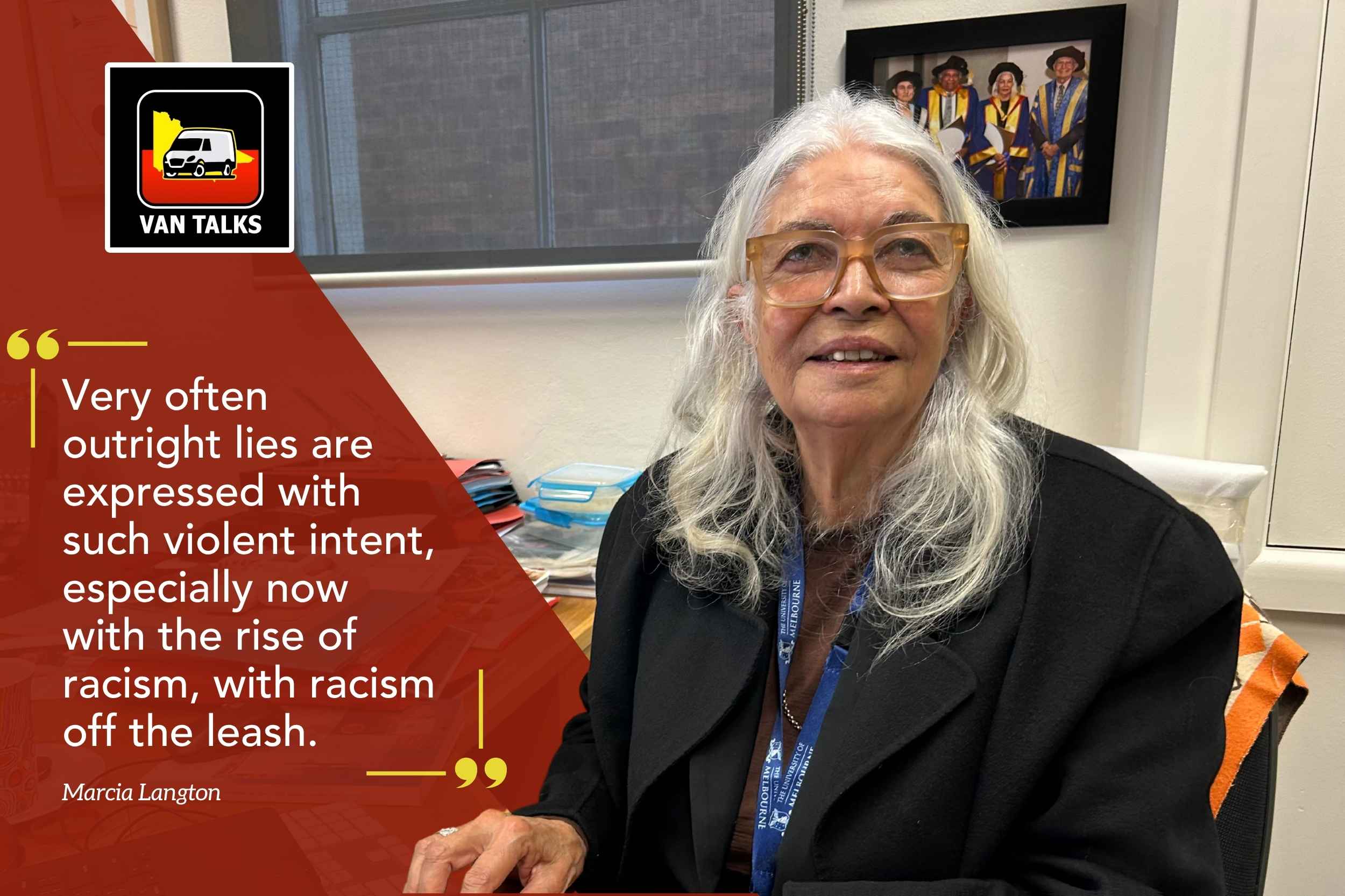
Distinguished scholar and First Nations advocate Laureate Professor Marcia Langton AO has issued a powerful call to rethink truth-telling in Australia, urging a move away from deficit narratives toward education that celebrates 65,000 years of Indigenous scientific innovation.
Reflecting on the fraught public debate following the Voice referendum, Langton warned that everyday racism has escalated into an aggressive, combative force across Australian society.
“Let’s call it for what it is: it’s everyday racism in Australia now,” Langton said. “And as I say, it’s expressed with such violence. We have a choice: do we engage with these fools, or do we walk away? I think in most instances, it’s tremendously important to walk away.”
Langton stressed that enduring relentless public hostility requires strategic disengagement, comparing deliberate online provocateurs to chaotic toddlers who act out harmfully. To preserve health and personal dignity, she argued, First Nations people have no obligation to debate bad-faith actors.
Instead, the key to lasting change lies in the classroom. Langton warned against introducing frontier trauma to young students without proper cultural safety, noting that children must first be given resilience and positive frameworks rather than deficit stereotypes.
Through the Ngarrngga initiative—named after the Wadawurrung word meaning “to know”—Langton has championed the embedding of First Nations knowledge directly into the national curriculum, focusing on astronomy, fire management, and water systems.
“It’s not a deficit content in the classroom,” she explained. “It opens up the children’s minds to the idea that there are bodies of knowledge that were created by Indigenous people over millennia, and it is available to them.”
By showing how ancient sky lore tracked complex phenomena like the variability of Betelgeuse long before Western science, education can dismantle systemic bias and celebrate deep First Nations ingenuity.
Challenging the public to build a safer, more respectful nation for future generations, Langton urged Australians to seek genuine scholarship over internet hostility.
“Do your own research’ doesn’t mean going to Facebook,” Langton said. “‘Do your own research’ means probably going to a library.”
Charles: I’m joined on the program today by one of Australia’s most distinguished scholars, authors and advocates for First Nations rights, Laureate Professor Marcia Langton AO. Professor, thanks for joining me on the programme today.
Marcia: Oh, thanks so much, Charles. Please call me Marcia.
Charles: Oh, thank you so much indeed.
Marcia: I think we know each other well enough to use our first names, don’t you think?
Charles: I appreciate that. Thank you so much indeed. Marcia, in touching on truth-telling, I want to yarn about a quote that I came across recently in an article that you wrote in 2024 for Pursuit, the publication of the University of Melbourne. And in that article, you stated about truth-telling: “Not only must we talk, we must also help to overcome the often traumatic historical legacies, and contribute to initiatives that redress the wrongs with respect and with regard to the rights of Indigenous peoples.” What does that actually mean on the ground and within organisations—academic and bigger organisations, and government?
Marcia: I’m glad you called me out on that, because we were just having a talk before we started the interview about you running into the big lies…
Charles: Mmm.
Marcia: …out in a country town in Victoria.
Charles: Yeah.
Marcia: And it is impossible in those circumstances, when you’re confronted with outright lies about our people, to speak back to people who persist, I would say psychopathically, with these lies with any kind of respect and retain dignity for your own person. And so, as you said, you felt compassion for a person standing next to you who would have suffered greatly from the horrendous thing said, and you led them aside and said, “Let’s go.” And that, you know, it’s a bit like violence. And it is violence. It is violence. It’s verbal violence. And in the face of violence, you have two choices: you can stay and slug it out, or you can walk away from it. And very often, outright lies are expressed with such violent intent, especially now with the rise of racism, with racism off the leash.
Charles: Yeah.
Marcia: I would revise the statement that you quoted at me from the Pursuit article.
Charles: How would you rephrase it?
Marcia: Okay, so for many Aboriginal people, and, you know, a large part of the Torres Strait population who live on the mainland—not to deny that the people in the islands have suffered various kinds of trauma—but I think the trauma on the continent is, well, very well documented in the first place, and a very real condition that affects our health. And most of that trauma, people describe it as, you know, intergenerational trauma resulting from colonialism. Well, actually, the truth of the matter is, yeah, there’s that, for sure, but more so is the trauma of the everyday that we experience. And so by constantly referring to it as colonially generated intergenerational trauma, we ignore the everyday.
Charles: Yeah, of course.
Marcia: And what you experienced is traumatic enough in itself. Let’s call it for what it is: it’s everyday racism in Australia now. And as I say, it’s expressed with such violence. We have a choice: do we engage with these fools, or do we walk away? I think in most instances, it’s tremendously important to walk away.
Now, you and I don’t have any special responsibility to speak to these racists. It’s not our job. We’re not paid to do it. We don’t have an elected position that requires that we speak to them as if they were constituents. It’s somebody else’s job; it’s not ours. So I think for our own good health, to maintain good health and equanimity in the face of relentless racism, we must walk away from it as often as possible.
If, however, you put me on TV and I’m sitting opposite Pauline Hanson, or Barnaby Joyce, or Tony Abbott, or Andrew Bolt, or Alan Jones…
Charles: Interesting collection of people there, Marcia.
Marcia: Yeah, or Thomas Sewell…
Charles: Yep.
Marcia: …and I’m on a TV panel programme with them and they say something that is untrue…
Charles: Yeah.
Marcia: …or something that is racist, however much they try to disguise the essential racism, you know, making it a joke, for instance, then I would be required to address it, because I’m in public, I’m voluntarily in public being broadcast.
Charles: You’re in a corner, practically speaking.
Marcia: And I’m in a corner. However, see, there are guardrails. Now, you’ve got to be very precise: are they racist, or is what they are saying racist?
Charles: Therein lies the rub. How much of it is just political mileage and trying to get the racists on board to vote for the next elections?
Marcia: Well, I have no doubt that there are some people who say extremely racist things who are indeed racists.
Charles: Of course.
Marcia: But the problem now, and I’ve experienced this—in fact, I think what happened to me might be the tipping point—so, I’m trying to remember her name, one of those mongrel journalists who hunts down stories and distorts them and starts culture wars, [name removed – Ed] right? So I was in Bunbury in Western Australia during the Voice campaign and I was speaking to an audience, and I was asked some questions.
Charles: Mmm.
Marcia: People are saying this, people are saying that. And of course, they were lies. So many lies were told about the constitutional proposition, the constitutional question. Our job was to constantly answer these lies, right? And I said these statements are informed by racism and stupidity.
Charles: What was the response then?
Marcia: Well, there was a big man sitting down the front, and I caught him out of the corner of my eye, and he was filming me on his phone.
Charles: Oh yeah.
Marcia: And I thought, “Oh okay, he’s going to take that back to the local club and get a few free beers or something.” But no, he shot it straight through to [name removed – Ed] who put it all over the media as “Marcia Langton calls Australians racist and stupid.”
Charles: Oh, my god.
Marcia: When that’s not what I said, right? And so that was the tipping point, and there was a pile-on, a vicious pile-on. Then all of them jumped in, you know, Jacinta Nampijinpa Price and Warren Mundine—Warren Nyunggai Mundine…
Charles: I wish we were filming this so the audience…
Marcia: …and you know, the whole Advance-funded crew jumped in and said I was the racist for calling decent white Australians racist.
Charles: You evil woman.
Marcia: Right? So, from after that point, everybody who called out racism was the racist.
Charles: Yeah.
Marcia: And you can attribute the MAGA alternate reality to [name removed – Ed] the master of culture wars. You’ll remember there was a lovely young boy, Quaden, from up in North Queensland. He suffered from dwarfism.
Charles: Oh, yes. Yes, of course.
Marcia: And he suffered extreme bullying and racism at school in Cairns, and his mother posted a video on a social media platform of him sitting in the car after school sobbing…
Charles: I remember this, yeah.
Marcia: …about the viciousness at school.
Charles: Yeah.
Marcia: And then all the [name removed – Ed] types—and there’s one in the United States and I can’t remember her name, I don’t think she’s game to come back to Australia because she is really a piece of work—they piled on this little boy. He was seven years old at the time. And it was a witch-hunt. It became a global witch-hunt.
Charles: It was brutal, yeah, I remember that.
Marcia: It was brutal. They accused him of being 18 years old, his mother posted the video to make money, he was lying. It was just horrendous.
Charles: Mmm.
Marcia: And it became so awful for the family. You know, they had to protect their son and themselves from the viciousness because he was Aboriginal and had dwarfism, and so double target for lunatic racists, right?
Charles: Yeah, very much so.
Marcia: Thank God our celebrities, our Hollywood celebrities stepped in, started a defence campaign for him and fundraising, and they gave him a part in a movie, one of those Mad Max movies, right?
Charles: Yep, I remember. Yep.
Marcia: Yeah, I went to watch it just to see him perform. And he had a significant part and he was very good for a little kid, did his job very well. And so people tried to step in, assist him and his family to mend and heal the harmful poison of these media folk.
Charles: So I want to bring it back, though, to the truth-telling component.
Marcia: Okay, so you’ve got to tell the truth, right? If you’re a decent human being, you’ve been brought up to tell the truth.
Charles: Yep.
Marcia: Or at least not tell an outright lie. You know, there’s an expression “little white lies”, right?
Charles: Yes, yep.
Marcia: So, you know, we don’t say to people, “My God, you look horrible in that dress”, right? You know what I mean?
Charles: I know exactly what you mean.
Marcia: So the concept of truth has its limits as well, especially in relation to how well we might be able to practise truth-telling on any given day. We grow up taught to respect, not to blurt out that they look dreadful in a dress or in a hairstyle or something, you know. And we grow up trying to be polite and respectful to people. That’s how we’re brought up as Aboriginal people, isn’t it? Especially our generation. I mean, I’m a lot older than you, but I can see the same upbringing, you know, the same kind of socialisation in you.
Charles: Yes, very much so. I’m not that much!
Marcia: But all of those tenets of a civil life, a decent life, have been completely rejected by elements of society in politics, in the media, in the entertainment business, in social media, especially in the online environment. It explains why truly evil people are tolerated for decades even though the terrible things they do to people are a public secret. Therefore, I have to say to you…
Charles: Mmm.
Marcia: …we have to be a lot smarter about truth-telling. I have to zip it and not say things like, “Well, saying that our Constitution says X, Y, and Z is not true. Our Constitution does not say that, and such statements are informed by racism and stupidity.” I shouldn’t say that anymore, because in the new One Nation MAGA environment, I will be labelled by thousands of white Australians as the racist, and that is not helpful at all.
Charles: I just want to go to you being labelled as one thing or the other. And look, we need to go back and address the bit of the elephant in the room. After 2023, you really suffered the slings and arrows of outrageous fortune and racism in the media and across the broader community. You’ve been talking about how we need to manage this racism, we need to manage the lies that come at us all the time. I think the audience would like to know, how did you manage to keep going, not after the defeat of the referendum, but after the massive amount of negative media that you and others, such as Thomas, received during 2023 and post-2023? Because it was huge.
Marcia: Yeah, it was, yeah. I think I was particularly a victim. And let’s look at why that would be. Why was I the main target for viciousness, racism, and stupidity? There, I said it! Oh, my goodness, I said it again! Why was I the target? Well, it’s because a: I’m Aboriginal, b: I’m female – a woman, and c: I’m very well educated.
Charles: Yep. So tick, tick, tick—three ticks.
Marcia: And so therefore, I am the primary target of ignorant, hateful people because I am—I don’t just represent, I am—everything they hate.
Charles: So that establishes why, though, but how did you manage it?
Marcia: It does tell you why. It does tell you why. It tells you who these people are.
Charles: But how then did you manage it? Because it was relentless.
Marcia: Well, just say you’re a grandparent, and you’ve given up a week to babysit the grandkids, and they’re all two-year-olds.
Charles: Yeah, I think I know where this is going.
Marcia: Yeah. It’s pretty obvious, isn’t it? Okay, so when they smash plates and annoy the dog, pull the dog’s tail, etc., etc., you say to yourself, “They’re just two-year-olds,” and you work out a strategy for managing the chaos.
Charles: Yeah.
Marcia: Their chaos, right? So, I really would want younger Indigenous Australians to understand this, because they’re so deeply hurt by the racism. You have to remember that the people who say these things, especially those who say them wilfully, deliberately, to cause harm, are like the two-year-olds smashing plates. I don’t feel a lot of compassion for them, because they’re not actually two-year-olds.
Charles: Yeah.
Marcia: I try hard to maintain my humanity in the face of—is it evil? Yes. In the old-fashioned parlance, it’s evil, right?
Charles: No one’s going to argue with that. Yes, of course.
Marcia: Wanting to cause harm to others wilfully and deliberately is evil in my book. And so, how do you manage evil in your life? What did I do wrong? I ask myself, what did I do wrong? And I look at myself closely. I made a strategic mistake because I didn’t look around the room to see if anybody was recording me. I thought I was amongst friends answering questions.
Charles: Yeah.
Marcia: I don’t know who the [removed – Ed] was. I have no idea who that was. But I thought it was a group of Yes campaigners wanting me to answer their questions about how to campaign better.
Charles: Yeah.
Marcia: But you know, obviously, they made it a public event and happened to be somebody who looked like a prime candidate for the local Ku Klux Klan.
Charles: Well, let’s talk about truth-telling in education. Another thing that I particularly noted was in The Guardian recently, you spoke about the importance that if we are to bring truth-telling into the education system, especially with younger people, Aboriginal and Torres Strait Islanders in particular, that there needed to be a great deal of care and caution put in place in order to avoid retraumatising. And you actually related the story about your daughter coming home from school one day, slamming the kitchen table, and saying, “Mum, why didn’t you tell me about the truth?” Let’s explore: what do we need to do in order to appropriately incorporate truth-telling into the education system?
Marcia: I am the granddaughter of a man who was brought in from the bush as an infant with his twin brother to the Aboriginal settlement in the Upper Dawson Valley, where from the 1860s onwards—probably even earlier than that…
Charles: Mmm.
Marcia: …there was a relentless and deliberate campaign to exterminate my grandfather’s people.
Charles: Yeah.
Marcia: Using the Native Police—and David Marr’s written an excellent book about his own ancestor being involved as the white officer of the Native Police troop operating in that area called Killing for Country.
Charles: Right.
Marcia: So I recommend everybody read it. And what happened in my grandfather’s country decade after decade is a story of unrelenting horror. And yet, people survived somehow. So, my daughter, who’s his great-granddaughter, is a direct descendant of that history, and I know how this has affected me. So I’m the daughter of third oldest sibling of my grandmother and my grandfather, who were born in the 1800s. So I’m very close to the frontier, because I spent a lot of time with my grandmother. You know, I would see my grandfather occasionally. I remember going to the races in Brisbane with him in the, you know, the open paddock and being spoilt. It was lovely.
But he and his twin brother were sent out from the Aboriginal settlement as indentured labourers to work on the stations because they were both brilliant horsemen. And so, essentially, like a type of genocide—a colonial form of genocide through to a post-colonial form of slavery—I knew all of this from the time that I was very young.
I remember asking my grandmother one Christmas, “What did you do on the station at Christmas time, Grandma?” Nana, I called her Nana. And she said, “Oh, we’d wash all the lace curtains, and then we’d iron it all, and we’d wash all of the manchester, and we’d lay out the Christmas table, we’d cook the Christmas dinner.” And I’m waiting for her to tell me about the Christmas dinner she ate.
Charles: It wasn’t for her, was it?
Marcia: No, no. I said, “Oh, so what did you eat for Christmas dinner?” She said, “Oh no, we weren’t allowed to eat dinner. We were sent out the back to the woodpile.” That was a shocking realisation for me. I didn’t want my daughter to grow up being traumatised by these endless horror stories and the microaggressions of racism. I probably overprotected her, but at the same time, she’s a very happy person. Whereas, you know, people who know me well know that I have a different view of the world, let’s put it that way.
I grew up in apartheid. My schooling, my early schooling was in apartheid towns, segregated towns in Queensland. Even the churches were segregated. So from a very young age, I could see racism very, very clearly. And so it gave me a certain outlook on the world. It toughened me up a lot.
The situation for young people today is—and I’m complicit in this, and so are many parents like myself—we brought our children up to be happy. We wanted them to have a happy life.
Charles: What’s wrong with that?
Marcia: Well, what’s wrong with that is that we didn’t teach them the tools of resilience in the face of millions of Australians who want to make their lives unhappy.
Charles: Yeah.
Marcia: That’s what’s wrong with that. And so, therefore, as a professional educator—I work in a university—it’s my job to ensure that I don’t cause harm to my students, and I encourage my colleagues not to cause harm to students when teaching Indigenous studies.
Charles: How do you do that when you need to put the truth in there?
Marcia: Well, I avoided the question for a long time by—well, it’s not really avoiding the question, it’s actually managing the curriculum content. So it’s nine years ago now that I created the National Aboriginal and Torres Strait Islander Curricula Project here in this very building, with funding from the Commonwealth Government to create curricular resources for Aboriginal and Torres Strait Islander histories and cultures, which is the title of the cross-curriculum priority. There are three of them in the Australian Curriculum Framework, and it is the one that is not implemented by teachers. Well, it certainly wasn’t at that time. We find it a little more so implemented now, but only because we’re encouraging teachers to implement the resources that are now available under a new form called ngarrngga.org—N-G-A-double R-N-double G-A—which is a Wadawurrung word given to us by a Wadawurrung aunty. It means “to know”.
What I did, and I thought about this very deeply: first of all, we have the challenge knowing that teachers are too afraid to teach Aboriginal and Torres Strait Islander histories and cultures in the classroom because they’re terrified of being accused of being racist by Aboriginal people; they’re terrified of being persecuted in the school by principals, parents and citizens associations, white parents—you know, the whole white flight from schools syndrome.
Charles: Yes, of course.
Marcia: And you’ve got to be careful about what you teach children so that it does conform with the Australian Curriculum Framework, and is taught at the level, and is taught in such a way as to meet the general expectations of the learning area. So I studied it long and hard and I figured, okay, the best way to do this, if we’re going to start at grade five—which is about the right place to start…
Charles: Okay.
Marcia: …we ought to then give children a view of the Aboriginal and Torres Strait Islander worlds that is positive, not negative. See, I grew up in horrible schools, horrible schools in Queensland.
Charles: Mmm.
Marcia: Well, one English teacher read one of those horrible old colonial racist poems in class and expected us to recite it. Well, of course, the white kids did, and I stood up and said, “No, I’m not going to. That’s racist.” I was promptly expelled. So what kind of content do you want to give children so that they grow up not immediately thinking Aboriginal people are dirty, stink, kill, thieve…
Charles: Yeah. So get rid of the deficit model. Yeah.
Marcia: …cunning, vicious, right? Subhuman, more like animals than humans. What kind of content do you give children so that they don’t grow up with those stereotypes, those tropes about us that were in the textbooks?
Charles: Yeah.
Marcia: So I thought, okay, one of the things that happens in the education systems is that everything that we, you and I as Aboriginal people know about the world, is obliterated—tabula rasa. It doesn’t exist. Only British knowledge exists. Only Western knowledge exists. Anything else is superstition, right? And yet, somehow, because I, you know, I’ve studied anthropology, prehistory, I’ve followed all of the debates pretty closely for decades, our peoples have been here on this continent for a minimum of 65,000 years on the evidence, right? So how is it that they had no knowledge systems, or that their knowledge systems were so febrile that they could be so easily replaced by the Western knowledge system? Well, of course, it’s one of the big lies, isn’t it? It’s a big lie. That’s a technical concept: big lie.
So let’s put Indigenous knowledge into the curriculum. And I chose three areas for the very simple reason that these are the three areas where there is the most literature and the most research, and they’re also very interesting: astronomy—Indigenous astronomy…
Charles: Yeah.
Marcia: …fire, and water. The research on these three topics is enormous. There’s a huge literature on these three topics. There’s a growing body of astronomers, Indigenous and non-Indigenous. And we have one of the real innovators here, an astrophysicist, Duane Hamacher.
Charles: Yeah.
Marcia: And there’s a huge website, aboriginalastronomy.com.au, with all the published research, literature, and videos. And so he and his colleagues—and he worked closely with elders; he published with the elders that wonderful book, The First Astronomers…
Charles: Yep, of course.
Marcia: …he and his colleagues have worked with elders and knowledge holders in Australia and various parts of the world, and shown what Indigenous peoples know about astronomy. And so, for instance, Indigenous people in Sydney knew about the variability of Betelgeuse long before Western astronomers did, because it’s recorded in a story from that area. If you go through the records, to cut a long story short, you go through all the old colonial records, you’d find all of this astronomy. Colonials were writing down what Aboriginal people told them about the sun, the moon, the stars…
Charles: Sure.
Marcia: …clouds, and various other sky phenomena. And that continued well into the 20th century. So we know a lot about Indigenous astronomy as a result of the work of astronomers documenting it. It’s called cultural astronomy, but it is a very important field of astronomy. A very large number of Aboriginal people in Australia and Torres Strait Islanders have contributed to the science of cultural astronomy.
Charles: Why is it that this subject in particular would be good in the classroom? Because it does seem to, of course, be anything but a deficit model. It’s actually constructive, it’s educational, it’s positive. What are the other rationales to embed this within the classrooms?
Marcia: Well, there are so many things to say about this.
Charles: Mmm.
Marcia: So, first of all, as you say, it’s not a deficit content in the classroom. It opens up the children’s minds to the idea that there are bodies of knowledge that were created by Indigenous people over millennia, and it is available to them. Once you know something from Indigenous knowledge and kids are told, “Okay, get out your Stellarium and go outside at 9:00 PM tonight and look up at the night sky. Can you see the dark emu?” And so the Stellarium is a, you know, a wonderful program that you can download onto your computer and it positions you under the sky as it is at the moment. And so kids can just go out there at night with their—or any time of the day as well—and look up at the sky, and the Stellarium will tell them what they’re looking at. But because they were in class learning about dark emu or any number of other Indigenous concepts about the night sky—the Milky Way itself…
Charles: Mmm.
Marcia: …they have immediate access to Indigenous knowledge and the real world to which this Indigenous knowledge refers. So it is an exciting form of learning, and it gives them an understanding of how Indigenous people lived here living under night skies as they did.
Charles: And it doesn’t even need to be something that is just for the classroom. Sounds like this is an option for everyone to really start learning about some deep and meaningful truths that have been for so long hidden. Marcia, we do need to wrap it up, but I want to ask you one more question, and that is a call to action for all Australians. When it comes to truth-telling, when it comes to reconciliation, the one thing, a realistic thing, I’m going to ask you, Marcia, that you would ask all Australians to consider.
Marcia: Think about what you want Australia to be for your children and your grandchildren. Do you want Australia to be the kind of dangerous, unsafe place where your children will run into hate speech, discrimination, xenophobia, racism, misogyny, violence? Or do you want a peaceful society where everyone is safe and has equal opportunity to advance in life?
So that’s the first thing. But secondly, how do we achieve that? Well, by showing respect for others, by being tolerant of others, by opening our minds to the realities of other people’s existence. Why insist that there’s only one way to live? Why insist that there’s only one right skin colour? It’s obviously nonsense given world history and human history. It’s a tiny, tiny, flea-sized concept of our existence as human beings. We can do better than that, and live a full life, and enjoy life and appreciate others.
I feel very sorry for people who hate the majority of the world’s population, but they don’t understand that that’s their predicament. So have a think about what you want for your own children and grandchildren and great-grandchildren. And if you do your research—not from Facebook, not from TikTok, not from Reddit…
Charles: (laughs)
Marcia: …not from Instagram, but you know, actual books, journals, science journals, history books that are published by reputable publishers, not vanity presses like, oh, one in Geelong, I better not go any further with that.
Charles: We’ve mentioned enough names in this episode for the day!
Marcia: So yeah, “do your own research” doesn’t mean going to Facebook. “Do your own research” means probably going to a library.
Charles: Foreign concept for many Australians, unfortunately. Aunty Marcia Langton, thank you so much indeed for your time, your thoughts, and sharing with us today.
Marcia: Thank you, Charles.
For Radio Play:
1 - Click the Download Audio button
2 - The audio file will commence automatic play in your browser
3 - Confirm this is the file you want to use in your program
4 - Once confirmed, click the vertical elipses (3 dots) and select download
CONTACT US VIA SMS
Get in contact with us via our dedicated SMS line:
0493 222 836
4 September 2026
Ipsos Indigenous Issues 2026 report reveals shift in public focus
2 September 2026
Long term economic independence at the heart of Victoria Treaty process
24 August 2026
Standing up for Mob through reporting racism and demanding real accountability
21 August 2026
Building self-determination on air through independent Aboriginal media
14 August 2026

0 Comments