
Long term economic independence at the heart of Victoria Treaty process
Self Determination Fund co-chair Leanne Miller explains how building capital and supporting Traditional Owner unity is driving long-term economic independence and equity across Victoria’s ongoing Treaty process.
Posted by: Karina Wells
Published: 2 September 2026
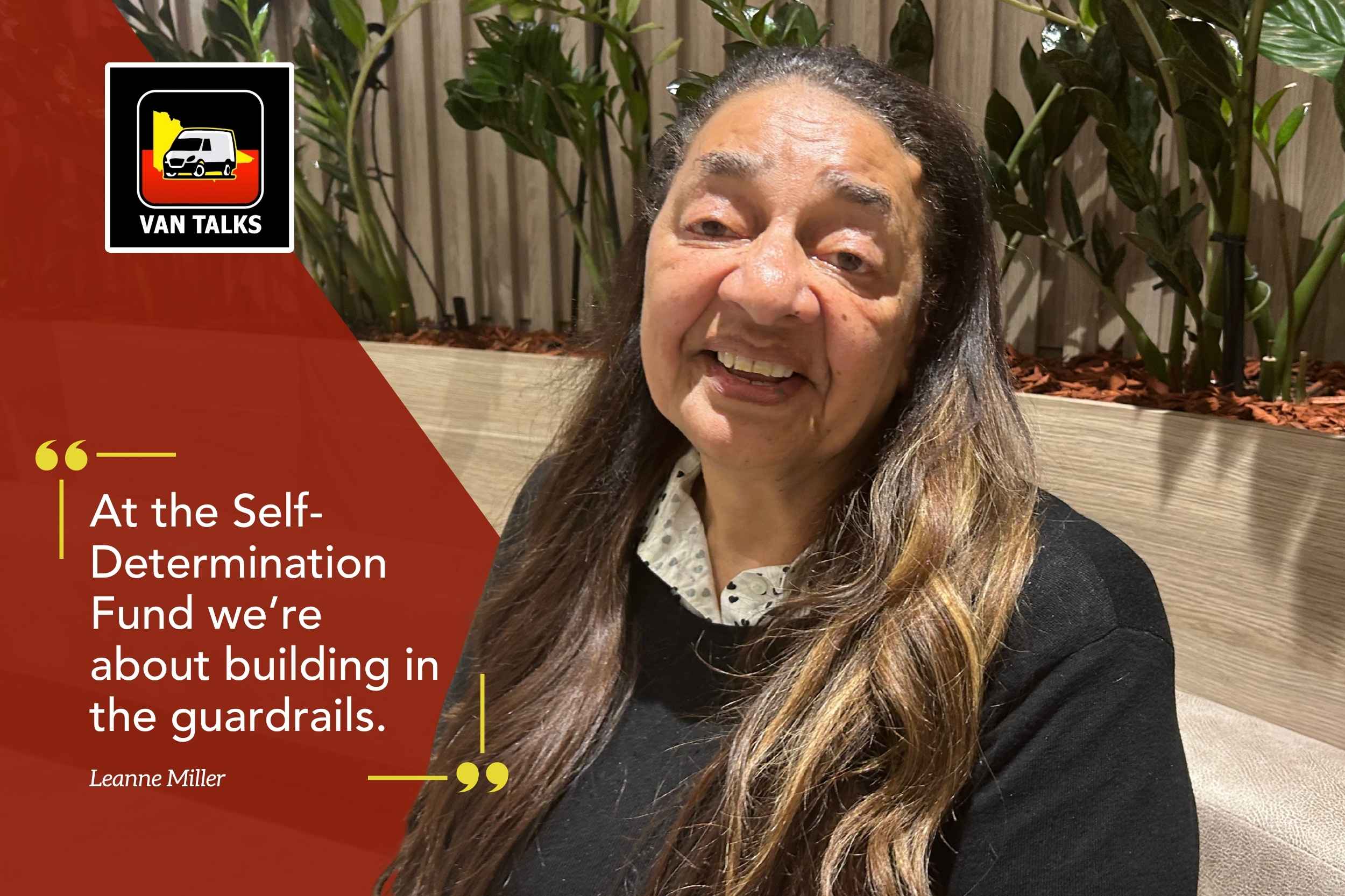
The Self Determination Fund is actively strengthening economic independence for First Nations communities as Treaty negotiations progress across Victoria.
Established to ensure Traditional Owner groups are not resource-disadvantaged during negotiations, the independent entity has already committed over $7.18 million to support Traditional Owner and family groups.
Speaking with Victorian Aboriginal News, Dhulanyagen Ulupna woman and fund Co-chair Leanne Miller detailed how equal footing funding is supporting community preparedness and unity.
“When we started talking about the Self Determination Fund… the focus for us is unity,” Leanne said.
“Self-determination isn’t about just sitting at the table; it’s about having a voice, it’s about generating a local legacy financial, economic, business for the family and for the clan,” she said.
Addressing questions around long-term sustainability beyond initial state seed funding, Leanne emphasised that the fund moves well past traditional grant-making models.
“We focus a lot on building capital because capital creates choice and opportunities and independence,” Leanne said.
“Our goal is to create an enduring fund that supports community-led decision-making, that strengthens Traditional Owner groups, and creates intergenerational prosperity for future generations.”
The fund continues to encourage family groups across the region to engage directly to build unified strategies for local and statewide Treaty outcomes.
Charles Pakana: One of the cornerstones of the Victorian Treaty process is the Self-Determination Fund. It’s an organisation which, along with the Treaty Authority, was established, or legislated, in 2018 under the Advancing the Treaty Process with Aboriginal Victorians Act. It was formally established in 2023 with two primary purposes. The first, which we’ve covered in previous interviews, is to establish resource equity to ensure no Aboriginal group is out-resourced when negotiating Treaty with the State.
The second primary purpose is the investment and growth of capital to support economic self-determination for generations to come. Joining me on the program to discuss this is Leanne Miller, a Dhulanyagen woman, and co-chair of the fund. Leanne, thank you so much for taking the time to speak with me today.
Leanne Miller: Pleasure.
Charles: Leanne, the fund received initial seed funding of $65 million from the State Government in 2023.
Leanne: Yep.
Charles: Now, since then, there have been literally dozens of applications from Traditional Owner groups for equal footing funding to assist in Treaty negotiation preparedness. Now, according to a review undertaken by First Nations Co. in 2025, that contribution has been insufficient to meet demands. Given the uncertainty now of future contributions to the fund, how does that uncertainty, and that pressure, and the current demand for funding impact on the fund’s long-term planning?
Leanne: At this point in time, that’s a valid question to ask. We have provided back to Gellung Warl our strategic planning for the next five to 10 years, which includes predetermined risk management around funding from State, and from private entities. We have… high hopes, like everybody else, that the interest in the fund continues with Traditional Owner groups. But we also have great support on the ground outside of government that makes us feel positive.
Charles: When you say great support on the ground from outside the government, what sort of interest and support actually is that? Can you name names?
Leanne: I’d rather not. Other than to say that a lot of our issues that are very public, there are quite a few outstanding citizens that want to show leadership.
Charles: Let’s just go back to the equal footing funding that’s available out to the Traditional Owners there. Just what actually does that look like? How much can be applied for, and if you’re able to share, how much actually has been distributed out to the Traditional Owner groups since that equal footing funding actually started?
Leanne: The fund has supported 31 Traditional Owner groups, and family groups. 37 funding agreements have been supported by the board. And in terms of committed monies, we’ve got $7.18 million set in train…
Charles: Yeah.
Leanne: …to support equal footing. That is our main purpose of operation at this point in time. Our agreement with State Government was to support equal footing funding, and a proportion of what we do and what we deliver on is around supporting the self-determination identified by Traditional Owner groups and family groups.
Charles: Just how much strain does that relate to the Self-Determination Fund, that $7-plus million?
Leanne: At this point in time, there is no strain, because for us, it’s… Traditional Owner groups and family groups need to understand the process. And the connectedness that we look at their funding is based a lot on our relationship with the Treaty Authority.
Charles: Now, a lot of the money is being put into community engagement to building up internal resources to go to those next stages of negotiating Treaty, or preparing for Treaty. What are some of the successes you’ve seen across the state from some of the Traditional Owner groups? Do you see that it has supported a stronger community within some of those TO groups?
Leanne: Some of the Traditional Owner groups have set the bar. When I say they’ve set the bar, they’ve actually done some deep thinking and connectedness within their clans to understand exactly what they want to have put on the table that benefits all.
When we started talking about Self-Determination Fund in the Assembly chamber, I was an original elected member…
Charles: I remember. Yeah.
Leanne: So, when we started talking about the Self-Determination Fund, we thought the focus for us is unity, and supporting unity, and bringing families and clan groups together to talk about what’s their bargaining position and to understand that self-determination isn’t about just sitting at the table. It’s about having a voice. It’s about generating a local legacy: financial, economic, business, for the family and for the clan.
Charles: Let’s get on now to the self-determination side of things, the side of the fund that people don’t really look at all that much, and that is generating revenue to support self-determination on the ground within Aboriginal Victoria. Just in general terms, what does that actually look like?
Leanne: Well, the Self-Determination Fund, we’re about building in the guardrails so family clans and Traditional Owner groups in Victoria are actually able to make those determinations themselves, but also to activate whatever we consider to be within our wheelhouse to support them, or within our influential pieces of work we’ve got going forward. or part of the Treaty ecosystem, and how we can achieve what works for them.
Charles: As I mentioned at the beginning of the interview, Leanne, the State Government provided in 2023 $65 million of seed funding.
Leanne: Yep.
Charles: This was intended to be essentially a one-off funding agreement with the Self-Determination Fund needing to look at ways to generate wealth itself and to capitalise on that initial investment. What are some of the strategies being put in place or at least considered to ensure the financial longevity of the fund?
Leanne: We are, at this point in time, reviewing our investment policies given the impacts overseas. But we also are generating interest from lots of different options that, as a board, we are yet to consider, but have had quite consecutive discussions with. And generating wealth is not what we focus wholly and solely on. We focus a lot on… We know what year we’re aiming to hit the market. 2028 is going to be an expected growth year, ‘27, ‘28. We just simply need to wait post the state election and also how things are delivered to Gellung Warl, which impacts the Treaty Authority and the Self-Determination Fund.
Charles: Leanne, when it comes to distribution of funds to Traditional Owner groups and family groups across Victoria, what measures are in place within the Self-Determination Fund to ensure that there’s equitable distribution? And by that, I’ll cut to the chase, how do you ensure that the smaller groups, the less resourced groups, get their fair share beyond it being taken up by the larger, more well-established and resourced groups?
Leanne: We are talking about equal footing funding, and we ensure fairness and equity. We’ve got a framework, which also has guardrails. And we recognise TO groups are going to vary in their resourcing, and also around what’s available to them, and their capacity on the ground, not just resource, but human capacity to deliver. Our responsibility is actually to just provide an accessible funding pathway, look at clear and consistent criterias, and make support available to TO groups that need assistance to participate. And that participation is defined by them. We have a team that actually speaks quite a bit and does on-ground visits. And it doesn’t matter the size of the entity when they apply. But in the context of what you asked me about equality, it doesn’t mean we’re going to be giving every group the same amount of money. It means recognising the difference… of people’s starting points, and ensuring the funding system we have is fair, and supports a very broad cross-section of our people.
Charles: I just want to address one elephant in the room, and by the room I mean the greater place of Victoria. And that is a lot of times I’ve heard the questions asked by local governments and by other organisations who wish to be involved in the Treaty process at some stage and in some way.
Leanne: Yep.
Charles: And the question has been, “Well, can we access the Self-Determination Fund as well?” So, let’s just draw a line in the sand, Leanne. Who is able to access the Self-Determination Fund, regardless of its purpose
Leanne: At this particular point in time, people accessing the Self-Determination Fund are Victorian Traditional Owners and family groups. And the other side, in terms of the ecosystem process, we actually also engage with the Treaty Authority around their engagement, but also some of the progress that’s being made in the Treaty negotiation framework.
Charles: So, in order then to approach the Self-Determination Fund to apply for funding, is there a requirement that the entity, whether it’s a clan or a family or a Traditional Owner group, be first of all recognised under Gellung Warl and by the Treaty Authority?
Leanne: Yes, they have to be recognised by the Treaty Authority. But family groups approach on the basis that they have an auspice, but also that they are a large family spread across lots of parts of New South Wales, Vic, and Tassie, and they want to come together to actually be very constructive about what their family sees as part of the process, what they would like to have on the table.
Charles: You mentioned before, and you were unable to share details, and that’s understandable, we need to wait until 2027, 2028 for this, but you did mention a five, potentially a 10-year goal, or aspirations for the Self-Determination Fund. Can we share some of those?
Leanne: I can say that, regardless of the external environment, there will always be a Self-Determination Fund. It’s always been established as an independent authority, the same as the Treaty Authority and Gellung Warl.
And by doing so, we recognise our peaks and troughs of where our funding, whether it’s generated by us or incoming, shall occur.
We also recognise that we are the silent partner in the ecosystem at this point in time, and there’s a rationale behind that for us in that we have just come out of the gates in talking to people and being very clear that this is our priority, and understanding the connectedness we have with the new entity. I feel that if it was the former entity, it may be a bit BAU [Business As Usual], but it isn’t. It’s got elements in it, but we are still doing ways of working.
Charles: So, and when you’re talking about the previous entity, you’re talking about the First Peoples’ Assembly as opposed to what we currently have now with Gellung Warl, is that correct?
Leanne: Yeah.
Charles: Let’s look ahead five to 10 years, some of those aspirations.
Leanne: In five to 10 years, for us, the SDF is about creating a stronger economic future for Victoria’s First Peoples. And at SDF, we focus on building capital, because capital creates choice and opportunities and independence. Our goal is to create an enduring fund that supports community-led decision-making, that strengthens Traditional Owner groups, and creates intergenerational prosperity for future generations.
Charles: Let me address something with you that is going to be in the minds of many people out there who don’t fully understand that First Nations prosperity and First Nations progress equates to benefits for the broader community as well. What do you say to those people, or what would you have them understand, those people who say, “Yep, once again, we’re simply giving money to an Aboriginal organisation, to Aboriginal people, and it’s a constant drain on the State’s coffers”?
Leanne: Firstly, we’re not into grant-making. Secondly, I talk about capital, and I talk about the need for us to come into that discussion, and for our communities to follow up those discussions around capital, because capital allows you access to so many things. And people that we speak to outside of SDF still interpret, even at home, “What does capital mean? Like Canberra?” And I’m like, “No.” We’re talking about money here. We’re talking about assets. We’re talking about, what do you want to leave your family? SDF wants to make sure that Traditional Owner groups and family groups are able to have in their toolkits the necessity of what helps them build capital from the minimum to the maximum.
Charles: Yeah.
Leanne: We are not about determining what they want, and how they should do things. We are about putting in the guardrails. We are about showing people their options, but we’re also about making sure that it’s done in a way that is a fit for Traditional Owners and family groups.
Charles: What are some of the key challenges—and we’re nearly at the end of the interview time here—but from the Self-Determination Fund’s perspective, I know it’s been a tough few years since its 2023 founding. What are some of the key challenges you are currently facing, and we’re not talking about state elections?
Leanne: I think in the broader Aboriginal community… front-facing, I would say that our challenges are the communication and the marketing of the Treaty ecosystem. Like, what does Gellung Warl do? What does [the] Treaty Authority do? And where does SDF play?People are still coming to terms with what is a statewide Treaty and what’s its implications, and who has responsibility to deliver that? We are silent because we are the Self-Determination Fund. We are waiting for people to tell us if they want to play in a statewide Treaty or a local Treaty.
We’re waiting for applications to tell us what they feel they need to do to engage with their bigger Traditional Owner group. And we do engage and encourage family groups to talk to us, and talk to the staff. We don’t do a lot of promoting in community at the moment. We are building and ensuring that we’ve got good guardrails for wealth investments for the future.
We are also geared up to look at, how do we work in delivering some of what we do and do it well with the Treaty Authority’s outreach. We do not want our community and family groups to come to us and be hit with a lot of bureaucratic processes. So, we’ve worked on refining our processes internally. We’ve worked on building our team. We have a CEO who’s been here over 12 months…
Charles: Yeah.
Leanne: …and he brings a wealth of experience from New Zealand. We have some really good key movers and advise people in our investment group. And we are a new board as well. We’ve been in place almost 10 months now. I feel that people need to just get to know the SDF and get to know the staff. We have a vision, but our vision can’t be complete unless Traditional Owner groups and family groups come chat with us. We will chat with you anytime.
Charles: So, that invitation is out there to all family groups and Traditional Owner groups across Victoria to reach out to the SDF, come in, and explain what their aspirations are, and see what sort of relationship and support can be gained through this.
Leanne: I feel my staff will probably shoot me down for that, so… [laughing]
Charles: That’s okay, that’s okay. Commit yourself.
Leanne: What is a better way is to say that SDF are encouraging family groups to come together to talk about their country, what they would like to see in a local Treaty, let alone a statewide Treaty. We’re encouraging Traditional Owners to actually widen their listening, to be inclusive. I’m not saying they are not, but I am saying the processes put in train means that people need to focus on unity. People need to recognise beyond just the immediate membership at times. I also believe that SDF is very engaging and flexible once people reach out.
Charles: Leanne Miller, thank you so much for your time.
Leanne: That was deadly. Thanks, Charles.
For Radio Play:
1 - Click the Download Audio button
2 - The audio file will commence automatic play in your browser
3 - Confirm this is the file you want to use in your program
4 - Once confirmed, click the vertical elipses (3 dots) and select download
CONTACT US VIA SMS
Get in contact with us via our dedicated SMS line:
0493 222 836
21 September 2026
Reclaiming cultural heritage through proper consent frameworks
17 September 2026
Media leader urges all Australians to engage with Blak media

11 September 2026
First Nations creatives given safe spaces through Blak and Bright
4 September 2026
Ipsos Indigenous Issues 2026 report reveals shift in public focus
29 August 2026

0 Comments