
Photo credit: Nick Cubbin
Click here to find Dr Terri Janke’s book, True Tracks
Reclaiming cultural heritage through proper consent frameworks
Existing Australian intellectual property laws fail to safeguard Indigenous Cultural and Intellectual Property. Dr Terri Janke outlines why true consultation, consent, and True Tracks principles are vital for protecting Blak knowledge.
Posted by: Karina Wells
Published: 21 September 2026
Australian legal frameworks were never designed to accommodate First Nations cultural rights, leaving Indigenous Cultural and Intellectual Property (ICIP) vulnerable to exploitation.
Leading legal expert Dr Terri Janke emphasised that existing Western intellectual property laws fail to protect community ownership, traditional knowledge, and living heritage.
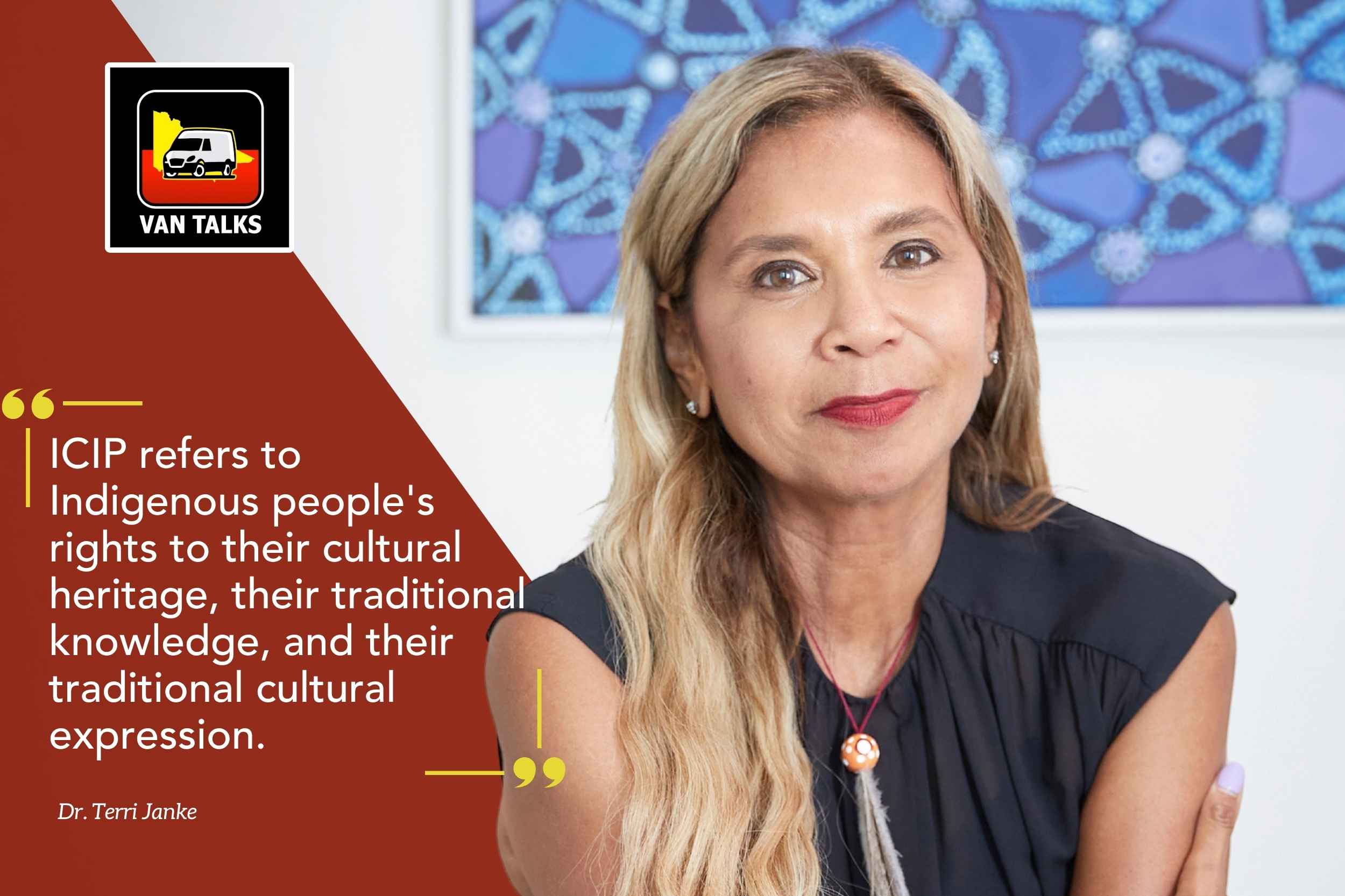
“Indigenous Cultural and Intellectual Property refers to Indigenous people’s rights to their cultural heritage, their traditional knowledge and their traditional cultural expression,” Terri said.
Current structures, such as the Copyright Act and the Trademarks Act, often allow non-Indigenous entities to register and profit from Blak knowledge without consent.
“They don’t have to ask anybody,” Terri explained, regarding commercial entities registering Aboriginal language words or plant knowledge.
“What’s happening is that trademarks offices are looking at that in a way… those registered IP systems are being asked about thinking how Indigenous people are firstly checking that it’s not offensive,” she noted.
While global developments like the World Intellectual Property Organisation Treaty promise future protection, local practices must change immediately.
The True Tracks principles offer a ten-step framework for self-determination, consent, and benefit-sharing.
“Use the True Tracks as your collaboration framework for working together,” Terri advised organisations and councils seeking genuine engagement.
Charles Pakana: Earlier this year, I spoke with Professor Emma-Jay Gavin, discussing how the Australian systems, bureaucratic and legal, were never really designed to accommodate First Nations peoples. Nothing new there.
One of the areas in which this is particularly prevalent is intellectual property, more precisely, Indigenous Cultural and Intellectual Property (ICIP).
A leader in this field is Dr Terri Janke who, in 1998, authored Our Culture: Our Future report. It was a report that exposed clear legislative gaps and delivered an ICIP blueprint upon which governments and organisations rely today.
She joins me on the program to help us gain an understanding of ICIP, where it sits today in Australia’s legal framework and, importantly, its impact on all of us. Terri, thanks for joining me on the program today.
Terri Janke: Thanks for having me, Charles.
Charles: Great to see you, and this is something we spoke about several years ago, but I think it’s definitely worth revisiting.
In 2019, you submitted your thesis titled True Tracks: Indigenous Cultural and Intellectual Property Principles for Putting Self-Determination into Practice. In that thesis, you stated that the appropriation of Indigenous knowledge is not adequately protected by Australian IP laws.
Before we explain some of the failings of those laws in respect to ICIP, let’s just gain an understanding of what is considered to be covered by Indigenous Cultural and Intellectual Property.
Terri: Indigenous Cultural and Intellectual Property refers to Indigenous people’s rights to their cultural heritage, their traditional knowledge and their traditional cultural expression, and it is the right of Indigenous people to define what that is.
But the nature of this content is that it comes from Country, it comes from place, people living on land, sea and waters, and it also is passed down from generations. People practising culture, passing it on through the generations, part of their birthright.
And it is also a living heritage, it’s not something that’s locked in time, done before colonisation or anything like that. It is the practice of speaking for the cultural knowledge that it is part of its innovation.
And the last point I’d like to raise about what ICIP is, is that at its core, it’s the identity of Indigenous people, so think about Australia, we have over 250 clan groups, and they have very diverse cultural knowledges and art styles. If you look at what’s up in the Top End, it might be very different from what’s down there in the South. So, there’s difference, but what is common is that it’s part of the identity of First Nations people.
So, it’s going to include things like art, basket weaving techniques, knowledge of Country, stories of Country, plant knowledge; it will include documentation of Indigenous people that was written by other people about them; it will include recordings, sound recordings, field notes that have language material; it might also have personal stories of Stolen Generations people on it; it also includes things like DNA, genetics, ancestral material, and languages is in it as well.
And you can see by listening to that list that Indigenous people are in some ways connected to that material and in a lot of ways not. There’s been a dispossession, and the right to maintain and control that Indigenous people are seeking is about reclaiming that, strengthening the identity and wanting to practice culture.
Charles: So, this seems to go across a lot of individual acts that exist within the Australian system, and just a few of them: the Copyright Act of 1968, the Trade Marks Act of 1995, the Patents Act, Designs Act, and you mentioned plants, so even the Plant Breeder’s Rights Act of 1994.
Just how complex is this? Because it’s all well and good to say, “Yes, we have this ICIP in place, and there are certain practices and frameworks,” but it does seem to go against a lot of these more entrenched white legal system acts.
Terri: Yeah, and you’re referring to the failings of the law. We have an intellectual property system that, other than copyright, requires registration for patents, plant breeder’s rights, designs rights and trademarks.
So, people might be filing, for example, language words, Aboriginal words, going through language resources that an Aboriginal Language Centre might have put together and think like, “Hey, this is a good name for the next brand of my car.” It’s been done before. And they don’t have to ask anybody.
But if you think about that in terms of an Indigenous right, the cultural reasons for putting that language dictionary together are about strengthening culture, and people want to speak to who might use it. They might see it as offensive for a non-Indigenous company to use an Aboriginal word as their car brand, and it might be that the word to use it that way is offensive culturally.
And so, it’s not covered by the Trade Marks Act, because the Trade Marks Act just deals with somebody showing that they have a trademark that’s different from anything that’s registered already, and it’s distinctive and not descriptive of the services that are being provided or the products that are being provided, and then the person can get registration, they get exclusive rights to use that name for that class of goods and services.
But they’re not dealing with the fact that they are taking a word out of context culturally, and they probably should be getting cultural permission, considering whether it’s offensive to use it.
So, what’s happening is that trademarks offices are looking at that in a way, those registered IP systems are being asked about thinking how Indigenous people are, firstly, checking that it’s not offensive or inappropriate for those uses, but then also have they been given consent? And my next thinking is there should be benefit sharing.
And if you look at the registration of patents, we are experiencing a lot of registration of Aboriginal plant knowledge that gives rise to patents, and then the person who owns the patent will be the owner of the invention if they can show that there’s a novel and inventive step.
And we’ve seen that things like the Mary Kay cosmetic company were filing for patents to do with the Kakadu plum and stuff like that, and it was only grown in a particular area in the North across Northern Territory and WA, and here we have a US company wanting to have exclusive rights to a patent that contained that material.
And, you know, that is not illegal because the company shows that it’s done research and can show the inventive step. And this is where it gets through.
So, Indigenous people, I mean, I guess for us to interact with that law and test these things is very difficult. It costs money, it costs time, and, you know, the companies with bigger resources have managed to file patents which include Indigenous content.
Charles: So, we’ve got this framework, this ICIP framework, but what’s the next step? When are we going to see changes made to all those various acts to factor in all these things under the ICIP framework?
Terri: Well… Hopefully it’s coming soon, Charles. I’ve been working on this area for so long, and that question’s been coming up now and again.
But we’ve got to use what we have in front of us now, and that’s why I’ve got the True Tracks protocols and calling for good relationships between people who want to use the cultural knowledge and the Aboriginal communities.
But let’s talk about the law. There has been calls for an Indigenous Cultural and Intellectual Property law. The report that you referred to, Our Culture: Our Future, had that as its main recommendation 27 years ago now, and it hasn’t happened.
It’s still on the cards, though, and there was a commitment in the Revive policy, the government’s Revive policy, for there to be two laws coming about. Something to deal with the fake arts law, the importation of those souvenirs that copy and demoralise Aboriginal art and craft.
But the second part of it was to look at a wider law on Indigenous Cultural and Intellectual Property where it might be used, you know, for the plant knowledge that we’re talking about here when it might be used as a springboard to research by big companies to develop new medicines, for example.
I think that still there’s a lot to be done towards that law. Two years ago, the World Intellectual Property Organisation, who’s been thinking about this for 26 years, they finalised the text of a treaty on genetic resources and associated traditional knowledge, and what they brought in and it’s required if the country signs on to the international treaty and it’s ratified, and I think Australia will be doing that.
The treaty’s not ratified yet; they need a certain number of countries. But if that treaty gets up, it will introduce a patent disclosure requirement, which means that if a company is filing a patent and it has used traditional knowledge, they have to disclose it, and they also have to disclose the origin of it. So, if they got it from Victoria, parts of Country there on Countrymen’s land, they would have to declare that.
And that is a procedural thing that all filing offices in the world, like the Patent and Trademark Office in, you know, the US… I guess the US might be another thing, you know, they’d have to sign on to the treaty and support it. But it would require that signatories to the treaty would need to abide by that disclosure provision.
Charles: Okay, so what I would like to focus on right now, though, is at a ground level. A lot of local governments are trying to do the right thing, especially here in Victoria, if they’re engaging with First Nations people, if they want to name events, if they want to name rooms and facilities, if they want to purchase art, what are some of the protocols that they should be examining and implementing in order to make sure that they’re following the best spirit of ICIP frameworks?
Terri: Yeah, so in the absence of these laws, and in good faith, companies are moving to follow protocols, and the work that we do, we call it the True Tracks protocols. And there 10 principles that take people through what the appropriate approach is.
So, it is about getting consent for use of language words, if you’re naming a place after an Aboriginal word, making sure that it is appropriate. It might include also in your selection of artwork, making sure that you’re working with an Indigenous person and that you’re giving them benefits, giving them attribution if there’s a collective component of that and it is a design or knowledge that comes from a group, that you’re giving attribution and benefits to them as well.
So, it’s taking those 10 principles that we call True Tracks to lay good foundations, and it runs from, firstly, respecting that Indigenous people have the rights to do this, Article 31 of the UN Draft Declaration, allowing self-determination, consulting and getting consent.
Four, speaking to people about the interpretation, our voice is our way, making sure that it’s not gammon.
Five, cultural integrity, not mixing it up or taking one artistic expression from one Country and using it on another, you know, that sort of thing. And that’s relevant, like I say, for naming places, you know? You think about the context, don’t you, rather than just grab any Aboriginal language word that might be from another Countryman’s place.
Six is secrecy and privacy, so dealing with things that might be men’s or women’s business or things that shouldn’t be out there that are kept within communities, maybe ceremony, stuff like that.
And seven is attribution, keeping the source community named. Like, if you think about all those uses that never properly did that, and we don’t know who the right people to speak to are now and all of that.
Benefit sharing, obviously payment of fees and money, but I think we should also be thinking about what ways that projects can benefit for knowledge exchange, even just giving copies of books and stuff like that and letting people know what the results of the research were, giving it back to them. And I think that’s becoming a big thing in light of Indigenous data sovereignty.
Nine is maintaining Indigenous cultures, thinking about the long-term impacts. Are the people whose knowledge that is used still able to connect with it years later? Are you going back to them for reuses? What about when people pass away, are you respecting cultural warning protocols?
And the last one is recognition and protection, which is thinking about what ways that you can pass on these protocols and the understanding of this cultural respect to the users of it, so it might be having contracts, policies in your workflow, or it might be having proper notices on publications of your work.
You know, like you have the ‘c’ in the circle, so it’s copyright, and then tell people where to go to read it, and if they want to reproduce it, they can go back to the copyright owner and ask consent. Well, you could have an ICIP notice that says, “Here, this is who you come back to and get consent from these people if you want to use the knowledge that’s being reproduced in the book or whatever product might embody the knowledge.”
Charles: Where can people find these 10 principles, these ten guiding principles?
Terri: Well, I’ve written a book called True Tracks which has it. It goes into detail to outline the principles, but it has chapters that cover things like the visual arts through to music; it goes into writing, dancing, bush foods, and also even research and education. So, have a look at that book.
Charles: Terri… and we’ll definitely have a link for that on our website accompanying this interview, so get on to victorianaboriginalnews.com.au to get that link.
Terri, I want to throw in one thing, and that is that it is, for a lot of people, individuals, incredibly confusing and frustrating. And a story that I have on that is something that happened only two days ago when a colleague of mine, or a friend of mine within our local community here in Melbourne, he’s a disconnected Palawa fella, and he had painted a beautiful landscape of an area in Tasmania, and he expressed to me his concern that this may be an area where men’s business took place. How could he be sure that in just doing a landscape painting, he wasn’t encroaching on some of these policies or best practices of ICIP? The fact is it is confusing for people.
Terri: Yeah. I think this is where it puts the responsibility on people to go back and talk to others, because, I mean, something like that I wouldn’t be able to advise on. But you have to do the research, you have to do the conversations, you have to do the connections and think about that.
And from my experience of having done it myself with my own cultural material, going back to people made it always a richer creative output that I had, you know, like speaking of when I wrote my novel, Butterfly Song, and including some stories and linkages there, or I found that it really gave me the depth to understand it more, and it took longer, yeah, even writing a book now and going through all of that, and yeah, it is complex.
But I’m there as part of the process to go through that, so I’m not just looking at it from an aesthetic lens or an individual lens, but I’m trying to think about those protocols as I’m creating, because it’s a gift that we have to be able to tell these stories as an Aboriginal or Torres Strait Islander person, but we also have that responsibility to keep the culture strong.
Charles: Terri, to wind it up, apart from recapitalising on those 10 principles, what are some of the key calls to action that you’d be sending out to organisations, local governments, state governments and individuals when it comes to ICIP and doing the right thing, for goodness’ sake?
Terri: Yeah, well, follow the True Tracks, learn to engage with them, and that will be a good first step.
If I’m an individual, embed them in my practice of art. If I’m someone who’s a knowledge holder, embed them in the way that you engage with people and share your knowledge, and don’t give away your cultural assets without considering them.
You also need to think about copyright, because copyright has some deeming provisions that might say, for example, when you share your knowledge with someone and they record it, that they might own the recording, or if they’re writing down a book, they might own the copyright in the book. So, you got to think about that, get savvy on copyright.
For communities, I really think communities have a great opportunity to work out the infrastructure for consent. What’s the proper ways of doing things, have the conversations, work through things, because you don’t want to lock it up for people within a group; you want to empower them.
We want to have artists and creators, and perhaps if there’s… if it’s done the right way, there might be opportunities for people to commercialise plant knowledge, so long as there’s benefits coming back to the group. So, build that infrastructure that’s built around the True Tracks and think about your consent regimes, but also what agreements you need and the negotiations that you’re going to have to have with the big companies that might want to come in and the universities.
And lastly, for the local councils, if we’re talking about local government councils here, they deal with a lot of interactions with, you know, naming places, planning. They have a real opportunity to bring in cultural knowledge that can show us more about places, the depth of understanding of places that could be brought to life if there’s great collaborations between Indigenous and non-Indigenous people. We’re just touching the surface now. Imagine.
So, I like to say, use the True Tracks as your collaboration framework for working together, and it’s worked well. We’ve worked with a lot of local government councils who have done that, and it’s being, you know, it’s a framework. Obviously, there’s journeys for every community and every council, but you want to do it in good faith and with information that can put you on your journey in good stead. So, follow the True Tracks. That’s what I say, Charles, that’s my advice, follow the True Tracks.
Charles: Dr Terri Janke, thanks so much indeed for your time.
Terri: Thank you so much, and yeah. Hello everybody, [inaudible] hope you’re having a good day. Yawo.
For Radio Play:
1 - Click the Download Audio button
2 - The audio file will commence automatic play in your browser
3 - Confirm this is the file you want to use in your program
4 - Once confirmed, click the vertical elipses (3 dots) and select download
CONTACT US VIA SMS
Get in contact with us via our dedicated SMS line:
0493 222 836
17 September 2026
Media leader urges all Australians to engage with Blak media

11 September 2026
First Nations creatives given safe spaces through Blak and Bright
4 September 2026
Ipsos Indigenous Issues 2026 report reveals shift in public focus
2 September 2026
Long term economic independence at the heart of Victoria Treaty process
29 August 2026

0 Comments