
It’s time for Australia to acknowledge historic atrocities
New research shows over two million people lived across Australia pre-invasion, shattering colonial myths and underscoring the urgent need for genuine truth-telling and historical accountability.
Posted by: Karina Wells
Published: 28 September 2026
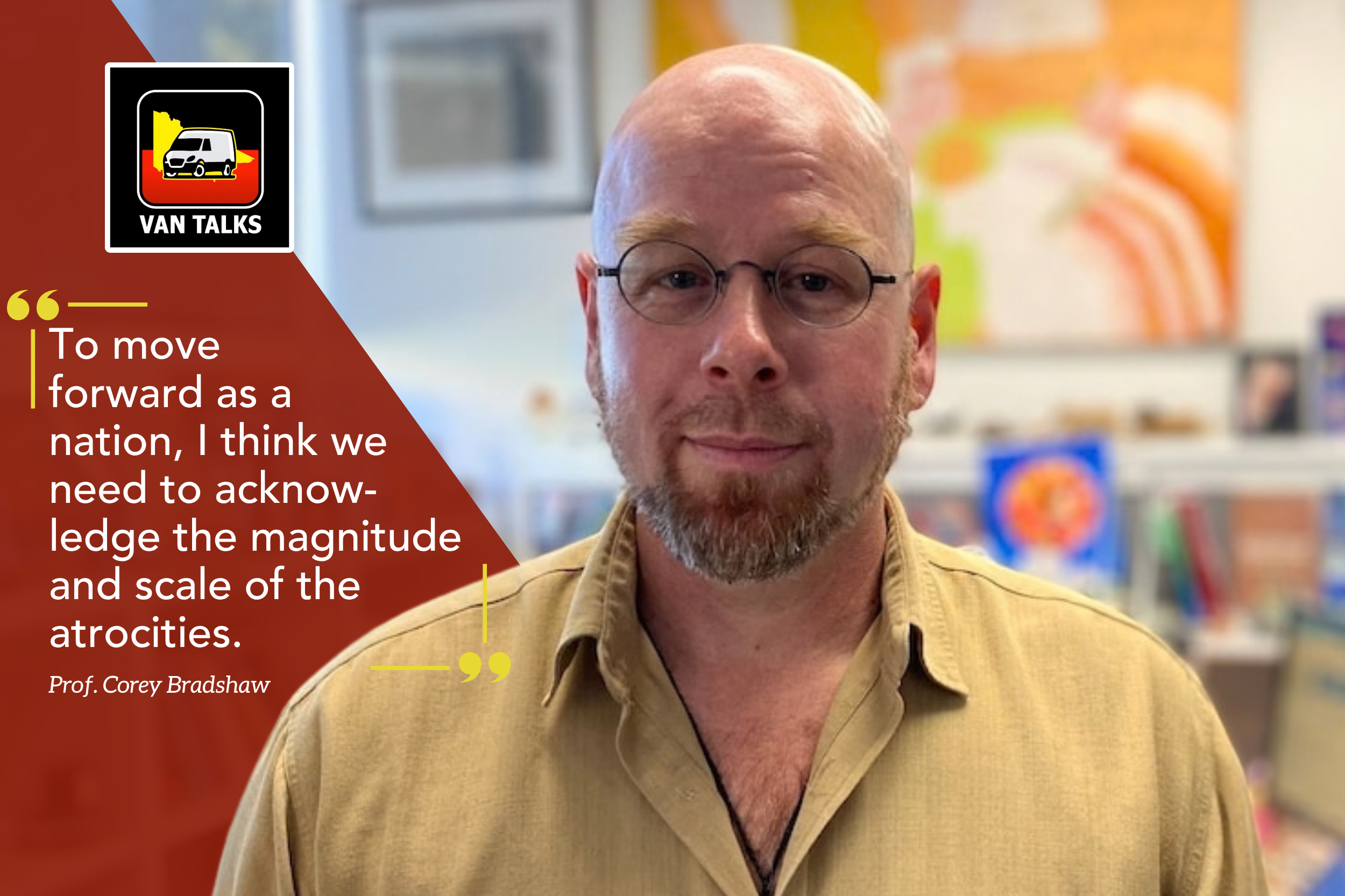
Groundbreaking new research published in Nature Human Behaviour has completely overturned a long-held colonial myth, revealing that Australia was home to more than 2.5 million people prior to British invasion.
For well over a century, public understanding and Australian legal doctrines were shaped by the assertion that only around 300,000 First Nations people occupied the continent in 1788.
Professor Corey Bradshaw from Flinders University explained that the original 300,000 estimate originated from anthropologist Radcliffe Brown in the 1930s, who relied on limited ethnographic anecdotes and rough “back-of-the-envelope” calculations.
“I think it’s really wrapped up in the racism of terra nullius,” Corey said.
“If you’re an imperialist and you’re coming in and you’re trying to take land for yourself that belongs to someone else, and you admit that there’s a lot of people there, it’s probably morally more challenging to justify than saying, ‘Oh no, there’s no one there, so it’s okay if we take it’.”
By combining archaeological discard rates, advanced genomic sequencing, and environmental carrying capacity models, researchers found that pre-invasion populations were vastly higher than previously acknowledged, with these scientific methods estimating around 2.2 million.
Tragically, historical modelling demonstrates that within 80 years of invasion, disease outbreaks such as smallpox alongside, frontier violence reduced the population by up to 90 per cent.
In addressing the scale of destruction, Corey drew parallels to Germany after the Second World War and the Holocaust, noting how nations must confront historic atrocities directly to achieve true reconciliation.
Corey emphasised that facing these figures is essential for the nation’s ongoing reconciliation process.
“To move forward as a nation, I think we need to acknowledge the magnitude and scale of the atrocities,” Corey said.
Recognising the sophistication and sheer scale of pre-invasion First Nations societies marks a crucial step toward genuine truth-telling and self-determination across Victoria and the continent.
Charles Pakana: One of the unfortunate, yet pervasive narratives that has shaped Australian public understanding, and even legal doctrines, for well over a century is that there were only around 300,000 Aboriginal people across Australia at the time of invasion in 1788.
In an article published recently in Nature Human Behaviour, that narrative is turned on its head, with a revised estimation of closer to 2.5 million Aboriginal people.
Joining me on the program to discuss this is one of the article’s co-authors, Professor Corey Bradshaw from Flinders University. Professor, thanks for speaking with me today.
Corey Bradshaw: My very big pleasure to be here.
Charles: Professor, why was that traditional baseline of only 300,000, which is obviously now way, way off target, so deeply rooted in the Australian narrative, and for so long?
Corey: Yeah, that’s a complicated question in its own right, but I think I can address it from a couple of perspectives.
So, this came from a bloke named Radcliffe-Brown back in the ’30s, an anthropologist. He used the available ethnographic—that means people going out and talking to people, observing how many people are around—historical anecdotes, and also a little bit of a back-of-the-envelope kind of calculation of what there could be based on the size of Australia.
And he did this back in the beginning of the 20th century, when most of the major, shall we say, disruptions to Indigenous life and peoples had already occurred.
So he mentioned himself that he came up with this number, 300,000-ish, but he said that that’s likely an underestimate. Now, he didn’t specify by how much.
The unfortunate thing is that through time, people sort of just focused on the 300,000 and forgot about the uncertainty or the bias associated with it, and just perpetuated that number through the literature. So it became ingrained a little bit like, if you repeat something often enough, people will start to believe it, irrespective of its origins or the robustness of that particular estimate.
So that’s probably why it persisted for so long. But it’s been challenged in certain circles, mostly academic, it’s been argued back and forth, but not with a lot of extra evidence or additional data. It’s just mostly comes down to opinion or interpretation of historical records.
So that’s probably why it persisted for so long, but there’s a more surreptitious, I should say, component to that, is that it’s really wrapped up in the racism of terra nullius.
If you think about it this way, if you’re an imperialist and you’re coming in and you’re trying to take land for yourself that belongs to someone else, and you admit that there’s a lot of people there…
Charles: It doesn’t work in your favour, yes.
Corey: …it’s probably morally more challenging to justify than saying, “oh no, there’s no one there, so it’s okay if we take it”.
And even if you don’t fully believe that, you don’t actually want to know, so you’re not going to put any effort into doing a census or counting the number of people that are there. You’re going to bias, whether it’s subconscious or on purpose, towards accepting a small number.
So I think it’s a very racist start-off point.
Charles: So what was it, or what were the methods that were used to take that figure of 300,000, realise the error, and arrive at approximately… a median, let’s say, of 2.2 million?
Corey: Okay, that’s also a multi-layered question. I’ll try to break that down.
Charles: The floor is yours.
Corey: So the first part was, I’m an ecologist, but I also do a lot of human demography, child health, economics, a lot of things. I’m mostly a mathematician, if you will.
A lot of the work we were doing, a lot of the examination of the initial peopling of Australia—so we’re talking 60,000 plus years ago—were starting to come up with numbers that were more in the 6 million range. Part of that reason was because way back then, sea levels were much lower, New Guinea was attached to Australia, Tasmania was part of the mainland, and there was about 15 per cent more land just on that coastal shelf. So Australia was about 25 per cent bigger, all up.
So those numbers actually, when you started looking at it, the densities were very much… and when I say density, that’s number of people per unit area, say people per square kilometre or something…
And that didn’t really gel with what people were saying like 300,000, fast-forward 60,000 years plus. It still didn’t gel ecologically.
And then we started looking more in the literature about the anthropological observations of densities of what we shall call non-agropastoralist peoples. Now that basically means that… it doesn’t suggest in any way that there wasn’t agriculture. There was definitely aquaculture, there was lots of different types of agriculture, but as Aboriginal cultures across Australia, most didn’t rely on that as the primary source of energy, although it did occur.
So this is the term that’s essentially replaced the somewhat racist “hunter-gatherer” nomenclature.
So for non-agropastoralist societies, in other words, those that didn’t engage in industrial-level agriculture, the densities that were implied by 300,000 just did not make sense. They were way, way, way too low. We just couldn’t figure out where these were coming from.
So that was kind of the impetus for looking at this in a more rigorous way.
So what we wanted to do is get away from the historical anecdotes, from the ethnographic observations that were clearly biased by the damage that had already occurred.
We wanted to use different scientific techniques, and the idea here is that there’s no one perfect technique unless you have a time machine. We have to make inferences, so we can’t do that.
So what we do is we say, okay, well, if we use different techniques and different types of data, and if they all more or less converge on the same answer, we have much more confidence in our predictions.
Charles: Right.
Corey: So the first one we looked at was a technique that was developed over the last 15 years, and it was looking at the rates of discard of archaeological materials. So you can think about artefacts like stone tools, or traded goods, or other things, that generally happens in a proportionate way to the number of people in the landscape.
So if you think of a big population, they’re going to throw away lots of stuff, right?
Charles: Yeah, that makes sense.
Corey: And tens of thousands of years later, an archaeologist comes by and does a little dig, and then they can date that material, and they can say, well, in this period there were lots of people, and in the next period there were fewer. It’s a relative indication.
So if you have some idea about founding population sizes way back when, and we do actually, based on pretty good demographic and ecological principles, we can project that through to the present day, or in this case, to just before European invasion. And we can make predictions based on that. Now, it has certain limitations and assumptions and advantages and disadvantages, right?
So we turn to another technique, and this is genomic, or genetic. So you can take someone alive today, and you can sequence their genome, and you can look at the diversity of the genes across their entire genome and then you can say, what in the past should have been there in terms of the minimum number of people to create that genetic diversity in that person alive today?
We can do that because we know what mutation rates are, more or less, of the DNA.
So if you know the genomic composition of someone today, and based on known mutation rates, you can work backward through time and figure out what we call an effective population size. Now, that’s a genetics term that essentially means the minimum number of genetically distinct individuals in a population that could have produced that genetic signal in someone alive today.
Charles: Good Lord, mathematics playground!
Corey: Yes, it’s pretty wild, and that technology’s getting even better and better and better. Of course, none of this was around back in the 1930s, so you can understand why they didn’t have access to all this extra information.
So that’s another technique.
The third technique is these ecological models, but basically what that means is that we can take what we call global circulation models—these are the same models we use to project climate change, you know, how hot it’s going to be at the end of the century—but we can do that not just going forward, we can do that going backward. So we can predict what the climate was back in time.
And yeah, and we actually, that’s much more robust because we’ve got validation data like pollen cores from lakes and things like that, that we can reconstruct the vegetation.
And from that, we can develop what the productivity of the landscape would have been based on the climate, the soil, and vegetation response. And from that, we can work out what we call net primary production. Now, that’s a fancy term basically to mean the capacity for plant growth.
And plants are, of course, the base of all food webs…
Charles: Sustaining life, yeah.
Corey: …sustaining life. So it turns out that lots of different animals, and I’m including people in that, we respond to how much the environment allows us to make a living, essentially.
And if you look at, for example, Indigenous territory sizes, the average sort of distance people moved, in the deserts people moved a long distance because there were fewer resources per unit area, whereas in really lush places like Arnhem Land, they didn’t have to go very far because all their food was there.
Or places like Gunditjmara people around Portland, who were aquaculture specialists, they didn’t have to go far at all, they just got the eels out and traded them and didn’t even have to hunt, probably.
Charles: So what I’m interested in, though, is you used those three different methods, essentially—so radiocarbon dating, by the sounds of it, genetic data, and can we say environmental carrying capacity? Did they all come to similar figures, because they’re obviously independent of each other?
Corey: Yes, yes, they did.
As I said, there’s a bit of uncertainty in all of them, but when you sort of look at the central tendency of all of them, they were around that two, just over two million mark. But it could have been as high as five million.
And to be honest, we were playing on the conservative side because if you think about the genomic data alone, what we’re measuring is, as I said, the effective population size, which is always below what we call the census population size. That’s the number of people you actually count, right?
That’s because there’s no such thing as a perfectly independently genetically distinct individual, there’s always some overlap, right? Although we try to avoid as much of that overlap as possible… skin names are a great way to do that, that’s a lot of the cultural traditions around marriages were based on that idea of avoiding too much similarity between potential partners, if you understand.
And that’s a normal thing, but it’s not a perfect system in any system anywhere in the world, so there’s always some similarity, meaning that we’re talking about potentially even larger numbers of real people on the ground as inferred from the effective population size.
Charles: Well, let’s assume that was about 2.2 million. Let’s just take that as a general figure.
What I’m particularly interested in understanding, and I’m sure the audience is as well, is that if we look at what it was, and that graph that you had in the article, where at the time of invasion it was around about the 2.2 million, and then barely 80 years later, it was down to a tenth of that, which says two million people died in…
Corey: That’s excess deaths, yes. Excess than what you’d expect from just normal life and death, yeah.
Charles: Of course, yeah. How can that be explained? We know there was smallpox, we know there were massacres. What are some of the factors there, because that is a staggering, almost beyond-belief number.
Corey: Well, yeah, I mean, what’s not beyond belief, and what is actually quite ecologically sound, is the two million number, or perhaps more. That’s perfectly in keeping with anthropological and ecological theory and observation.
What is remarkable and devastating is the decline. And so, how could that have happened?
Well, we did some work on smallpox recently, last month in fact, published in the same journal, that was just looking at the first outbreak in Dharug country around what is known as Botany Bay today. So we’re working with the Gujaga Foundation, that’s a Dharug PBC, and that was basically ground zero.
Charles: This was barely 18 months after the initial settlement or invasion, wasn’t it?
Corey: Yeah, so it was about April 1789. And that was sort of April, May, June, that was the height of it.
You know, when you start looking at the anecdotal records from the colonists, and they were talking about bodies littering the beaches as far as they could see, if you know anything about Aboriginal cultures across Australia, you know that burial ceremony and sorry business is a very important thing. People don’t abandon their dead, so it had to have been a catastrophic event for that to have happened.
But at the same time, we know that within a month of the height of the epidemic, there were people back on Country, you know, so the survivors did flee and they managed to survive that outbreak. It wasn’t a complete gutting of the landscape.
But we worked out that based on epidemiological models and known patterns of exchange between different mobs and movement rates, that up to 220,000 people could have died just on the south-east coast of Australia within a couple of years of that initial outbreak.
And that’s just one outbreak of three major outbreaks that occurred over the next 80 years. So there was another outbreak in 1820s and ’30s, and then there was another one mostly in WA sort of in the 1860s.
Charles: So from your research, were those three outbreaks the main contributors to that incredible decline?
Corey: I think they were a big part of it. Smallpox can be about 60 per cent fatal if you get it, especially if you’re what we say immunologically naive, in other words, you haven’t been exposed to that before, unlike Europeans.
But that means that there’s a lot of other stuff going on as well. Even if you say, you know, 60 per cent, we still have to work that out, and we’re in fact doing that today.
But the next cab off the rank, if you will, was frontier violence and the massacres.
And if you look at the distribution of the massacre data, it’s very patchy, it depends on where you were. For example, the Queensland Police were very good at keeping records, not unlike the Nazis were during the Holocaust. But elsewhere in Australia, not so much.
And also, if you think about it, even if you’re a racist bastard and you justify this somehow, you know, you’re probably not likely to write down how many people you’ve killed on property and boast about it. So there’s probably a lot of under-the-table killings that didn’t go recorded, and so that bias as well probably means that our massacre database, or frontier violence databases, don’t even cover half of what was actually out there, probably much less.
Then, of course, there’s a whole host of other diseases, while not as lethal as smallpox, there was measles, there was tuberculosis, there was syphilis, all these European diseases that would have compromised people immunologically, would have shortened their lifespan, would have probably killed many before they had children.
There was the mass dispossession, caused people to live in very unhealthy environments. I’m reminded of Wybalenna on Flinders Island in Bass Strait. After the killings in Tasmania, the survivors were herded up and brought to Wybalenna, and within two years, most of them had died from respiratory infections. You know, it was appalling conditions.
And of course, there were other components like malnutrition, even suicide. The mortality rate certainly would have climbed dramatically from a normal Aboriginal society operating without the conflict and disturbance from colonialism.
Charles: Let’s go back from these tragic figures and facts, and let’s look at pre-invasion, pre-1788. A population of in excess of two million, and that in itself is a huge number, and you’re saying it could conceivably have been up to five million.
What does that tell scientists and tell us about the intensity and the sophistication of pre-invasion land management? Because that’s got to be quite significant.
Corey: I think you hit it on the head. It’s about thriving in the environments that Australia threw at its people.
And over 60,000-plus years, people of course had a lot of time to develop ways to thrive in those sometimes very challenging environments. I mean, we had large desert populations that could survive in any sort of extreme and lack of water. We had people in every single habitat, from the snow-covered mountains to the deserts. We had coastal peoples, and we still do today, we had river peoples, we had forest peoples, and sea country.
Every niche that was available, people adapted to, and thrived in. This wasn’t just hanging on for survival’s sake, it was a thriving society that was so diverse, slightly imposed by the diversity of the environments that Australia has to offer.
And part of that, of course, that thriving, means managing Country so that it benefits you and the country itself. And this is a long-standing notion about how, you know, there’s no such thing as wilderness in an Australian sense, in the fact that there’s no part of Australia that wasn’t managed over many tens of thousands of years.
Charles: That’s a perfect observation. How do you hope that this research feeds into the current national conversation around the all-important matters of truth-telling and reconciliation?
Corey: Yeah, I don’t think a country can move forward until it acknowledges the atrocities of the past.
I mean, if you look at Germany after the Second World War, you know, they fronted up and they moved forward as a nation. You look at Rwanda after the genocide there, they acknowledge that yearly. We do that with Anzac Day here, we acknowledge the war.
To move forward as a nation, I think we need to acknowledge the magnitude and scale of the atrocities.
At the same time, I think that’s necessary also to understand why we still have such a large gap. This was traumatic beyond almost any modern-day person’s conception of how much disturbance happened in the system, how much people declined to almost extinction, and yet thrived after that.
And understanding that closing the gap is a generational-scale question, there are no quick fixes and it’s not an overnight thing. This is an entire series of societies that are starting essentially from zero, and it’s remarkable that we still have the diversity of language and culture and ways of doing things that we do today as a result.
Charles: Well, it seems that we do need to start a new Australian narrative. Professor Corey Bradshaw, thank you for your time and your insights.
Corey: It was my great pleasure.
For Radio Play:
1 - Click the Download Audio button
2 - The audio file will commence automatic play in your browser
3 - Confirm this is the file you want to use in your program
4 - Once confirmed, click the vertical elipses (3 dots) and select download
CONTACT US VIA SMS
Get in contact with us via our dedicated SMS line:
0493 222 836
24 September 2026
First Nations star knowledge predates Western astrophysics by millennia
21 September 2026
Reclaiming cultural heritage through proper consent frameworks
17 September 2026
Media leader urges all Australians to engage with Blak media

11 September 2026
First Nations creatives given safe spaces through Blak and Bright
4 September 2026

0 Comments