
A starting conversation on UNDRIP with Kaley Nicholson, CEO of the Federation of Victorian Traditional Owners Corporation
We kick off a series of discussions about the United Nations Declaration on the Rights of Indigenous Peoples with the CEO of the Federation of Victorian Traditional Owners Corporation, Kaley Nicholson
Posted by: Charles
Published: 30 October 2026
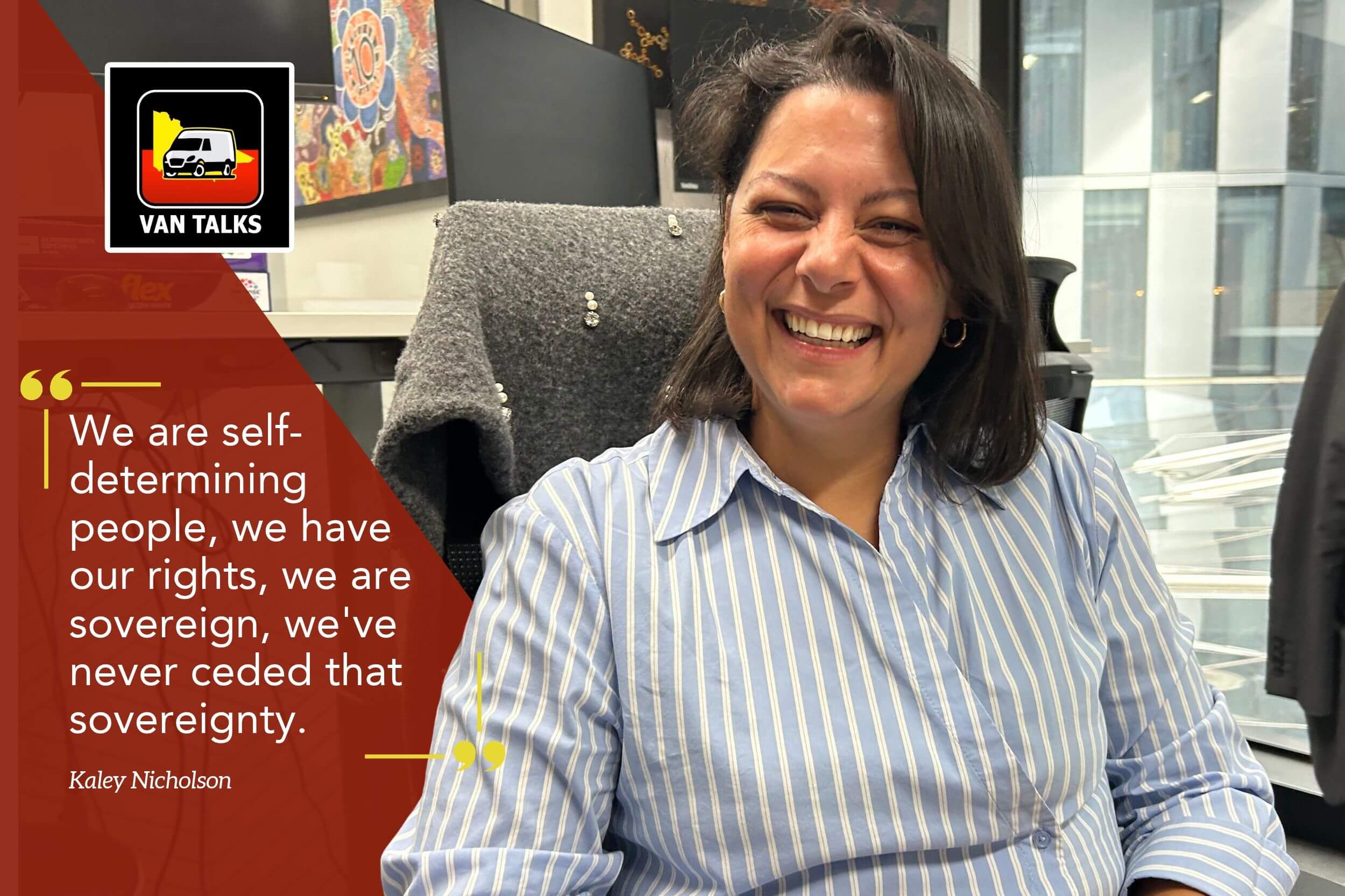
Traditional Owner corporations are pushing back against rushed government consultation timelines as massive renewable energy and critical mineral projects accelerate across Victoria.
Federation of Victorian Traditional Owner Corporation CEO Kaley Nicholson warns that current processes often reduce free, prior, and informed consent to a compliance checklist rather than genuine shared decision-making.
“Where I think that gets a lot more difficult is, you know, when they actually have to share power and when the rubber hits the road and the practicalities of what free, prior, and informed consent actually looks like on the ground,” Nicholson said.
While some groups leverage Native Title to secure strong agreements, many others face immense pressure from government and industry timelines driven by national security and economic priorities. Nicholson emphasises that true consent requires upfront minimum standards, transparent project lifecycles, and mandated agreement-making frameworks rather than compressed consultation windows.
Despite systemic limitations, Nicholson stresses that sovereignty remains unceded and community leverage extends far beyond legislative frameworks.
“We are self-determining people, we have our rights, we are sovereign, we’ve never ceded that sovereignty,” Nicholson said.
True self-determination relies on a collective worldview centered on country, consensus, and ongoing responsibility. Nicholson argues that embedding genuine free, prior, and informed consent ultimately benefits the entire state by reducing project risks, lowering overheads, and addressing entrenched social inequities.
Charles Pakana: On the 13th of September 2007, after more than 20 years of advocacy from around the world, the United Nations General Assembly adopted the United Nations Declaration on the Rights of Indigenous Peoples, known colloquially as UNDRIP. A total of 46 articles covering self-determination, self-government, cultural preservation, and land rights were included in the landmark document.
Now, during the vote, 143 or 144 voted in favour, 11 countries abstained, 34 were absent during the vote, and only four voted against. Those four? The United States—surprise, surprise—Canada, New Zealand, and Australia.
19 months later, on the 3rd of April 2009, that decision by Australia was reversed after the Rudd government came into office. Yet, while many celebrate that reversal, there is a clear sentiment that a system established by colonisers can never truly deliver the self-determination guaranteed by UNDRIP.
Joining me on the program today to initiate a discussion on some of the questions arising from this—in a Victorian context, at least—is the CEO of the Federation of Victorian Traditional Owner Corporation, Kaley Nicholson. Kaley, welcome back to the program.
Kaley Nicholson: Thanks for having me. Always great to be here.
Charles: And this is an interesting topic. This is a little bit different than what we normally cover.
Kaley, Article 32 of UNDRIP, let’s start with that one in particular, and it’s crystal clear on free, prior, and informed consent. But in Victoria right now, amid massive renewable energy rollouts, housing developments, and infrastructure projects, traditional owners are often handed consultation timelines that look more like a compliance checklist than genuine veto or consent power.
So, where do you consider the Victorian government is failing the hardest when it comes to respecting that free, prior, and informed consent?
Kaley: It’s a bit of a big question and a loaded one for sure. I think, you know, there are plenty of good examples of the Victorian government over the last couple of decades, you know, making good strides in terms of…
Charles: Well, let’s look at those as well.
Kaley: Yeah. So in terms of making strides to embed UNDRIP and to include Traditional Owners in decision-making and to empower collective decision-making and recognising the rights of Traditional Owners. Where I think that gets a lot more difficult is, you know, when they actually have to share power and when the rubber hits the road and the practicalities of what free, prior, and informed consent actually looks like on the ground.
And in your intro, you sort of talked about consultation timelines and things looking like a checklist rather than true and genuine self-determination and free, prior, and informed consent. And so I think that some of those, the real on-the-ground shared power, shared decision-making is where it tends to get a lot more difficult.
And when companies and I’m thinking about, for example, the renewables or critical minerals establishing a new industry, bringing in new sources of revenue into the state, having that big carrot dangling out there makes it, I think, at times difficult for Traditional Owners to genuinely be in the driver’s seat to say what actually is free, prior, and informed consent, what are the things that we are willing to accommodate for and plan for, and how do we want to be included, and how do we want to help to shape these industries.
That tension between the timelines and the material sharing of power, I think, becomes a lot more difficult. I would just go back to critical minerals, so…
Charles: Something we’ve spoken about several times before.
Kaley: Yeah, we have. And at the moment, it’s the real and emerging economy in Victoria. And we’re grappling with how does this industry get off the ground in a real way and and enjoy real and true social license in this state. And that’s been, I think, a large part of how we’ve been having this conversation.
But free, prior, and informed consent, when a proponent comes to a Traditional Owner group and says, “Tell us what you want,” and negotiate with us, essentially there’s just an unlimited set of circumstances that could be factors in decision-making. And for a lot of the time, without genuine frameworks around things, free, prior, and informed consent can’t genuinely be held for Traditional Owners, let alone for proponents.
And so…
Charles: Well, what does free, prior, and informed consent actually mean? How does it look on the ground, literally, when you’re talking about this critical minerals and a Traditional Owner across Victoria?
Kaley: So, at the moment, we’re working on an agreement-making framework at a statewide level that looks at what are the minimum standards that Traditional Owners need to be able to say are in place in order to say that they have free, prior, and informed consent. So, they’ve freely come to the table to negotiate, they’ve had prior notice, they’ve got understanding of the lifecycle of a project and all of the things that are on the table, they’re well informed about what’s happening and and what’s available, and then they give consent.
What often happens when those timelines come to crunch is that there’s a timeline on the horizon for issuing a license, government want that revenue—it’s a matter of national security, so it’s not just government, it’s lots of competing factors there—and that timeline and the window for genuine free, prior, and informed consent just gets chewed down. And so, agreement-making needs to be mandated and it needs to be planned for and it needs to be included, you know, well in advance, and it needs to just be the way of business.
Charles: I think the—the word consent, though, can be very open to interpretation or to just throwing aside. You can’t really mean it if you—if you were to say to me, “Well, if the state government and a mining industry were to go to a Traditional Owner and say, ‘Well, okay, we’ve given you the free prior information, and we now see your consent.'” If Traditional Owners went, “No,” all the government really has to do is say, “Well, this is for security, for national interest.” What does that consent really look like, and have you seen it play out?
Kaley: Well, let me just say that there have been plenty of proponents that have gone to Traditional Owners already in the critical minerals space. I think about Gunaikurnai, for example, they’ve got a number of agreements with proponents around how mining might take place, and they’ve been able to leverage their native title rights.
And I think that, in terms of them having a seat at the table and having real and recognized rights, they have such strong leverage, and that’s been a huge part of the success. Where I see it fall by the wayside is areas where there aren’t groups that have recognition yet, where there is recognition perhaps, but not quite to the level of, you know, Native Title.
And so, there is always this wedging, I think, and, you know, in any negotiation, it’s about the leverage that you hold and how you might wield that, and so I think that that’s where it gets a lot more difficult to say, “Okay, this is going to be a good outcome.”
I know Dja Dja Wurrung negotiated an agreement with a mining company on their land, and that was without native title, and that was with a proponent that was incredibly committed to free, prior, and informed consent and to being able to say that they walked the talk and they actually do the work.
Charles: Taungurung’s on the same thing, haven’t they?
Kaley: Taungurung’s currently in negotiation at the minute with Southern Cross Gold, and an agreement hasn’t been reached yet, but we’ve been utilizing the CESG, so the cultural, environmental, social, governance framework. ASX-listed companies need to report back their outputs around ESG, and so we’ve added a the C to the front of that, and our incredibly talented team have been really strategic in saying, “Well, what does that actually look like?”
And that framework, the CESG, sets out what we believe to be true free, prior, and informed consent that says from the outset what a proponent needs to do in order to say that they’ve partnered with us and that we agree to work with them. So, that process is currently underway. So far, so good. Negotiations have been happening, I’m not a part of the negotiations, and us as a full group have nominated a set of people to go away and do that work on our behalf, and that will come back to the full group once a suitable offer is reached, and then we will make a decision about that then.
Charles: Where in other areas have you seen it actually work in Victoria for Traditional Owners?
Kaley: Well, let me just say, it doesn’t matter what any government, international, federal, state, local, or other says. We are self-determining people, we have our rights, we are sovereign, we’ve never ceded that sovereignty.
And so, you know, as much as we understand that we don’t have a right to veto, that we don’t have legislated rights to negotiate in all circumstances, what we always have is our ability for social justice, we can campaign, we can protest, we’ve got a whole set of actions that are available to us that fall outside of government systems.
And I think that for the broader public, like if I’m just—I know you’re trying to get away from critical minerals, but I think about critical minerals, there are local communities that are going to be affected by this, and they talk all the time to Traditional Owners to say, “Well, what can you do about this?” And they don’t actually realize that we don’t have a right to say yes or no at the end of the day, so it is that consent piece.
But, you know, we are huge contributors to that social license, and I think about the Djab Wurrung birthing trees and the protests around the highway expansion, and, you know, there are all sorts of action that Traditional Owners can take that are not necessarily within the confines of what is set out to us.
We have that right and that ability, and I think our position as people that have and hold rights and continue to exercise those rights means that, I think, nothing is off the table essentially in this current environment if there is a change of government or whatever that might look like.
It sort of doesn’t necessarily really matter that much in terms of what we know about ourselves and our responsibility to country and our responsibility to community and the benefit that has for the broader state of Victoria.
Charles: Well, look, under the—the broader scope of the 46 separate articles within UNDRIP—and they were very, very wide-ranging—do you and other members of the federation regard any particular areas or articles as of advantage to what you’re seeking to achieve for the TOs and for the greater First Nations community across Victoria?
Kaley: Self-determination, I think, is one that comes up all the time and perhaps…
Charles: Well, let’s dive down into that. That’s always a funny subject, and I’ve spoken about this to a number of people. From the federation’s perspective, what is self-determination?
Kaley: I think self-determination is the right that can never be alienated, to make decisions about your own life and your own community and your country. So, self-determination, I think, like with all things, there’s a lot of nuance, you know, and there’s individual self-determination, then there’s collective self-determination, and UNDRIP talks about collective self-determination.
We have in our bill of human rights that I think are very much focused on the individual, but us as Indigenous peoples have a collective worldview and have a worldview that is in relationship with country, with place, with each other. And so, self-determination in the context of UNDRIP is about that collective worldview and I think that that’s really important because it means, you know, we have to do things by consensus.
You have to bring people along, you have to include community, you have to think about our relationship with place and everything around us. And so, self-determination needs the basis that underpins all of that, I think, and so I just think it’s really important.
Charles: A lot of the naysayers out there in the community look at UNDRIP and they’ll look at terms such as self-governing, self-determination, and they’ll immediately jump to the conclusion that First Nations people in Australia—you’ve got this ulterior motive—to secede from the Commonwealth, essentially, to set up their own political state within Australia. What are your comments to those naysayers?
Kaley: First and foremost, that’s just for the majority of Aboriginal people—let me put that one out there, because obviously I don’t speak on everybody’s behalf—that’s just not true. Of course there are black fellas, you know, I think about the Sovereign Citizens movement that really took off through COVID, there were plenty of black fellas tangled up in that.
Charles: Absolutely.
Kaley: I can think of a few.
Charles: Yeah, yeah, I have a few in my family, that’s for sure.
Kaley: But for the most part, we are members of this country, we’re members of our states, we’re contributors, and we’re community members at a like or level, wherever it is that we live and work. We care deeply about country and place and we care deeply about each other.
And so, I think that us wanting to exercise our rights and have a greater say is never about standing apart and removing ourselves from Victoria, from Australia, from Melbourne, whatever the local area is that you live, it’s about making it better for us and then for everybody else.
The saying “a rising tide floats all boats around” or whatever that that is. Us gaining and having rights doesn’t come at the expense of anybody else’s rights. Human rights, collectively held rights are not like a pie that, you know, you cut up and the person next to you doesn’t get as much as you do—they’re inalienable, and, you know, they inform the basis of how we see ourselves as a nation and how we see ourselves in community with each other.
And so, for us, wanting to exercise those rights is purely and simply about addressing social injustice, about living fruitful and prosperous and healthy lives, and changing the inequities that we’ve been battling since colonization.
Prior to colonisation, our people were thriving, we weren’t just wandering around, you know, picking berries and tillen, we were actually managing these lands, we were we had complex systems of governance, we supported and uplifted each other, and we had real prosperity.
So, us wanting to have our self-determination, us wanting to have our rights, is about re-establishing ourselves as healthy, wealthy, prosperous people who contribute to the community, who help shape this beautiful place that we all get to call home. And I think that pitting Aboriginal people against the broader state or the broader collective is particularly unhelpful, because it’s how are we ever going to address the entrenched inequality that everybody knows is there.
Charles: Regardless of what government is here in Victoria, what would you like to see from that government in doing more with UNDRIP rather than just having it included as a pretty preamble in a government document? Your smile is telling me that you know of a number of those documents, I think we all know a number of those documents. What would you like to see first and foremost prioritized when it comes to really bringing practical results from UNDRIP? Critical minerals, right?
Kaley: Yes, I didn’t—I did have a big smile there. I’m thinking of anything in general. The state of Victoria, as a Victorian person, as a Victorian Aboriginal person, I’m incredibly proud to be a Victorian. What we have done is so deadly.
And Victorians care about social justice and Victorians care about equity and egalitarian society, and, you know, that’s beautiful and I feel really fortunate.
Charles: But what could be done better by the government?
Kaley: What could be done better? So it doesn’t matter what government’s in, I think we need to be able to communicate the return on investment that’s there, and it’s frustrating to have to always put things in economic terms. But by having real, meaningful ways to drive and deliver informed consent means that all projects will just have lower overheads, reduced risk.
Think about the complexities of establishing an industry and the need for social license. What’s the way to do that is to have a process mapped out, is for everybody to understand what’s going to happen and how decisions are made, and to agree to that upfront, and then you bring people in and they’re able to shape what an outcome looks like, and all of that means that there is less risk, less overheads, less time blowouts, and the state is richer.
There is new revenue brought in, there is reduced inequality, there are less people relying on government just to have their basic needs met. All of this stuff—I mean, it seems so simple, but it’s all enabled through UNDRIP and through free, prior, and informed consent and self-determination.
And so any government that’s coming in or that’s staying in potentially, who knows what’s going to happen in Victoria, you know, if they’ve got an eye to economic development, if they’ve got an eye to a rich and prosperous and healthy and safe state, all of that needs to include free, prior, and informed consent and self-determination and Traditional Owners being at the table to help make those decisions.
Charles: It seems what you’re saying, it’s all boiling down to communications and collaboration, consultation, the three C’s.
Kaley: Yeah. And maybe I’ll add one in there: relationship.
Charles: Okay, well you’ve gone to an R. Okay, triple CR, there we go. Kaley Nicholson, we will talk more about this in a future episode of the program. But up until then, thanks again for your time.
Kaley: Thanks for having me.
For Radio Play:
1 - Click the Download Audio button
2 - The audio file will commence automatic play in your browser
3 - Confirm this is the file you want to use in your program
4 - Once confirmed, click the vertical elipses (3 dots) and select download
CONTACT US VIA SMS
Get in contact with us via our dedicated SMS line:
0493 222 836
26 October 2026
Leading the push to embed Indigenous knowledge systems in Australia’s tertiary education system
21 October 2026
Reconciliation in Seymour – one of Victoria’s highest recorded “No” vote regions
19 October 2026
Understanding the use – and over use – of the Acknowledgement of Country
15 October 2026
It’s time Australia recognised a shared history of often brutal “settlement” and expansion
12 October 2026

0 Comments