
Exploring the beauty of the Yidaki with internationally acclaimed Ganga Giri
Having learned the yidaki as a young man, Ganga Giri has shared the instrument's grounding sounds right across the world.
Posted by: Charles
Published: 3 November 2026
Charles Pakana: When most of us hear the yidaki, or the didgeridoo as it’s commonly known around the world, we picture, quite often, tourist shops, drone sounds, or new age soundscapes. But behind those popular clichés lies an ancient, sophisticated musical language, deeply tied to specific country, law, and culture.
Joining me on the program today is Ganga Giri, a Melukerdee man who is a master of the instrument and a visionary world music pioneer. Ganga has taken the sounds of the Arnhem Land tradition onto global stages while fiercely protecting its integrity. Ganga, welcome to the program.
Ganga Giri: Thank you. It’s a pleasure to be here today.
Charles: Ganga, let’s just kick it off by understanding what is the yidaki? And is it a yidaki, is it a didgeridoo?
Ganga: Yidaki is one of the most well-known traditional names for the instrument from northeast Arnhem Land, from the Yolngu people, and which I’ve had the privilege to spend a lot of time with this amazing culture.
Charles: And it’s your grandfather’s country, isn’t it?
Ganga: My grandfather moved up there many years ago and married in, twice. However, when I went to look for him once, when I was a young fellow as soon as I could get a car license—[laughs]
Charles: As you do in your youth.
Ganga: —in South Australia, I was 16 and I headed north. I didn’t find my grandfather, but I came across Djalu Gurruwiwi, who is actually the custodian of the instrument. And at that point, he took me in, and I was a young skinny fellow back then, little fellow with hair, and I got to learn more the traditional style of the instrument and a bit more of the background and the spiritual connectedness of the instrument.
So getting back to yidaki, yidaki is from the Yolngu peoples, but there are many, many other traditional names for it. However, if you were going to choose a traditional name for the instrument, it’s best known as the yidaki, but I could mention another 20 others. The didgeridoo is a white fellow’s name. When the early settlers came to Australia, they heard a rhythm in the bush, that went didgeridoo, didgeridoo, didgeridoo. And they named it didgeridoo, okay? But it has nothing to do with First Nations culture.
Charles: Okay, so its roots though are in the Yolngu people.
Ganga: Yeah, Yolngu people. One of the stories goes that women gifted us men this instrument to stay grounded because—
Charles: Now this is an interesting story that I heard you telling recently at an event. Just if you wouldn’t mind sharing that. I think it’d be really insightful.
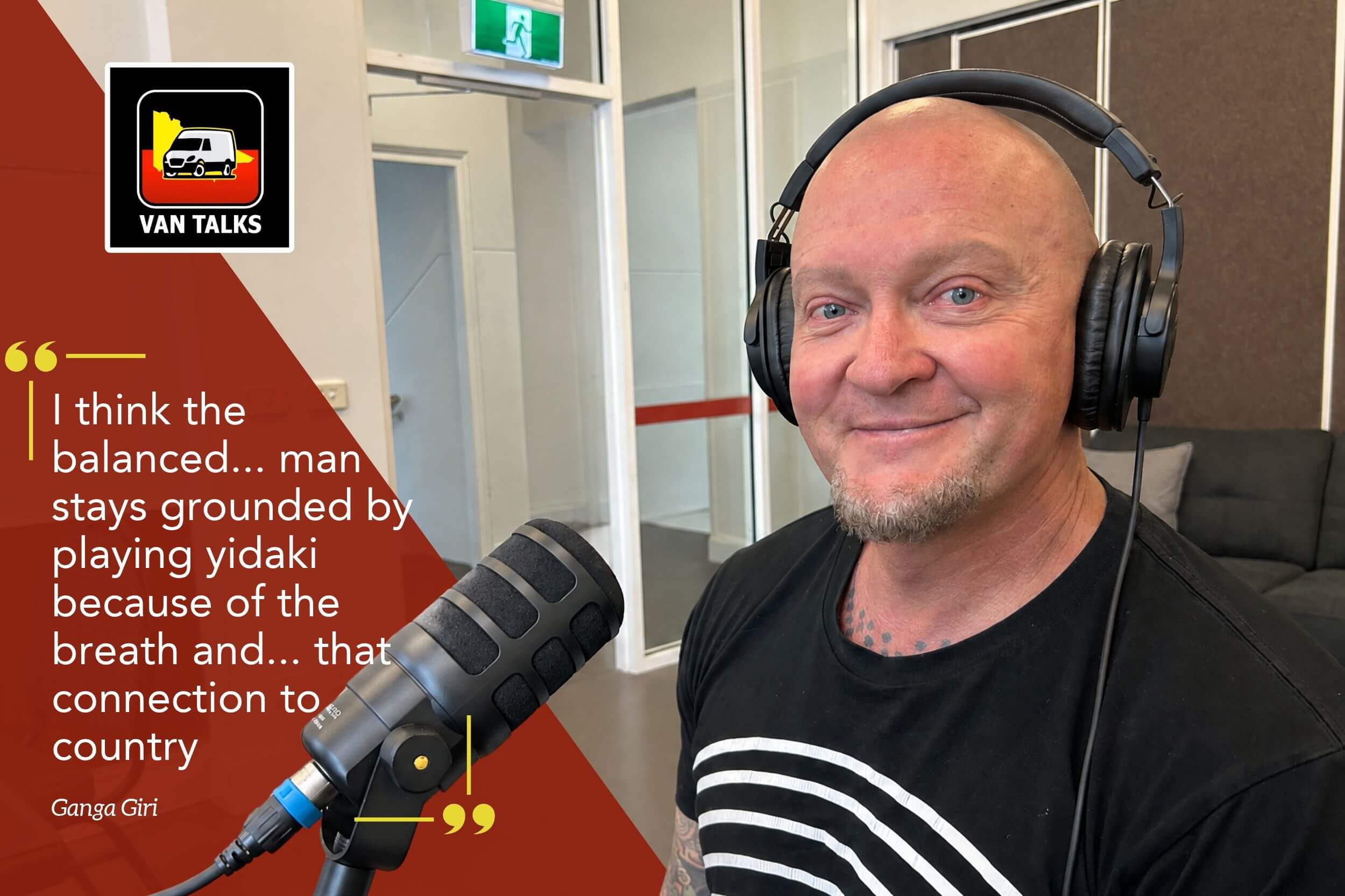
Ganga: Men generally are not grounded by nature because of the innate feelings of wanting to procreate and keep the lineage going. And that can be ungrounding. That’s just one example, but there’s many others. Women are naturally grounded because they’re mothers. They give birth, they’ve got monthly cycles, and I think the balanced male or man stays grounded by playing yidaki because of the breath and that connection to the breath, connection to self, connection to country.
Charles: And we’ll get on to the male/female sides of things a little bit later on in the interview. But what I’m particularly interested in to set a bit more of a foundation is how you first came to fall in love with this incredible instrument.
Ganga: I had a dream when I was a young fellow. And you know, when you have a dream, you think differently about that thing when you wake up. You know, whether it was another example might have been primary school. I never had the thoughts of kissing a girl, but one time I had a dream that I kissed a girl in my class, and I’d look at her differently the next day.
Putting it more in a mature context, I had a dream about playing yidaki. You know, I was by a fire and I could see myself playing, and I woke up and I couldn’t stop thinking about the instrument. So I went to the lady across the road, who, you know, was a little bit open-minded. She wasn’t Mob or anything like that. She was very open-minded. And I said, “Look, I had this dream last night and I I can’t stop thinking about it. I was playing yidaki, and now I can’t stop thinking about yidaki.”
And so by chance her husband, because they were friends of the family, had a yidaki. So I got to play the yidaki that was out the back, you know, little corner of a back storeroom, and by chance it was easy to play. And I feel by when I close my eyes, the dream taught me how to play. And within a short time I was circular breathing, the sounds came, and I just had this really amazing appreciation. I couldn’t get enough of this sound. And so I continued to play and play and play.
Charles: But you learned a lot about this up on Yolngu country.
Ganga: I started to play myself first, and I learned as much as I could. I didn’t really have too many teachers either, so I had to bring some of my drumming skill because I was learning drum kit, you know, from an early age. So I started to play drum kit rhythms, which essentially was beatboxing, but beatboxing, I don’t think was around back then. And so I started to get some rhythms going.
But later on in life, when I mentioned before that I connected with the Gurruwiwi family, that’s when I had more of a deeper understanding of the traditional ways. I don’t profess to be a traditional player at all, because to be a very good traditional player, you need to speak Yolngu matha, you know, like the language. And because I didn’t grow up in that culture and I’m not from there, I never really wanted to be something that I’m not. So I sort of have the influence of that traditional way of playing, but I’m not going to play that style in and around a career because it’s not my culture or authority to do so. So the style that I play in public, it’s a different contemporary style of all that I’ve been exposed to and inspired by.
Charles: Well, talking about playing it in public, you’ve taken the yidaki internationally, and you’ve been doing that for a heck of a long time. What’s the sort of reception you get overseas when all of a sudden they see this fellow up there on stage who’s leading the performance with this strange long wooden instrument?
Ganga: It’s been an amazing journey. Like, it picked me. I had no idea that I would be a person that was in public, because by nature I’m a pretty shy guy, especially when I was a young fellow. You know, I’d stick to myself. Before doing so, Uncle Djalu would say to me, he’s very proud that the world is playing his instrument. And so I feel like spending time with him, it was okay for me to go out there and also inspire, because he wanted the world to play his instrument.
And so for me, seeing so many cultures within Australia and the world—because part of my life I grew up in Adelaide and in and around the WOMAD festival, where I saw so many different cultures come and express themselves musically. I thought, “Wow, you know, there’s Yothu Yindi, there’s all these things I grew up with, but I want to hear something that is world music infused with First Nations, celebrated in the now with modern production,” you know, and celebrate all the cultures, because at the end of the day, we all need to come together and really live a little more harmonious, and I would hope And I think music can actually be that amazing catalyst.
So for me, my inspiration is community coming together, because really, at the end of the day, if we can do that, if we can care for country, if we can care for each other as a community, we’re actually going to really progress. So I wanted to reflect that musically. And so, initially, I did go overseas because I started to get emails and because I made a CD. I started to get these emails. I was a shy guy, and it’s like, “Oh, can you come to this country and that country, and do you want to come here and do you want to go there?” And it’s like, “Oh, okay, sure.” You know, so off I went. Solo guy and turned into an amazing way to see the world.
Charles: Where have you taken it to? What countries? Give us a sample.
Ganga: I’ve been to a lot of places all through Europe. I’ve played, you know, everything from Glastonbury to Burning Man, to Boom Festival, to Zoom Festival, many a festival. And I’ve represented Australia in different capacities in Europe as well as Japan, all through the United States, Canada, where I met my partner. It just kept going.
Charles: You’ve mentioned before that when you were being taught, the ways of Uncle was really excited about the world learning to play his instrument. Let’s just talk about some of the concerns that people have, Aboriginal and non-Aboriginal people. The concerns they have about playing the yidaki.
Ganga: Going back to Djalu’s words was he wants to see the world play his instrument. And for a very long time, it was more popular in Europe and overseas as to what it was here in Australia. Really? Yeah, yeah. I mean, at the time there was, I think, 30,000 didgeridoo players in Germany alone. And the amount of yidaki or didgeridoo festivals that they had all around the world was quite amazing because people came here from all around the world and were so taken by the energy of the land, by Aboriginal culture, by Australia in general.
And so they wanted a little bit of that to take home. And I think instead of buying a plastic kangaroo or something else, they got a yidaki or a didgeridoo. And if by chance it was a real yidaki made by a First Nations person or somebody that could make them, they had a chance to teach themselves. And they ended up getting really good. And there was a big movement, and Djalu, myself, Mark Atkins, Charlie McMahon, like a lot of us early old-school yidaki players got to cruise around and play and also teach. We’d all meet up overseas, like the Alan Darin days were amazing, would meet up and play and it was an amazing time. So there was inspiration initially overseas, but then we got to go and share some of our techniques and ways of playing. And yeah, the European audience got or the players got really good.
Charles: You mentioned something that I do want to pick up on, and that is if they were fortunate enough to pick up a legitimate yidaki, what can people do in order to ascertain that the didgeridoo or yidaki they’re looking to buy at a tourist shop or at a market is fair dinkum? Is there any way to determine that?
Ganga: Well, I think firstly, I’m really anti-Balinese instruments. They make things really well in Indonesia. Not didgeridoos or yidakis, that’s for sure. But I think initially it needs to be termite hollowed, although there’s yidakis, or I’m going to call them didgeridoos, because they’re not yidakis, they’re not termite hollowed. There is a big difference. We could talk on that for a long time, but didgeridoos have been produced in different countries, and people have been using whatever they can actually get their hands on. It could be agave cactus, it could be plastic, it could be glass, it could be hemp, it could be whatever people could get their hands on. And some of them sound good, some of them are very quirky.
And I think at the end of the day, people are doing what they can with them. And I’m not going to judge, because what I have observed is people start out, they start playing, they feel good, and they start learning more about Aboriginal culture. And some of these people that take it further have ended up in Arnhem Land meeting some of the traditional owners of this instrument and have gone and met and lived with, you know, the Gurruwiwi family and gone out and actually learned how to make these instruments properly. So they’ve become more educated. It’s been a journey. So rather than be judgmental, it’s like, well, people have had these, you know, I guess just scratching the surface experiences, but some people have been able to go and deepen their playing by connecting with culture.
Charles: You mentioned benefits, and one of the things we yarned about before we started the interview was the health and spiritual benefits of playing the yidaki. And I was really keen to hear you talk about that when I saw you speak last week. Let’s just dive into that a little bit, because what are some of those health and spiritual benefits?
Ganga: Really, at the end of the day, it’s the breath. And the breath is an amazing thing. Some of us don’t breathe well at all. Like us men generally can be shallow breathers. We have heart attacks. But if we breathe from our diaphragm and then utilise the different three parts of our lungs, then we’re actually going to be in really good shape because our tension, our stress relief, being able to transform that into something creative that’s healing, because the vibration is giving back to mother earth. You know, it’s a positive sound.
And that’s the beautiful thing about the instrument. We might take something from nature, but then we’re giving back through the vibration. And for me, I don’t like these tourist didgeridoos. I don’t like these mass produced didgeridoos. I think it should be kept to be something that is respected, and people that are making lots and lots and lots of them, if it’s not cultural, or if it doesn’t have context, then I don’t really like what I’m seeing with that.
Charles: Well, it’s an exploitation, for goodness sake, yeah.
Ganga: Yeah. Initially, for me, it was to get the sound out to the world. You know, I was sort of feeling like Djalu Gurruwiwi, how he was passionate about getting it out to the world, but where I’m at now is being a dad living, you know, in Naarm, or on the outskirts, and being a dad, I’ve been realising that I want to give more back to my local community, so I’m out there teaching, inspiring mob, like fellas, how to play, because I think it’s really important for Aboriginal people to play to have that connection to country and empower themselves, because I think, you know, a lot of local mob actually need it more than other parts of the world, in my opinion.
Charles: I want to get back to the male/female side of things. Of course, you knew I was going to get there, brother. But there’s that age-old story that women should not even touch a yidaki, let alone play it. From your learnings, from your understanding, what’s some of the truth around there, or truths around that?
Ganga: Yeah. I think there’s a lot of misinformation out there. And certain things might be real for some people because they’ve been brought up being told a certain way. For me, it’s really important to go, you know, to the horse’s mouth or to the source of any truth or the source of any creation. And that being said, the yidaki is from the top end of Australia, and if you want to know about this instrument, if you want to know about, you know, more the traditions, then you got to go there and live on country and be with the people where it comes from.
And there, women go out and make them. Women paint them. They don’t have bad luck by brushing against them accidentally. There’s no real taboo like what, you know, we’re being told here in the south. I think it’s important to… if you’re going to have an opinion, I actually don’t think it’s healthy to have an opinion. I think, you know, we we actually all need to be educated. And if you want to educate yourself more about the instrument or about anything at all, you need to go to where it’s from.
Charles: But that’s not stopping people from picking one up and trying at least, which then brings us to the circular breathing. You mentioned that you were able to pick it up relatively quickly. I’ve tried it and fluked it a couple of times, but if I were to actually stand there with the yidaki right now and try it, I’ll bet you anything that I wouldn’t be able to. Is there a secret to circular breathing?
Ganga: It’s like anything. If we’re shown step by step. And because I’ve been playing for 37 years, I don’t have time to really teach everybody. However, I’ve got three steps that I teach that simplify it because it’s really important that we have access to an amazing vibrational healing instrument. And so, you know, step one is the drone sound, which is the [drone], you know, the drone. That sound. And then from there, you know, we can try some different calls and things like that. But then I start the circular breathing and I demystify it step by step. And there’s only two more steps after that, but it’s going to be pretty hard to explain it without being on camera and without accidentally making, um, yeah, other sounds. [laughs]
Charles: Okay, all right. Well, let’s not go there. Now, you’ve published a large number of albums with yidaki music. I’ve forgotten the actual number. How many was it?
Ganga: There could be maybe close to 15 or something like that.
Charles: How long a period have they been produced over?
Ganga: Probably over 25 years or so. I’ve got albums that I haven’t released, because I don’t know how to release them these days. It’s a different world, this digital world. So when it went digital, I’m not sure how I meant to release these albums anymore. And I haven’t really had the time or resource to produce so much of late, because it takes a lot of time, and it’s expensive. And so I haven’t quite been in that space to have that time and resource to actually release new albums. It’s actually been a while.
Charles: Before I let you go, Ganga, I do want to ask, where can people find out more about the yidaki, you, and your music?
Ganga: gangagiri.com. That’s g-a-n-g-a-g-i-r-i.com. Yidaki, I think there’s some amazing documentaries on Djalu Gurruwiwi. I think one of them’s called West Wind, which is amazing. That’s really worth checking out. And you can find a lot on Google these days.
Charles: Ever ever trustworthy. Ganga, thanks for your time.
Ganga: Thank you. Appreciate being here.
For Radio Play:
1 - Click the Download Audio button
2 - The audio file will commence automatic play in your browser
3 - Confirm this is the file you want to use in your program
4 - Once confirmed, click the vertical elipses (3 dots) and select download
CONTACT US VIA SMS
Get in contact with us via our dedicated SMS line:
0493 222 836
30 October 2026
A starting conversation on UNDRIP with Kaley Nicholson, CEO of the Federation of Victorian Traditional Owners Corporation
26 October 2026
Leading the push to embed Indigenous knowledge systems in Australia’s tertiary education system
21 October 2026
Reconciliation in Seymour – one of Victoria’s highest recorded “No” vote regions
19 October 2026
Understanding the use – and over use – of the Acknowledgement of Country
15 October 2026
0 Comments