
Real changes needed in the current Reconciliation Action Plan program
Following the 2026 National RAP Conference, Professor Gunstone returns with strong recommendations for the national RAP program
Posted by: Charles
Published: 14 November 2026
Reconciliation Australia’s recent national conference in Adelaide marked two major milestones, celebrating 25 years of the organisation and two decades of the Reconciliation Action Plan program. What began as a modest group of eight plans in 2006 has now surged to over 3,300.
Despite this massive growth, Professor Andrew Gunstone warns that greater accountability is urgently needed across the sector. Many organisations fund high-profile launches with stunning artwork, only for transparency to vanish until the next cycle.
“There is no requirement for RAP organisations to publish in just as big a high-profile launch their findings of what happened in their RAP.”
Professor Gunstone advocates for mandatory, public traffic light reports detailing exactly which targets succeeded, which failed, and why. Without public accountability, RAPs risk being dismissed as mere tick-a-box exercises.
Beyond internal compliance, organisations must step up their advocacy on broader societal issues like anti-racism and youth justice reform. Professor Gunstone expressed deep disappointment that many prominent RAP organisations stayed silent during the 2023 Referendum. He emphasises that true allies must champion structural reform and constitutional change.
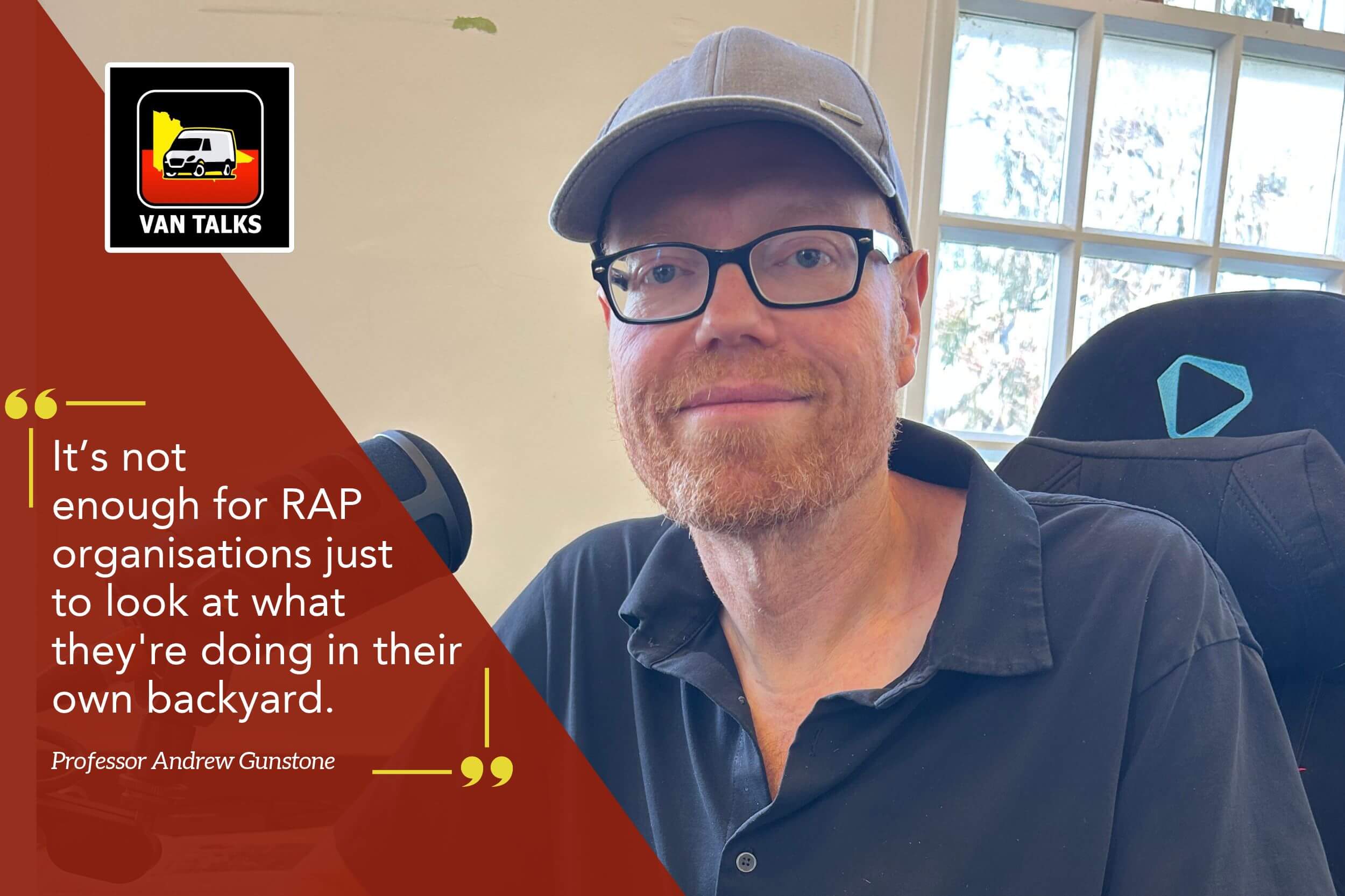
“It’s not enough for RAP organisations just to look at what they’re doing in their own backyard. They need to also look at how they can contribute to substantive structural reform across Australia, to constitutional change, to anti-racism, to indigenous rights.”
The conference also placed a vital spotlight on truth-telling and truth-listening. While truth commissions provide brilliant recommendations, governments have repeatedly failed to act.
Professor Gunstone stresses that hearing the truth is only the first step; organisations and governments must move directly to truth-acting and real implementation.
Charles Pakana: In early November, Reconciliation Australia held the 2026 National RAP Reconciliation Action Plan conference in Tarntanya, also known as Adelaide. The conference marked two significant milestones: the first, 25 years of Reconciliation Australia, and secondly, 20 years of the Reconciliation Action Plan RAP program, which has expanded from a very humble beginning of 8 plans in 2006 to its current number of over 3,300.
VAN was very fortunate in that our own Reconciliation Lead, Professor Andrew Gunstone, attended the conference in his role of co-chair of Reconciliation Victoria and he’s here today to talk about some of the findings and some of his observations about the conference and indeed Reconciliation Action Plans. Welcome back, Andrew.
Professor Andrew Gunstone: Thanks very much, Uncle Charles.
Charles: Andrew, this is particularly important for you because in 2018, you actually instigated the very first National RAP conference held at the Richmond Football Club, subsequently then taken over by another university and ultimately in 2021 to become a biennial event managed by Reconciliation Australia. So first of all, congratulations – from little things, big things grow.
Andrew: Thanks, Uncle Charles. When I was at Swinburne University running Indigenous and reconciliation matters, I wrote the 2017-2019 Reconciliation Action Plan, and that was recognised by Reconciliation Australia as an Elevate RAP, which is the highest level, and that was the first university RAP recognised as an elevate.
And I included one little target in there to create a national RAP conference. And yes, from little things big things grow. It’s really exciting to see the beginnings of that conference in 2018 when we organised that, and it was held at Richmond Football Club, and we had about 80 people turn up. And of course now there’s over 800 people turning up to these events—a thousand percent amazing, a thousand percent increase. So it’s terrific, and it’s, yeah, really nice to see how that conference has grown over the years.
Charles: Let’s look at some of the key takeaways that you’ve gained as a result of this particular one. You and I have spoken extensively about Reconciliation Action Plans. I’m not a great supporter of them in general. I think there are for certain types of organisations better alternatives. I’m aware, through the grapevine, that Reconciliation Australia is looking to update at some level.
But in the pre-interview yarn that we’ve had, you had a couple of concerns. Let’s get down to the first one of those, and that was the accountability of the Reconciliation Action Plan, and I’ve got to agree this is one of the key stumbling points that I’ve had over the years.
Andrew: So, Uncle Charles, it was a great conference. We had two days of really engaging discussions, and there were a lot of really enjoyable and worthwhile contributions there. And I think for RAP organisations, particularly the newer organisations that often are working in fairly isolated conditions, to come to a national conference and to be guided by more experienced RAP organisations is a really good benefit for them. So, there’s a lot of good positives out of that.
But as we talked about in the pre-interview, there are a couple of things I still have some concerns about with RAPs, and one of those is the accountability section. So, I always thought it’s been interesting to see that many organisations when they develop a RAP, they’ll have a big flash launch and they’ll have a lot of money put into creating a flash RAP document. Lots of pretty artwork. And that’s great because it’s going to Indigenous artists.
And then nothing. And then three years later, you see the next RAP launch. But what happened to that RAP? And so there’s no requirement for RAP organisations to publish in just as big a high-profile launch their findings of what happened in their RAP.
Charles: But don’t they have to report back to Reconciliation Australia?
Andrew: So there is a RAP questionnaire. It’s not required for all RAP organisations to do, but the leading RAP organisations are expected to do those questionnaires. But those RAP questionnaires—and they’re very good and they’re very useful—that looks at the overall impact of the RAP program. So how many Indigenous employees are in the RAP organisation? How many employees in general go into cultural competency training? So it synthesises a lot of broad information.
And some organisations do this, but there’s no requirement for a RAP organisation to say in an annual report, or most importantly at the end of their three-year tenure as that particular RAP, to say, “Okay, we had 80 targets in this RAP, and we have a traffic light report, and we find that 46 got a green light, they succeeded, 34 didn’t, and we explain why they didn’t.” And that, to me, is an accountability that the community, and as we both know, there’s a lot of concern about RAPs that people see them as just tick-a-box exercise.
Now, I think there are some real benefits of RAPs, which I’ll talk about in a sec, but I think if we just had that key accountability that all RAP organisations are required to publicly list a traffic light report to say what their RAP targets were and how many passed and failed and why didn’t they pass, that I think would add to that accountability.
Charles: And you want this to be publicised?
Andrew: Absolutely, I want it to be public and just as big a fan-fare as the launch of their RAP artwork and the RAP document is to launch what happened. Now, some organisations do that, some leading RAP organisations already do that, but I stress it’s not a requirement of the RAP program, and I think it should be.
Charles: Off the top of your head, what organisations do it?
Andrew: BHP does that. I stress that for the leading Elevate RAPs when I was doing this at Swinburne, we had to do a limited assurance audit when we had independent auditors come in and review the RAP, and that’s really important, and so Elevate RAPs have to do that. But again, those limited assurance audits are not publicly available, they go back to Reconciliation Australia.
So, I think there needs to be a scope where organisations are encouraged and supported to develop their own public accountability mechanisms. And I think that will do a lot of things. One, it increases the confidence communities have in the program, but also ensures that organisations don’t just do broad targets because they know that if they put a target in there, they have to account for that target at the end of the three years.
Charles: So more specific in their goals.
Andrew: Yes.
Charles: Okay. Let’s just continue along this line there. Before we get to the positives, and this is not meant to be a bash down of Reconciliation Action Plans, because as you’ve said, there are some great things happening in that area.
But one of the other things that you and I have spoken about over the years is the engagement beyond the organisation itself. Now, whether it’s a big organisation, a local government, an educational institution, you and I have spoken endlessly about the need to actually be out there and advocating almost as an activist, representing to government, for example. And we’ve spoken about this when it came to 2023 and the Referendum, where a lot of organisations that had fairly high profile Reconciliation Action Plans were doing nothing.
Andrew: Absolutely, Uncle Charles, and I was so disappointed when I saw that, because as I’ve always said, if you’ve got a RAP and it’s a meaningful RAP, then you’re privileging Indigenous voices in that organiSation. So you’re ensuring that Aboriginal staff, Aboriginal board members are there, Aboriginal executives are there, you’re prioritizing Indigenous voices.
So if you recognise the importance of that for your own organisation, why did so many of these organisations not Recognize that for the country? And so I was very disappointed to see so many RAP organizations not support the 2023 Referendum.
Charles: But how then do you build that into the framework of a reconciliation action plan, that political advocacy?
Andrew: I think there should be greater encouragement and support for RAP organisations to build those particular targets in there. So, for example, when I was running RAPs at Swinburne, we had targets in there to ensure that as an education institution, we’re able to educate the wider public on issues such as the Uluru Statement from the Heart, on issues such as anti-racism.
We’ve all seen how dreadful racism has become since the Referendum. Organisations need to be taking an active stand. So, when I go around the country and talk to non-Indigenous people and saying you have to be genuinely supportive and substantive allies, we also need the same for our RAP organisations. It’s not enough for RAP organisations just to look at what they’re doing in their own backyard. That’s important. They need to also look at how they can contribute to substantive structural reform across Australia, to constitutional change, to anti-racism, to Indigenous rights.
Charles: You’ve actually touched on something that was a key point within the conference itself, and that was a call for a national anti-racism framework. So tell us a little bit about that, because that’s really come into its own in recent years, as you mentioned since 2023 in particular.
Andrew: Absolutely, and I did want to get to the positives as well, and I think the National RAP conference that was just held had some really good positives, and I think one of the key things they did was have two key plenaries on the opening day, one was on anti-racism and one was on truth-telling.
And I think that’s really important for particularly those newer organisations in the RAP movement to understand how important is it that they can look at ways to do truth-telling in their own organisation, and how they can also contribute to anti-racism.
So the RAP movement for many years and many leading RAP organisations have called for a national racism framework, and we can see obviously with the impact since the Referendum of the rise in racism, and so that was a really important discussion that we had at the conference. And I think there’s also some discussions with Senator Jana Stuart, who was there, and she of course is chairing that in a very important parliamentary inquiry that I think is going to be releasing its findings towards the end of the year, as we know that’s been a parliamentary inquiry that’s looked at racism towards Indigenous peoples.
And that was set up because of the racist violence that occurred to Indigenous peoples in Invasion Day last year in Perth, and also with Camp Sovereignty. So, that’s been a really important inquiry, and I think the RAP movement needs to look at ways as individual organisations and as a movement they can get behind the anti-racism push.
Charles: It’s all well and good to say, well, hey, the RAP movement should be advocating for this and being behind this and pushing for greater changes. But as someone who’s been involved in Reconciliation Action Plans and the reconciliation process for goodness knows how long, how would you say that it could be brought into a system that can be easily rolled out across organisations of all sizes, educational institutions, governments?
Andrew: On a couple of levels. On an internal level, organisations should be having a significant review of their HR policies and practices to not just ensure that there’s anti-discrimination and the general processes, but to ensure that specific policies, processes, and penalties for people who engage in racist behavior or attitudes towards Indigenous staff or Indigenous students or Indigenous peoples in general.
So that’s a key thing they can do within their own organisation. And two, RAP organisations, particularly the larger, more prominent organisations, should take a bigger stand in ensuring that they can take a leading role in addressing anti-racism in advocacy level across the country, calling out racism.
So just as we often talk about non-Indigenous people needing to be better advocates, we need RAP organisations to be better advocates at an internal level, but in their external sphere of influence.
Charles: Well, that also leads on to advocating for youth justice reform, which was another key topic brought up in the conference. Let’s talk a little bit about that, your takeaways from that and how you believe once again that can be brought into the Reconciliation Action Plan program.
Andrew: Absolutely, that’s a great example where we’ve seen the importance of justice reform since the Royal Commission days. So, the Royal Commission into Aboriginal deaths in custody in 1991 had 339 recommendations, of which the vast majority state governments have never implemented.
And so we still see the impact of that today, and we still see the race to the bottom from governments and oppositions to try to look appear tough on crime, and there’s a big role for the Reconciliation Action Plan community to play in that. We keep hearing about 3,300 organisations with RAPs. We keep hearing about the huge numbers of Australians who work or state in the RAP organisation. That influence needs to be born to help lobby governments to ensure that we have much more effective youth justice programs and not just a race to the bottom of chasing the racist vote.
Charles: So once again, this is a case of building into Reconciliation Action Plans that political advocacy.
Andrew: Absolutely, and we see some organisations do that very well. We have again BHP as an example, but other organisations as well, they have built into their RAPs commitments to the United Nations Declaration on the Rights of Indigenous Peoples. So we can do this as organisations. But many smaller organisations, I think, need some more support for that.
Charles: Truth-telling, always a constant, but seemingly going a little bit off the boil right now. Just what was the focus on truth-telling there? I believe that Aunty Jackie Huggins spoke, Travis Lovett spoke, of course, well known, especially across Victoria and with his National Walk for Truth. Just how much emphasis was being placed on truth-telling at the conference, and what were some of the calls to action that were being made by these strong advocates?
Andrew: That was a terrific panel. Again, that was one of the plenaries on day one, which I thought having that and the plenary on anti-racism was a great way to structure the conference. So that was very successful, and talked about the importance of organisations engaging in truth-telling.
And just from my own experience of advising RAP organisations across Australia, I’ve noticed a rise of RAP organisations coming to me to ask for support for truth-telling. So I see that’s becoming more and more happening. We of course know that Melbourne Uni has done a truth-telling effort through their work, and we see more organisations start to look at that.
So I thought that was important to have that focus. I think it’s still important though, when we’re talking to new RAP organisations in particular, that there is a very strong focus on truth-telling, but that’s not enough. There also needs to be a focus, which was discussed at the conference, which is good, on truth-listening. So non-Indigenous people have to listen to the truth they’ve been told, and then of course truth-acting.
It’s not enough just to hear the truth, we have to act on the truth. And the classic example, that’s the Victorian government. Obviously, the Yoorook Justice Commission is the first Indigenous-led truth-telling commission in the country, but just like so many other truth-telling inquiries, they had brilliant recommendations, but governments have failed generally to act on them. So that truth-acting is critical whether you’re at the governmental level or RAP program level. You don’t just have to know the truth, you have to then implement that change at that structural level.
Charles: Just keeping on with truth-telling, how does a smaller organisation incorporate truth-telling into a Reconciliation Action Plan? Because it’s all well and good to say to the state government, to say to big organisations, BHP, educational institutions, hey, you’ve got to implement truth-telling into your reconciliation action activities and plan. But what about for a smaller organisation? What does it actually look like on the ground?
Andrew: That’s a really good point, Uncle Charles, and I think it’s a general point that we see a lot in smaller RAP organisations. So, for example, 50% of the business in this country are small-medium enterprises, and they don’t really fit the RAP program. It’s interesting, you know, when you talk to the introduction about RAP program has been around since 2006, it’s 20 years this year. Those eight original RAP programs were large organisations, so one government department and seven corporates, and I think it’s always been built for corporates, and it’s doing a great deal of work for corporates.
But as you also said in the introduction, there are other ways to look at these engagements through Indigenous strategies, self-determination frameworks. I know that Reconciliation Australia is doing a review of their RAP program. I think a critical thing for that renewal is to look at how RAPs can be better suited for all those other sectors that don’t fit that corporate model: small to medium enterprises, universities—and there’s a lot of universities that have not engaged as much as they used to in the RAP program—local government councils are not engaging as much in the RAP program.
So we need to look at ways to do that. And the example of you saying about truth-telling is a good example of why we need to do that. So how do organisations with very limited resources that might just be a small family business, how do they do a genuine truth-telling exercise?
And so of course that’s going to look different to different organisations, but it’s a really important point. Those organisations with lots of resources can go and spend a lot of money on doing archival research. That’s not going to happen for all organisations. So I’d argue that those organisations don’t have the resources can still look at ways to support truth-telling, but just to be doing it in a more limited way, but in maybe a broader way in terms of looking at the societal impact of truth-telling.
Charles: Just before we wind up, Andrew, what’s the measure of success of Reconciliation Action Plans?
Andrew: Well, I think there’s some challenges which I’ve talked about in this conversation, but I think it’s also really important to note that when you look at the surveys that Reconciliation Australia conducts of the wider Australian community and also surveys they conduct of the employees in RAP organisations, those surveys consistently show a significant high level of support in RAP organisations for Indigenous issues, for reconciliation, and recognition that there is racism in the community, then there is in the wider community.
And I think we need to recognise that that shows that when Reconciliation Action Plans do well, and are led well, they can have an impact. I just think we need to look at ways to ensure that more and more organisations are doing genuine transformational substantive RAPs.
Charles: I must admit you brought up something there that I was very, very tempted to go over time on, and that is that RAPs should be led well, but we’re not going to go down that rabbit hole right now. At another time, absolutely.
Andrew, three key takeaways for you from the conference.
Andrew: I thought it was a very successful conference. I really like the fact that they led with very important plenaries in anti-racism and truth-telling. I think it’s some very useful conferences as I said at the start for lots of organisations who are quite isolated in their normal work to come together. And I think there’s also a scope though for the broader RAP movement to look at ways to increase the effectiveness of RAPs even further, as I’ve talked about.
Charles: Professor Gunstone, Reconciliation Lead at Victorian Aboriginal News and co-chair of Reconciliation Victoria, mate, thanks again for your time.
Andrew: Thanks very much, Uncle Charles.
For Radio Play:
1 - Click the Download Audio button
2 - The audio file will commence automatic play in your browser
3 - Confirm this is the file you want to use in your program
4 - Once confirmed, click the vertical elipses (3 dots) and select download
CONTACT US VIA SMS
Get in contact with us via our dedicated SMS line:
0493 222 836
11 November 2026
Gellung Warl commits to community accountability and answerability on Treaty process
9 November 2026
Bendigo community and environment clearly benefiting from Dja Dja Wurrung cultural knowledge
3 November 2026
Exploring the beauty of the Yidaki with internationally acclaimed Ganga Giri
30 October 2026
A starting conversation on UNDRIP with Kaley Nicholson, CEO of the Federation of Victorian Traditional Owners Corporation
26 October 2026

0 Comments