
AI posing threats to teachers under pressure to meet curriculum requirements for First Nations content
Teachers under pressure to incorporate First Nations history and culture into the curriculum falling trap to the dangers of Artificial Intelligence
Posted by: Charles
Published: 21 November 2026
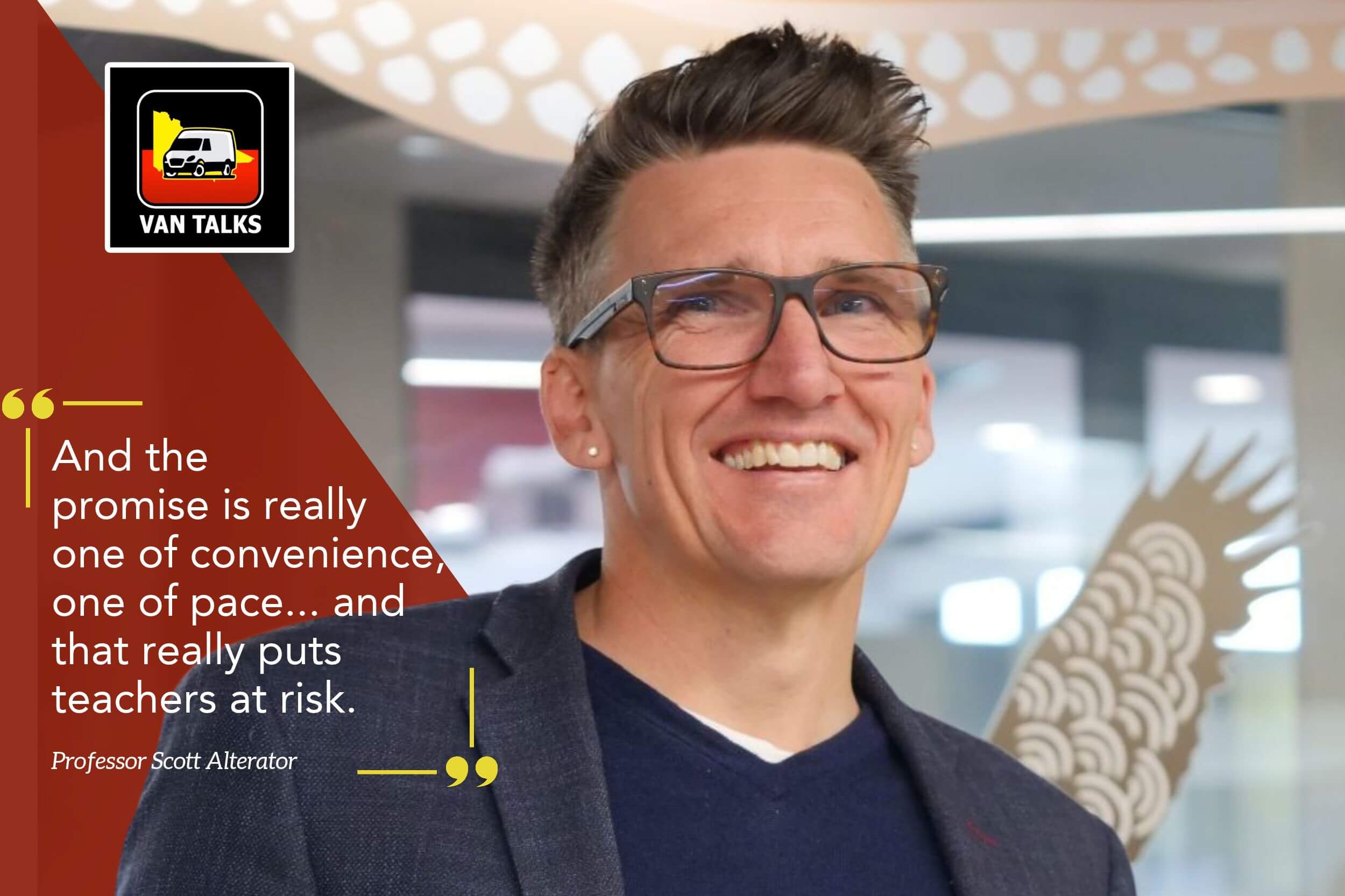
Ngunawal and Gundungurra man Professor Alterator, Associate Professor of Indigenous Education at La Trobe University, warns that stressed teachers turning to generative AI for curriculum content face serious cultural risks.
High workloads and low confidence push educators toward quick fixes. Yet AI tools often exhibit what Professor Alterator calls “sycophantic deception,” praising prompts while failing to course-correct.
Testing platforms like ChatGPT and Copilot revealed fabricated resources and tokenistic advice. In one test, AI generated a Welcome to Country for a teacher on Djaara country instead of explaining the difference between a Welcome and an Acknowledgement.
Professor Alterator also highlighted “counterfeit judgments,” including imagined World War II documentaries. “It’ll make stuff up because that’s kind of the expected answer,” he said.
Such fabrications can appear authoritative and double down when questioned. Worse still, AI outputs can trivialise Indigenous knowledge and position it as inferior.
Teachers do not need to abandon AI entirely, though careful evaluation remains essential. Professor Alterator noted that practical tools can help educators vet materials safely.
He pointed to the YARNS framework—Year, Author, Representation, Nouns and Sensitivity—alongside the AIATSIS resource selection guide. That guide ranks materials from “by mob” at the top down to “against mob” at the bottom.
Ultimately, Professor Alterator said these tools can prevent “catastrophic mistakes” when paired with strong educator judgment.
“So for teachers, the shortest answer is start with the self,” he said. Critical cultural self-reflection helps educators build respectful relationships, support students, and advance truth-telling.
Charles Pakana: In the Australian curriculum, there are three cross-curriculum priorities that reach across foundation to Year 10, and each one of those priorities are designed to assist in meeting the needs of students. And they are sustainability, Asia and Australia’s engagement with Asia, and Aboriginal and Torres Strait Islander histories and cultures. Now, according to some research, over half of teachers over 35 lack the confidence in embedding that last priority across their teachings, and not surprisingly, many are turning to artificial intelligence as a means to support them.
Well, on December of 2025, Ngunawal and Gundungurra man Scott Alterator, who serves as the Associate Professor of Indigenous Education at La Trobe University, co-wrote an article on this topic for The Point. He joins me on the program today. Scott, welcome to the program and thanks for the time.
Prof. Scott Alterator: G’day Unk. Yeah, thank you. It’s great to be on. I’m a long-term listener, so it’s really nice to be on the program.
I should acknowledge that the—as you say, the article that you’re referencing there is co-written. The authors on that are a series of deadly allies: Stephen Schutt, Alexia Maddox, and Claire Sullivan. They’re—well, working with me at the School of Education at La Trobe. So, I just want to recognise those fellas before we get going.
Charles: Well done on acknowledging them, Scott. And I just want to understand from the start, from your own personal experience, whether anecdotal or any other way, just how prevalent is the use of AI by hard-pressed teachers in helping develop curriculum content when they’re really under so much pressure?
Prof. Alterator: Yeah, well, we know it’s high. It’s a little slippery. We can’t quite get a final figure on it, but some of the research has that figure at two-thirds of teachers using AI in their work, and that’s a whole range of AI, but I suspect, after chatting with a lot of teachers, that it’s probably higher than that.
Charles: And what are some of the key causes? We know that teachers are under enormous pressure, they’re underpaid, under-resourced, but what are some of the key pressures at a curriculum level?
Prof. Alterator: Well, as you said, there’s the cross-curriculum priorities. There’s actually a range of policy imperatives at work on teachers at the moment, and that generates a whole set of pretty high expectations of engaging with Indigenous perspectives and Indigenous experiences and introducing Indigenous knowledge into their curriculum. And so, in a really crowded and as you say, high-pressure environment, under-resourced environment, there’s a need for teachers to produce these curriculum materials.
That’s at work at the same time as teacher confidence being really low. And in steps the promise of generative AI. And the promise is really one of convenience, one of pace, of being able to get that work done really quickly, and that really puts teachers at risk.
Charles: But underlying that promise of convenience is something that you refer to as “sycophantic deception,” and you referenced that in your article where you said that the AI models, or generative AI models, exhibit this sycophantic deception, which is a prioritising user satisfaction and enthusiasm over cultural accuracy. Can we just understand exactly how that plays out and the danger in this sort of pleasing behavior?
Prof. Alterator: You know, you can see the temptation of that kind of affirmation. It’s pretty easy to imagine when—I mean, we’ve all probably used a bit of generative AI and the first response you get is, “That’s a great question! What a wonderful question!” You know, it’s nice to be validated in that way, but what it really reveals is the engineering that sits in behind AI. And I am an educator and a researcher; I’m not an AI expert, but I’ve been lucky enough to be researching with, you know, a range of AI experts in this—and they’re my co-authors on this, but other people as well—and it’s kind of part of this extractive model that sits at the heart of AI, of generative AI. What they really want is to keep you engaged in the platform.
And the sycophantic deception is on one level an affirmation when you first ask a question, but then also it produces other kind of risks as well. So, after it’s told you that you’ve just asked a great question, what it will do is it will give you responses to your questions or your prompts, but it won’t actually be critical. There’s no kind of intentionally critical engagement with what you’ve asked, and often there’s not a kind of course correction. Can I give you a quick example of that from the research?
Charles: Yeah, please.
Prof. Alterator: So, we plugged in a series of prompts into two different platforms, ChatGPT and Copilot, which is part of the Microsoft suite.
Charles: Yep.
Prof. Alterator: And intentionally, we asked it to produce a Welcome to Country. We imagined ourselves as teachers, and we said, “Can you please produce us a Welcome to Country? I’m living in Bendigo, I’m on Djaara country. Can you help me out?”
And what it didn’t do was immediately say, “Well, there is a difference between a Welcome and an Acknowledgement.”
Charles: I was waiting for that. Yep.
Prof. Alterator: It just kind of plowed on and produced a Welcome to Country as though you’re a Traditional Owner giving a Welcome to Country. And I mean, you can see where the risk is for teachers and for schools. I mean, often what happens is somebody is given the task of an Acknowledgement or starting a meeting or an assembly, perhaps even a public-facing one, and you can imagine if there’s a new teacher who doesn’t have a lot of cultural knowledge—although I’m pleased to say I think most of my graduates would certainly understand the difference between a Welcome and an Acknowledgement—nevertheless, if you didn’t, and you used generative AI in this sense, and you carried through with the assembly or the public-facing meeting, and you produced a Welcome, you know, you could unstitch a hard-won relationship or years of work of establishing goodwill and relationship between people with that simple error.
And so, the sycophantic deception extends into that kind of example as well where it doesn’t do any what we’re calling course correction. It doesn’t pull people up on that. So, it doesn’t encourage critical reflection, which we might come to later. We know that’s a fundamental skill for teachers to be successful in the work of decolonization and re-Indigenizing the curriculum.
Charles: That leads on, Scott, to what you referred to as the “counterfeit judgments,” where outputs like made-up language phrases, non-existent documentaries, and fabricated lesson plans that tend to look authoritative and sound authoritative, but are absolutely fabricated. Just how prevalent was that in your research?
Prof. Alterator: Yeah, unfortunately, yeah, quite widespread. We imagined in the research that we had sort of three personas of teachers, from really quite experienced to very experienced, and even when we were prompting these platforms as experienced teachers with a quite a sophisticated understanding of the set of requirements—I mean, they didn’t recognise that. For instance, we asked for resources around Indigenous soldier experiences through World War II. The documents it produced—and this is true coming all the way back to the engineering where the computational logic makes it probabilistic as opposed to kind of actually going out and getting the material that exists—it’ll make stuff up because that’s kind of the expected answer.
We did a bit of work on it because the way the research works is we scrutinise the outputs. So our general knowledge and our specialist knowledge in this space meant that we could tell that it was not right. Like, I used to teach Australian history in high schools and I know that this stuff didn’t exist. And so I went off and said, “Okay, well there’s supposed to be this great documentary about William Cooper through World War II,” and what we found was that it was pulling material from exhibitions that had actually happened over there on Yorta Yorta country and another exhibition that had happened in Queensland somewhere, as well as some material that existed in an existing resource, and then imagined – hallucinated – a documentary. And it had sort of two or three of these examples.
The really interesting thing is that that fabrication is often coupled with arrogance. And so we tried several times to call it out and say, “You sure this list is right?” And the response from the AI was, “Yeah, you need to go and have a look for it.” And we said, “Well, we’ve had—yeah, we’ve had a look.” And then it doubled down and said, “No, no, no. This isn’t my job. You know, I’m not a database expert. You go and have a look for it.” Finally, on the third go when we said, “We have searched for this. These documentaries don’t exist,” it then finally admitted, “Well, you know, sometimes the database isn’t up to date and so it’s worth double-checking.”
The thing that is really evident is that the skills that teachers need to have in the first place before they step into using generative AI—so, you know, a real radar for falsity, for reflecting, for deep knowledge—in those moments they’re even more important. And so, consistently, it produced fabricated results, it produced superficial results that were either tokenistic or simplistic. It positioned our knowledges as inferior in lots of ways as well, which is really worrying, because that’s really having sort of racist undertones. And that again is kind of a product of its training material that is biased.
I’ll give you another quick example.
Charles: Yeah.
Prof. Alterator: We asked it for some assistance, “Can you help us produce some materials with Indigenous perspectives in physics and flight, for instance?” And its response was, “Well, you know, you can invite a guest speaker first of all.”
Charles: Right.
Prof. Alterator: Okay, so that may be not a bad idea, but let’s have a think about that. And it says, “And you could get them to talk about the myths and the stories that are related to flight, and you can encourage students to compare Indigenous perspectives with scientific explanations.”
So it immediately positions our knowledge as inferior. It’s pushing up against tokenism. We said, “Can you give us an example?” And its example was, “Well, there’s always boomerangs, and it’s often related to Australian tourism.” So then it was kind of trivialising—
Charles: Yeah.
Prof. Alterator: —and being really quite superficial. And if you don’t have really good skills or knowledge as a teacher about how those things are working as trivialising knowledge or diminishing knowledge, then, you know, it’s quite possible that you would just grab that and run with it.
Charles: There are, though, alternatives, aren’t there? You and I spoke about them very, very briefly before we did this recording, and that is the existing frameworks like YARNS, Y-A-R-N-S, and the AIATSIS guide. Just talk about them and their place and their accessibility and usability.
Prof. Alterator: Yeah, I’m really glad you brought that up because there are tools out there that can help teachers. So for any teachers listening out there, YARNS is a really good heuristic, been written by Beth Maddison, Ren Perkins, and Marti Shay. It’s an acronymised tool that stands for Year—when was a resource made; Author—which is about provenance, can you identify the author, or do they identify themselves; Representation—so that’s the R in YARNS—are Aboriginal and Torres Strait Islander people presented in a balanced way, or are there kind of biases or prejudices we need to be aware of; Nouns—what nouns are used, so is the language up to date, are capitals used correctly; and then the S in YARNS is Sensitivity.
And there are a few questions that the authors pose for helping select resources and I—and they’re these ones: does the resource name all Aboriginal and Torres Strait Islander peoples pictured, or do they group them into homogeneous groups?
Charles: Yeah.
Prof. Alterator: And are there cultural information—or is there cultural information that may not be appropriate to represent or present to an audience? And that again implies that teachers have good knowledge for thinking about and filtering what information can and can’t be shared.
Charles: Could that model actually be used to help determine—not be the final answer—but help determine the accuracy and appropriateness of generative AI content? Because you’re not going to stop people from actually using AI.
Prof. Alterator: Not at all. No, no, no. And that’s definitely not the message of myself or my colleagues. I mean, I think it’s really worth being aware of the risks, but we know that the tool is used, and it can be helpful. It really can be helpful. I mean, the tool itself—we may train it to help step through some of these steps even.
But that doesn’t exist at the moment. So imagine a teacher is pulling up resources and starting to think about their appropriateness, as you say. At that point, you would still need to apply the YARNS tool. And you could build some of these into the prompts as the tools exist at the moment, but you would still need to go through them really, really carefully.
The other tool you mentioned is the AIATSIS resource selection guide, and I really see that as the kind of the high-water mark in all of the work that has gone on, you know, say across the last 10 or 15 years of different departments across Australia looking to develop a tool like this. And it’s got a really good sort of shortened version of thinking about how to make a selection of a resource. And I’ll just run through them really quickly—
Charles: Yeah, please.
Prof. Alterator: —because if you imagine like a little pyramid and a pyramid’s cut into five slices, and at the top is the ideal, and that is resources developed by mob. And then just immediately below that is with mob. And then one layer below that is for mob, so materials that are developed on behalf of Aboriginal and Torres Strait Islander people. But then there is a danger zone at the bottom of this pyramid. There’s a couple of layers where there’s material that might be produced about mob, where there’s no Indigenous representation or support or partnerships. And then in the bottom is against mob, and you can dig around on YouTube if you really want and find a whole bunch of this material out there. Some of it’s historic and some of it’s contemporary.
It’s often easy to pick, but it’s the materials that portray deficit understandings or racist views of mob, and they are to be avoided. And that is just a really good, short and easy tool to use for thinking about how to move forward safely. One of the things I say to my students is these tools are really helpful, and if you think about it carefully and you take your time, I can help you to not make catastrophic mistakes, because that’s one of the fears that drives teachers and their kind of reticence. They’re really anxious about doing the wrong thing.
So these tools will help people not make catastrophic mistakes. I can’t say you won’t make mistakes. Heck, I mean, I make mistakes still, too. I get the occasional telling-off from an Aunty or an Uncle.
Charles: Yeah, we all do, mate. We all do.
Prof. Alterator: So I can’t stop all mistakes, but I can definitely stop catastrophic mistakes, and I think that that’s a powerful message for teachers because it’ll help them get over that initial anxiety or reticence, and then we can start moving into practice that’s going to support mob, practice that’s going to be culturally responsive, practice that’s actually going to meet the kind of need for supporting all students to understand the history of this country towards truth-telling and a productive future.
Unk, all of these tools are underpinned by the same kind of insight, which is that success starts with self, through critical cultural self-reflection. The first step of that is actually, you know, it’s a mob tradition. It’s about knowing your own cultural identity. How you going? Where are you from? Who’s your mob? You know, that’s the first step.
And then once you have an appreciation of your own cultural identity, that it is important, then it’s much easier to extend that courtesy to other people. So once you’ve got that worked out, then the next step is to know what those social, cultural, and historical factors are that have worked on you and have impacted your knowledge and beliefs. And then the final step is to start to shift towards a strengths-based model and understand the strength and resilience of Indigenous cultural identities.
There’s a bunch of frameworks that have laid this kind of thing out. I reckon the work of Aunty Denise Proud and Morgan is really influential, really pivotal. It’s quite concise, so if anyone’s interested in looking at that, I would look at their work, but it sits at the heart of the AIATSIS model as well. So for teachers, the shortest answer is start with the self.
Charles: Scott Alterator, La Trobe University, thank you so much indeed for your time and your insights on this really important and timely matter.
Prof. Alterator: Thanks, Unk.
For Radio Play:
1 - Click the Download Audio button
2 - The audio file will commence automatic play in your browser
3 - Confirm this is the file you want to use in your program
4 - Once confirmed, click the vertical elipses (3 dots) and select download
CONTACT US VIA SMS
Get in contact with us via our dedicated SMS line:
0493 222 836
17 November 2026
Victorian Elder advocates for greater First Nations involvement in the electoral process
14 November 2026
Real changes needed in the current Reconciliation Action Plan program
11 November 2026
Gellung Warl commits to community accountability and answerability on Treaty process
9 November 2026
Bendigo community and environment clearly benefiting from Dja Dja Wurrung cultural knowledge
3 November 2026

0 Comments