
Advancing Victoria’s education model in a post-Yoorrook era
12 months after first speaking with Shelley Ware, one of Australia’s foremost First Nations education system reform advocates, we catch up again to talk about the future of Victoria’s education system in a post-Yoorrook era.
Posted by: Karina Wells
Published: 22 June 2026
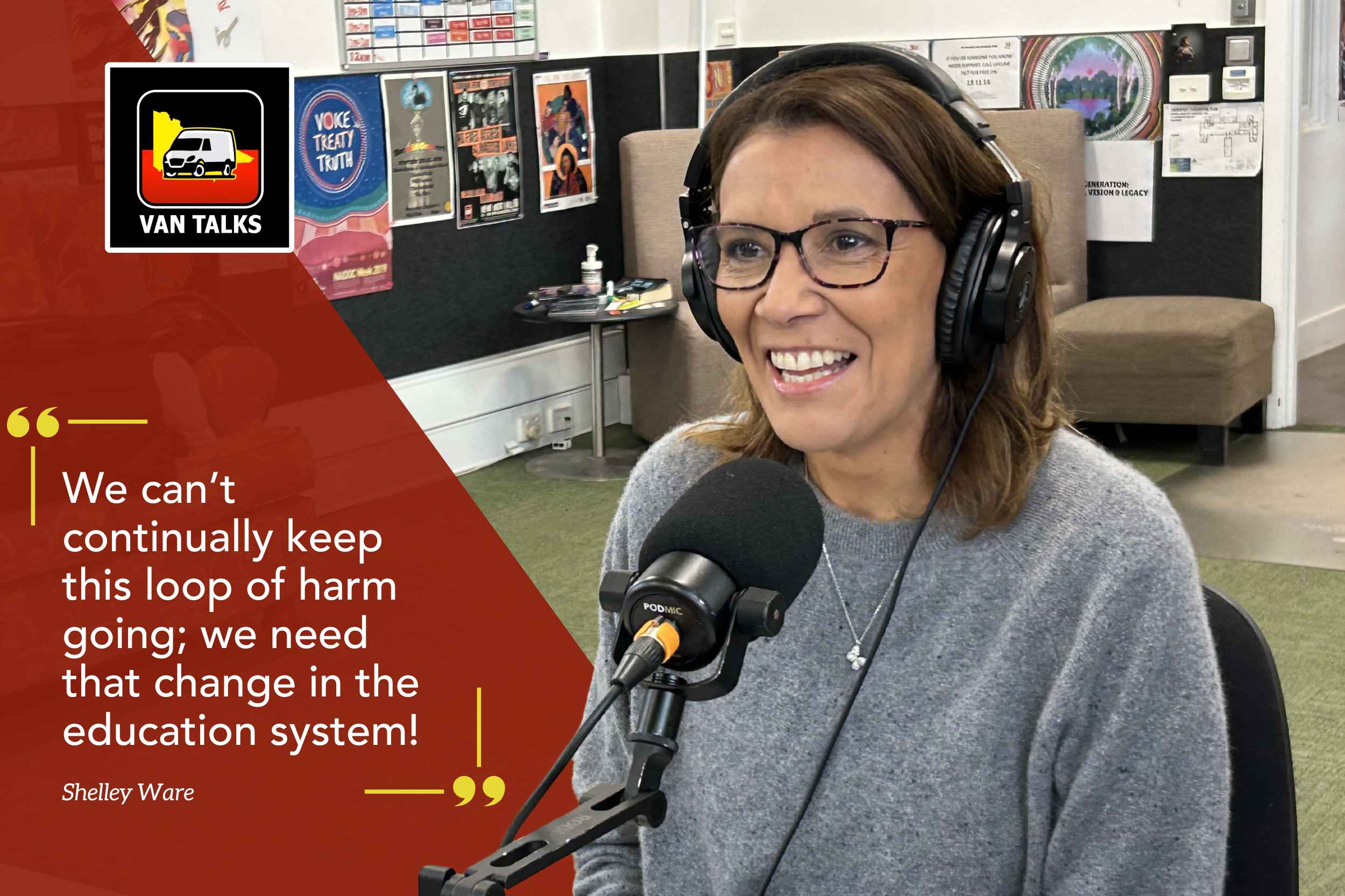
A year after Victoria’s historic steps toward truth-telling, the glaring gaps in cultural safety within classrooms remain a critical battleground for self-determination.
Renowned educator and journalist, Shelley Ware, returned to VAN Talks with host Charles Pakana to discuss how the heavy, raw truths laid bare by the Yoorrook Justice Commission must be woven into the school curriculum.
Despite federal mandates and landmark state developments, systemic progress has largely stagnated. “I know that the Yoorrook Commission has also stated that… but I would say that we are pretty much in the same place,” Shelley said.
With the Treaty Act of 2025 and the First Peoples’ Assembly of Victoria 3.0 prioritising education overhauls, First Nations educators are demanding a seat at the table to transform Yoorrook’s findings into classroom-ready resources.
Shelley envisions a collaborative round table of experts to guide bureaucrats, who must roll up their sleeves and deeply engage with lived experiences rather than just sign off on policies.
For individual teachers waiting on systemic mandates, Shelley urged immediate action by normalising Aboriginal cultures and true history in daily lessons, encouraging them to overcome the fear of making mistakes.
“We want people just to go: ‘All right, if I make a mistake, I’ll—I’ll learn from it, move on,'” Shelley explained.
She believes that integrating cultural elements should be a seamless part of the day, from sliding a photo of possum skin cloaks into a textiles lesson to taking students outside onto Country. “When those split little decisions start to include our cultures and our histories… they’ll just start to feel very proud of themselves,” she said.
Ultimately, true educational reform extends beyond school gates, requiring parents to actively celebrate the resilience and diverse beauty of Mob at home through literature, language, and local community events.
By embedding these truths daily, Victoria can cultivate an empathetic generation, finally breaking historical loops of harm.
Charles Pakana: Just over a year ago on this program, we sat down with renowned educator and journalist, Yunkapandi and Wardandi woman, Shelley Ware. And we spoke about the glaring gap in Victoria’s school system. She gave voice to a truth many of us know all too well: that generations of Australians and Victorians have been fundamentally denied an education when it comes to First Nations history and culture. Now, since that conversation, the landscape, as most of us know in Victoria, has continued to shift.
The state government signed a treaty with the First Peoples’ Assembly of Victoria, and the Yoorrook Justice Commission’s four-year process laid bare many of the systemic failures of our institutions, including the classrooms. So, where do we go from here? How do we take the heavy, raw truths being entered in the public record from Yoorrook and weave them into a curriculum that has its historic whitewashing removed? Today, Shelley Ware returns to VAN Talks to look at what’s changed, if anything, over the past 12 months. Shelley, welcome back to the program.
Shelley Ware: Thank you. Thank you for having me.
Charles: Shelley, last year we discussed the federal mandate for culturally safe classrooms, but you noted in that interview that there was no real funding or backing for that.
Shelley: Mm-hmm.
Charles: One year on—
Both: (Laugh)
Charles: —and the smile—the smile is saying a lot. Are you seeing any shift at all from a statement for the sake of a statement, to actual accountability?
Shelley: I would say that we are in the same position. I know that the Yoorrook Commission has also stated that in one of their recommendations around cultural safety in the classroom, and I know that the education department is working on some things, but I would say that we are pretty much in the same place.
Charles: Do you believe, though, that this evidence and the submissions that were received by Yoorrook can be used—not will be used, because I’m not going to ask you to look into a crystal ball, but can be used—to bring about that fundamental change?
Shelley: Absolutely. As Aboriginal people, we’re storytellers. That’s how we communicate our needs, and have for thousands and thousands of years, and our stories that affect people and our connection to people. And I do believe that we can use them. Will they use them is another question. I know that the Victorian government is very much committed to it. We need to know at a federal base if they are willing. We see too often that we have commissions, and inquiries, and reports written that just sit on desks over and over and over again. I do like to think that we’ve seen more action with the Yoorrook Commission’s report and their recommendations. I just hope—I still have hope, and I will always have hope until the day I die—that people are actually reading them and connecting to them.
Charles: Given that one of the—the key points in the Treaty Act of 2025 was this use of the Yoorrook evidence to overhaul the education system, and this is something that the First Peoples’ Assembly of Victoria 3.0 is looking to achieve, what role do you see for yourself and other First Nations educators in this process of working with the Assembly, working with the government to overhaul the system using all these evidence and submissions?
Shelley: I would love them to get us all in a room and do a round table. It would be fantastic. There’s so many of us that are actually committed to education and creating culturally safe spaces for people. I would love to see us invited in one day when they get to that point on education and share our lived experience, share what we’ve been doing. You know, I’ve been doing this for 25 years as a teacher and 15 years of this kind of work and going in and out of schools at a national level and helping with education resources. I’ve written probably over 50 of them, so, there are already incredible resources, and there are many other education writers as well. We’ve got so many already, let’s collate them, put them into one spot, let’s make sure that they’re accessible for teachers.
Get us into this round table situation where we can share our experiences and build upon what the Yoorrook Commission has asked us to do and make it happen. I think that treaty—the treaty process and the Treaty Assembly have a really important role in that. The recommendations are huge for education, and they will take time for people to absorb. We can’t expect people to read that 1,500-page document, because the regular human just won’t do that.
Charles: Yeah.
Shelley: So, we need to make sure that we’re breaking it down and making it Yoorrook in schools ready for schools, teachers, communities, and the wider Australia.
Charles: If you had to be in a position of prioritising changes within the system, what would be among your top three or four immediate calls to action?
Shelley: First of all, I would just shut down schools for a week and just say, “Hey, let’s just get this…”—I know you can’t shut down schools for a week, but—go around to schools and really work with teachers, making them feel confident and comfortable because, like you said at the start, denied an education. And that’s the problem. And one of the biggest problems is teachers still rely on me or someone else coming in and actually educating them on the true history of this country. As a school, a whole school should diarise it. It should be a part of their weekly thing. Let’s watch this, let’s get in the staff room and do that. So, this whole education for teachers needs to happen immediately. And they need to be encouraged. They need to see their leaders in their education system actually being honest and saying, “I’m on this journey, too.” I mean, it’s a word that people go, “Oh, I don’t like that word,” but it’s just a fact. It’s a journey that they need to go on, and they need leadership to be doing it, and they need to see it so then they’re inspired to connect to the beauty, to the truths, to all of those things. But that historical, shared history and our beauty before colonisation, that needs to be connected to. Because people think, “Oh, that 200″—what have they been around, 250, 70 years or whatever—
Charles: Mmmm.
Shelley: —they think that’s our history.
Charles: (Laughs)
Shelley: So, they need to actually connect to the 65,000-plus years. So, the historical thing would be number one. Once that’s happened, teach them what it really actually means to create a culturally safe place. Some people are sprouting out there that they’re doing it, let me assure you, it’s not happening in many schools in this state at all. How I know this is because of the way that my son went through school, Aboriginal children that I know currently going through school. There are not many schools that have created a culturally safe space. And we know that they have created it when every single family tries to get into that school. And then we know that it’s culturally safe because it’s full of Aboriginal children.
Charles: Yeah.
Shelley: And then we also know that the department knows it is because they stop letting Aboriginal children in because there’s so many of them and they want them to go to other schools. But our Blak telegraph tells us where they are. So, we—we go there. So, making those culturally safe spaces is probably—is number two. Number three: go through your library as a school. It’s an easy one to do, some real easy kinds of things as a school. People go, “Oh, that’s just tokenistic.” That’s what we need. We need the tokenism.
Charles: Well it’s not is it, really?
Shelley: We need to walk into a space and go, “Wow, look at that beautiful mural. I belong here. I can see those NAIDOC posters. I can see that acknowledgement plaque.” Do that. Beautify your school with our culture.
Charles: Becoming a part of the environment of the school itself.
Shelley: Becoming a part of the environment of the school, so you feel as soon as you walk in, you feel like, “This is where I belong.” Make that happen, and make sure that you know your families of Aboriginal children, you know the families’ stories, so those stories are a part of your story. And that when you go to do something really difficult, and that connects back to the cultural safety and have those difficult conversations, you know that family’s story, and then that family feels like you care, and then you have that two-way connection. That needs to happen, all of those kind of tick-a-box things. People go, “Oh, I don’t want to tick a box.” Please tick them. Please make sure that those things happen, so when our kids are in those schools, they know that they’re seen, that their culture’s matter, and that they’re valued.
Charles: Let me challenge you a little bit on that. You said that it’s not enough for people such as yourselves to be called into the schools, that you really would like time to be set aside where you’re working directly with the teachers just to start to change the culture in that. I’m paraphrasing you, of course.
But what then about the responsibility being with the bureaucrats and the politicians at the state level? Because all too often we see that when it comes to these matters, the responsibility is forced off onto schools or to other organisations, and the pollies [politicians] and the bureaucrats sit there and say, “Well, you know, we’ve done our bit.”
Shelley: Oh, they do that. That’s—that’s a regular thing that goes with absolutely everything. You know, they can put a policy in place. Let’s look at the social media for children under age.
Charles: Yeah.
Shelley: We’ve fixed that. No, you haven’t. That was fixed for not even 20 seconds, but you can still hold on to that and say, “We’re doing the right thing.”
Charles: Self-justification.
Shelley: Self-justification, self-preservation, and we can move on. You haven’t created a safe place for these children.
Charles: Mm-hmm.
Shelley: You’ve just said you have, and then you’ve moved on. Bureaucracy needs to take a good, hard look at themselves and actually say, “Am I doing the right thing?” So, it goes into education as well. You can put things into place, but if you’re not actually going into the schools and seeing what is happening and actually talking to people with lived experience, then you’re not doing your full job.
So, they can put things into place, and I absolutely hope that they mandate more of the recommendations. And I know that they’re working through them, and that they are hopefully going to pick the right ones. (Laughs) But when they do put these in, I hope they’re talking to people with lived experience, and all of that is very clear in the Yoorrook Commission recommendations on what to do. Like, it’s a roadmap. You can’t get it wrong.
Once the bureaucracy does that, the schools still have a responsibility. When I became a teacher 25 years ago, that was my responsibility, was number one for those children, and then I had to deal with their parents, and talking with them and making sure that their parents were. But number one, those children are my number one priority. Making sure I have well-rounded children that will go into society, create opportunity for others, have the opportunity to live their best life.
And all of that starts with our bureaucracy, but they can’t just sit at a table and think they’ve done a job. They need to get dirty, roll their sleeves up, and make sure that their policies and their actions are actually being put into place, and not feel good about themselves because they’ve made some recommendations.
Charles: Let’s step back a few years to when you were in Year 8. Now, Yoorrook has put very raw, sometimes traumatic historical truths into the public record. Now, remembering your own school experience with that uncontextualised video in Year 8—and we spoke about this in the previous interview—how do we bring Yoorrook’s heavy truths into the classrooms without traumatising First Nations kids or causing non-Indigenous teachers to panic and pull back?
Shelley: It’s a big problem. We’ve got teachers that are too nervous, they don’t want to do it. But for me, that’s not good enough. We as teachers teach that when we do a mistake, we learn from it.
Charles: Yeah.
Shelley: When we leave school, we should be lifelong learners. They’re two things that we pump into these children. So, why can’t we live it? Why can’t we make mistakes? Why can’t we be brave to show these children, “Oops, I taught something, it wasn’t correct. But because I had a connection to the local community, I have an elder or I have a respected community member, or I have a family that could come to me because I have created a culturally safe space for them to feel that they can come and talk to me, then we can fix it.”? We can sit down with the children and go, “I thought I was teaching you the right thing. This is incorrect. I’ve got someone in to help, or I’ve actually sat with them and I’ve resolved what I did, and I’m here to talk to you about what it was.” That’s teaching children to have a go, not be afraid, make mistakes, learn from them, and then be able to move on. We don’t want to do things where people are stopping or, you know, “I can’t do that anymore,” or, “I’m going to get told off.” We don’t want any of that or—
Charles: Mmmm.
Shelley: —that fear. We want people just to go, “All right, if I make a mistake, I’ll—I’ll learn from it, move on.” How many times have you growled at? I’ve been growled at that many times by Elders, it’s not funny.
Charles: (Laughs) Let’s not go there.
Shelley: But, you know, that’s part of being human. So, why do teachers hide behind that and not do it? It’s not good enough. It’s actually—I find it infuriating to be perfectly honest with you. I need teachers to just step into it and go for it.
Charles: Well, that’s just it. So, it’s all well and good to say, “Yep, okay, here are the measures to take and the steps to take and the people to whom you should speak after the event.” But just as that video that you watched when you were in Year 8, how do we educate our teachers to start discerning what is appropriate and inappropriate? Because you’re talking about age groups, you’re talking about cultural identities in there, a whole raft of issues that need to be taken into consideration.
Shelley: Absolutely, so that is part of that historical education. You’ve also got emotional intelligence.
Charles: Yeah.
Shelley: Teachers have that. Teachers are really good with that. They know and they understand what hurts children. So, if they’re watching something and they feel hurt, they should know the year level that they’re working in, they should know the curriculum, they should know what’s age-appropriate. And that’s what the curriculum is. It teaches things at an age-appropriate level. So, when you educate yourself about true history and you understand what it is, you should be able to, as a teacher, make it age-appropriate for children. Yes, you may make a mistake, and you can learn from that.
But as teachers, we’re pretty good at that, knowing what is appropriate to say to children. We’re not going to walk in and talk about the Stolen Generations and say horrible, terrible things that will make children feel frightened.
But we are going to talk about it in a really age-appropriate way. “You’re safe”—we let them know that they’re safe in that moment— “but this is historically what has happened to Aboriginal children.” Where they can then have empathy when they are an adult about where Aboriginal and Torres Strait Islander people fit into society still because of the effects of colonisation, and they can make real changes as adults because they have that empathy. That’s part of our education system creating well-rounded, educated people who make a real impact and change in all aspects of life, especially with Aboriginal and Torres Strait Islander people, so that we can make real change so that we’re not reliving what I lived, my son lived, my dad lived, and my grandfather lived. We can’t continually keep this loop of harm going. We need that change in the education system.
Charles: Let’s look beyond the education system. You and I have spoken off-air a number of times about the responsibility that parents have at home to continue the education and build on the education that young people are afforded in their school hours. What would you say to parents when it comes to following through with what’s taught in the classroom, or even where nothing is taught in the classroom, filling that critical gap?
Shelley: Filling that gap as a parent is critical. It’s part of being somebody who loves the country that they live in, loves the history of this country, wants to celebrate it. So, it’s not just always about looking at the shared history and the harm that has been caused to Aboriginal and Torres Strait Islander people. It’s about celebrating the beauty. So, if they’re celebrating the beauty at home, they’ve got things like Indigenous plants and foods that they’re using in their weekly cooking. They’ve got cookbooks that are written by Aboriginal and Torres Strait Islander people that they’re cooking these foods that are a part of it. They’re going to local festivals. They’re watching television—NITV, SBS, ABC. You know, let’s be honest, we don’t see much of it on mainstream [TV], which is an absolute blight on mainstream TV. But they’re sitting down and they’re making and allocating time to celebrate the beauty. They’re wearing clothes. You know, there’s so many clothing stores around that they can wear.
Charles: We’ve got to mention Clothing The Gaps.
Shelley: We’ve got to mention—I was like, “Do I mention my beautiful ………. at Clothing The Gaps?” (Laughs) Stars work. Like, Clothing The Gaps, like, I am constantly ordering myself—you know, I just ordered my pride range because I’m, you know—this is Pride Month. I want to connect to the—the pride community, so I’ve just ordered my pride socks and my pride—
Charles: Well, you’re doing what they want you to do, and that’s wearing your values.
Shelley: I’m wearing my values. So, it’s really important that—that’s what we want. And people go, “Oh, can allies do that?” Don’t just be an ally that goes, “I’m an ally.” Like, actually live, breathe it, so that when we look at you, we go, “There’s an ally. There’s someone that’s walking past.” We’re saying that about you.
But get books. You know, I’m an Indigenous Literacy Foundation lifetime ambassador. Have those books in your home library where you are learning languages from around the country, you are learning about different cultures. I’ve written, like, eight books with children from other communities around Australia with them as a mentor, and the language is in there. These books are incredible, and they connect all Australians—people around the world are buying these books—and you get to learn about the different cultures and the different foods. You know, we don’t have dugongs that push us out of a boat here in, you know, Victoria, but they do up in the Tiwi Islands. And kids should be reading about that and celebrating it and knowing it and wanting to travel there and be connected.
Charles: Understanding it’s more than just an Aboriginal culture.
Shelley: Yeah, absolutely. There’s cultures, and we are different, and we are diverse, and we are—it’s beautiful. So, celebrate that at home as a parent.
Charles: I just want to get back to the classroom now before we run out of time, and that is the situation where teachers are sitting around waiting for curriculum changes. They’re waiting for changes being mandated by the principals. How do we empower the individual teachers who are all too often feeling like they’re a stranger in a strange land, almost? They’re the only ones crying out that we need to embed this within the curriculum. So, what would you say to them?
Shelley: Just embed it. I constantly say to teachers—I do lots of work with art—art about how to embed it into art, into the art room. There are ways to make it into just your regular day. So, if you are in your classroom and say you were talking, in Victoria, about patchwork or, you know, textiles, just slide in a photo of possum skin cloaks. It doesn’t have to be this big, “Oh, look how clever I am. I’m doing Aboriginal and Torres Strait Islander people today.” (Laughs) It’s just in there. We’re just normalised.
You know, and I talk about that in art a lot. But there is so much that you can do in your everyday. Instead of saying, “Oh, let’s go outside,” you might say, “Let’s go outside on country and sit for a while and read a book.” You know, it’s tiny little things that normalise Aboriginal cultures in your everyday as a teacher. Change your language. Just take the time to sit in it. Don’t go, “Oh, I’ve got to make time.” Diarise it!
Make sure as a teacher that you’re not afraid. You can do this. Teachers are so smart. They’re so intelligent. Everyday they’re thinking on their feet, split little decisions everyday. When those split little decisions start to include our cultures and our histories and all the beauty in it, they’ll just start to feel very proud of themselves. But it’ll be a quiet pride because they know that they’re bringing these children into a beautiful future that will be better for everyone.
Charles: Shelley Ware, thanks for your time.
Shelley: Pleasure.
For Radio Play:
1 - Click the Download Audio button
2 - The audio file will commence automatic play in your browser
3 - Confirm this is the file you want to use in your program
4 - Once confirmed, click the vertical elipses (3 dots) and select download
4 Comments
CONTACT US VIA SMS
Get in contact with us via our dedicated SMS line:
0493 222 836
21 October 2026
Reconciliation in Seymour – one of Victoria’s highest recorded “No” vote regions
19 October 2026
Understanding the use – and over use – of the Acknowledgement of Country
15 October 2026
It’s time Australia recognised a shared history of often brutal “settlement” and expansion
12 October 2026
Start learning about First Nations cultures without the fear of offending
5 October 2026

Thank you Uncle Charles – A pleasure and privilege to listen to Shelly with her wonderful words of having Aboriginal culture normalised in the school curriculum . Great encouragement for teachers to begin a journey to learn and share . Particularly enjoyed and resonated with me ‘lets go outside and learn on Country ‘ rather than’ lets go outside’. I know that early learning in education and care services are doing excellent, inspiring things that the children take with them into their primary schools.
Thank you for your comment, Marli. Shelley Ware is fantastic and so full of helpful tips and tricks!
thank you Uncle Charles and Shelley. I’m just wondering how VAEAI fits into the process of change.
Hi, Maureen. This is where Gellung Warl and the Statewide Treaty come into play. “…recognising, respecting and protecting the role and mandates of existing First Peoples’ community-controlled organisations and peak bodies in their respective sectors…” With the Treaty Act in place and the current Marrung: Aboriginal Education Plan winding down, the above quote seems to indicate that VAEAI is going to be core to mapping out a new education strategy.
That’s an assumption on my part, and with that in mind I reckon it might be time to organise an interview with Gellung Warl to find out just what will happen in this space and VAEAI’s role. Thanks for the comment and the inspiration for another interview, Maureen.