
Victorian Elder advocates for greater First Nations involvement in the electoral process
Respected Yorta Yorta Elder Uncle Andrew Jackomos speaks on VAN to encourage First Nations Victorians to engage in the electoral process at all levels
Posted by: Charles
Published: 17 November 2026
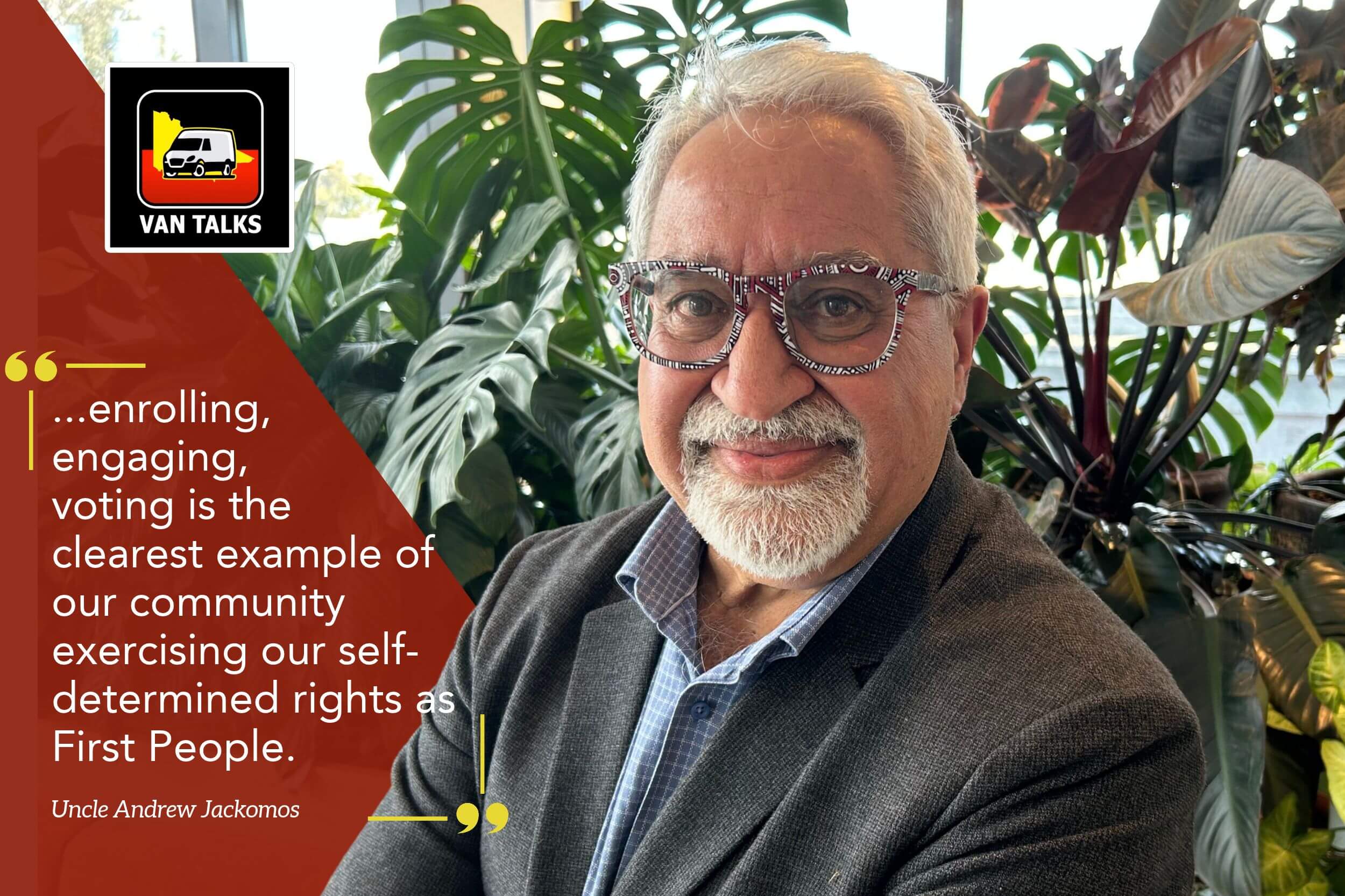
Engaging in the democratic process is a vital exercise in self-determination for First Nations communities. Ensuring strong voter enrolment and civic participation empowers communities to make their voices heard across local, state, and federal levels of government.
Historically, various systemic barriers have contributed to lower enrolment numbers among Aboriginal and Torres Strait Islander peoples.
However, community-led efforts and advisory groups are working to close that gap.
Yorta Yorta Elder Uncle Andrew, a member of the Victorian Electoral Commission’s Aboriginal Advisory Group emphasises the importance of community involvement, noting, “It’s important that we make our voices heard, that we have our votes counted, and we let people know what the issues are important to us.”
Participating in civics goes far beyond casting a ballot. It includes stepping up to run for local government, joining community groups, and advocating for local services.
Uncle Andrew highlights this broader responsibility, stating, “Enrolling, engaging, voting is the clearest example of our community exercising our self-determined rights as first people.”
With upcoming state elections approaching, the Victorian Electoral Commission has introduced specialised voting booths across 22 Aboriginal Community-Controlled Organisations to facilitate access. Community members seeking guidance or voting details can contact the dedicated Aboriginal electoral team.
The core message remains clear and urgent. As Uncle Andrew urges, enroll, engage, be informed, and vote.
Charles Pakana: While many people regard engagement in the Australian electoral system as somewhat of an inconvenience, the fact is that our system is designed to ensure a process that is as fair, equitable and equal as possible. With regard to Aboriginal and Torres Strait Islander peoples, the Australian Electoral Commission and respective State and Territory Electoral Commissions have committed to engaging with communities to ensure maximum engagement.
Now, in Victoria, with the Victorian Electoral Commission, one of the initiatives they’ve undertaken is the establishment of the Aboriginal Advisory Group, the AAG. And I’m joined today by one of the members of that group, a longstanding leader, Yorta Yorta man and past member of the Victorian Treaty Authority, Uncle Andrew Jackomos. Uncle Andrew, thanks for joining me today.
Uncle Andrew Jackomos: My absolute pleasure, Charles.
Charles: Uncle Andrew, why the need for an Aboriginal Advisory Group with the VEC?
Uncle Andrew: Since we’ve had the opportunity to vote, we haven’t taken up that opportunity to go on the enrolment register. And there’s a whole range of reasons why that has happened, whether it’s literacy skills, whether it’s racism, whether they’ve been denied access, there’s a whole range of different reasons. But it’s important that we make our voices heard, that we have our votes counted, and we let people know what the issues are important to us. And that’s why it’s important that we maximise the numbers of our community on the enrolment roll, whether it’s for local government, whether it’s for state government, whether it’s for the federal elections. We need to have our voices heard. And our community is very strong in our responsibilities, our civil responsibilities. If you look at our involvement in Aboriginal community-controlled organisations, voting for boards, that’s exactly the same thing where we make our voices heard.
Charles: You’re not just talking about having people enroll to vote. You’re actually strongly advocating for people to become in the entire civics of the state and the country as well.
Uncle Andrew: There are three key steps. One is to enroll, two is to engage, and three is to vote. About being informed what the issues are and about engaging in civil responsibilities. This is our opportunity. You know, we need more of our community to stand for local government. We need more of our community to stand for state parliament. We need more of our community to stand for federal parliament. And there’s been excellent role models who’ve done this over the years. So, this is now the time when we need to maximise the enrollment of our community on the enrollment register.
Charles: You made mention of local government, and a lot of people may not be aware that we have three levels of government in this country. We have local, which are the councils, and we have state government, and then federal government as well. Let’s just look at local government as well. Why from your perspective—and I know we were talking about the Closing the Gap report just a short while ago before we started the recording—but from your perspective, why is it so important to have First Nations peoples’ voices heard in local government, whether voting, advocating, or actually as representatives?
Uncle Andrew: So, it’s absolutely important that we’re there, because local government delivers services to our local communities, whether it’s libraries, whether it’s prenatal healthcare, just necessary services. It’s important that our community ensures that their voices are heard right at the local level.
Charles: What about as candidates? Because when you look at it, we represent probably what? 3%? of the population. Definitely we don’t have 3% of councillors across Victoria who are First Nations people. How do you encourage First Nations peoples to start enrolling and putting themselves forward as candidates for local elections?
Uncle Andrew: We have a whole range of very talented people in our community. It’s not just blackfellas who will vote for us. It’s the whole community. You know, if you’re good, people will recognise that. Look at Lidia Thorpe as senator. It wasn’t just our mob who voted for her, but it was a whole range of people, and she’s an excellent example of what’s possible.
Charles: And more recently you had Greg James up on Shepparton, on your country, who was there for a term or so.
Uncle Andrew: Yes, on Shepparton City Council. He was an excellent representative of our community, and there have been previous members from our community who’ve been on local government – here in Collingwood, down in the southwest, across the state. And this is an excellent platform to start off local government, state government, federal parliament.
Charles: What do you think is holding a lot of mob back from actually getting to that next level of running as a candidate?
Uncle Andrew: There could be a range of reasons why our people haven’t stood for local government, state parliament, federal parliament. And one of those is fear of the unknown, one is absolute racism in the community, others are financial concerns. These are real issues. But we have people who stand and who’ve stood and will stand in the future, and these are excellent examples of what we can do in our community.
Charles: I mentioned just a minute or so ago that you and I were speaking before we started recording this about the Productivity Commission’s report into Closing the Gap, and there are obviously some severe problems there. What a lot of people don’t realise, of course, is that when it comes to closing the gaps, that’s a requirement for all three levels of government: local, state, territory, and federal. Just what impact can involvement in local government have on addressing some of those key concerns in closing the gaps?
Uncle Andrew: I live in the city of Wyndham out at Werribee, and we have a local government that I believe is doing good work with community in local community centre. There are local government areas that aren’t doing good work or could do far better work. And this is an opportunity by mob as individuals, collectively, to let their voices be heard to local government about what are the issues that are important to us. This is an excellent place to start off.
Charles: But are you talking about just voting, just running, or is there another form of involvement in this civic responsibility?
Uncle Andrew: Voting’s important, but it’s just the first step. The second step is to get involved in local government, different community groups. Stand for local government is important. There are a whole multiple ranges, whether it’s from different sub-committees on local government, cultural festivals, economic opportunities. There are a whole range of opportunities that we need to tap into. And by tapping into, standing for local government, joining your local government community groups.
Charles: You must be a bit heartened though, because obviously civic involvement, especially here in Victoria, more so over the last say 15, 12 years or so, has really gone through the roof. Because when you look at the fact that we now have an Aboriginal electoral roll, and the number of people who are involved in that voting for Gellung Warl and the representatives there has really escalated enormously, that must give you a lot of hope that people are waking up to the fact that, yep, this is a great chance to have our voices heard and bring about substantive change.
Uncle Andrew: So whilst there’s been a significantly lower number of our community on the electoral roll, it is now through work that’s been done over a number of years where we’re not far off the national enrolment levels. And that’s heartening. And I think a lot of that has flowed on from people actually enrolling on the Treaty roll. I think that’s a positive outcome.
Charles: What are some of the other challenges you have though? Because we’re still, I think, what about 3.7 to 4% below the rate of all Victorians? So you’ve got all Victorians that are around about 97-98%. First Nations Victorians are around about 93-94%. What’s the challenge in getting that up to that 98% level?
Uncle Andrew: There is a challenge, but I believe by concerted effort, continued effort, involvement of community members in providing guidance and directions to the Victorian Electoral Commission, is that we will get there. You just need to nurture it. We need to nurture and continue the effort to build and to grow the level of enrollments in our community. But you can see where we have positive local government efforts in areas where enrollments are higher. And whether the chook come first or the egg come first, but it is where our voices can be heard and ensure that local government responds.
Charles: Unk, I’ve heard you talk in conversations and even publicly at times about involvement in just ordinary civics, in enrolling to vote, in participating in the voting process is actually supporting self-determination. Let’s just expand on that for a minute if you wouldn’t mind.
Uncle Andrew: So enrolling, engaging, voting is the clearest example of our community exercising our self-determined rights as First People. It’s not just as self-determined rights, it’s a human right to participate freely and informed in the democratic process. And our community are very strong on our civil responsibilities.
Just look at our involvement, the work that we did in our community in establishing Aboriginal community-controlled organisations. This is really at the starting point where our community recognised a deficiency in government services, and our community responded by saying, “We’ll do it our way because government won’t do it for us.” And this is such an important—this is about self-determination at play. And voting is one of those self-determined human rights that we need to celebrate and act upon.
Charles: I was going to ask the question, what do you say to those mob who say, “Well, why should I be involved in a colonial bureaucratic system?” but you’ve essentially answered that question with what you said right there, Unk.
Depending on when you’re hearing this interview, we are approaching here in Victoria the 2026 election on the 28th of November. Unk, there are a number of initiatives that the VEC has actually brought in place to support First Nations people becoming involved in this electoral process. What are some of those?
Uncle Andrew: So, in 22 Aboriginal community-controlled organisations across the state from tomorrow, Tuesday the 17th, until the 27th of November, there’ll be voting booths.
Charles: Where can people find out about those?
Uncle Andrew: So, you can find out information about these by phone on 0461 333 895 and they will take you to the Aboriginal team at the Victorian Electoral Commission. I’ll just repeat that: 0461 333 895, and there they have the details of those 22 ACCOs that are hosting a polling booth over the next eight days or so. And then we have the team at the Victorian Electoral Commission who can answer all your queries, and that’s on the number I just gave you.
Charles: All right, and we’ll also have that number on our website.
Uncle Andrew: If you’re unable to vote on Saturday the 28th, early voting is open across the state in all towns. And if you don’t have that information, then go to that number: 0461 333 895, and there’ll be workers from the Aboriginal electoral team who will answer all your queries.
Charles: And I do know that they’ve only recently brought that line on, and they are really desperate to have those calls come through. They’ve got to justify it somehow, so I encourage all mob to get out there and give them a call. Once again, 0461 333 895. Unk, closing comments, we’re just going to pass to you.
Uncle Andrew: My closing comments are: enroll, engage, be informed, and vote.
Charles: And I’ve got to say, if we’re going to bring about change, and by goodness, we do need change at so many flipping levels, then I couldn’t concur any more. Uncle Andrew Jackomos, thank you for your time.
Uncle Andrew: My absolute pleasure, Charles, as always.
For Radio Play:
1 - Click the Download Audio button
2 - The audio file will commence automatic play in your browser
3 - Confirm this is the file you want to use in your program
4 - Once confirmed, click the vertical elipses (3 dots) and select download
CONTACT US VIA SMS
Get in contact with us via our dedicated SMS line:
0493 222 836
14 November 2026
Real changes needed in the current Reconciliation Action Plan program
11 November 2026
Gellung Warl commits to community accountability and answerability on Treaty process
9 November 2026
Bendigo community and environment clearly benefiting from Dja Dja Wurrung cultural knowledge
3 November 2026
Exploring the beauty of the Yidaki with internationally acclaimed Ganga Giri
30 October 2026
0 Comments