
Treaty in Ink: Understanding the Victorian Treaty Scroll
We meet up with Dr Megan Evans and Clare Land to find out more about the Victorian Treaty Scroll, which represents a powerful community call for justice. Adorned with thousands of fingerprints, this living document symbolises a collective commitment to formalise a Treaty between the State and First Peoples.
Posted by: Karina Wells
Published: 10 April 2026
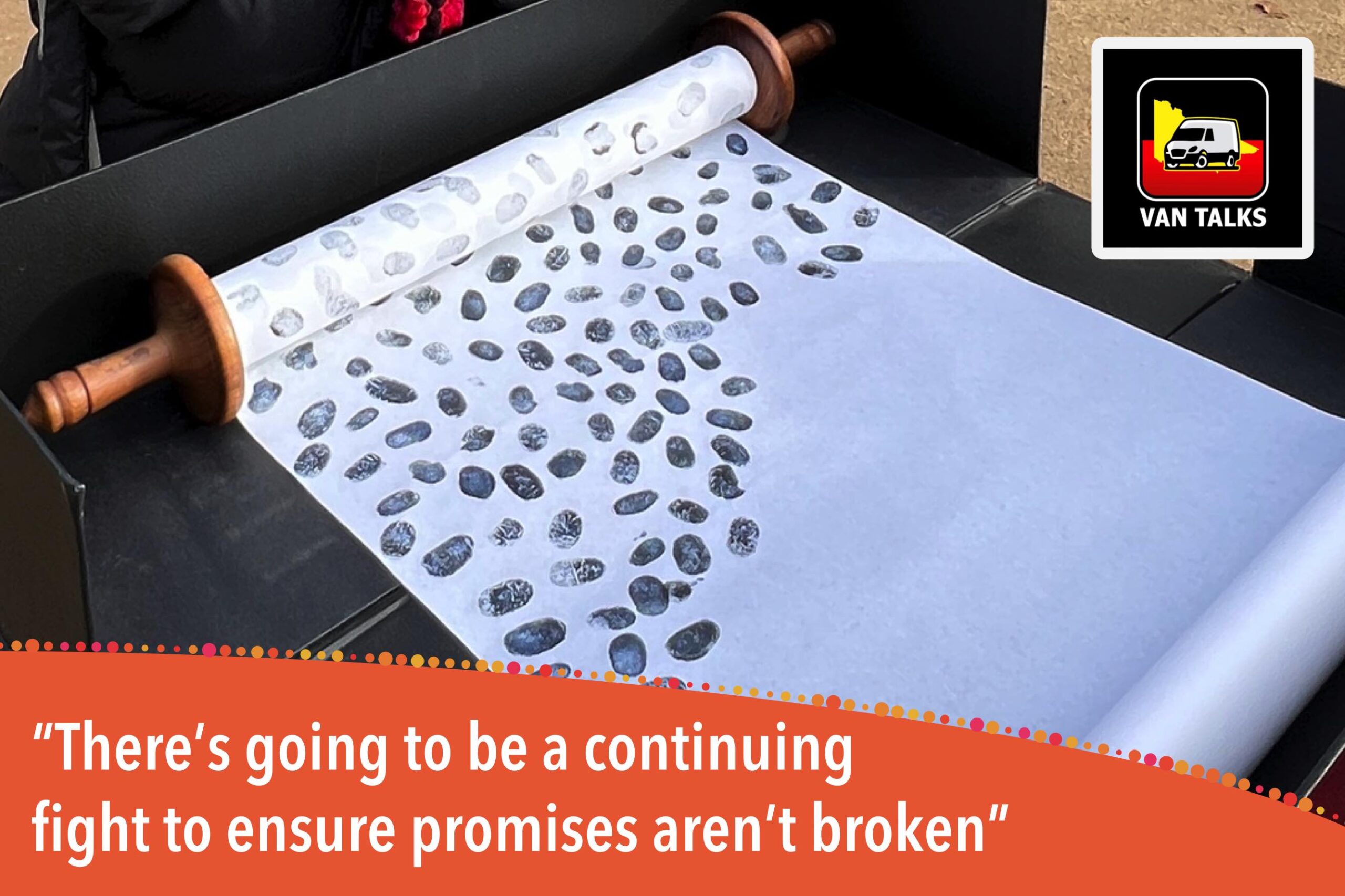
In late 2025, Victoria made history as the first state in Australia to formally commence a statewide Treaty.
Long before this legislation was drafted, non-Indigenous allies were building tangible evidence of public support for First Nations self-determination through the Victorian Treaty Scroll.
Initiated in 2005 by ANTaR Victoria, the 20-metre Japanese parchment scroll captures individual thumbprints instead of signatures as a visual petition for Treaty.
Dr Claire Land, an activist and author, recalled the project’s genesis alongside artist Megan Evans.
“We wanted to create essentially a petition for a Treaty, which would be a beautiful artwork signed with your thumbprint,” Claire said.
Megan emphasised the lasting visual power of using a personal mark rather than standard paperwork.
“I’ve always felt that written documents often just get put in a cupboard and are not necessarily that accessible to people,” Megan explained.
“You can’t get much closer to your identity than your thumbprint.”
After being shelved for several years, the scroll re-emerged during a leg of the Walk for Truth, drawing enthusiastic community engagement once again.
With political shifts always posing a potential threat to legislative progress, ongoing public solidarity remains essential to safeguarding First Nations rights.
“The work of allies… is actually to be a Treaty worker and is to fight to defend the Treaty and make sure the Treaty is honoured and upheld,” Claire noted.
Megan envisioned expanding the concept nationwide to demonstrate overwhelming support for justice.
“I’d love to see a major 500-metre scroll that could travel around Australia,” she said.
Now safely housed in a newly crafted box, the Victorian Treaty Scroll stands ready to be filled as a living testament to solidarity and truth-telling.
Charles Pakana: In late 2025, Victoria made history as the first state in Australia to formally commence a statewide Treaty. But long before the legislation was drafted, there was a physical document traveling across this state gathering the fingerprints of thousands of Victorians who wanted to be on the record for justice. It’s called the Victorian Treaty Scroll, a powerful project managed by ANTaR Victoria that asked non indigenous people to move beyond a simple signature and leave a personal, tactile mark of commitment to First Nations self determination. Joining me today are two women who’ve spent decades navigating the complexities of the colonial frontier. Dr. Clare Land is an activist and the author of Decolonising Solidarity. And Megan Evans is an interdisciplinary artist whose work interrogates her own settler ancestry and the uncomfortable truths of our shared history. Megan, thanks so much indeed for joining us today.
Megan Evans: Pleasure. Thanks for coming.
Charles: And Clare, thanks as well.
Dr. Clare Land: Thanks, Uncle Charles.
Charles: I’d like to start with you, Clare. The Treaty Scroll is quite famous for its use of fingerprints rather than signatures. And just before we started recording this, we were talking about, well, It’s on a piece of paper 20 meters long and it’s filled up to 15 meters currently. Let’s talk about the genesis of the project when you and Megan were both at ANTaR, what were the aspirations and what was the… I suppose the initial project outline?
Clare: The genesis of the project was about having something to work together on because we’d bee… . I’d been sort of working as a campaigner and Megan as a community development, a cultural, community development worker. And I’d been very much inspired by Robbie Thorpe and his relentless focus on genocide and Treaty and sovereignty. And in 2005, it was the 135th anniversary of the signing of the Batman Treaty.
Charles: Yep.
Clare: And that’s a complicated history about what that moment was and who gave what or took what. But we were raising awareness about Treaty and Megan came up with the idea that we could create a beautiful artwork, a petition that’s a visual petition that refers back to other amazing petitions, especially the [Ṉäku] Dhäruk Yirrkala bark petitions. And so we wanted to create essentially a petition for a Treaty which would be a beautiful artwork signed with your thumbprint, but connected in with signing the Treaty was becoming a Treaty supporter.
Charles: Yeah.
Clare: So you would get a badge where you declared you’re a Treaty supporter, you would get information about what a Treaty is, and you would also sign an undertaking to take real actions in your community, in your local area and on yourself to be a supporter, to deepen your support and activism around land rights, reconciliation.
Charles: And this was all 20 years ago. So quite a while ago. Well, indeed. Predating the 2018 Advancing the Treaty Act. Megan, to you; the idea to have it on this beautiful piece of, I believe it’s Japanese parchment, is that right?
Megan: Yes.
Charles: What led to that?
Megan: Well, I think I was also inspired by the bark petition, and I’ve always felt that written documents often just get put in a cupboard and are not necessarily that accessible to people. And so being an artist, my focus is always, how do you make something visible. And so we both were working in Brunswick street at the time, and I think I was at Zetta Florence, and there was a Scroll of Japanese paper that was 20 meters long. And I thought, oh, wow, we could do that, use that, and make a Treaty Scroll. And the idea was that you’d have this visual representation of people’s individual thumbprints, which is sort of very close to your identity. Like, you can’t get much closer to your identity than your thumbprint. And that it was really a great way for people to show their support for Treaty and make it into a visual… artifact, I guess.
Charles: So we’re talking about more than 20 years ago right now. What was the reaction that you were getting from the community members when you went out there to seek their support, by means of a thumbprint, to this concept of Treaty? Because it… wasn’t really as well known across community as it is now. Megan, I’ll stick with you, and Clare, you’ve obviously got some thoughts there. We’ll come back to you in a second.
Megan: Well, I guess to some degree, at the time, we were preaching to the converted because the people that we were working with were already, sort of, willing to support the notion. To be honest, I’d never dreamt in my lifetime I’d see a Treaty. And so it was really like this symbolic thing that would be; okay, this is a way to call for something. Something that we weren’t even sure would ever happen. You know, again, I was also inspired by Robbie Thorpe, who, since the early 80s, I remember him talking about sovereignty all those years ago. And so when nobody ever thought sovereignty would become a thing, and now it’s discussed,, it’s used in everybody’s Acknowledgement of Country. And so, you know, that really inspired me. And I think that standing for something, even when you can’t see it can happen, or it looks like it could possibly happen, I think that was something that inspired me to be that way about Treaty.
Charles: Clare, your perspective on the responses you were getting from people when you took this document out?
Clare: The general public seems to just adore this object. Like the most recent time we took it out was actually at a leg of the Walk For Truth.
Charles: Ah, in 2025, yeah.
Clare: …and the moment we unrolled it, people formed a queue and just wanted to sign up to it, not even knowing what it was, they just were attracted by it. Back in 2005 we were needing to explain, you know, what is a Treaty? So we were giving, it was like a postcard that you could put on your fridge which explains the basic outline of a Treaty because it did need to be an educational project. There had been obviously consistent calls for Treaty from Aboriginal people since the invasion, and there’d been a Treaty committee in Canberra in, you know, the 70s or the 80s or there’d been different times when it had come up. There was even an idea that at the end of the decade on reconciliation that this would be culminated with a Treaty. But it was sort of found that over that period, particularly John Howard being in government for a large part of the 90s is that there was no way the Australian public was ready for a Treaty, let alone the government. Howard famously said, ‘a nation doesn’t make a Treaty with itself’, you know, so they were just…
Charles: Yes, that’s fueled the arguments for years to come.
Clare: Everyone was having to fight against that… that basic fallacy as well.
Charles: Once the Scroll was started, what was the strategy to get it out there and start getting the first of those 15,000 thumbprints apart from obviously the ANTaR crew itself, what was the strategy, Clare?
Clare: Well we created a little kit with an explanatory pamphlet so, how to host a Treaty Scroll event. So any local community group could borrow the Treaty Scroll from the ANTaR office and take the badges and the, you know, the sign up book where you committed to your actions. They would take the whole kit and they would be able to run an event, take it to a stall at an existing festival or just, or create an informational, you know, event about Treaty and have that there. So it was always designed for local people in different areas of Victoria to be able to… to use it and that’s how we got it out there.
Charles: How many areas did it go out to do you recall?
Clare: There are dozens of local groups and it’s, yeah, it’s a bit too long ago for me to remember, but we had… Yeah. We had many, many of the sign up books filled in, and so yeah, it was hundreds of people at that point.
Charles: Megan, to you now. The reality is that this only went on for about five years before, unfortunately, that Scroll, as powerful as it was, was put away into a cupboard. What happened there? Why did it lose that momentum?
Megan: Well, Clare and I were only working at ANTaR for three years. We were part of the Fanning the Flames funding project, and that ran out of money, and so we both had to go off and do other things. And I guess without a driving force behind anything, really, things fall off. I don’t really know why it never continued. And that’s sort of probably partly to do with the fact that we didn’t really put enough of those structures in place. I think ANTaR went through a period where it didn’t have many people that it… I think it lost its employees and so-
Charles: It had to reprioritise.
Megan: Had to reprioritise, probably, yeah.
Charles: But it found light of day recently, in 2025, as Clare mentioned, with Travis Lovett’s Walk For Truth from Portland to Parliament House in Victoria. It was dusted off and it was shared again. What was the response from people? Clare touched on that a bit before. When they saw this, what was the excitement? What was the response from the people?
Megan: It was. It was amazing. While we were on the walk, Clare and I, we walked together. Clare had a bike, and she had sore knees, and I had sore hips, and so we actually were sort of… I was piggybacking on her bike, and we were talking, ‘wonder what happened to the Scroll?’ And we were sort of just discussing it as we went on the walk. And then we – this was from Footscray Park to Camp Sovereignty – and when we got to Camp Sovereignty, we said, ‘let’s find out what happened to it.’ And Clare contacted Matt from ANTaR. And anyway, the whole thing then got uncovered, and I went and picked it up. It was in this box that looked like a dog had chewed it, and it was sort of like it came out of the boondocks. And yeah, it was really exciting because the next day we went, oh, let’s – this is a perfect place to bring it out. And so we set up a table, and it was just, it was amazing how many people wanted to participate in it. Someone even had their dog, and they put their dog’s paw print on it. It was really… But yeah, everybody, because it was part of the walk. It wasn’t really set up for…
Charles: Sure.
Megan: Something that was… And in the end, we didn’t take it to Parliament House because we weren’t sure whether there’d be a space for it. And so it was just the people that came past in the walk. But we could have got hundreds and hundreds on that day if we’d been, probably a bit more organised. We weren’t really that organised because it was just this great idea to get it back out again.
Charles: But it was kept in the light because during that cultural ascent ceremony at John Cain Arena, it was presented to the [First People’s] Assembly [of Victoria], is that correct?
Megan: Well, Clare and I presented it to the Assembly before then. It wasn’t actually presented to the Assembly at that event. It was there for the allies who work – the Assembly were there to make sure people had the opportunity, if they wanted to, to put their thumbprint on it.
Charles: I’m really interested, Clare, coming back to you, when you mentioned before with that initial rollout of the Scroll, that apart from getting the little badge, they also got the postcard, the fridge magnet, with a bit of an education about what Treaty actually is Because it was a very foreign concept, I’m sure, even 20 years ago for most Australians. What would you like to see now? Because we do still require a call to action; we can’t rest on our laurels, the fact that we have the 2025 Treaty Act.
Clare: That’s right. And there’s a continuing need from the First People’s Assembly of Victoria to demonstrate that Treaty is widely supported by the Victorian electorate. And so they were calling for allies and aligned organisations to put out statements supporting Treaty before the Treaty Act was signed, because it’s never a guarantee until you’ve got that signed and so having the support of the masses and the people is an important aspect of that politically. In the lead up to the election later this year in the Victorian state elections, there is also a danger that if the ALP gets voted out, then what happens to the Treaty Act? Or if not the Act itself, then the incoming government’s commitment to honouring the Treaty? As, unfortunately, as we’ve seen in Aotearoa (New Zealand) and many Treaties around the world that often get broken. But in the modern Treaty space in Aotearoa (New Zealand) the work of allies, like myself, is actually to be a Treaty worker, and is to fight to defend the Treaty and make sure the Treaty is honoured and upheld. And so rather than cultural awareness programs and things like that, it’ll be how your organisation can uphold Treaty. So there is going to be a continuing fight by Aboriginal and non-Aboriginal people to be ensuring that the promises that the government has literally signed up to, aren’t broken. Unfortunately, this is part of our future. But also we don’t have a Treaty in other states and territories and we don’t even have a truth process in other states and territories. And that was something that was walked back by those other states and territories after the ‘No’ vote in the referendum. So there is, you know, there’s campaigns like Together for Treaty that are trying to ensure that Treaties happen elsewhere as well as, you know, Travis Lovett’s taking the Walk for Truth national because, you know, we do need a national truth process. Lidia Thorpe’s also always called for a real truth process to feed into a national Treaty.
Charles: All very, very valid points, Clare. Megan, to you now, building on the legacy of the Treaty Scroll, do you think this is replicable across other areas? States and territories, as Clare has mentioned. But also if we stick to Victoria, the local reconciliation groups. We’ve got over 30 reconciliation groups now, a vast increase since 2023 in the campaign there. Rather than wait for the resurfacing again of this Treaty Scroll. Do you see there’s a place for these local groups to start their own petitions, to really echo the voices of support for Treaty in light of the fact that there may well be a change of government later in 2026?
Megan: Absolutely. The way I see the Treaty Scroll is its evidence. Evidence of non-Indigenous people’s support for a Treaty and for truth telling. And I think it’s absolutely possible for other groups. Doesn’t have to be in a scroll format. It could be, you know, they could get books, so they could get sketchbooks, they could fill them up. There’s lots of different ways that people can do that. I think it’s nice to continue the notion of the thumbprint because it was funny when people were signing the Treaty; people were like, ‘oh, well, that’s actually what you have to do if you get picked up by the police. You have to do it, you have to do a thumbprint. It’s actually a way…’
Charles: That’s ominous. That’s ominous, Megan.
Megan: But it is true. It’s like, you know, it’s a way to identify yourself which is actually close to your DNA, you know. So for me, it’s a way that people can say, hey, this is what I’m supporting and I’m putting myself on the line to support this. And so I think there’s lots of ways, as I think we were talking before, I’d love to see like a 500 metre scroll that is-
Charles: Talk about that for a bit. That’s a really interesting concept you made mention of.
Megan: Well, there was a similar thing that was done for women getting the vote. It was back in the day when women didn’t have the vote and there was a huge scroll, and there’s actually a beautiful public artwork that’s near Parliament House that is a sort of acknowledgement of that Scroll. And I don’t see why we can’t do a major 500-metre scroll that could travel around Australia. There was a project years ago that I remember someone doing that was a ball of string. And they… they made string based around the grasses of the local area and then as that grew, the ball became this enormous thing that had to be carried on the back of a trailer. And I can see the Treaty Scroll becoming like that, that you, you know, maybe you start with a 20-metre scroll and then you add to it and you glue the next 20 metres on and then you end up with 100 metres and then you make another one that’s 100 metres. You know, it could go on forever. And I’d love to see major visual evidence of people across the country supporting Treaty. And I do think it’s all very well for us to have Treaty in Victoria, and I’m really proud that we do and proud of the work that young folk and First Nations mob have done to achieve that. And I take my hat off to every single person who’s involved. But I also think it’s not enough to just have it in Victoria; it’s got to be across the country, and that’s what we have to work towards.
Charles: Clare, I’m going to hit you with a bit of an awkward question, but what would you like to see the First Peoples’ Assembly of Victoria do with that current scroll right now? Because it is incomplete, as you mentioned, it’s 15 of 20 metres. The chances are that if nothing is done, it’s going to sit once again in another cupboard in a dog-chewed box. What’s your call to action for the First Peoples’ Assembly on this?
Clare: I don’t think it’s going to end up in a dog-chewed box because it’s a very precious object and I think they recognise that for sure. If it does have a permanent home once it is complete, they’ve said that they would like it to go to the Aboriginal History Archive. Gary Foley found it at VU [Victoria University]. But it could be a bit like the hearse at the Melbourne Museum is that it’s still used. It’s a beautiful object and it is looked after as a treasure but it’s also taken out and used when the time has come and it’s definitely the time has come back for the Treaty Scroll as we’ve been talking about and I’d love it if community groups did want to borrow the scroll and add to it, is that the First People’s Assembly would enable that and would allow that and the ally coordinator I’m sure would be stoked and able to help facilitate that. So I’d love to see it filled up. And we’ve always wanted for it to be displayed as well as an exhibition to really show that non-Aboriginal people also desire a Treaty. And Megan and I have always talked about how it’s in our interests as non-Aboriginal people to have a Treaty in place. Got to deal with the unfinished business of how we asserted sovereignty here and how there was no Treaty. We’re still essentially at war, and we need to, we do need to come together and that benefits Aboriginal people, but it also benefits non-Aboriginal people to deal with the… the illegitimate occupation really. I know that’s a…
Charles: That’s fine.
Clare: …Maybe a point of historical interest, but it is something that does worry non-Aboriginal people in ways that most of us probably don’t admit, which makes us freak out about land rights or Aboriginal people’s situation. And sometimes that’s in a reactionary way, like a One Nation kind of reaction, but other times it’s a bit of guilt and worry about where we really belong. And I think a Treaty does deal with that in some sort of deep symbolic way, as well as the most important thing is that it does deliver power, and land, and people back to their First Nations owners.
Charles: Megan, I noticed when I mentioned a dog chewed box you raised your eyebrows a little bit. I think for my sake and the audience’s sake, if you can follow through on those raised eyebrows.
Megan: Oh, it’s just that the box was in a very bad way, and it was designed so that it could be rolled out so that people could take it in the box. And [unknown] paid for a beautiful new box to be made. It’s now an appropriately elegant and beautiful box with the Treaty Scroll impressed in gold on the top. So it’s not a dog-chewed box anymore.
Charles: Megan Evans, Clare Land, thank you so much indeed for your time.
Megan: It’s a pleasure. Thank you.
Clare: Thank you, Uncle Charles.
For Radio Play:
1 - Click the Download Audio button
2 - The audio file will commence automatic play in your browser
3 - Confirm this is the file you want to use in your program
4 - Once confirmed, click the vertical elipses (3 dots) and select download
CONTACT US VIA SMS
Get in contact with us via our dedicated SMS line:
0493 222 836
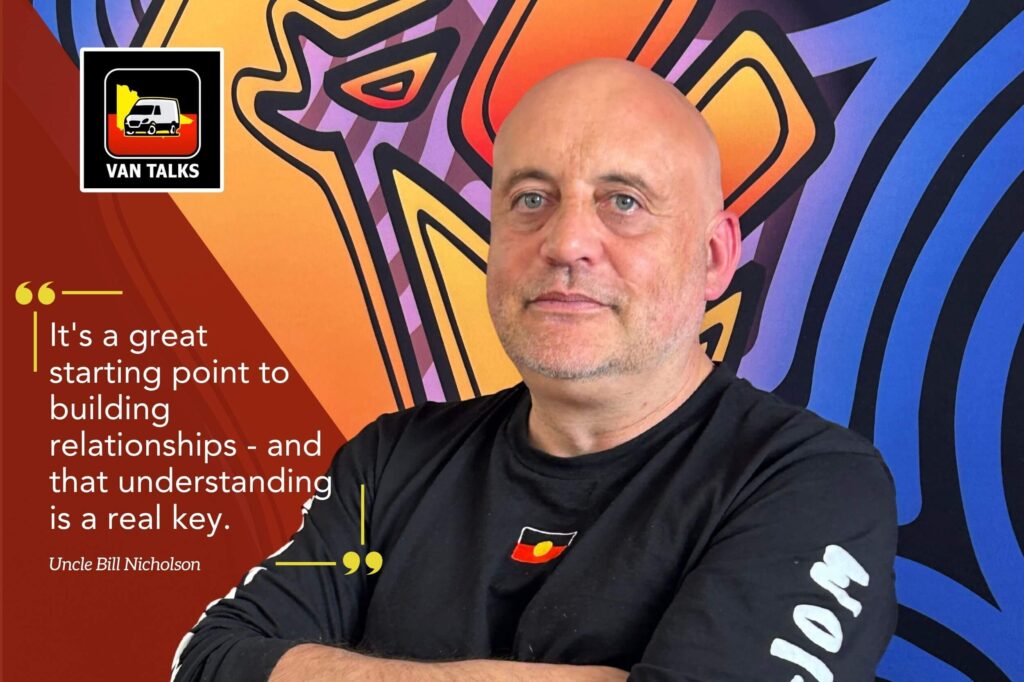
19 October 2026
Understanding the use – and over use – of the Acknowledgement of Country
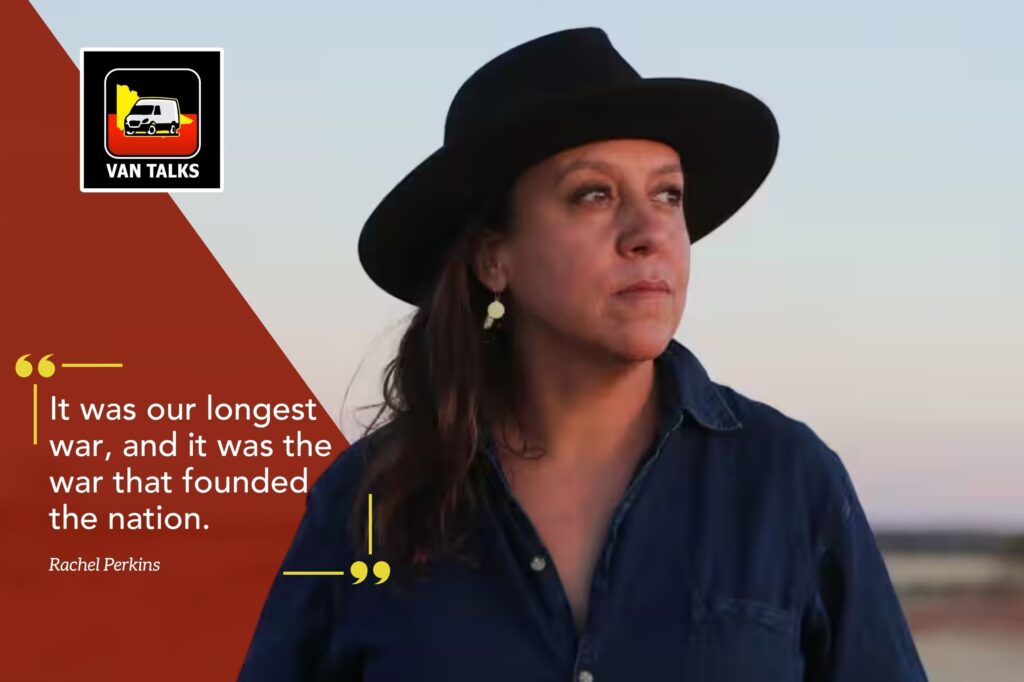
15 October 2026
It’s time Australia recognised a shared history of often brutal “settlement” and expansion
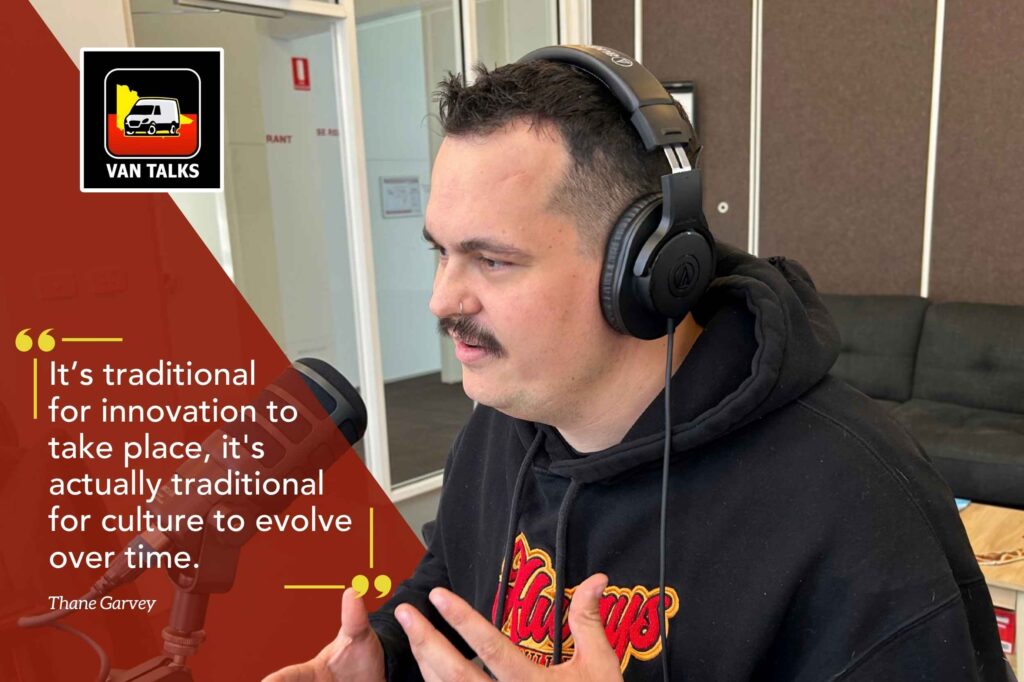
12 October 2026
Start learning about First Nations cultures without the fear of offending
5 October 2026
The revival of cultural burning practices to remediate Country and help mitigate disasters
1 October 2026
0 Comments