
Travis Lovett on the National Walk for Truth
Charles Pakana has a yarn with Travis Lovett, a Kerrupmara Gunditjmara man and former Yoorrook Justice Commissioner, 18 hours before he leaves to leads the 2026 National Walk for Truth. This 800km journey from Narrm to Canberra advocates for a national truth-telling process and collective healing.
Posted by: Karina Wells
Published: 20 April 2026
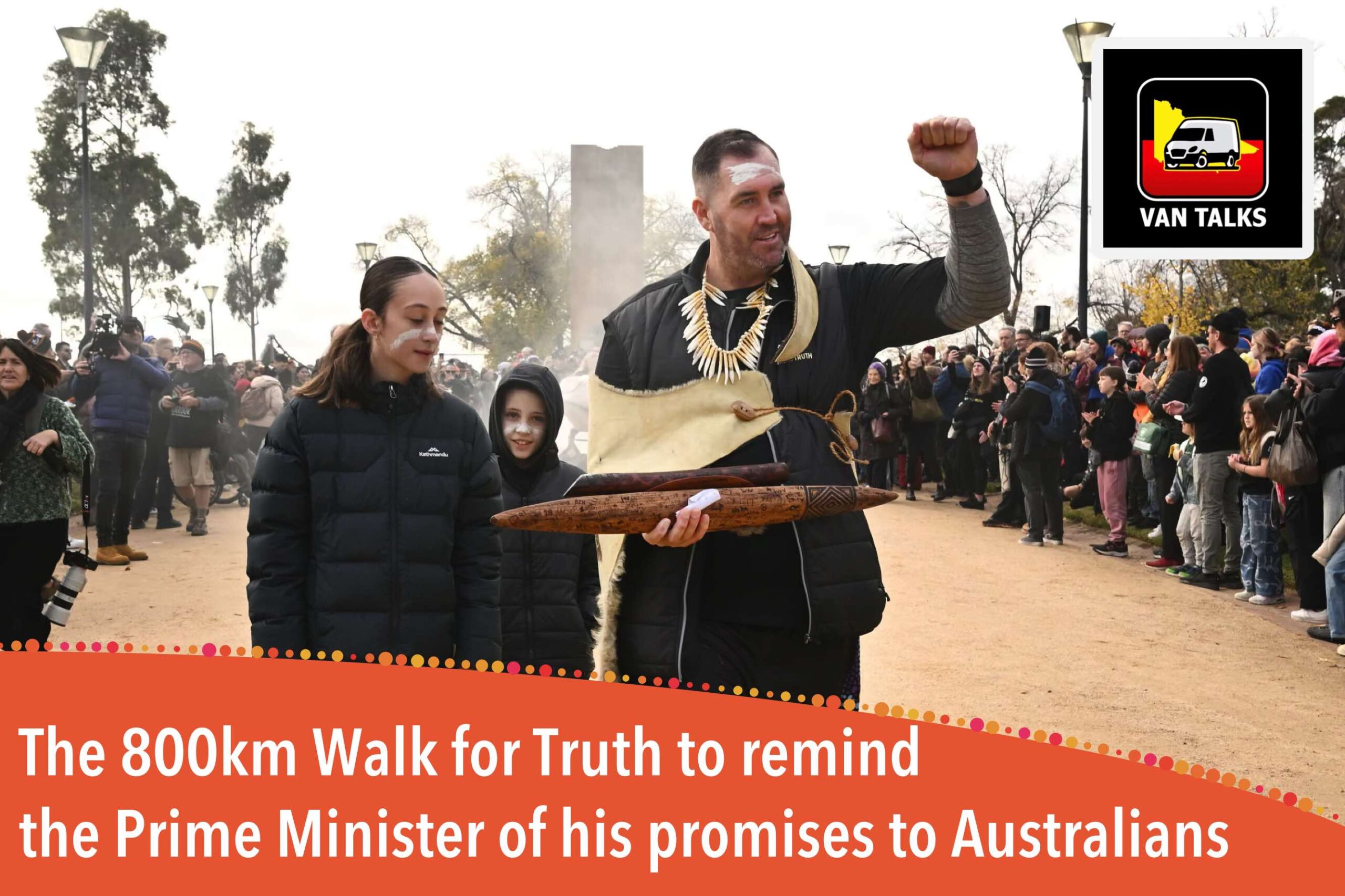
Following the launch of the National Walk for Truth, proud Kerrupmara/Gunditjmara man, Travis Lovett, undertook a massive 800-kilometre journey from the steps of Parliament House in Naarm (Melbourne) to the steps of Parliament House in Canberra
The momentous walk saw thousands of people register to walk alongside First Nations people.
The extensive journey traveled across Country into New South Wales and up into Canberra, stopping at numerous historical sites of trauma and significance allowing local Traditional Owners to share their unedited truths.
Travis explained that this visibility is vital for long-term understanding, building directly upon the foundational evidence gathered during his years serving on the Yoorrook Justice Commission.
“This is truth telling and it is a Walk for Truth,” Travis stated. “This is not about rewriting history… No, we’re just trying to tell the full story here… institutions [must] be accountable for the institutional harm that they’ve caused our people.”
Reclaiming traditional customs is central to the walk, which featured message stick handovers between nations like the Wurundjeri and Taungurung to state their peaceful intentions while moving through other peoples’ Country.
The walk also continued through Anzac Day to explicitly highlight the unbroken legacy of Indigenous military service across every major Australian conflict.
Looking to the conclusion in Canberra, Travis issued a powerful, strengths-based call to action to federal leaders, including the Prime Minister, to fulfill previous election promises and actively implement a National Truth-Telling process.
“Bring our country together to heal. We want to move forward as First Peoples, but we also want to move forward as a country as well,” Travis concluded, urging all Australians to join the movement or sign the open letter online.
Charles Pakana: Well, it’s almost become a habit now; 18 hours before yet another big walk with Travis Lovett, this time, rather than Portland to the steps of Parliament in Naarm, it’s going to be from the steps of Parliament in Naarm to the steps of Parliament House in Canberra. Travis, before we introduce you and start the ball rolling, as is your tradition almost, if you wouldn’t mind, in language, brother.
Travis Lovett: [Acknowledgement of country in language.] I acknowledge country, pay my respects to elders past, present. Recognise that I’m a proud Kerrupmara/Gunditjmara man. But also that we are here today on Wurundjeri meeting, Wurundjeri country. And I pay my respects to their elders, past, present and future. But also recognise Bunjil, the spirit creator, and Waa, the crow. And I think it’s really important that we also give Waa a shout out as well, because I’m a visitor on country and we respect everyone’s land, law and customs – you always want to recognise that as well. But also to share language with people, I think it’s really important. And to also let our, you know, our ancestors know their fight, their struggle, but also their resistance meant something, and it’s contributed to us maintaining an ongoing connection to these lands and waters, which is now called Victoria.
Charles: Travis, it’s becoming a tradition right now; every time you’re heading off on something momentous, such as a big walk, we’re sitting down, having a yarn 18 hours out from it. How are you feeling? First of all, because this is a big one, this is 800 kilometres. Not that the previous walk from Portland to Naarm was short, but how are you feeling for this one?
Travis: Yeah, look, I put in the work, a lot of hours on the road, walking in and training in rain, hail and shine, literally. Even though that rain and hail sounds really unique in summer, but it is Melbourne, it is Naarm. It is a huge, huge undertaking. You know, I was reflecting just last night alone about the first Walk for Truth. Just incredibly inspiring, but also just overwhelmed with the support that we received. And then coming into this walk, you know, we’ve got more than 3,400 people that are registered already to walk with us as well, but feeling mentally, physically, spiritually pretty strong. I feel like the ancestors are with us. It feels right. It’s the right thing to do. I’m looking forward to walking beside our mob, but also non-Aboriginal people, as we invite them in to not only share our culture, our language, our song, our dance, the way we express ourselves continually, but also to talk about our lived experiences around some of those quite harmful things that our people have been through. This is truth-telling, and it is a Walk for Truth. And we do stop at some of the most horrific sites that these lands and waters have ever seen because it’s important that we don’t shy away from that. And many Australians don’t really know truly what really happened here through, not just the early colonial process, but how the policies of today have morphed in, and been built upon the foundations of those early colonial roots.
Charles: What are some of the places that you are intending to stop? Because I remember on the walk from Portland to Naarm, you stopped at the convincing grounds, had people talking about that. What are some specific sites that you’re looking at in this particular walk?
Travis: So there’s a few, I guess, on the first day or when we leave the steps of Naarm Parliament, we’re going up to the stolen gens marker. And I think that’s a really… culturally, but also historic for all the reasons where a lot of our mob who were displaced onto missions, when they left, they came to Naarm for, I guess, connection place, people, family, as well. So it’s only fitting that one of the first stops, the first stop, is actually stopping there as well. And then we head out to Dights Falls, where we’ll be welcomed onto country there as well. And mob out there will be able to share their truths with us about 65,000 plus years connection to that place and what it really meant, you know, we understand from a colonial point of view, but certainly that is incredibly important. But also message stick handovers along the way. I think day three is the first message stick handover as well, which I’m getting really excited about, because that’s that reclamation of culture, that’s that continuation. Because culture, it develops and evolves, and it always has. That’s why our people have been able to sustain themselves for 75 years.
Charles: What is the importance of handing over the message sticks, and who will that first one be to?
Travis: The importance, I guess, is to state your intentions for why you’re coming through, to seek a blessing, but also bringing messages that we are walking through country, we are walking through other people’s country. So, it’s like, you’ve been welcomed on, but there was also the tradition of responding and actually giving your intentions for being there before you were welcome, you stated those intentions and so forth. And I think that’s, kind of, what can sometimes be missing in contemporary society as well, about, “oh, I’m just welcomed onto the lands.” And this now being a contentious issue, which really it shouldn’t be.
So the ability to be able to do that. The ability also for mob to be able to pick and choose where the message sticks come from from their country as well and craft it and work it for hours and put messages on there. These messages aren’t in English, which is even more powerful as well. So the message stick handover; the first one will actually be between a Wurundjeri mob and Tunurong mob, as well. And like I said, they’ve been working for months on crafting these really important messages between each other.
But then also I’ll be fortunate enough to receive a message stick personally myself from Wurundjeri mob to take all the way to Canberra. So that’ll be the one that goes the longest. Because when we get to Canberra, we are handing these message sticks over. But you know, it’s really important.
We will be walking on Anzac Day.
Charles: Yeah.
Travis: I think it’s incredibly important that we do because many people don’t know our contributions, Unc[le], that we have contributed and served in every single major conflict that this country’s ever been a part of. As I said, many people don’t know that, and we’ve spoken about that many a times, you know, having key speakers, including yours truly, come and actually share your yarns and your insights as well.
Charles: I’ll be there, yeah.
Travis: Exactly right. We also have current serving members who are going to be speaking along that journey as well. And I think that’s incredibly important to say, “we’ve still continued. It didn’t just stop.” Our people have continued to serve. And they don’t just do it for the recognition, but we want to make sure that our truths are put on the record, and that’s why we are walking as well. And we are respectful of other ceremonies happening on that day, and we also will be as the walking crew, stopping and paying respect at the appropriate times in the morning at the dawn service locally as well. We’re not just kind of coming through to try to take over, and that’s really important. We have invited all of society to walk with us. We’re shooting right through to Yorta Yorta country next, and there’s a few historical walks there as well that, you know, one of the Aunties is going to be taking us through. We’re also going to stop at the William Cooper statue. Uncle William Cooper statue.
Charles: That’s an amazing statue.
Travis: Yeah, it’s beautiful.
Charles: Yeah, right in the heart of Shepparton.
Travis: Yeah, that’s right. And we’ve got some really special things planned around Uncle William Cooper’s statue there as well. And honour the legacy and the contribution that Unc and mob around there have contributed to, not just in Victoria. These Australian icons, and they should be Australian icons, but not just for First Peoples, but for everybody.
Charles: I’m interested. How will Treaty figure into all this? Because obviously, as soon as you mention Uncle William Cooper’s statue, one of the astounding things about that statue is it’s almost looking straight onto the Assembly’s office located in Shepparton. It’s almost as if it was meant to be. But how does Treaty and Victoria’s move towards Treaty figure into this particular walk? Will you be sharing the messages in New South Wales and up in Canberra?
Travis: Oh 100%. When we were negotiating the Treaty in Victoria, our people turned around and said, rightfully so, “We can’t have a Treaty without the truth.”
Charles: Yeah.
Travis: And I think the important messages around Truth Telling and how, actually, the more than 8,000 First Peoples that came and engaged with the Yoorrook Justice Commission were able to translate those lived experiences into recommendations for change and transformation. And it laid the foundation for Treaty, Truth Telling. So we will be continually sharing the importance of truth, not just in New South Wales and into Canberra, but also into the broader part of Victoria, building on the work of yourself and others that are continually talking and advocating and getting people to understand. It’s not about educating people. It’s about getting people to understand about Treaty…
Charles: Yeah.
Travis: …and what it means and Truth Telling as well. This is not about rewriting history. Like many people go, “Oh, but you’s are just tryin’ to rewrite history.” No, we’re just trying to tell the full story. Let’s just tell the full story here. And that’s what we as a people are focused on. It’s not about naming and blaming everyday Australians for the traumas that our people have been through. But we do ask for, and this is what Treaty’s about; about institutions to be accountable for the institutional harm that they’ve caused our people. And it’s been very dire, that institutional harm. So, that’s another really strong message that we’re also carrying through. And New South Wales is going through their Treaty process around consultations around what Treaty could look like and so forth as well. So I’m looking forward to also meeting with the Treaty commissioners as we come through the country as well.
Charles: I was going to ask you about that.
Travis: Yes. We’ve been actively engaged with traditional owners right through country as well, around and identifying, like we’ve done in Victoria, places of significance to their mob as well. We’re stopping at Gundagai, where we’ll be stopping at the statues of Yarri and Jacky Jacky.
Charles: Who saved so many white people in the past.
Travis: Exactly.
Charles: Yeah.
Travis: That’s that contributions I keep talking about as well. It’s to highlight that lived experience and that contributions. And that was in the 1800s period, where it was pretty dire for our people. And for them to show leadership, to show heart, to actually save people in their bark-skin canoes. I mean, even deadly on top of that, you know, these bark-skins actually do work, bark-skin canoes and so forth as well. So, things like that and places like that and just seeing and yarning ahead. We’ve been doing a lot of Teams meetings and yarns on the phone and stuff when I’ve been walking and training, and just hearing the excitement on the voices of New South Wales mob. Because they never got to experience the first Walk for Truth. Same coming into Canberra as well, “We’re ready, we’re getting ready.” I even know of dance groups which I won’t name because they’ll be embarrassed to say, but they’re even learning even new dances when we come through to be able to dance up country really strong. I mean, how can you not be inspired by that? I mean, that’s where that kind of emotion kicks in. You start to… “wow, like this is just, you know, this is reclamation.” This is ceremony dance culture, but also lived experience.
Charles: I just want to step back to [the] Yoorrook Justice Commission. How much of the evidence and the submissions that you were exposed to during your years on the Commission, how much has that informed what you’re doing on these walks?
Travis: Oh, incredibly, all of it really. Because we were fortunate enough to be able to travel around the state to hear people’s truths directly and for them to make submissions on their truths to the Yoorrook Justice Commission as well. So, this is another opportunity for us to really walk through these lands and waters as we’ve done for 65 plus thousands of years, but also to elevate those lived experiences as well. I mean, people can read a lot of the report, and the recommendations so forth are on the website as well. But this is another tangible way where we get out on country together; we’re equals, we’re on the same path, we’re on the same wavelength, we’re actually walking together side by side and just having conversations. And not everybody agrees on the walk when we’re walking beside each other as well, there’s different perspectives and different points of view, but we’re at an equal playing field. We’re walking together. There’s a strength in that.
Charles: You have brought that point up, and I’m aware that there have been some fairly awkward instances that have occurred in the logistical planning for this particular event. And I’m not asking you to compromise yourself there. What are some of the key challenges that you can talk to that have confronted you and the team in the lead up to this walk?
Travis: Yeah, well, I mean the very art of colonisation, the art that what it was around dividing and conquering our people, I think that’s one of the biggest causes of trauma amongst our people today. Not the only, but one of the contributing factors. When you’ve got issues that government have picked and prodded and pulled us in those early mission days, where they removed mob from Gunditj and took them to Lake Tyers and moved everyone up to Coranderrk and so forth as well, it has really displaced our mob and our connection to country.
And then when you think about things like Native Title and Traditional Owner Settlement Agreement and the Heritage act and so forth, really, and I’ve said this before, many a times and I articulate it like this; you have to prove that government did a really crack job of trying to get rid of you, to prove that ongoing connection and who the right people are here, there and so forth as well.
So these types of walks and the initiatives that we try to do, you know, really bring up the depths of trauma for people, I totally understand and can empathize and I sit down and I spend hours thinking about this; around how do we provide opportunities and voice to be able to elevate it through things because it was a targeted strategic play from colonization to displace us. They attack your culture, they attack your language first and foremost, about not being able to share your language, because your language comes from place, you know, the role of the churches through that early colonial process to be able to do that. And that’s what we mean by institutional harm that we’re trying to call out here. This is truth-telling, and it is hard, and we have to confront these truths, and these lived experiences of our people, because again, it’s government’s policy working at its best to get us to turn on each other.
But we come from the oldest continuous living culture in the world, and we are strong, and we are more stronger when we’re united. Again, this is the opportunity to also is to share this with non-Aboriginal people about the injustice, because it’s an injustice in its own right, this. But also it’s being able to work through these things and actually seeing groups come together and, you know, share culture and language and dance and ceremony on country as well. I think that’s what we are doing and that’s what we’re trying to do here, and that’s what we’ll continue to try to do.
Charles: I realise it’s been a really tough path, no pun intended, up to this point. Has there been any stage, really, where you’ve just sat back and turned to Renata, your lovely wife, who’s been so supportive right across the board…
Travis: She’s amazing.
Charles: …And just said, “I just don’t want to do this. I don’t know how I can do it.”
Travis: Yeah. I mean, I’m always honest when I talk. You know, there is times where you just go, “Oh, geez, are we doing the right thing here like you do?” You’d be kidding yourself to sit here and say that you don’t have a microcosm of a moment where you’re like, “yeah, no, no, it’s just all joy.” Like, we have been dealing with over 25 different councils on top of not just our mob – not just our mob and working through, but also councils and seeking council approvals and going through all the bureaucracy.
Charles: How’s that been for you?
Travis: Oh, it’s been incredibly hard, and we’re lucky we got a small team. And Renata, as you said, has been an absolute gem and just working day and night and volunteering her time for well over eight months on the National Walk For Truth. But, yeah, no, you have your days. And there’s been several. Like, I have to be transparent, there has been several where I’m like, “Are we doing the right thing here? Is this a message?” Because we as mob are spiritual people and we’re always looking for, “Is there a sign? Is there a message? Is there something deeper coming for us, like, or at us or telling us something?” Because we are caught in this transactional, we’re dealing with this council this minute and then two minutes later on the next, and then we’re dealing with the TOs, and then we’re dealing with other conversations around support and contributions to The Walk and so forth. So just deep in everything, it has its moments.
But then you have those moments where you’re on the phone with the mob, and they’re like, to pick up on that point I made before about, “we’re learning new dance, bruz, don’t worry, it’s going to be special!”
Charles: That’s gotta inspire you.
Travis: Right? Yeah, totally. Or even a few times that I’ll call him out. Like, Mickey Burke will just call me – a Yorta Yorta fella from Shep[parton] will just call me and go, “buz, don’t worry, you’ll be all right, we’re going this way.” Like, I’ll be, “oh, we got this sorted. We got this. We want to put this on Eventbrite, to make sure that we’re bringing non-Aboriginal people in as well as our mob.” Because our mobs, we’re organic as people, you know, we’re very fluid, we’re very nuanced. But also, this is not a dig at non-Aboriginal people, but they also like to have plans and dates and all that kind of stuff, where we just kind of wake up and go; we just go with the flow.
Charles: But you can’t tell me that you can do this without dates and plans and that.
Travis: Oh, no, no, no, no, no, no. Exactly. Everything is well thought through and documented. The point is that there’s so much pressure and priorities for TOs to have to juggle. And then all of a sudden, “oh, let’s go for a national Walk of Truth” on top. That’s all part of it as well. But personally, myself, I’ve had those moments where it’s just like that, and then something will just happen where the ancestors will put someone on the phone to you or something, just in a meeting where you’re not expecting it to happen. It’ll be like, “oh, the mayor wants to now walk and rah, rah.” like in a different conversation. It’s just, okay, great. Like, people are walking with us. That’s great. And I think that one of the things I can’t stress enough is when people join the National Walk for Truth or the Walk for Truth, the first time, they didn’t walk for Trav, they walk for our people.
Charles: Mmm.
Travis: And I think, particularly post The Voice Referendum, we needed that as a people. We have felt segregated again. We have felt alone; we felt ostracised. It’s opened up a plethora of negativity, not only online, but also, you know, the undercurrent in person and so forth. You know, when I got to the steps of Parliament, and there was 12,000 people, they weren’t there for Trav, they were there for us, you know, and, like, I can’t even articulate that any other different way. And that was what was so special. And it’s hard to not get emotional. It’s hard to not get a bit teared-up when you see that. And then the next special part for me was handing those message sticks back when we were in Parliament, when we were giving them over to the Premier, where everyone thought that I was going to give them over. And I didn’t tell the TOs that I was going to do that. I just. Let’s come on then. I’ve got to invite you in. We’re going to hand them over. But I framed that I was going to hand it over because I always knew my whole intention, but I never shared [it] with them. And I’ve sort of ousted it for the next one now. But it’s to give the message stick back. My job here… It’s not Trav calling for National Truth, it’s our people calling for National Truth. And I see myself as a mechanism to help our people be able to achieve this National Truth Telling process.
Charles: So, what are the expectations at the end of this particular walk on the steps of Parliament House in Canberra?
Travis: We have extended the invitation to every federal politician right across the country to work with us first and foremost, to walk alongside us to support a national truth-telling process. We also have concurrently the open letter that is online at www.walkfortruth.com as well. We’re encouraging people to also sign that open letter and walk with us.
Charles: Yeah.
Travis: But also, we’ve encouraged and we’ve written again to the Prime Minister to not just receive us at the end, but to come and walk with us too. Come and walk with us. Come and listen, learn and engage – not with Trav.
Charles: Well, given his commitment he made during the election campaign, which was to follow through with all those calls from… from the Uluru Statement of the Heart, one would imagine that he’d be pretty hard pressed not to follow through.
Travis: Yeah, well, that’s right. And truth is a key architecture of that document. But also as well, he not only mentioned that, but he also promised all Australians in the last election in that victory speech with that big smile, and he turned around and said, “No Australian left behind.” Yeah, that’s, you know, we as mob are First Peoples of what is now called Australia, and we are Australian. And the data and the statistics that have come out of the government recently around closing the gap, only four of the 19 targets are on track. Four of 19. That means someone’s getting left behind, and that’s our people. We are further getting left behind everybody else. And we have to call out. Closing the gap is also built on a deficit model. It actually doesn’t bring us up to par. So we’re getting further left behind. So what we’re asking – we’re not a new election commitment to pick up on your point there. We’re asking just for the Prime Minister to deliver on the commitments he’s already made to not just First Peoples, but all Australians, when he made those commitments publicly. To deliver on a National Truth Telling process, to deliver on Truth Telling, to deliver on a national truth telling process, but also to the Prime Minister and to all Politicians, state, federal, local, “Bring our country together to heal. We want to move forward as First Peoples, but we also want to move forward as a country as well and bring us all together. This is your opportunity – we’re extending an opportunity out as First Peoples. We understand there’s a lot going on in the world right now, but there’s also a lot going on in Australia around division and tension and so forth as well. And I think that, again, the National Walk for Truth is about extending that opportunity for people to come, listen, learn, engage with our lived experience – not to name and blame people – but come and learn from us. Come and walk with us because that’s what our Elders have always advocated for: extending the hand out. Come and walk with us, and what a beautiful way to be able to do that, that out on country together as equals.
Charles: And the challenge is out there, to all Australians and all politicians and, of course, to the Prime Minister of Australia. Travis, until next time, wishing you all the very best for this, you and your team, of course. And thanks again, my brother.
Travis: Nah, deadly Unc. And thanks for the opportunity to come and yarn, Unc and I’m looking forward to the 25th when we get to see each other again on the National Walk for Truth. Where we can share some truths about our people’s contributions to that day, as well and what it means for us as well. But in my language, we say wurruk, which means for now. And I hope to see you all on the National Walk for Truth. Again, that website is www.walkfortruth.com. If you can’t walk, consider signing the open letter to the Prime Minister. But also, if you do want to walk, register via the links in the website there. It’s a deadly website. It’s informative. I look forward to seeing you out on the Walk for Truth. Wurruk!
For Radio Play:
1 - Click the Download Audio button
2 - The audio file will commence automatic play in your browser
3 - Confirm this is the file you want to use in your program
4 - Once confirmed, click the vertical elipses (3 dots) and select download
CONTACT US VIA SMS
Get in contact with us via our dedicated SMS line:
0493 222 836
21 October 2026
Reconciliation in Seymour – one of Victoria’s highest recorded “No” vote regions
19 October 2026
Understanding the use – and over use – of the Acknowledgement of Country
15 October 2026
It’s time Australia recognised a shared history of often brutal “settlement” and expansion
12 October 2026
Start learning about First Nations cultures without the fear of offending
5 October 2026

0 Comments