
Charles Pakana:
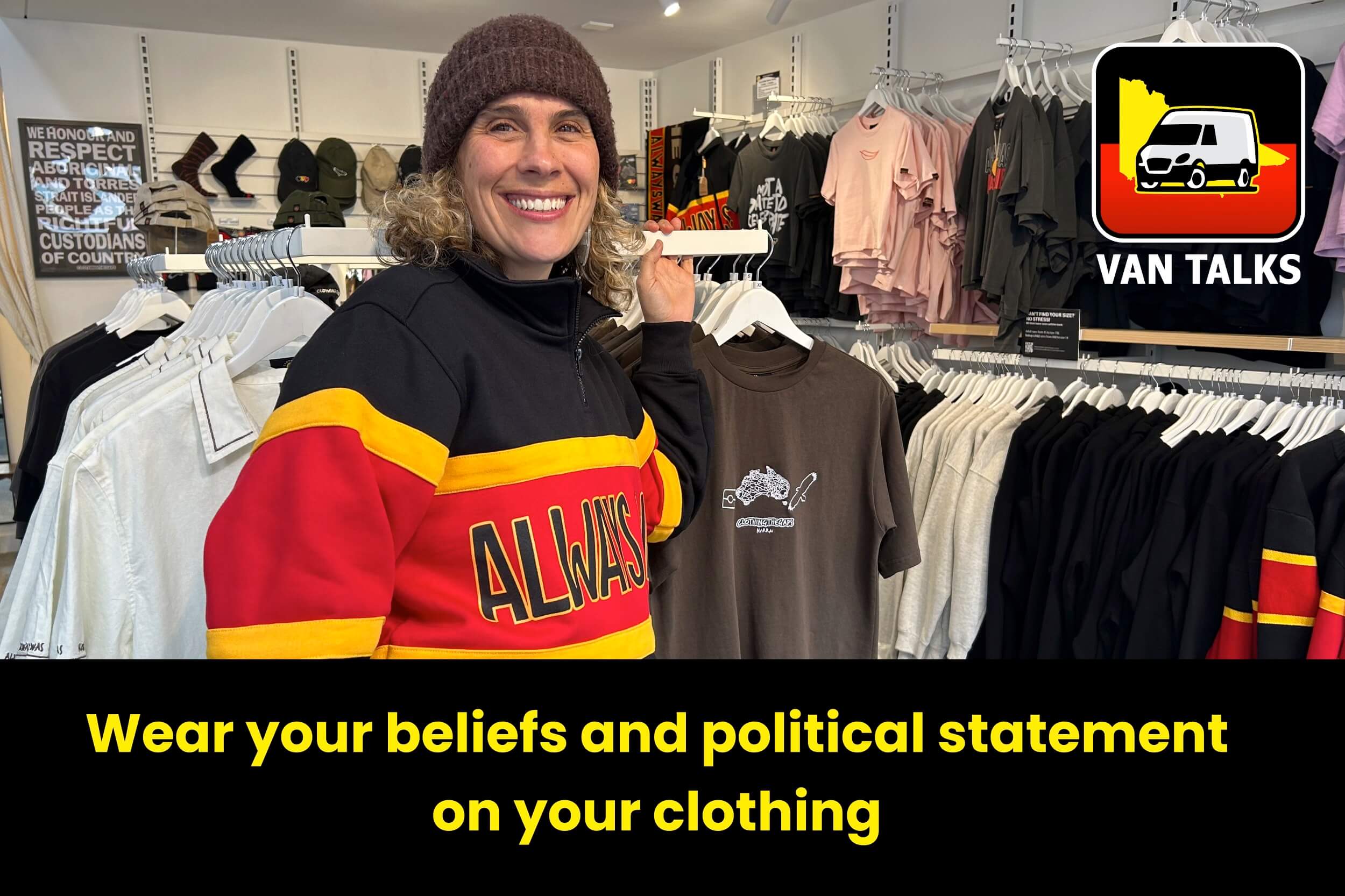
Joining me today on the program is Gunditjmara Woman, Laura Thompson, a co-founder of the very high profile and well regarded fashion as a platform for purpose company Clothing The Gaps. Laura, thank you for coming onto the program today.
Laura Thompson:
Thanks for having me.
Charles:
Laura, merch with a message. Now, Clothing The Gaps famously uses fashion as a platform for purpose. When you started, did you immediately see a T-shirt as being as effective as say a protest sign or a public health campaign?
Laura:
It's really interesting because I'd always been creating merch. Previously, I'd just used them as incentives for community to participate in health programs. So when we started Clothing The Gaps, what we really did was take that merch and open it up outside of the Victorian Aboriginal community. I think Mob have always sort of been wearing their values. Like when I was growing up, I always think about myself going to a rally in a pram with a protest tee.
So I feel like political fashion, it isn't new and essentially everything we wear is political, whether it has a message on it or not, where it's made, how ethical that is, what different brands say about you and your personality and what you stand for. So we've got an opportunity when we get dressed every morning to let the world know where we stand on certain issues.
So our clothes really, they're an opportunity to not only look good, but spark conversations. And I think more and more people buying more consciously and looking for opportunities to make sure that every dollar they spend, they spend consciously, and if you can spend consciously and also spark a conversation that creates social change, I think that's the perfect combination.
Charles:
We'll come back to that fashion with a sense of purpose and conversation starter in a short while, but I just want to talk a little bit about the genesis of the company because you started off with non-Aboriginal woman and your co-founder, Sarah Sheridan. Tell us about those early days and what inspired the actual formation of the company itself.
Laura:
Yeah, so I first met Sarah when I was a manager of a healthy lifestyle team at the Victorian Aboriginal Health Service, and she actually approached me to be a student placement, which she did, and we had a real connection. Our skill sets really complemented each other. After that, I offered her a job and she worked for a few years alongside myself at the Victorian Aboriginal Health Service. We were running incredible programs with lots of community engagement and retention and lots of energy.
And I think we got to the point together where we thought we want to really step outside of the limitations of government funding. And that was really what I guess sparked us to create a business called Spark Health, which was essentially a health promotion business. It wasn't a great business idea. We always laugh about it because our competitions did it for free. No one was paying us to tell them to drink more water or move more or smoke less. So we were subcontracted to Wathaurong Aboriginal Co-op.
We worked and established the Junior Football Club at Fitzroy Stars under the banner of Spark Health. But when COVID hit all those community activations and health promotion programs were running, we could no longer do and we become really nervous and said, "God, what are we going to do? All we've got is the internet." We pivoted really quickly. Ran some health programs online, some virtual fun runs we ran, which were awesome. And then we also started to think, "All right, let's open up this merge range." Which previously had been focused on being participant incentives.
Charles:
So that was really as a result of COVID. So something good for you came as a direct result of COVID.
Laura:
Yeah, and it was also, if you can remember at the time, it was the rise of the Black Lives Matter Movement.
Charles:
Of course.
Laura:
Here in 2020. And lots of people were realizing that we too had injustices for First Nations people here and there was these rallies all across the country and people wanted to wear a T-shirt and in many ways were first in the market. At that time, we had two T-shirts for sale. We had a Free The Flag T-shirt because we had received a cease and desist for using the Aboriginal flag on our shirts. And we had an alternative design to the Aboriginal flag, which was kindly donated by Carla Scotto, a non-Indigenous climate change artist. And if you know Clothing The Gaps, you would've seen this iconic design. It says, "Always was, always will be in the shape of the flag."
Charles:
Yeah, of course. Yeah.
Laura:
And it was one of those ways that we tried to get around the copyright. So that were the two T-shirts we were selling at the time. And there was a whole lot of demand for those. And it really was in some ways where we sort of did our first lot of seed funding and that injections of funds from people dressing for the protests allowed us to buy more merch, expand the range, reinvest back in the business, and most importantly, create a mailing list of community and supporters who cared about First Nations issues.
I'm like, "Here, look at all these incredible people who are stepping up and stepping out. We are dressing them, but this is also the community that we can get to sign the petitions to do more." It's like we'd literally build a community of allies alongside Mob who wanted to see better outcomes for First Nations people and were doing it through the brand.
Charles:
You mentioned copyright and that obviously brings up the huge issue that arose several years ago with the Gap, that clothing brand. Tell us a little bit about that because that really was quite a stressful period for you and Sarah.
Laura:
Yeah, so at the same time we had the Free The Flag cease and desist. We also had in our draw a cease and desist from the American giant Gap clothing because the word clothing, the Gap clothing and the were too generic to trademark, which left the word Gap.
Charles:
So it just came down to that.
Laura:
Yes.
Charles:
Goodness me.
Laura:
And I thought we were going to get in trouble from the Australian government for it being a play on the word Clothing The Gaps. But at that point in time, we didn't have money to go the Trademark Tribunal to challenge the gap. That's why we chucked it in the drawer. We had six months to deal with it. And in that six months with the Black Lives Matter movement happening, the increased support for Free the Flag, we started to realize, "We'd built momentum around Clothing The Gaps, and we wanted to fight back because we thought our brand's nothing like the brand in US brand."
You can't get confused by them. And we wanted to challenge them. And I had actually a lot of lawyers reach out once they heard about the Aboriginal flag copyright debacle to represent us pro bono. And I got a little bit cheeky and I asked one of them and said, "Look, you can have the job, but you have to represent us on the Gap as well."
Charles:
Oh, why not? Why not? And the response obviously was, "Yes, I will do it."
Laura:
Yeah, and we've been friends ever since. And I just think I hit the jackpot with this law firm, FAL Lawyers, they're IP lawyers and Peter Francis who was one of the partners there, and he was just incredible support all throughout the Free the Flag campaign. We were definitely on a journey together. He never counted his hours, and we talk about allyship, it's a great example of that. And he got us the best representation to fight back the Gap as well.
Unfortunately, we didn't win that. And they said there's technical copyright language around it, but basically, you couldn't differentiate between the two brands. I would argue you could, but the tribunal thought you couldn't. Oh my goodness. So at that point, we didn't want to change names and we couldn't think of a better alternative other than adding the S. So it wasn't Gap, but we were now Gaps.
Charles:
And the Gap was actually satisfied with just adding the S?
Laura:
There's limitations on the way that we trade. We're primarily based in Australia, and I don't think they'd like to see us expand internationally because of the word Gap. Also, if you look at our branding, the words Clothing The Gaps are all one continuous word, and that was part of the deal was we couldn't emphasize the word Gaps.
So it took some creativity and commitment to get around it and a whole lot of community support because everything that had a tag on including Clothing The Gaps had to be sold. So it was such a traumatic, turbulent time, Clothing The Gaps, and we're in so deep that we had so many incredible experts around us and a community of supporters that I think understood that, well, just two girls trying to do our best that didn't understand a whole lot about copyright, but we're fighting back the best way they could.
Charles:
Well, it's certainly been successful for you, but let's just get back to your active encouragement of allies to wear their values on their tees. What I would like to understand is what's the etiquette or protocol that you want non-Indigenous people to understand when they choose to wear Aboriginal branded apparel? Because that is a big issue,
Laura:
Yeah. I guess specifically for Clothing The Gaps when you've got a message on your tee, whether that's Always Was, Always Will Be or Free the Flag, I think it's really important that you educate yourself and you're equipped with the knowledge whether of the campaign or the true history of this country, because people will talk to you when you're wearing those tees and depending on what suburb you're in, I always like to say I'm in Brunswick, we're based in Brunswick, and I feel like Clothing The Gaps is uniform, but we're also in a bubble.
Charles:
Yes, very much so.
Laura:
And sometimes it's easy to forget that. And when you step outside of our Brunswick bubble into other suburbs, you'll see less and less Clothing The Gaps, especially in we are political fashion because when we track our sales, we postcodes, we are only selling to Greens and Labor voter postcodes. So in those liberal national seats you'll see very few Clothing The Gaps tees.
And that's actually what excites me is those people who choose to wear their values in places where it feels less safe because that's a huge responsibility and burden and one that should be shared with non-Indigenous people to carry those conversations as well. Clothing The Gaps is very much an invitation for allies to step into and share the load.
Charles:
Yeah, so let's talk then about the differentiation between some of the clothing and apparel that you do have because you've got allies and you've got Mob-only gear. Discuss that a little bit if you wouldn't mind, and explain the rationale for it.
Laura:
Labeling the clothes Ally-Friendly and Mob-Only was really a response to community feedback in our DMs on Instagram and message as everyone was saying, "Look, we really want to support, but we don't want to culturally appropriate and we'll do anything wrong or upset anyone." And a version of that message we're getting two or three a day and we're like, "Okay."
Charles:
That's pretty uplifting though.
Laura:
Yes, but then I realized, there was something in our communication where people were really nervous about wearing our clothes, what could we do to make it easier? So we labeled our clothes Ally-Friendly and Mob-Only instantly we saw an increase in sales and people thanking us. Thanks for making shopping with you easy. It's almost like it was a green light. It's okay that you can wear that.
Charles:
And what about reaction from Mob on that differentiation?
Laura:
I think Mob really enjoyed that we had created a collection just for them as well. Our mob-only collection has messages in it that specifically relate to First Nations people. Like for example, we have a t-shirt that says Sovereign. So if you're not a sovereign person to this country, it wouldn't make sense that you wore a t-shirt with a sovereign message on it.
Also in that collection is our Shades of Deadly T-shirt, which talks to all the different Colors First Nation people's identity can come in. So yeah, both of those campaigns that all people can learn about, but those messages like Shades of Deadly and Sovereign are just for Mob.
Charles:
How do you see this organization plays out in promoting political and social change? Because we're in Victoria, this is a place of treaty, this is a place of truth-telling. How do you see the apparel that you put out and design and will design, promote social and political change?
Laura:
I love this question because I feel that business is uniquely positioned to do it so well. And as a social enterprise, we're profit for purpose. We are not afraid of upsetting the government or worrying about our funding being pulled. So it makes us perfect advocates actually.
So we use the grand swell of community support and they fund us essentially to create the change. And brands I've once heard that brands are more influential than politicians. We certainly have more followers than a lot of politicians. I'm laughing because how did this happen? It's what keeps me in the work, and I think the perfect combination is when you combine business and brands like ours with government organizations and not-for-profits. And together we work to share messages.
An example of that now is the work we're doing with the First Peoples Assembly and together for Treaty. They may receive some philanthropy or government funding to do it, but we're able to share the messages and the work they're doing, elevate their messages with our community of people as well. And always love to see businesses being brave and doing good. And I think the more of them as a collective that do that, that we are actually very well-positioned to create social change.
Charles:
You mentioned that you're a social enterprise and profit-for-purpose organization. Explain how that works because you and Sarah could well be making quite a pretty penny for yourselves. Yet most of it, the profits go back to community. Just talk a little bit about that and show us how it works out.
Laura:
So we're a certified social enterprise. So basically when we set up the business, you sort of write into your constitution that at least 50% of your profits go back into a social cause. And as part of being certified, you have regular audits and all of those things, which is great. I think we have lots of certifications including B Corp certification and Ethical Clothing Australia certification.
I think it's important for that transparency piece for our audience. And I think in general with lots of greenwashing and purpose-driven washing around, it's important that people know that there's other people checking in on what we're saying is true. So for us, the values of Clothing The Gaps that advocate and educate and celebrate. So we're spending our profits on educating and running campaigns. And to be honest, retail is tough, the cost of living.
So it's this real balance between focusing on the purpose of the organization. It's lucky, the purpose of our organizations is built into every T and being a viable business because we're not propped up by any government. And that's the trick with social enterprise is how do you, I guess, straddle both worlds of purpose and profit?
Charles:
Well, in a way, it's sort of staying relevant, isn't it as well. And that brings us to the next question. How do you stay relevant given the ongoing changes and increase in calls for First Nations rights that are occurring right across Australia?
Laura:
I think early on we realized, we couldn't do everything for everyone, and we're getting all these requests to share different causes and we just couldn't be across the issues deeply enough to do them justice. So we started to look for community partners and just elevating the work and just really had a less is more kind of approach.
So now we're doing work in the treaty space led by people who are the organizations that are leading treaties, and we are literally just elevating their work and some work in the Torres Strait with Our Islands Our Home. So elevating the work of the group, they're talking about climate change on the islands. So we very quickly realized that it was hard to run the social campaigns and the business, but we could elevate the work of others, share their petitions and exist.
Charles:
So what's been the biggest single surprise or lesson that you've learned about the Australian public through the clothes that they choose to wear?
Laura:
God, I have to go back to the referendum and the night of the referendum when it was announced that it was failed. And just looking at sales later that night, which was a devastating night, and I hadn't looked at our Shopify at all that day and seeing the amount of support, the 6.2 million people that voted yes, the number of people that brought a T-shirt that night was phenomenal. It was one of our biggest sales days that we've ever had and completely unexpected.
So when I sat in that sadness of losing the referendum, I also sat in this hope that so many Australians that I suspect we're wearing their values on their tee with their Yes tee and then want to continue to wear that. And I was like, "All right, Laura, this is a sad day one that will impact on you and the community for the rest of your life, but it's easier to identify the Australians that want to step up and support First Nations people now." And how do you harness them into your business into the future.
Charles:
So do you see the role of businesses like yours becoming more or less critical in driving social and political change over the next few years?
Laura:
I think we need businesses to step into this space. We talk about brand bravery. I mentioned earlier that we're a B Corp. So there is a community of businesses that focus on doing business for good and working alongside those businesses as well to create change. One of the campaigns that we are leading now is not the Date to Celebrate campaign.
Charles:
Yeah, let's talk about that a bit.
Laura:
Yeah. Well, we have asked, over 70,000 people have signed that petition that we should essentially not celebrate Australia on the day that we're colonized and invaded. We're the only country in the world that does that, and I think we can all agree that perhaps January 26th was the worst day to pick.
So we are calling on, I guess a community of people, people power to sign the petition, but also businesses and organizations that support the campaign. And we've got over 100 businesses and workplaces that support that. Now, for me, it's always exciting about which brands I can get. And I can say now that we've got LUSH, the soap company on board, and given their physical presence in so many shopping centres and that visibility of the message, that's going to be really, I think, key to raising awareness around this issue.
And that's an opportunity for us. It's an opportunity for LUSH, but it's an opportunity to actually put even more pressure on the government to make these changes when they see that not only are people standing up, but our workplaces as collectives are saying, "Hey, we think that this is time to change." And the fact that this work is being driven by a social enterprise and by us.
Charles:
Yeah, it's amazing.
Laura:
Yeah, it's crazy. But I think if I worked in any other organization, I wouldn't be able to lead this campaign. And certainly the Albanese government isn't going to fund me to run a petition against him.
Charles:
No. Funny about that, isn't it? So look, on that note, if a listener walks away with only one thought about your mission, one thought only, what would it be?
Laura:
If I could leave the listeners as one thing is that you can wear that, step into that space and educate yourself, and you are in fact the best person to influence your circle of people, your family, your work colleagues. They care about what you think, and yeah, you are the best person to have that conversation with them. Clothing can unite people and yeah, it can spark conversations.
Charles:
Laura Thompson from Clothing The Gaps. Thanks so much indeed.
Laura:
Thank you.
0 Comments